
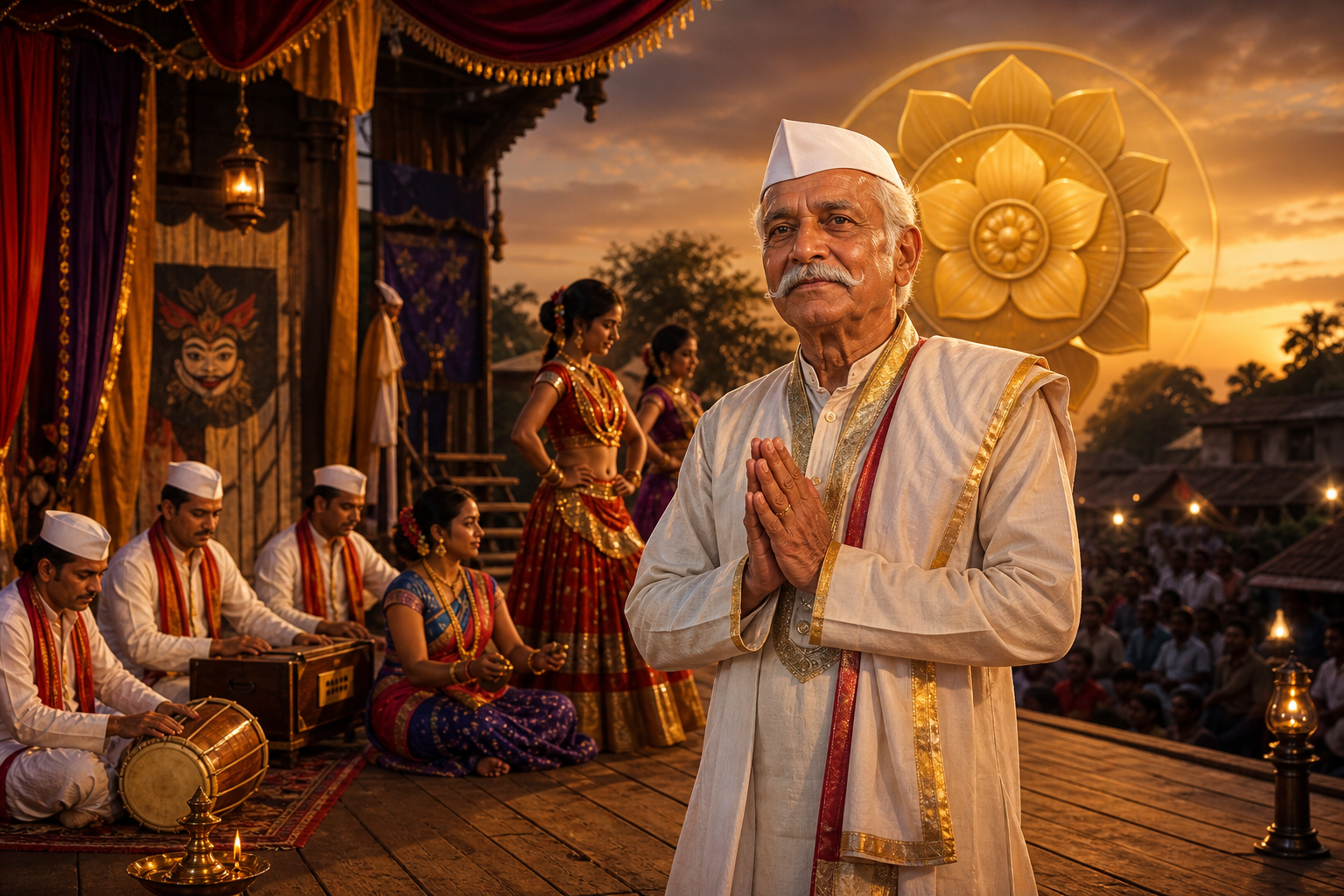
Padma Shri Raghuveer Tukaram Khedkar occupies a significant place in the cultural history of Maharashtra because his life demonstrates how a regional folk form can remain vibrant even under the pressure of modern entertainment, urban migration, and changing audience habits. For more than five decades, he has worked as a performer, director, organiser, and mentor within the Tamasha tradition, carrying forward a form of folk theatre that blends music, dance, drama, poetry, humour, satire, and social commentary. His recognition with the Padma Shri in 2026 is therefore not only an individual honour; it is also a national acknowledgement of Maharashtra’s folk theatre heritage and of the many artists who have preserved cultural memory outside elite urban stages.
Tamasha has historically belonged to the living cultural world of rural Maharashtra. It is not merely a performance genre but a social space where entertainment, public conversation, moral reflection, and community gathering meet. In villages and small towns, a Tamasha performance has often functioned as an accessible theatre of the people, carrying stories, songs, wit, and commentary to audiences who may not regularly enter formal auditoriums. This is why Khedkar’s contribution carries special importance: he preserved an art form that speaks in the idiom of ordinary people while retaining the dignity of a disciplined performing tradition.
Raghuveer Khedkar was born into an artistic household deeply rooted in folk theatre. His father, Tukaram Khedkar, and mother, Kantabai Satarkar, were respected figures associated with Tamasha, and their lives shaped the atmosphere in which he grew up. In such a family, performance was not an occasional event but a way of life. The stage, the rehearsal, the travelling troupe, the rhythm of music, and the responsibility of holding an audience together formed the early grammar of his artistic training. His inheritance was therefore not only genetic or familial; it was practical, emotional, and civilisational.
The discipline required by Tamasha is often underestimated by those who view folk performance only through the lens of spectacle. A strong Tamasha production depends on voice, timing, improvisation, musical command, bodily rhythm, narrative understanding, stage presence, and the ability to read a live audience. Khedkar’s career shows mastery over these demands. He did not approach Tamasha as a static relic to be displayed in a museum-like setting; he treated it as a living art that must breathe with its community while remaining anchored in tradition.
The emotional depth of Khedkar’s journey becomes clearer when one considers the social and economic uncertainties faced by many folk artists. Traditional performers often travel continuously, work under difficult logistical conditions, and depend on seasonal patronage and audience turnout. Their labour is visible on stage but less visible in the planning, training, transport, costume maintenance, financial management, and troupe coordination that sustain each performance. Khedkar’s long career therefore reflects not only artistic excellence but also endurance, organisational intelligence, and a profound commitment to cultural preservation.
Reports credit him with participation in more than 12,000 shows, an extraordinary figure that reveals the scale of his public engagement. Such a number cannot be understood merely as a statistic. Each performance represents a village, a town, a night of preparation, a gathered audience, and a renewed bond between artist and community. Over decades, these performances helped Tamasha remain visible in Maharashtra’s cultural landscape, even as cinema, television, mobile entertainment, and digital platforms transformed habits of leisure and attention.
Khedkar’s importance also lies in his ability to balance preservation with adaptation. Folk traditions survive when they remain recognisable to their inherited communities while also becoming intelligible to newer audiences. His productions retained the flavour, structure, and emotional force of traditional Tamasha, yet they also responded to contemporary social realities. This balance is difficult: excessive change can weaken authenticity, while rigid repetition can make a form inaccessible to younger generations. Khedkar’s work is valuable because it negotiated this tension with seriousness and care.
Tamasha is closely associated with music and dance, and its relationship with Lavani has given Maharashtra one of its most recognisable performative identities. Yet the form is broader than popular memory often allows. It includes dramatic episodes, comic exchanges, poetic expression, and commentary on social life. Through this range, Tamasha has historically carried messages about community conduct, public ethics, education, gender relations, social reform, and everyday struggles. Khedkar strengthened this dimension by using the stage not only to entertain but also to encourage awareness and reflection.
This educational dimension is especially important in the context of Bharat’s folk traditions. Oral and performative cultures have long served as vehicles of knowledge, memory, and social instruction. They transmit values through rhythm, story, humour, and emotion rather than through formal lectures. Khedkar’s Tamasha work belongs to this larger Indian tradition in which art becomes a medium of social connection. It allows audiences to laugh, listen, think, and recognise themselves in the lives and dilemmas presented before them.
His role as a mentor is equally significant. The survival of any performing tradition depends on transmission. Songs, gestures, stage instincts, timing, and audience management cannot be fully preserved through written documentation alone. They must be embodied, practiced, corrected, and refined under the guidance of senior artists. Khedkar’s work with large troupes and younger performers helped sustain this chain of learning. In that sense, his contribution extends beyond what he personally performed; it includes the artistic confidence he helped build in others.
The management of a Tamasha troupe demands a rare combination of artistic sensitivity and administrative capacity. A troupe must coordinate performers, musicians, technical workers, travel routes, bookings, publicity, finances, costumes, stage material, and audience expectations. Khedkar’s reputation as an organiser reflects this wider labour. His career shows that cultural leadership is not limited to creative talent; it also requires responsibility toward fellow artists, audiences, and the institutional continuity of the form itself.
Khedkar’s performances at major cultural platforms across Bharat helped introduce Tamasha to audiences beyond its traditional regional base. His invitation to present Tamasha during the 2010 Commonwealth Games period in Delhi is especially notable because it placed a rural Maharashtrian folk theatre form before a wider national and international audience. Such moments matter because they challenge narrow assumptions about what counts as prestigious art. They show that folk theatre, when presented with confidence and integrity, can represent Bharat’s cultural sophistication as powerfully as classical or urban forms.
Recognition from institutions such as the Sangeet Natak Akademi and theatre organisations further underlines the seriousness of his artistic contribution. Institutional acknowledgement is important for folk traditions because it helps correct the imbalance between mainstream visibility and actual cultural value. Many folk artists shape public life for decades without receiving sustained attention from media or cultural policy. Khedkar’s recognition helps bring Tamasha into a broader conversation about heritage preservation, cultural dignity, and the future of traditional arts.
The Padma Shri announcement in 2026 was widely welcomed because it symbolised respect for an entire artistic fraternity. For admirers of Maharashtra’s cultural traditions, the honour affirmed that the labour of folk artists deserves national remembrance. For the Tamasha community, it carried the emotional weight of generations who performed through uncertainty, social change, and limited institutional support. Khedkar’s own response, marked by humility and gratitude toward his parents and fellow artists, reflected this collective meaning.
His reported emotional remark, “माझ्या सात कुळांचा उद्धार झाला,” captures the depth of feeling associated with the award. The statement is rooted in a cultural understanding of honour as something that extends beyond the individual to ancestors, family, teachers, and community. In the context of Khedkar’s life, it suggests that the Padma Shri was experienced not as a mere decoration but as a vindication of inherited artistic duty. It recognised the sacrifices of his parents, the perseverance of his troupe, and the dignity of the Tamasha stage.
From an academic perspective, Khedkar’s life also invites a broader reflection on how cultural heritage should be understood. Heritage is not only architecture, manuscripts, monuments, or classical canons. It also lives in travelling performers, oral compositions, local idioms, humour, regional dialects, community gatherings, and the shared emotional memory of audiences. Tamasha belongs to this embodied heritage. Khedkar’s career demonstrates that preserving culture means preserving people, practices, contexts, and the social ecosystems that allow art to remain alive.
His journey also resonates with the wider dharmic civilisational habit of honouring diverse paths of expression. Bharat’s cultural world has long included classical, folk, devotional, theatrical, martial, poetic, and community-based traditions. These forms need not compete with one another; together they create a layered cultural inheritance. Khedkar’s Tamasha work contributes to this unity by affirming that regional folk art is not peripheral to Indian civilisation. It is one of the ways in which society remembers, questions, celebrates, and renews itself.
The challenges before Tamasha, however, remain serious. Younger audiences are increasingly shaped by digital media, and traditional performance circuits face economic and logistical pressures. Folk artists require platforms, documentation, training support, fair remuneration, and cultural education that introduces students to regional arts with respect rather than condescension. Khedkar’s Padma Shri should therefore be read not as a closing chapter but as an invitation to strengthen the conditions under which Tamasha and similar traditions can flourish.
There is also a need to document the technical and aesthetic vocabulary of Tamasha more systematically. Its musical structures, narrative conventions, performance sequences, character types, costume practices, humour, audience interaction, and social themes deserve careful study. Scholars, cultural institutions, and local communities can collaborate to ensure that this knowledge is not lost. Khedkar’s career provides a valuable reference point for such work because it connects inherited practice with modern public recognition.
Padma Shri Raghuveer Tukaram Khedkar today stands as one of Maharashtra’s important cultural ambassadors. His life is the story of an artist who turned inheritance into responsibility and performance into public service. Through more than five decades of work, he helped keep Tamasha visible, respected, and emotionally meaningful for audiences across Maharashtra and beyond. His honour is therefore a tribute to artistic perseverance, village culture, cultural preservation, and the enduring power of Bharat’s folk traditions to educate as they entertain.
(Featured Image Source: X Account of DD News)
Inspired by this post on Hindu Post.
