
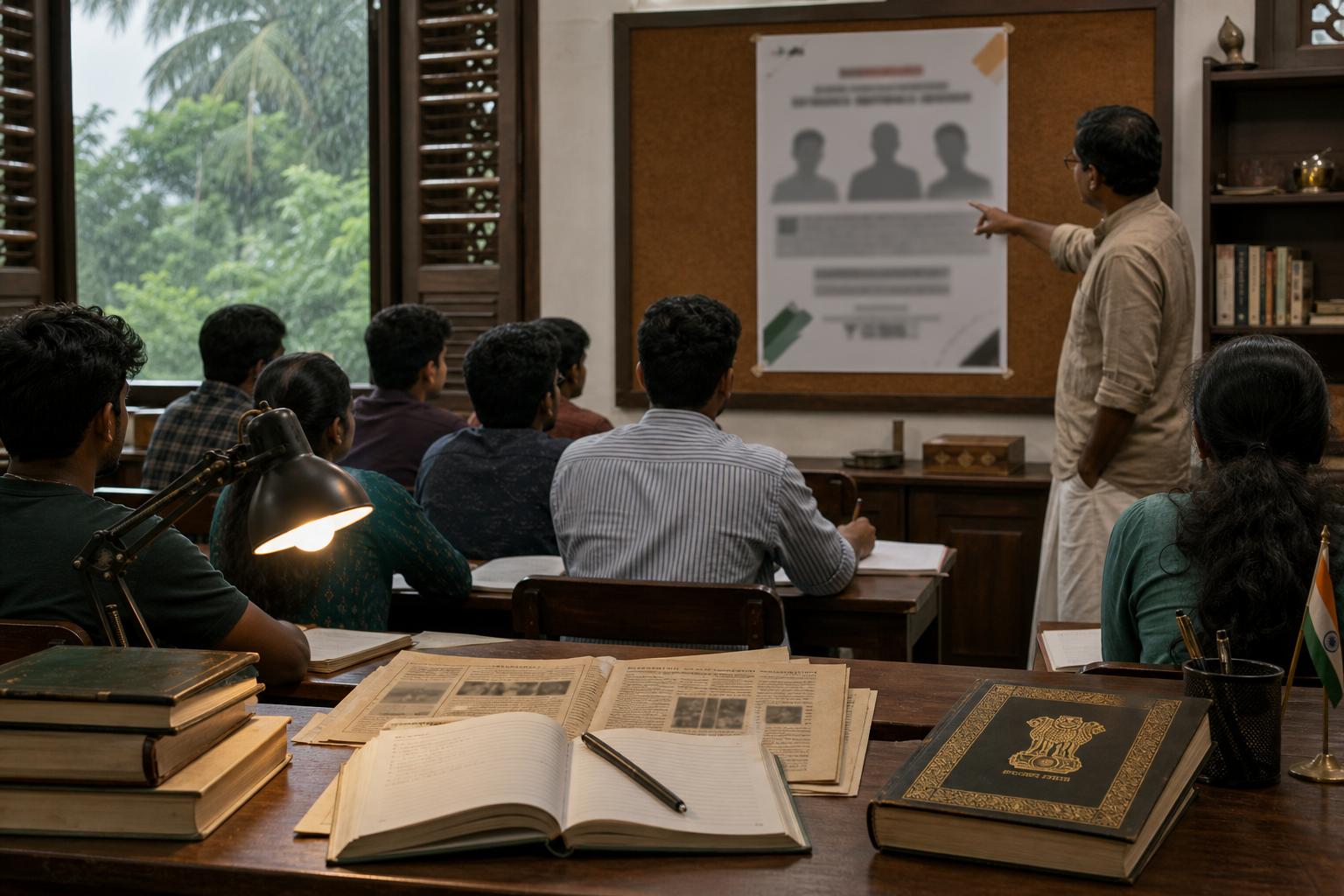
A study camp poster reportedly circulated in Kerala by the Students Islamic Organisation has drawn attention because of the ideological figures placed prominently on it. The concern is not merely visual symbolism. Posters used in youth-oriented educational spaces often communicate who is to be admired, what intellectual tradition is considered respectable, and which political imagination is being normalised for the next generation.
The figures associated with the poster, according to the source material, are Hassan al-Banna, Sayyid Qutb, and Ahmed Yassin. Each belongs to a major strand in the history of modern Islamism: the Muslim Brotherhood, Qutbist revolutionary thought, and Hamas. A careful discussion of these names requires accuracy, restraint, and moral clarity. It must distinguish ordinary Muslims from Islamist political movements, while also refusing to minimise the ideological roots of extremism.
Hassan al-Banna, the Egyptian founder of the Muslim Brotherhood in 1928, is central to any study of organised modern Islamism. He was a schoolteacher and preacher whose movement combined religious reform, social welfare, political mobilisation, and eventually militant organisation. His message presented Islam as a complete system governing personal conduct, law, society, politics, economics, and state power. That idea became deeply influential because it turned religious identity into a comprehensive political programme.
Al-Banna’s appeal grew in the context of British influence in Egypt, social inequality, and the collapse of older Islamic political symbols after the abolition of the Ottoman Caliphate. His movement spoke to humiliation, loss, and the desire for cultural restoration. These historical conditions matter, because extremist ideologies rarely emerge in a vacuum. They often grow by transforming real grievances into a totalising political project that divides society into religiously approved and religiously illegitimate camps.
The controversy around al-Banna arises from this fusion of faith, politics, mass mobilisation, and the pursuit of an Islamic order. The Muslim Brotherhood’s history includes social service and electoral activism, but also a secret apparatus, armed activity, and ideological influence on later Islamist movements. Al-Banna was assassinated in Cairo in 1949 after the Egyptian state banned the Brotherhood amid escalating conflict, including the assassination of Prime Minister Mahmoud an-Nukrashi Pasha by a Brotherhood member. That history is too serious to be reduced to a harmless portrait on a student poster.
Sayyid Qutb represents a still sharper intellectual turn. Also Egyptian and associated with the Muslim Brotherhood, Qutb became one of the most consequential ideologues of modern radical Islamism. His writings, especially Milestones and his Qur’anic commentary, argued that modern societies had fallen into Jahiliyyah, a condition of ignorance and rebellion against divine sovereignty. For Qutb, the problem was not only Western power, but also Muslim-majority governments that did not fully implement his understanding of Islamic rule.
Qutb’s idea of Jahiliyyah had explosive political implications. It delegitimised secular law, liberal democracy, nationalism, Marxism, and any system that placed sovereignty in human institutions rather than divine command as he interpreted it. Later jihadist movements drew heavily from Qutb’s vocabulary of rupture, vanguard struggle, and religiously framed confrontation. His execution by the Egyptian state in 1966 after conviction in a conspiracy case turned him, for supporters, into a martyr figure, further amplifying his influence.
It is important to be precise here. Not every reader of Qutb becomes violent, and not every Islamist current follows the same path. Yet Qutb’s ideas have undeniably shaped extremist currents that view pluralist politics, secular constitutionalism, and religious diversity as signs of corruption rather than civic realities. When such a figure is presented to students without strong critical framing, the educational space risks becoming an entry point into ideological romanticisation.
Ahmed Yassin, the third figure named in the source material, was the Palestinian founder and spiritual leader of Hamas, established during the First Intifada in 1987. Hamas emerged from the Palestinian branch of the Muslim Brotherhood and combined Palestinian nationalism with Islamist doctrine and armed struggle. Yassin, who used a wheelchair after a childhood sports injury left him severely disabled, became a powerful symbolic and organisational figure in Gaza. He was killed in an Israeli airstrike in 2004.
Hamas is widely designated as a terrorist organisation by several Western governments and has a long record of suicide bombings, rocket attacks, hostage-taking, and attacks on civilians. Its 1988 charter explicitly located the movement within the Muslim Brotherhood tradition and contained religiously charged hostility toward Jews and Israel. The later 2017 political document softened some formulations, but it did not erase the historical significance of the earlier charter or the organisation’s record of violence.
The presence of these three figures together is therefore not an accidental matter of academic biography. Taken as a cluster, they represent a lineage: al-Banna’s organised Islamism, Qutb’s revolutionary ideological radicalism, and Yassin’s militant institutional expression through Hamas. A democratic society may study all three, and indeed should study them. The problem begins when study turns into reverence, and reverence is offered to young audiences without a rigorous account of violence, supremacism, and anti-pluralist politics.
Kerala’s public culture has long presented itself as literate, politically alert, and secular in vocabulary. That makes the silence around such symbolism more troubling. Political parties and civil society groups that quickly condemn majoritarian extremism, caste discrimination, Hinduphobia, or communal provocation from other quarters must apply the same standard to Islamist extremism. Selective moral concern weakens public trust and teaches young citizens that ideology is judged not by its content, but by its political convenience.
This issue also affects Hindu Dharma and the wider family of Dharmic traditions, including Buddhism, Jainism, and Sikhism. These traditions are not identical, but they share a civilisational respect for multiple paths, ethical discipline, debate, and spiritual plurality. A society shaped by such traditions cannot remain indifferent when religious supremacism is repackaged as intellectual seriousness. The defence of pluralism requires consistency, not selective outrage.
Families who send children and young adults to study circles, campus discussions, and community events do so with trust. They expect education to sharpen moral judgment, not to sanitise radical politics. The concern is therefore deeply relatable: parents, teachers, and students all understand that the portraits on a wall often matter as much as the books on a table. Visual honour creates emotional authority before intellectual scrutiny even begins.
The academic question is not whether controversial thinkers can be studied. They can and should be studied, especially in political science, religious studies, counter-terrorism analysis, and modern history. The question is whether they are being studied critically or celebrated normatively. A university or youth organisation may examine Qutb’s theory of Jahiliyyah, al-Banna’s organisational model, or Hamas’s ideological development. But such study must include the consequences of these ideas for minorities, women, dissidents, democratic institutions, and interfaith coexistence.
India’s national security debate has often focused on visible violence: bombings, recruitment, weapons, and cross-border networks. Ideological preparation is less visible but equally significant. Radicalisation rarely begins with an act of violence. It often begins with admiration, grievance, moral separation, and the belief that one community alone carries divine legitimacy while others represent corruption or hostility. That is why symbolic endorsement in youth spaces deserves serious scrutiny.
Kerala’s social harmony depends on honest civic speech. Criticising Islamist extremism is not an attack on Muslims as a community. In fact, many Muslims across the world have been victims of Islamist violence, coercion, and authoritarianism. The distinction between Muslim citizens and Islamist political ideology must be maintained firmly. Without that distinction, public debate becomes either bigoted or evasive; with it, democratic society can oppose extremism without demonising ordinary believers.
The same principle applies across all ideologies. Hindu society, Buddhist communities, Jain institutions, Sikh organisations, Christian groups, Muslim bodies, secular parties, and left-wing movements should all be subject to fair scrutiny when they glorify intolerance or violence. Plural democracy survives not by protecting one ideology from criticism, but by applying consistent standards to every movement that seeks to dominate public life through coercive or supremacist ideas.
The danger of normalisation lies in gradual familiarity. A young person may first encounter a radical figure as an icon, then as a thinker, then as a moral guide, and eventually as part of an identity structure. Once that process begins, later factual correction becomes harder. This is why educational and community institutions must be careful with whom they elevate as role models. Intellectual freedom does not require moral carelessness.
Kerala’s political leadership should therefore ask direct questions. Was the poster intended to honour these figures or merely study them? Were participants given critical material on the Muslim Brotherhood, Qutbism, Hamas, terrorism, antisemitism, and religious supremacism? Were alternative Muslim voices, liberal reformist voices, and Dharmic perspectives on pluralism included? Did the programme encourage constitutional citizenship, or did it romanticise transnational Islamist politics?
These questions are not rhetorical weapons; they are democratic safeguards. A healthy society should not fear inquiry. If the event was academic, its organisers should welcome transparent explanation. If it was ideological celebration, Kerala’s civil society has reason to object. Public accountability is especially necessary when the audience includes students, because youth spaces shape future civic instincts.
The larger lesson extends beyond one poster and one organisation. India must develop a more mature vocabulary for discussing religious extremism, ideological radicalisation, and national integration. The debate should be firm but not reckless, critical but not communal, historically informed but not inflammatory. A civilisation that values Dharma, reason, and spiritual diversity should have the confidence to name dangerous ideas without descending into hatred.
Silence, in such matters, is not neutrality. It can become permission. When influential figures linked to radical Islamist traditions are presented as intellectual models without adequate criticism, the burden falls on political leaders, educators, journalists, and community elders to respond. Kerala, and India more broadly, must insist that education strengthens pluralism, constitutional loyalty, and social harmony rather than providing prestige to movements associated with extremism.
A democratic and Dharmic civilisational response must be rooted in courage and fairness. It must reject anti-Hindu prejudice, religious supremacism, antisemitism, and violence against civilians with equal clarity. It must also protect innocent citizens from collective blame. The real test of public morality is consistency: the willingness to confront extremist ideas even when doing so is politically inconvenient.
Inspired by this post on Hindu Post.
