
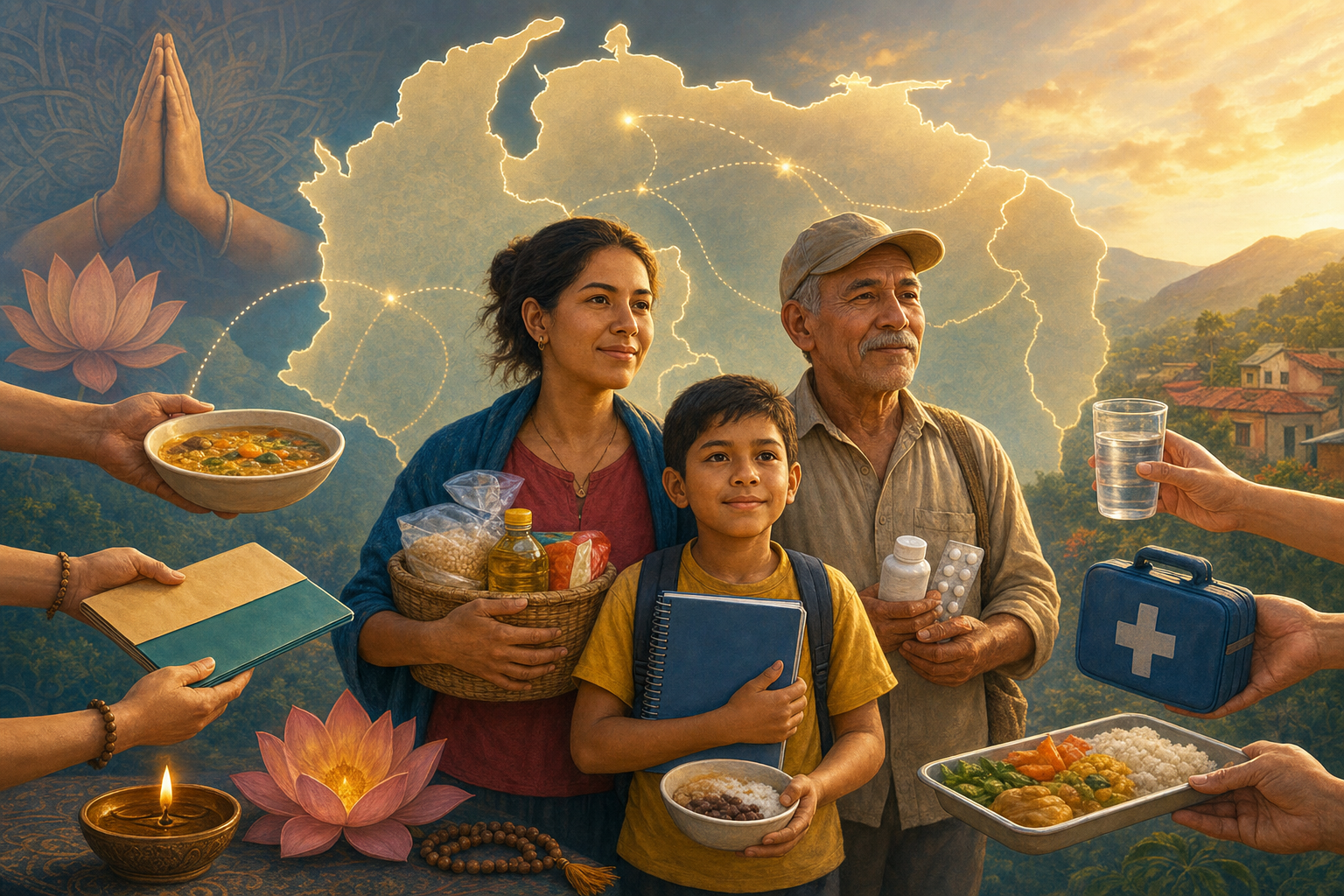
Venezuela’s suffering cannot be reduced to a headline, a political argument, or a passing expression of sympathy. The phrase “our love and prayers for the people of Venezuela” carries moral weight because it asks for more than sentiment. It calls for disciplined compassion, factual understanding, and a humane response to people living through displacement, food insecurity, weakened public services, and repeated shocks to daily life.
In academic terms, Venezuela represents a complex humanitarian crisis shaped by economic contraction, institutional stress, migration, public health vulnerabilities, food access constraints, and regional displacement. In human terms, it is the story of families separated across borders, children whose school meal may be the most reliable nutrition of the day, elders struggling with medicines and utilities, and communities trying to preserve dignity under pressure.
The most responsible starting point is data. UNHCR reports that nearly 7.9 million Venezuelans have left the country in search of protection and a better life, with more than 6.9 million hosted in Latin America and the Caribbean. The same UNHCR overview, updated in December 2025, notes more than 1.3 million Venezuelan asylum-seekers worldwide and more than 395,000 recognized refugees. These figures reveal not only the scale of movement, but also the depth of insecurity that has pushed millions to rebuild life elsewhere.
Migration at this scale is not a simple matter of movement from one country to another. It transforms the emotional geography of families. A parent may remain in Venezuela while a son or daughter works in Colombia, Peru, Brazil, Chile, the United States, or Spain. Grandparents may help raise children while younger adults cross borders for wages. A family table becomes scattered across cities, currencies, languages, and legal systems. Compassion must therefore be regional, not merely national.
Food security is one of the clearest indicators of the crisis. The World Food Programme’s Venezuela country page states that the food security situation remains critical, with many families struggling to obtain nutritious food as price increases erode purchasing power. WFP also reports that it reached 750,000 people in 2025 and that its school meals programme supports more than 330,000 people across over 1,100 schools. In practical humanitarian analysis, a school meal is not a minor intervention; it can affect attendance, learning, child development, household budgets, and community stability.
The technical dimension of the crisis includes more than hunger. Humanitarian agencies identify needs linked to documentation, legal status, employment, shelter, health care, water, sanitation, protection, and integration. UNHCR notes that many displaced Venezuelans in Latin America and the Caribbean face poverty, barriers to adequate housing, and difficulty accessing formal employment. Where documentation is weak, vulnerability increases. Where employment is informal, exploitation becomes easier. Where housing is unaffordable, families may accept unsafe arrangements simply to avoid homelessness.
This is why love and prayer must be understood as ethical disciplines rather than emotional slogans. In Dharmic traditions, compassion is not passive. Hinduism speaks of seva, selfless service offered without ego. Buddhism emphasizes karuna, compassion grounded in awareness of suffering. Jainism places ahimsa at the center of moral life, asking that harm be reduced wherever possible. Sikhism gives living form to service through langar, dignity, and shared humanity. Together, these traditions remind society that prayer reaches its maturity when it becomes responsibility.
A Dharmic response to Venezuela therefore avoids ideological cruelty. It does not mock the poor, dehumanize migrants, or treat suffering as evidence in a partisan contest. It studies causes honestly, names failures carefully, and keeps the human being at the center of analysis. The Venezuelan mother seeking food, the child in a school meal programme, the migrant awaiting legal regularization, and the host community under strain are not abstractions. They are persons whose dignity must remain visible.
The regional burden has also been significant. Countries that welcomed Venezuelans have often acted with generosity while facing their own economic and administrative constraints. Regularization processes, access to schooling, health services, and employment pathways are essential because unmanaged displacement can deepen poverty for migrants and host communities alike. Strong humanitarian policy must therefore combine emergency relief with integration, legal protection, and development planning.
There is also a psychological dimension that statistics cannot fully express. Displacement often produces grief without a funeral: grief for a home left behind, for professional identity interrupted, for a language or neighborhood no longer heard daily, for festivals celebrated through a phone screen. A factual account should not erase that interior life. The emotional reality of Venezuelan families matters because durable recovery depends not only on food and shelter, but also on trust, belonging, and hope.
At the same time, compassion must remain intellectually honest. Venezuela’s crisis has been shaped by multiple interacting forces: governance failures, economic mismanagement, inflationary pressure, sanctions, institutional distrust, public service deterioration, political repression concerns, and external geopolitical pressures. Reducing the crisis to a single cause may be rhetorically convenient, but it does not help families who need food, medicine, safety, work, and legal certainty. Serious analysis requires a multi-causal framework.
Humanitarian response also requires coordination. WFP describes work in school meals, food assistance, livelihoods, emergency preparedness, logistics, and coordination with partners. UNHCR describes protection, legal aid, shelter support, documentation efforts, vocational training, and inclusion in host communities. These are technical areas, but their moral purpose is simple: to prevent vulnerability from hardening into permanent exclusion.
For communities inspired by Sanatana Dharma, Buddhism, Jainism, and Sikhism, the lesson is direct. Prayer for Venezuela should cultivate humility, not superiority. It should create solidarity across religious, ethnic, and national lines. It should encourage careful speech, especially online, where distant suffering is too often converted into contempt or spectacle. The Dharmic ideal of seeing the same sacred worth in all beings is tested most clearly when the suffering person is far away, unfamiliar, and politically inconvenient.
The Venezuelan crisis also teaches that social stability is fragile. Food systems, public trust, currency stability, institutional accountability, and community networks are not secondary details of civilization. When they weaken together, ordinary people pay the highest price. This insight is relevant beyond Venezuela. It reminds every society that good governance, ethical economics, and community resilience are forms of preventive compassion.
Love, in this context, means refusing indifference. Prayer means holding the suffering of others with seriousness. Practical solidarity means supporting credible humanitarian work, welcoming displaced families with dignity, resisting xenophobia, and advocating policies that protect human life while strengthening host communities. None of these actions requires abandoning critical thought. On the contrary, they require more of it.
Venezuela’s people deserve more than pity. They deserve truthful attention, humane policy, regional cooperation, and the restoration of conditions in which families can live with safety, nourishment, education, work, and dignity. The most meaningful expression of love and prayers is therefore a disciplined commitment to compassion: informed by facts, guided by dharma, and open to the shared humanity that binds all people across borders.
Inspired by this post on Dandavats.
