
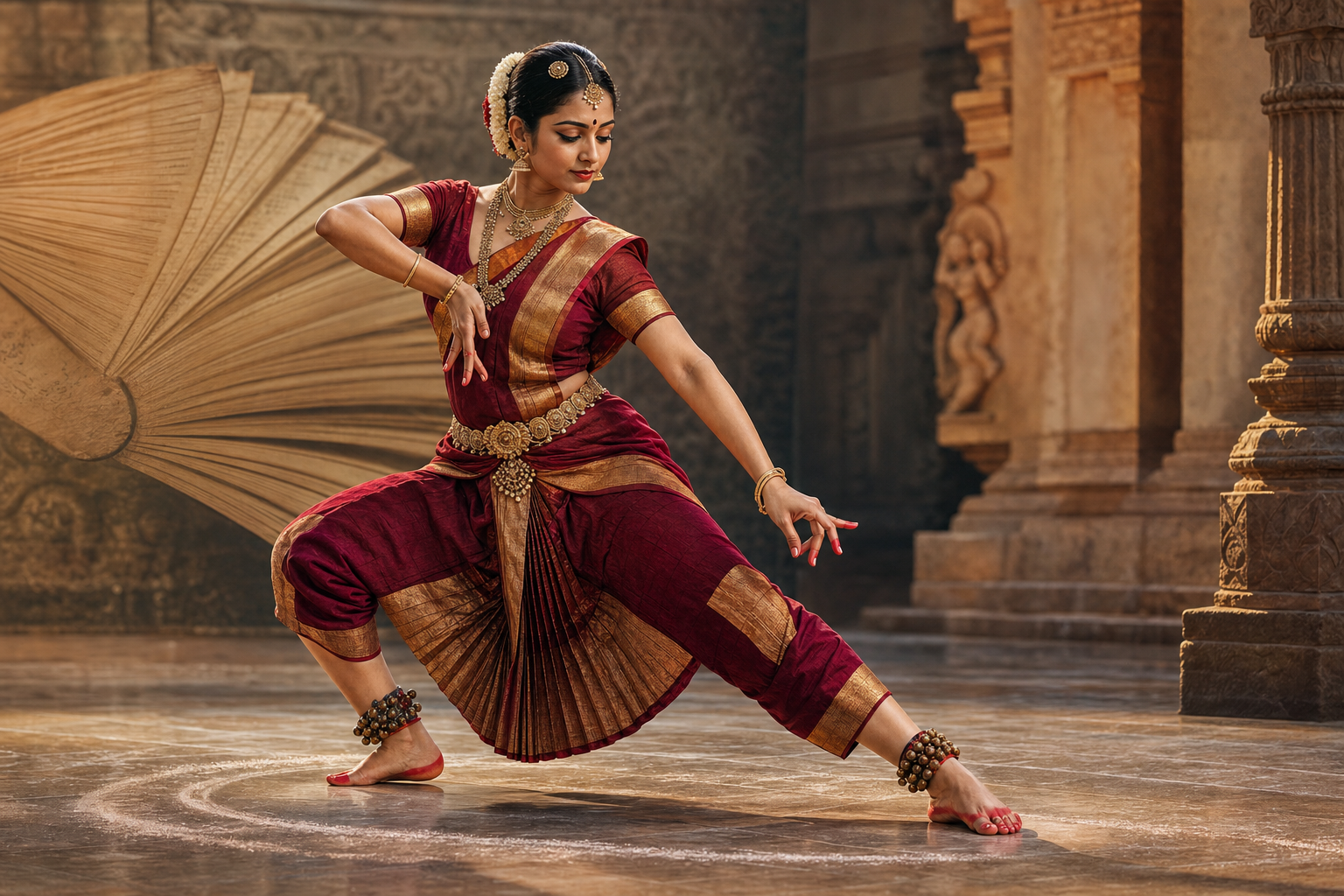
Bhaumi Chari refers to the earth-bound movement vocabulary of Hindu classical dance, especially as understood through the technical language of the Nāṭyaśāstra and later performance traditions. In simple terms, it is the group of charis in which the dancer’s movement remains visibly connected to the ground. The feet, calves, thighs, hips, torso, and expressive intention are not treated as separate parts; they are organized into a coordinated kinetic unit.
The word chari, also written as cari or cārī, is usually explained as the movement of one foot followed by the corresponding movement of the body. This definition is important because it prevents a common misunderstanding: a chari is not merely a step. It is a complete bodily action. The foot initiates or marks the movement, but the dancer’s weight, hips, thighs, torso, balance, and dramatic purpose give it meaning.
Classical dance traditions preserve thirty-two charis within the broader technical repertoire. These are divided into two major groups: sixteen Bhaumi charis, which are earth-bound, and sixteen Akashiki charis, which involve airborne, lifted, or more strongly elevated movement. This division reveals a refined ancient understanding of movement dynamics. Indian dance theory did not merely describe whether a dancer moved fast or slowly; it classified how the body related to space, gravity, rhythm, and dramatic expression.
Bhaumi Chari is therefore best understood as grounded movement. The word bhaumi comes from bhumi, meaning earth or ground. In practice, this grounding is both physical and aesthetic. The dancer’s relationship with the floor becomes a source of strength, stability, rhythm, and emotional clarity. The movement may be delicate, forceful, devotional, martial, graceful, or dramatic, but it does not lose its connection to the earth.
Technically, Bhaumi Chari requires the coordinated action of the feet, calves, thighs, and hips. The knees may bend, the weight may shift, the foot may glide, stamp, turn, or reposition, and the hip line may subtly respond to the direction of movement. The dancer must control the transfer of weight with precision. A poorly executed chari can appear like a casual step, while a well-executed chari reveals balance, intention, and command over the body.
This is why Bhaumi Chari remains central to the grammar of Bharatanatyam, Kuchipudi, Odissi, Kathak, Kathakali, Manipuri, Mohiniyattam, and related Indian classical dance systems, even when each tradition uses its own regional vocabulary and stylistic emphasis. The underlying principle is shared: movement must arise from disciplined embodiment, not from decorative motion alone.
In Bharatanatyam, the grounded quality of movement is especially visible in araimandi, the half-seated stance that gives the form its sculptural stability. In Kuchipudi, the same principle may appear with a more flowing and mobile quality. In Odissi, the relationship between the grounded stance and the curved body line creates a distinct visual rhythm. In Kathakali, earth-bound footwork supports intense dramatic characterization. These examples show that Bhaumi Chari is not a frozen historical category; it continues to live through different classical dance idioms.
The importance of Bhaumi Chari also lies in its relationship to rasa and abhinaya. A dancer cannot communicate heroism, devotion, tenderness, anger, humility, or wonder through facial expression alone. The emotional force of performance often begins in the way the body stands, advances, withdraws, turns, or settles. When the feet are steady and the body is aligned, the emotional world of the performance becomes more believable.
For students of classical dance, Bhaumi Chari can feel demanding because it asks for patience before spectacle. The work is often repetitive: bend, place, shift, balance, turn, and return. Yet this repetition is not mechanical. It builds the body’s intelligence. Over time, the dancer begins to feel how the ground supports movement, how the hips guide direction, how the thighs stabilize rhythm, and how the foot becomes an instrument of both percussion and meaning.
This grounded discipline has a deeper cultural resonance in Hindu art. Indian classical dance is not only entertainment; it is a system of embodied knowledge. The dancer’s body becomes a site where rhythm, mythology, philosophy, devotion, and aesthetic theory meet. Bhaumi Chari reflects this civilizational understanding by treating contact with the earth as sacred, disciplined, and expressive.
The earth-bound quality of Bhaumi Chari also creates visual dignity. The dancer does not appear weightless in the modern athletic sense; instead, the body appears rooted, alert, and purposeful. This gives classical Indian dance a distinctive aesthetic different from performance forms that emphasize vertical lift as the primary sign of mastery. Here, mastery may be seen in stillness, controlled descent, measured travel, and the ability to move without losing inner alignment.
In performance, Bhaumi Chari helps shape entrances, exits, transitions, combat sequences, devotional passages, and dramatic encounters. A character may approach with confidence, retreat with hesitation, circle with suspicion, or stand with reverence. These are not arbitrary movements. The chari gives the dancer a codified method to make dramatic movement readable to the audience.
The distinction between Bhaumi and Akashiki charis also highlights an elegant balance within Indian aesthetics. Earth-bound movement provides weight, steadiness, and clarity. Airborne movement provides lift, expansion, and dramatic intensity. Classical choreography draws from both, but Bhaumi Chari forms the indispensable foundation. Without grounded technique, elevated movement loses context; without disciplined contact with the earth, expressive flight becomes unstable.
From a training perspective, Bhaumi Chari develops strength in the lower body, awareness of alignment, rhythmic accuracy, and spatial control. The dancer learns how to move without collapsing the knees, how to place the foot without disturbing balance, and how to coordinate lower-body action with upper-body expressiveness. These details may appear subtle to a casual viewer, but they are essential to classical technique.
It is also significant that the classical texts describe movement through precise categories rather than vague impressions. This reveals the analytical sophistication of ancient Indian performance theory. The Nāṭyaśāstra does not treat dance as merely instinctive or ornamental. It presents dance as a disciplined art with grammar, structure, classification, and philosophical purpose.
Bhaumi Chari therefore deserves attention not only from dancers but also from students of Hindu culture, Indian aesthetics, Sanskrit literature, temple arts, and embodied philosophy. It offers a way to understand how movement can carry memory across generations. Each properly trained step preserves a fragment of a larger artistic inheritance.
For audiences, recognizing Bhaumi Chari can deepen appreciation of classical dance. A viewer who notices only hand gestures or facial expressions may miss the architecture of the performance. When attention shifts to the feet and lower body, the dance becomes more layered. The audience begins to see how rhythm enters the body, how the ground is used as a partner, and how technique supports emotion.
This is especially relevant in contemporary cultural education, where classical dance is sometimes reduced to costume, music, or festival display. Bhaumi Chari reminds modern readers and practitioners that the classical arts are knowledge systems. Their details matter because they encode ways of thinking about the body, discipline, beauty, and sacred expression.
Within the wider unity of dharmic traditions, Bhaumi Chari can also be viewed as part of a shared respect for embodied practice. Hinduism, Buddhism, Jainism, and Sikhism each preserve distinctive approaches to discipline, devotion, self-cultivation, and reverence. Classical dance belongs most directly to Hindu temple and aesthetic traditions, yet its disciplined attention to body, awareness, and ethical refinement can be appreciated across dharmic cultural life.
Ultimately, Bhaumi Chari is not just a technical category meaning earth-bound movement. It is a doorway into the grammar of Indian classical dance. It teaches that the foot is never merely a foot, the ground is never merely a surface, and movement is never merely motion. In the classical imagination, the dancer’s contact with the earth becomes rhythm, structure, emotion, and cultural memory.
Inspired by this post on Hindu Blog.
