
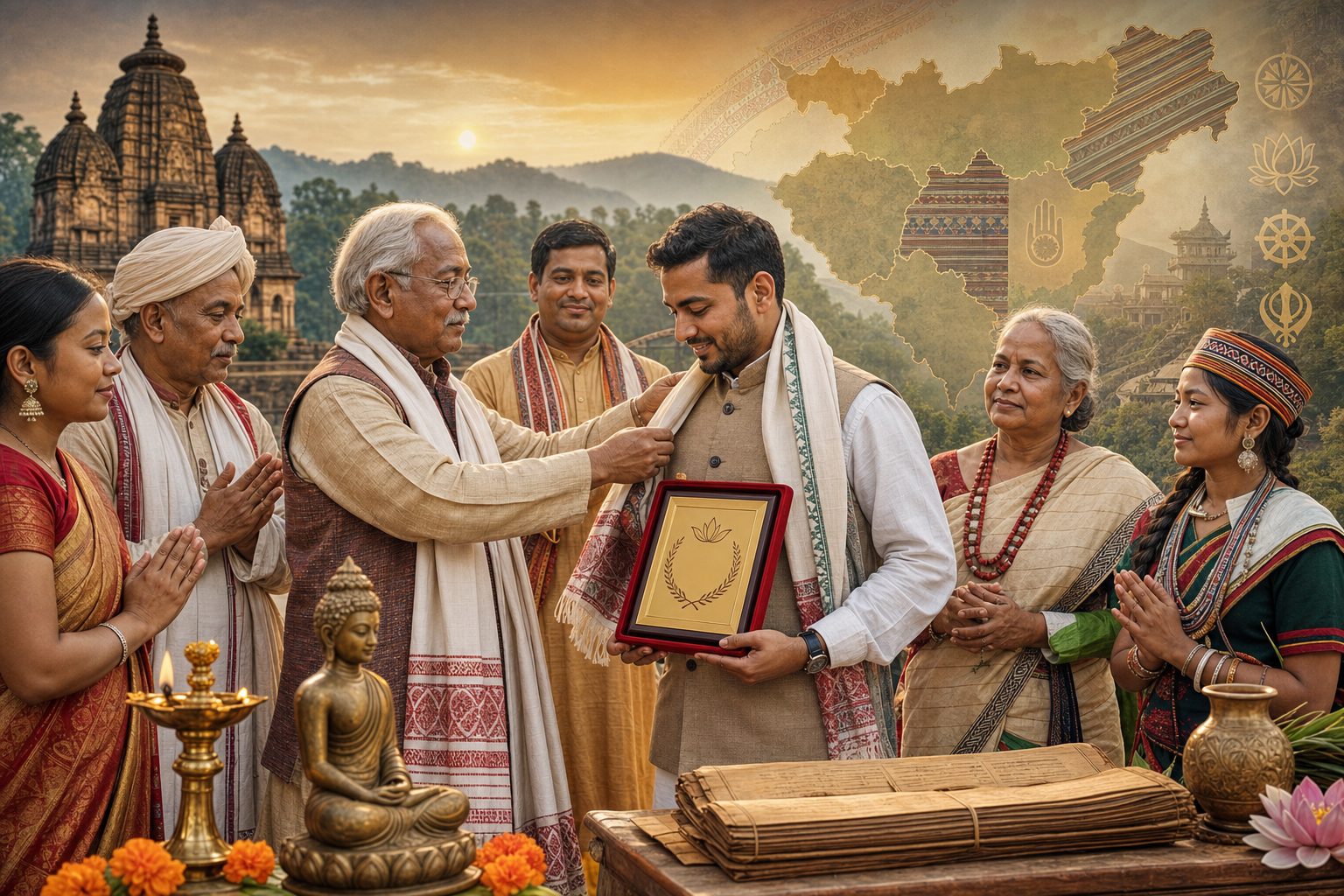
The honouring of Shri. Shambhu Gavare, Eastern and North-Eastern States Coordinator of the Hindu Janajagruti Samiti (HJS), with the ‘Matrubhoomi Samman’ in Ranchi is more than a ceremonial recognition. It represents the acknowledgement of sustained public service in the fields of national protection, Dharma, and cultural preservation. In an age when social cohesion, civilisational continuity, and responsible citizenship are central concerns, such recognition draws attention to the importance of disciplined grassroots work.
The ‘Matrubhoomi Samman’ carries a meaning rooted in reverence for the motherland. The term itself evokes a moral relationship between the individual and the nation, where service is not treated merely as activism but as a form of duty. In this context, Shri. Gavare’s honour in Ranchi reflects a broader appreciation for those who work to strengthen cultural confidence while remaining connected to the needs of society.
As the Eastern and North-Eastern States Coordinator of the HJS, Shri. Gavare’s responsibilities are associated with a region of exceptional cultural depth and social complexity. Eastern India and Northeast India contain diverse linguistic communities, ancient pilgrimage traditions, living temple cultures, indigenous practices, and multiple Dharmic expressions. Work in such a region requires more than organisational skill; it demands sensitivity, patience, historical awareness, and a capacity to engage communities without reducing them to uniform categories.
The public reference to his contributions in protecting the nation, Dharma, and culture should be understood within this wider civil society framework. National protection is not limited to physical security alone. It also includes safeguarding social trust, strengthening cultural literacy, encouraging ethical citizenship, and preserving institutions that sustain collective memory. Dharma, in this sense, is not a narrow slogan but a framework of duty, order, responsibility, restraint, and mutual respect.
Cultural preservation has become a serious contemporary concern because communities across the world are facing rapid social change, digital fragmentation, historical amnesia, and weakened intergenerational transmission. Traditions survive when they are taught, practiced, explained, and adapted with integrity. Recognition such as the ‘Matrubhoomi Samman’ therefore highlights the labour of individuals who keep public attention on heritage, values, and civilisational continuity.
The HJS is commonly associated with Hindu advocacy, awareness campaigns, and public engagement around matters of Hindu Dharma and cultural rights. In evaluating such work academically, it is useful to distinguish between cultural assertion and social exclusion. A mature Dharmic outlook supports confidence without hostility, identity without arrogance, and preservation without contempt for others. This distinction is essential for any meaningful contribution to India’s plural and deeply layered society.
The broader Dharmic vision includes Hinduism, Buddhism, Jainism, and Sikhism as traditions that have shaped the moral and philosophical landscape of India. These paths differ in doctrine, discipline, metaphysics, and ritual expression, yet they share long histories of ethical reflection, self-cultivation, restraint, compassion, and community responsibility. Any discussion of Dharma and culture becomes stronger when it affirms this unity among diverse Dharmic traditions.
For many citizens, awards of this kind create an emotional connection because they make visible work that often remains outside the spotlight. Public service in cultural and religious fields is rarely glamorous. It may involve travel, dialogue, documentation, public meetings, awareness efforts, and repeated engagement with local communities. Such work depends on consistency more than spectacle, and its effects are often seen slowly through renewed confidence and participation.
Ranchi, as the location of the honour, also has symbolic relevance. Jharkhand is home to layered cultural traditions, tribal heritage, temple practices, and evolving public debates about identity and development. A recognition ceremony in such a setting naturally points toward the need for cultural advocacy that respects local distinctiveness while connecting it to the larger civilisational story of Bharat.
From a technical perspective, cultural work can be assessed through several dimensions: community outreach, preservation of rituals and institutions, educational awareness, documentation of heritage, response to public concerns, and the ability to create constructive social participation. When a coordinator is honoured for contributions across a large region, the recognition implies not only personal commitment but also organisational coordination, communication, and sustained public presence.
The phrase protection of the nation, Dharma, and culture should not be read as three separate concerns. In the Indian civilisational framework, they are often interlinked. A nation is strengthened by citizens who understand their inheritance, Dharma is preserved through ethical conduct and public responsibility, and culture remains alive when communities practice it with knowledge and dignity. Together, these elements form a social ethic rather than a merely political position.
At the same time, responsible cultural advocacy must be rooted in factual clarity, restraint, and social harmony. The goal is not to deepen divisions but to restore confidence, protect heritage, and encourage informed participation. This is especially important in a society where multiple communities, languages, sects, and traditions live side by side. A Dharmic approach becomes meaningful when it strengthens courage and compassion together.
Shri. Gavare’s recognition therefore offers an opportunity to reflect on the role of individuals who work beyond formal state institutions. Civil society actors often become bridges between local concerns and larger cultural questions. Their contribution lies not only in public programmes but also in the less visible work of listening, organising, explaining, and sustaining morale among communities that seek continuity with their heritage.
The ‘Matrubhoomi Samman’ awarded to Shri. Shambhu Gavare may be seen as a public affirmation of service anchored in Dharma, cultural heritage, and national responsibility. Its significance lies not merely in the honour itself but in the values it brings into focus: disciplined service, civilisational memory, ethical citizenship, and unity among Dharmic traditions. Such moments remind society that cultural preservation is not a passive inheritance; it is an active responsibility carried forward by committed individuals and communities.
Inspired by this post on Hindu Jagruti Samiti.
