
Sacred Sikh Heritage in South Kashmir
South Kashmir is often described through its mountains, orchards, springs, shrines, and older civilizational layers, yet its Sikh heritage deserves a fuller and more careful place in that conversation. The Sikh presence in this region is not merely a demographic fact or a list of gurdwaras. It is a living inheritance shaped by pilgrimage, memory, agricultural life, military service, trade, community discipline, and an enduring culture of seva. In districts such as Anantnag, Pulwama, Shopian, and Kulgam, Sikh families and institutions have contributed to the social fabric of Kashmir while preserving a distinct religious identity rooted in the teachings of the Sikh Gurus.
The phrase “Sikh heritage in South Kashmir” immediately brings attention to a layered landscape. This is a region where sacred geography has long mattered: springs, old temples, Sufi shrines, village sanctuaries, and gurdwaras often stand within the same cultural horizon. Such a landscape cannot be understood through narrow communal categories. It is better understood as a civilizational meeting ground where Hindu, Sikh, Buddhist, Jain, and other Indic traditions have historically interacted with one another through pilgrimage routes, shared ethical vocabularies, local economies, and everyday neighborly life.
One of the most important reference points in any discussion of Sikh heritage in South Kashmir is the tradition associated with Guru Nanak Dev Ji’s travels through Kashmir. Sikh memory preserves accounts of Guru Nanak’s northern journeys, and several places in Jammu and Kashmir are associated with his presence. In South Kashmir, the Mattan area near Anantnag holds particular significance in Sikh tradition. Gurdwara Mattan Sahib is widely remembered as a sacred site connected with Guru Nanak Dev Ji’s visit and his engagement with learned pandits and seekers. Whether approached through devotional memory, local tradition, or historical inquiry, the site remains a powerful reminder of dialogue as a sacred act.
Mattan itself is a deeply significant place in the older sacred geography of Kashmir. Located near Anantnag and associated with the ancient Martand region, it reflects how South Kashmir’s religious memory extends across many centuries. The association of Sikh tradition with such a landscape is meaningful because it shows the Sikh path not as an isolated development, but as part of the broader Indic world of learning, devotion, debate, and ethical discipline. The Sikh emphasis on the remembrance of the Divine, honest labor, and sharing with others found natural resonance in regions where pilgrimage, sacred learning, and agrarian life had long coexisted.
The Sikh Gurus did not build a tradition of separation from society. They articulated a disciplined spiritual life within society. That principle is especially visible in Kashmir, where Sikh communities often functioned as small but resilient households embedded in wider village and town networks. Their gurdwaras were not only religious buildings; they served as centers of gathering, memory, food distribution, moral instruction, and social coordination. In difficult times, such institutions became anchors of identity and emotional strength.
South Kashmir’s Sikh heritage also has to be read alongside the political history of the region. The Sikh Empire under Maharaja Ranjit Singh entered Kashmir in 1819, ending Afghan rule in the Valley. The Sikh administration in Kashmir lasted until the mid-nineteenth century, after which the region passed into Dogra rule under the wider changes that followed the Anglo-Sikh conflicts. This period remains historically complex and should be studied with care, but it undeniably forms part of the background through which Sikh families, officials, soldiers, artisans, and traders became more visible in different parts of Jammu and Kashmir.
The legacy of Maharaja Ranjit Singh in Kashmir is therefore not only political. It is also connected to movement, settlement, and institutional memory. Sikh soldiers and administrators brought with them forms of discipline, community organization, and religious practice that later became woven into local histories. Over time, Sikh families in South Kashmir developed rooted relationships with the land. They cultivated fields, maintained orchards, participated in local commerce, served in security forces, and preserved gurdwaras as living spaces of prayer and service.
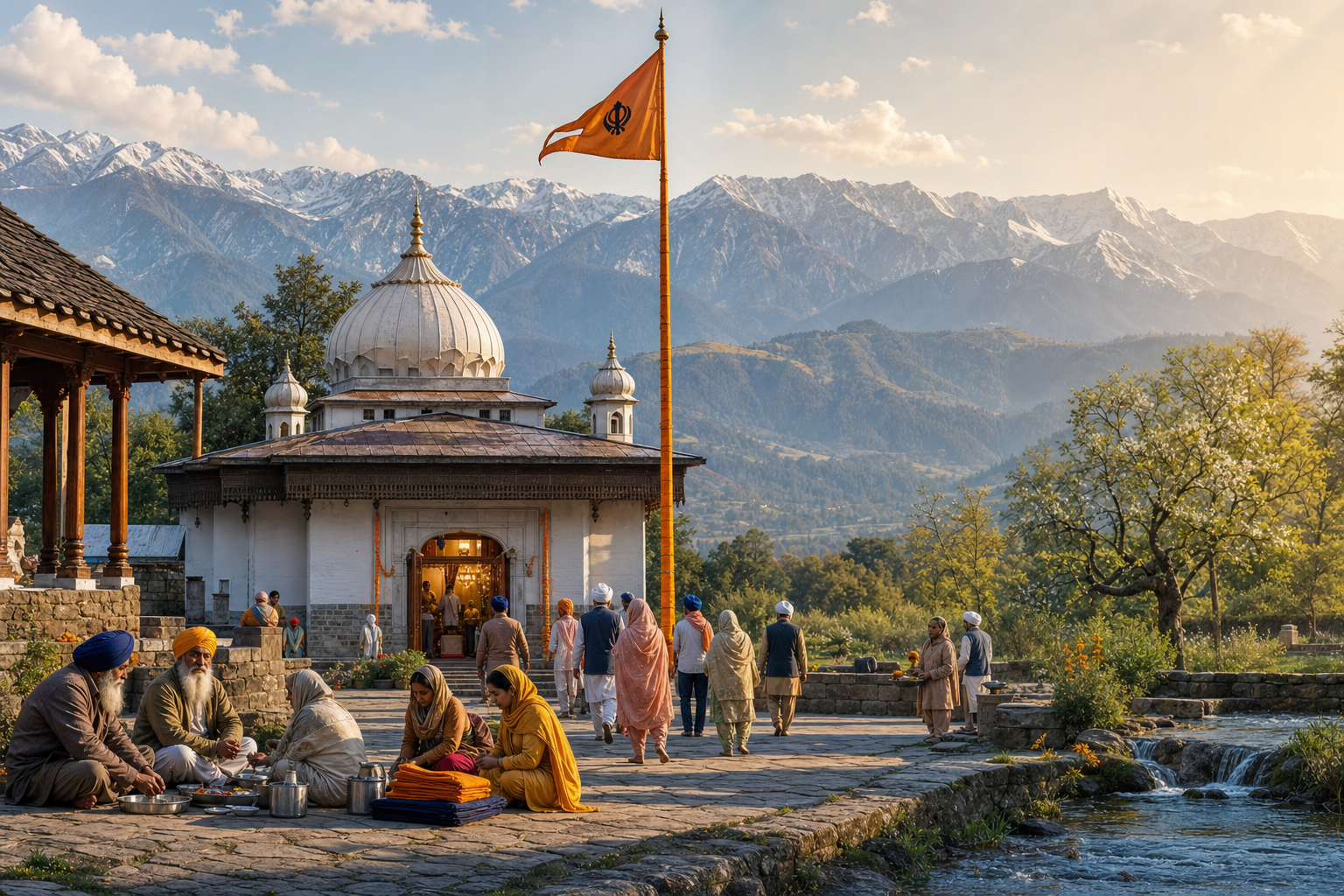
For many visitors, the most moving feature of Sikh heritage in South Kashmir is not grandeur but continuity. A rural gurdwara, a Nishan Sahib rising above a village, the sound of kirtan, and the shared preparation of langar can communicate more about historical resilience than a monument alone. Heritage here is not frozen in stone. It is recited in the Guru Granth Sahib, sung in shabad kirtan, carried in family stories, cooked in community kitchens, and renewed in the simple act of gathering in sangat.
The Sikh principle of seva gives South Kashmir’s Sikh heritage a particularly practical character. Seva is not abstract charity. It is disciplined service performed without ego, often through ordinary acts: cooking, cleaning, feeding travelers, assisting neighbors, supporting education, caring for the vulnerable, and standing with the community in times of distress. In Kashmir’s often fragile social environment, such practices have helped preserve trust across religious and ethnic boundaries. They also reflect a wider Dharmic ethic in which duty, compassion, and self-restraint are inseparable from spiritual life.
Langar, the community kitchen of the Sikh tradition, is among the clearest expressions of this ethic. In South Kashmir, as elsewhere, langar affirms equality in a direct and embodied way. People sit together, receive food without hierarchy, and experience hospitality as a form of spiritual teaching. This practice has deep relevance in a region where identity can easily become politicized. Langar quietly insists that human dignity comes before social division, and that sacred institutions must remain open to the needs of the wider world.
The Sikh community of South Kashmir has also preserved a strong relationship with education and self-respect. In many families, religious identity is transmitted through daily prayer, reverence for the Guru Granth Sahib, observance of gurpurabs, Punjabi and Gurmukhi learning where available, and the remembrance of family elders who maintained faith under pressure. These practices are not always visible in public narratives, but they are central to the survival of heritage. A community survives not only by protecting buildings, but by teaching its children why those buildings matter.
Gurdwaras in South Kashmir should therefore be seen as archives of lived history. They hold memories of migration, settlement, local cooperation, conflict, recovery, and devotion. Some preserve associations with the Gurus; others embody the history of particular villages and families. Even when formal documentation is limited, oral tradition can provide important clues about how communities understood their past. Academic study should treat these oral traditions with respect while also comparing them carefully with inscriptions, revenue records, travel accounts, community registers, and local histories.
The heritage of South Kashmir’s Sikhs is also inseparable from the broader history of Kashmiri society. Kashmir has produced profound traditions of Sanskrit learning, Shaiva philosophy, Buddhist presence, Sufi spirituality, temple culture, and vernacular poetry. The Sikh presence entered this already rich landscape and added another layer of devotional and ethical life. This layered inheritance should be approached through cultural confidence rather than competition. The most meaningful reading of South Kashmir’s sacred geography is one that recognizes the dignity of each tradition while seeing their shared civilizational roots.
This approach is especially important for a blog committed to unity among Dharmic traditions. Sikhism, Hinduism, Buddhism, and Jainism each have distinctive doctrines, practices, and histories, yet they also share deep concern for dharma, disciplined living, liberation from ego, compassion, truthful conduct, and reverence for spiritual teachers. Sikh heritage in South Kashmir can become a bridge for understanding these shared values. It reminds readers that religious identity need not become a wall; it can also become a disciplined path toward service, courage, and moral clarity.
In Sikh history, the relationship between spirituality and courage is central. The Khalsa tradition, the memory of Guru Gobind Singh Ji, and the sacrifices of Sikh martyrs shaped a community prepared to defend dignity while remaining bound to prayer and ethical restraint. In Kashmir, where communities have often experienced insecurity, this legacy of courage has had emotional significance. It has helped Sikh families maintain confidence without abandoning coexistence. Such courage is not aggression; it is the inner strength to preserve faith, protect the vulnerable, and continue living with integrity.
South Kashmir’s Sikh community has also faced challenges that deserve sober acknowledgment. Periods of militancy, displacement, targeted fear, economic uncertainty, and demographic pressure have affected minority communities in the Valley, including Sikhs and Kashmiri Hindus. An academic and factual account cannot ignore these realities. At the same time, the purpose of heritage writing should not be to deepen resentment. The more constructive task is to record suffering accurately, honor resilience, and strengthen the ethical foundations necessary for peaceful coexistence and justice.
Preserving Sikh heritage in South Kashmir requires documentation at several levels. Physical sites should be mapped, photographed, and maintained. Oral histories of elders should be recorded before they disappear. Local accounts of gurpurab celebrations, langar traditions, marriages, educational efforts, and community responses to crisis should be preserved. Scholars should study gurdwaras not only as religious sites but as social institutions. Such work would benefit historians, descendants of the community, pilgrims, policymakers, and anyone interested in Kashmir’s plural heritage.
Heritage preservation should also include language. Gurmukhi literacy, Punjabi devotional vocabulary, Kashmiri local expressions, and the multilingual character of community life all form part of the Sikh inheritance in the region. In many families, identity is carried through a mixture of languages: the language of scripture, the language of home, the language of market life, and the language of administration. Protecting this linguistic diversity is essential because language carries memory, emotion, and inherited ways of seeing the world.
Another important dimension is women’s role in preserving Sikh heritage. In many South Kashmiri Sikh households, mothers and grandmothers have transmitted prayer, food traditions, moral discipline, family memory, and reverence for the Guru Granth Sahib. Their contributions are often underrepresented in formal histories. Yet without domestic religious education, community hospitality, and intergenerational storytelling, heritage becomes fragile. Any serious account of Sikh heritage in South Kashmir must therefore recognize the household as a sacred institution and women as central custodians of continuity.
Young Sikhs in South Kashmir inherit a complicated but meaningful responsibility. They must navigate modern education, employment, digital culture, regional politics, and the expectations of tradition. Their challenge is not simply to preserve the past as nostalgia. It is to translate inherited values into contemporary life. Seva can become professional ethics. Kirtan can become emotional grounding. The discipline of the Sikh form can become confidence rather than isolation. Knowledge of history can become a foundation for respectful dialogue with neighbors from other communities.
For visitors and researchers, South Kashmir offers a valuable lesson in how to approach sacred heritage responsibly. One should not reduce the Sikh presence to conflict, nor romanticize it as untouched harmony. The truth is more mature. It contains devotion, hardship, adaptation, contribution, and memory. It includes gurdwaras associated with pilgrimage, families rooted in local soil, and communities that have held to faith while participating in the wider life of Kashmir. This complexity is precisely what makes the subject worthy of careful study.
The region’s natural environment adds another layer to the experience of heritage. South Kashmir’s springs, fields, mountain views, and old routes create a setting in which sacred memory feels close to the land. A gurdwara in such a landscape is not merely a structure; it becomes part of a larger rhythm of water, soil, work, prayer, and seasonal change. This relationship between place and faith is common across Dharmic traditions. Temples, monasteries, deras, mathas, and gurdwaras often become meaningful because they gather human devotion around a landscape already felt to be sacred.
Sikh heritage in South Kashmir also invites a wider conversation about Indian cultural heritage. India’s civilizational strength has never depended on uniformity. It has depended on the ability of many traditions to flourish while contributing to a shared moral and cultural vocabulary. The Sikh community’s presence in Kashmir illustrates that principle. Its institutions preserve Sikh identity, but they also enrich the collective heritage of the region. Protecting them is therefore not only a Sikh concern; it is an Indian cultural responsibility.
Responsible heritage work must avoid two extremes. One extreme is neglect, where small communities and local shrines disappear from public memory because they lack visibility. The other is politicization, where sacred sites are used only as symbols in contemporary conflict. South Kashmir’s Sikh heritage deserves better than both. It should be documented with scholarly care, preserved with community participation, and presented in a way that encourages dignity, historical awareness, and interfaith respect.
The story of Sikh heritage in South Kashmir is ultimately a story of rootedness. It shows how a community can remain faithful to its Gurus while living within a wider regional culture. It shows how sacred institutions can provide strength during uncertainty. It shows how memory survives through prayer, food, language, family, and service. Most importantly, it shows that Kashmir’s heritage is not a single-thread narrative. It is a woven fabric, and the Sikh thread is one of its strong and luminous strands.
To trace this heritage is to move beyond a narrow reading of place. South Kashmir becomes not only a geographical region, but a moral landscape where devotion and resilience meet. The gurdwara becomes not only a religious building, but a school of equality. The community kitchen becomes not only a meal, but a lesson in human dignity. The memory of Guru Nanak Dev Ji becomes not only a historical tradition, but an invitation to dialogue. In this sense, Sikh heritage in South Kashmir remains deeply relevant for the present and essential for the future.
Inspired by this post on SikhNet – News.
