
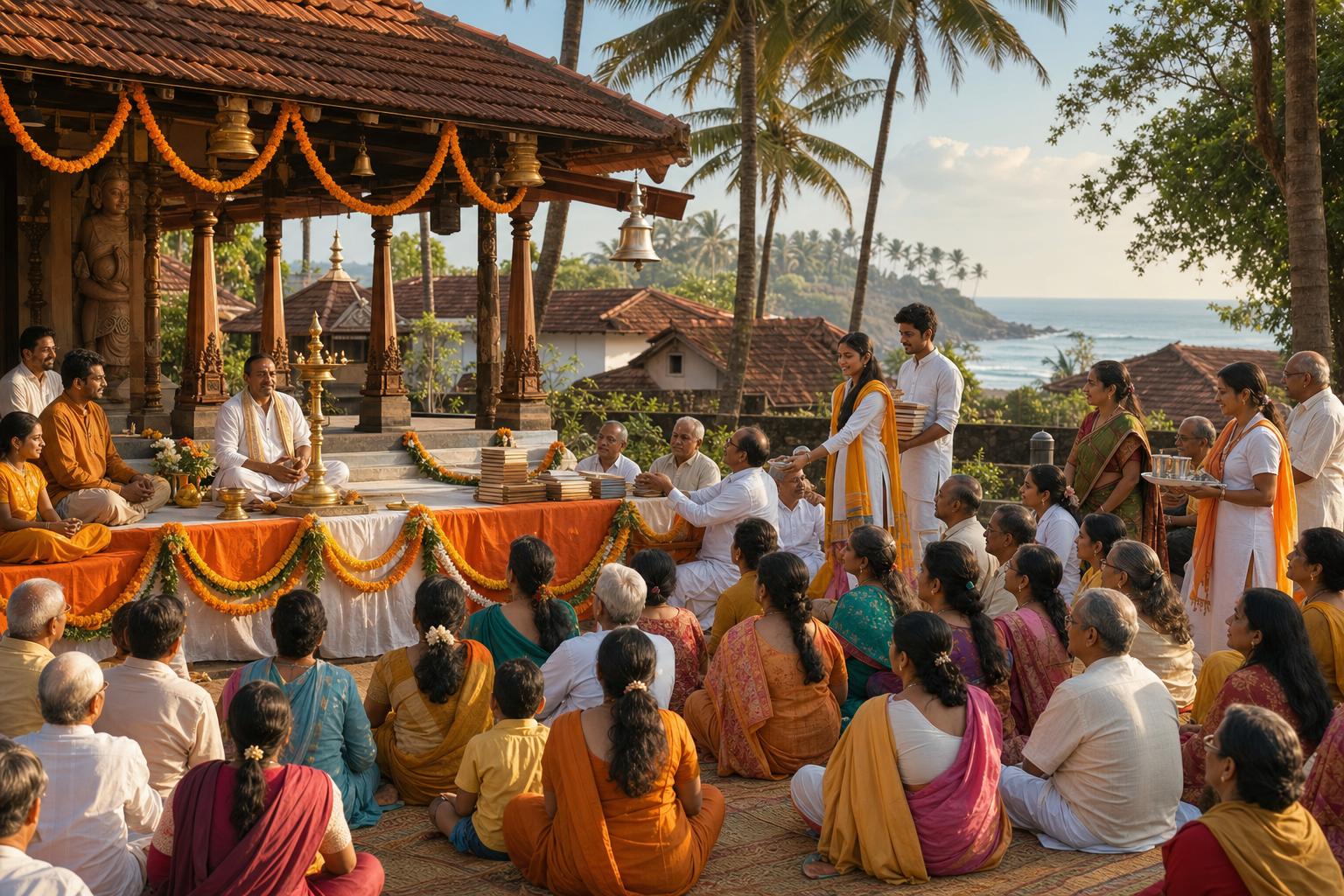
The Sakal Hindu Sammelan held in Vengurla has been presented as a significant community gathering centered on Hindu unity, patriotism, Dharma, cultural continuity, and social responsibility. According to the available source summary, the central message of the event was clear: an organised Hindu society is seen as essential for preserving cultural heritage, strengthening civic commitment, protecting Dharma, and contributing to national security.
Vengurla, situated in Maharashtra’s Konkan region, carries a social landscape shaped by coastal traditions, temple culture, local associations, and intergenerational community networks. In such a setting, a Sammelan is not merely a public meeting. It functions as a platform where religious identity, social organisation, cultural memory, and civic duty are brought into one shared conversation. The emphasis on unity therefore needs to be understood not as a narrow slogan, but as a call for disciplined social cooperation.
The phrase Sakal Hindu Sammelan itself suggests a broad gathering of Hindus across social, regional, and organisational lines. In public discourse, such gatherings often attempt to address a recurring concern: cultural confidence weakens when society becomes fragmented, indifferent, or disconnected from its inherited institutions. The speakers’ appeal for unity appears to have been rooted in this concern. The message was that Hindu society must remain aware, organised, and service-oriented if it is to preserve its traditions with dignity.
At the heart of the Sammelan was the idea that Dharma is not limited to ritual observance. In the broader Indic understanding, Dharma includes ethical conduct, duty, social harmony, self-restraint, compassion, courage, and responsibility toward the collective good. When a public meeting invokes Dharma in this wider sense, it places religious life within the framework of social discipline. It asks communities to move beyond passive identity and toward meaningful participation in family, locality, temple, education, service, and national life.
The call for Hindu unity also has a deeper civilisational dimension. Hinduism has historically contained many sampradayas, philosophical schools, modes of worship, temple traditions, folk practices, and regional expressions. Shaiva, Vaishnava, Shakta, Smarta, tribal, bhakti, yogic, and philosophical streams have all shaped the Hindu experience. The most constructive form of Hindu unity therefore does not erase diversity. It recognises diversity as a strength while encouraging common commitment to Dharma, cultural preservation, social service, and national welfare.
This principle is equally important for the wider family of Dharmic traditions, including Buddhism, Jainism, and Sikhism. These traditions have distinct histories, teachings, scriptures, and practices, yet they share civilisational conversations around Dharma, karma, ethical discipline, liberation, compassion, self-mastery, and responsibility. A responsible reading of the Vengurla Sammelan’s message should therefore support harmony among Dharmic traditions rather than sectarian competition. Unity is most durable when it is grounded in mutual respect, not uniformity.
The speakers’ emphasis on patriotism is also notable. In the Indian context, patriotism at such gatherings is often linked with cultural rootedness, civic responsibility, social order, and respect for the nation as a shared civilisational home. Patriotism, when expressed constructively, does not require hostility toward others. It requires service, discipline, lawfulness, protection of heritage, and a willingness to contribute to the stability and dignity of society. This distinction is essential for maintaining an academic and factual understanding of the event.
National security was another theme highlighted in the source summary. The connection between cultural unity and national security should be interpreted carefully. A society with strong local institutions, responsible citizens, and resilient community networks is better prepared to resist misinformation, social fragmentation, crime, radicalisation, and external manipulation. In this sense, social cohesion becomes a security asset. The message is not only about borders or military strength; it is also about internal resilience, civic trust, and cultural confidence.
An organised Hindu society, as described in the context of the Sammelan, may be understood through several practical dimensions. It includes preserving temples and sacred spaces, supporting Sanskrit and regional languages, strengthening family values, encouraging youth education, protecting women and vulnerable groups, promoting seva, and responding to social challenges with discipline. Organisation here does not mean aggression. It means the ability of a community to act coherently, ethically, and constructively when faced with cultural, social, or civic responsibilities.
Community service is especially important in this discussion. Hindu social thought has long valued dana, seva, annadanam, pilgrimage support, temple-centered charity, education, and assistance during distress. A Sammelan that speaks of social commitment must be evaluated not only by speeches delivered from a stage but by the social energy it creates afterward. The most meaningful outcome of such a gathering would be greater participation in education, health support, environmental responsibility, heritage conservation, and relief work.
The emotional force of such an event comes from a common experience many Hindu families recognise: the feeling that traditions survive only when they are practiced, taught, defended, and lovingly transmitted. A festival loses meaning when children do not know its story. A temple becomes fragile when community responsibility declines. A language weakens when it is treated as ornamental rather than living. A Sammelan becomes significant when it reminds people that culture is not inherited automatically; it is renewed through conscious effort.
The Vengurla gathering therefore reflects a wider pattern within contemporary Hindu society. Across India, local and regional platforms are increasingly being used to discuss identity, rights, duties, cultural education, demographic anxieties, temple administration, social reform, and national integration. These discussions are often emotional because they touch inherited memory and present-day insecurity. Yet the most productive form of such discussion remains grounded in facts, lawful conduct, inter-community dignity, and constructive institution-building.
For Hindu unity to become meaningful, it must also address internal weaknesses. Social fragmentation, caste prejudice, indifference toward poorer families, neglect of rural institutions, lack of youth mentorship, and superficial religiosity can all weaken Hindu society from within. A truly organised community cannot merely gather in large numbers; it must cultivate character, fairness, learning, courage, and compassion. The protection of Dharma begins with the practice of Dharma.
This is where the ethical core of Sanatan Dharma becomes relevant. The ideals of satya, ahimsa, dana, tapas, shraddha, karuna, and lokasangraha offer a framework for public life. Lokasangraha, especially, points toward the welfare and stability of the world. When community leaders call for unity, the most elevated interpretation of that call is not merely defensive mobilisation. It is the creation of a society capable of serving the common good while remaining rooted in its spiritual inheritance.
The Sammelan’s message also has implications for youth. Younger generations often encounter Hindu Dharma through fragments: festivals, family customs, social media debates, temple visits, political slogans, or occasional rituals. Without structured education, these fragments can remain disconnected. A serious movement for Hindu unity must therefore invest in knowledge: scriptures, history, philosophy, ethics, regional traditions, temple culture, and the contributions of Dharmic traditions to Indian civilisation. Confidence without knowledge can become shallow; knowledge with humility can become transformative.
Women and families also occupy a central place in cultural continuity. In many homes, festivals, vows, food traditions, devotional songs, family histories, and moral teachings are preserved through everyday domestic practice. Public calls for Hindu unity become stronger when they recognise this quiet labour. Cultural preservation is not only achieved through public events; it is sustained through kitchens, courtyards, classrooms, temples, libraries, farms, and neighbourhood associations where values are lived before they are declared.
The reference to national security should also include social harmony. A divided society is easier to manipulate, while a self-aware and disciplined society is harder to destabilise. However, harmony cannot be built through careless speech or resentment. It requires clarity about one’s own heritage and maturity in public conduct. The most responsible expression of Hindu unity is therefore one that strengthens Hindu society while maintaining constitutional order, civic peace, and respect for India’s plural civilisational fabric.
Cultural preservation, another key theme of the event, must be treated as a technical and institutional task. It includes documentation of local temples, oral histories, manuscripts, festivals, pilgrimage routes, folk arts, traditional ecological knowledge, and regional devotional literature. It also requires legal awareness, archival work, language education, digital preservation, and community funding models. Without institutional planning, cultural memory becomes dependent on nostalgia. With organisation, it becomes a living resource for future generations.
In this sense, the Vengurla Sakal Hindu Sammelan can be read as a local expression of a larger civilisational question: how should Hindu society preserve its identity in a fast-changing world while remaining ethical, inclusive within the Dharmic family, and committed to national welfare? The answer suggested by the event is organisation. Yet organisation must be guided by Dharma, scholarship, service, and restraint. Otherwise, unity can become merely rhetorical.
The long-term value of such a Sammelan will depend on the work that follows it. If the gathering inspires education programs, seva initiatives, youth study circles, temple preservation efforts, inter-sampradaya respect, and greater civic participation, then its message will move from speech to practice. If it remains only a ceremonial event, its impact will be limited. The difference lies in whether participants convert emotional energy into disciplined social contribution.
The Vengurla event ultimately underlines a recurring truth in Hindu public life: Dharma survives through organised, knowledgeable, and compassionate communities. Patriotism becomes meaningful when it serves national stability and social welfare. Cultural pride becomes noble when it is joined with humility and responsibility. Unity becomes powerful when it protects diversity while nurturing shared civilisational purpose. That appears to be the enduring significance of the Sakal Hindu Sammelan’s call for Hindu unity, Dharma, and national commitment.
Inspired by this post on Hindu Jagruti Samiti.
