
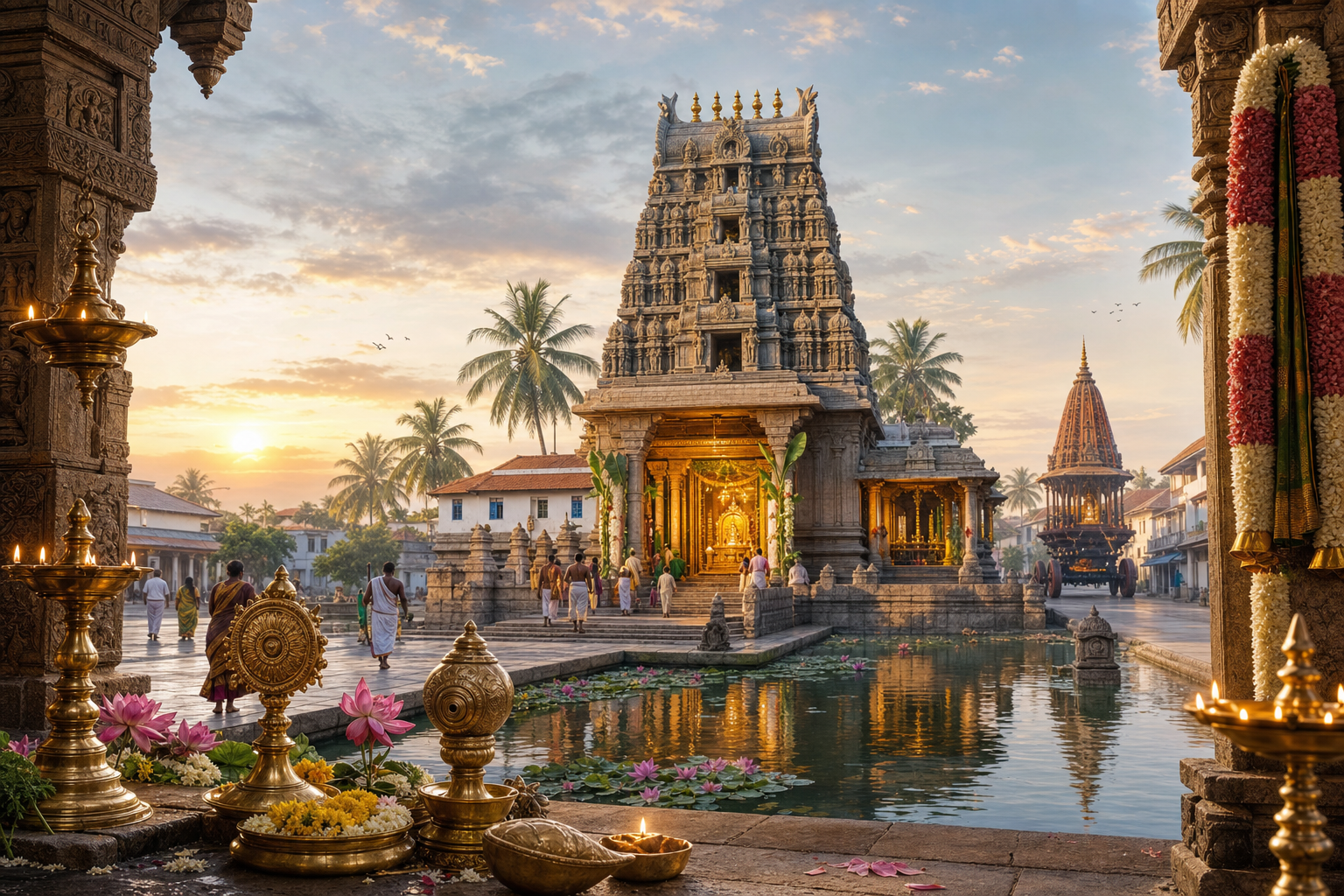
Soundararaja Perumal Temple at Nagapattinam in Tamil Nadu occupies a cherished place in the sacred geography of Sri Vaishnavism. It is counted among the 108 Divya Desams, the temples of Lord Vishnu praised by the Alvar saints in the Nalayira Divya Prabandham. The presiding deity is worshipped as Soundararaja Perumal, while Goddess Lakshmi is venerated as Soundaravalli Thayar. The temple’s identity rests on beauty, grace, protection, and the ancient Tamil devotional imagination that sees the divine not as distant abstraction, but as a living presence in landscape, ritual, memory, and poetry.
Nagapattinam itself is an important coastal town with a long religious and cultural history. The Soundararaja Perumal Temple stands within this wider heritage as a Vaishnava shrine shaped by temple ritual, Chola-era tradition, sacred water bodies, festival processions, and Divya Prabandham recitation. Its importance is not only architectural or historical. It is also theological. The temple preserves a vision of Vishnu as the beautiful sovereign, the compassionate protector, and the all-pervading reality who is present in every form of existence.
The name Soundararaja is central to understanding the shrine. In temple tradition, Lord Vishnu is said to have manifested with a radiant and beautiful form, giving rise to the name Soundara Rajan, often understood as the beautiful king or the lord of divine beauty. His consort Soundaravalli Thayar embodies the same theological aesthetic: beauty is not treated as mere outward appearance, but as a sign of auspiciousness, compassion, harmony, and spiritual completeness. In this sense, the temple’s title is itself a theological statement.
Traditional accounts connect the shrine with the Chola period, especially the 8th century AD. While temple histories often preserve layers of inscriptional, literary, oral, and ritual memory, the Chola association is significant because the Cholas played a major role in expanding and sustaining temple culture in Tamil Nadu. Their world linked devotional poetry, image worship, royal patronage, agrarian institutions, festivals, temple streets, and sacred architecture. Soundararaja Perumal Temple should therefore be read not as an isolated monument, but as part of the wider South Indian temple civilization that gave enduring form to bhakti.
The shrine is associated with several sacred figures. Lord Soundararaja Perumal is believed to have granted divine darshan to Sage Markandeya, Dhruva, and Ma Bhudevi. Each association deepens the temple’s spiritual meaning. Markandeya represents longevity, devotion, and the triumph of divine grace over fear. Dhruva symbolizes unwavering concentration and childlike steadfastness in the pursuit of the divine. Ma Bhudevi represents the earth itself, reminding devotees that Vishnu’s protection is cosmic, ecological, and deeply connected to the stability of the world.
The ancient name of the place is remembered as Sundararinyam, a sacred forest. This memory is important because many Hindu temple traditions begin with a forest, a riverbank, a pond, or a site of tapas. Before the built temple becomes visible, the sacred landscape already carries meaning. In this tradition, Lord Brahma worshipped Vishnu here before beginning the work of creation. Vishnu is believed to have appeared on the auspicious day of Masi Maham on the banks of Sarapushkarani. The narrative places creation, water, worship, and divine manifestation in a single sacred frame.
The temple is also linked with the name Nagapattinam. According to the traditional explanation, Adisesha, the king of Nagas, worshipped Vishnu at this place. Because of this association, the region came to be known as Nagar Pattinam, the sacred place connected with the Nagas. Such etymological traditions are not merely linguistic explanations. They reveal how sacred geography is remembered through story, devotion, and symbolic association. Adisesha, the divine serpent of Vishnu, points to cosmic support, protection, and the resting form of Narayana.
The nearby river is traditionally called Virutha Kaveri. Rivers in Tamil temple culture are not incidental features. They are ritual environments, markers of fertility, and symbols of purification. The presence of Sarapushkarani and the memory of Virutha Kaveri situate the shrine within the sacred hydrology of Tamil Nadu. Devotees approaching such a temple encounter not only stone, sculpture, and sanctum, but also water, seasonal rhythm, and the older memory of a landscape where worship and nature were inseparable.
As a Divya Desam, Soundararaja Perumal Temple is sanctified by the hymns of the Alvars. The Alvars transformed the religious culture of South India by giving devotional experience a powerful Tamil voice. Their hymns made temple worship emotionally immediate and philosophically profound. In the Nalayira Divya Prabandham, Vishnu is praised as the supreme reality who transcends all categories and yet becomes accessible to loving devotion. This union of metaphysics and intimacy is one of the great achievements of the Vaishnava bhakti tradition.
The temple tradition preserves and encourages the recitation of verses from the Holy Text Sri Nalayira Divya Prabhandam. The theological themes associated with these verses are expansive. The divine is described as protector, remover of ignorance, giver of knowledge, and refuge from sorrow. The hymns direct the mind toward the shining feet of the Lord, not as a poetic ornament alone, but as a disciplined devotional focus. The feet of Vishnu become the symbol of surrender, stability, and release from the restlessness of worldly attachment.
A striking feature of the devotional vision is its philosophical inclusiveness. The Lord is described as beyond sensory limitation, beyond ordinary change, and present within the soul. Earth and sky are understood as forms of the divine. The divine is also spoken of as both with form and beyond form. This is a sophisticated theological position. It allows personal devotion to Soundararaja Perumal while also affirming the cosmic and formless nature of the supreme reality. Such a vision helps unify different modes of Hindu worship rather than setting them against one another.
The Prabandham tradition also recognizes that different people may approach the divine through different forms and names. One person may say, this is my God; another may choose a different form of worship. The deeper teaching is that sincere devotion, disciplined conduct, and surrender guide the seeker toward grace. This understanding is especially important for a dharmic view of religious life. Hinduism, Buddhism, Jainism, and Sikhism each preserve distinct spiritual disciplines, yet all affirm the seriousness of ethical refinement, inner transformation, and liberation from narrow ego-centered life.
Soundararaja Perumal Temple therefore offers more than sectarian identity. It provides a model of rooted pluralism. The temple is unmistakably Vaishnava: its deity, liturgy, festivals, and theological language are centered on Vishnu and Lakshmi. Yet the spiritual ideas associated with the temple speak to broader dharmic concerns: the removal of ignorance, the restraint of desire, the pursuit of moksha, reverence for sacred geography, and the recognition that the divine pervades all beings. This is unity without erasure, and diversity without fragmentation.
Daily worship at the temple follows a structured ritual rhythm. The temple is said to observe six daily rituals, a pattern common to many important South Indian temples. Such rituals are not simply ceremonial repetitions. They regulate sacred time. The deity is awakened, adorned, offered food, praised, and ritually honored through the day. For devotees, this rhythm turns ordinary time into sacred time. The day is no longer measured only by work, commerce, or personal obligation; it is measured by darshan, offering, sound, fragrance, light, and remembrance.
The temple also observes three major annual festivals. Among them, the chariot festival during the Tamil month of Chittirai, corresponding broadly to March and April, is regarded as the most important. During this festival, the festival deity is taken in procession around the Mada street of the temple. The chariot procession is one of the most powerful public forms of Hindu temple worship. It brings the deity out of the sanctum and into the shared civic space of the community, allowing the sacred presence to be encountered collectively.
The Chittirai festival also reveals the social function of temples. A temple is not only a place of private prayer. It is a community institution that gathers families, priests, musicians, artisans, flower sellers, scholars, children, elders, pilgrims, and local residents into a shared ritual world. The movement of the deity through the streets affirms that divine grace is not confined to the inner sanctum. It enters the town, blesses the community, and renews the bond between sacred space and everyday life.
The association with Masi Maham adds another layer of ritual significance. Masi Maham is traditionally connected with sacred bathing, temple processions, and the honoring of divine manifestation in relation to water. When Vishnu is remembered as appearing on the banks of Sarapushkarani on this day, the temple’s calendar is tied to cosmic time, lunar observance, and sacred geography. Festivals are therefore not arbitrary dates. They are structured acts of memory that renew the temple’s origin story each year.
The image of Soundararaja Perumal as a beautiful and glittering form should be interpreted within the larger Hindu understanding of darshan. In darshan, beauty is not passive visual pleasure. It is encounter. The devotee sees the deity, and the deity is understood to see the devotee. Ornaments, lamps, flowers, fragrance, sacred food, and music are not decorative excess. They are ritual technologies that train attention, awaken reverence, and make the invisible qualities of divinity perceptible to the senses.
Soundaravalli Thayar’s presence is equally central. In Sri Vaishnava theology, Lakshmi is not peripheral to Vishnu worship. She is the compassionate mediator, the motherly presence, and the embodiment of auspicious grace. Her shrine reminds devotees that divine sovereignty and divine tenderness must be understood together. A temple dedicated to Soundararaja Perumal is therefore also a temple of Soundaravalli Thayar’s protection, beauty, and merciful intercession.
The temple’s devotional philosophy places great emphasis on surrender. The Prabandham passages associated with the temple urge the seeker to give up excessive attachment to worldly possessions, bodily identity, and self-centered desire. This does not require contempt for life. Rather, it calls for proper proportion. The body is temporary, worldly status is unstable, and possessions cannot provide lasting refuge. The divine, described as everlasting and all-pervading, becomes the only secure foundation for spiritual life.
This teaching has enduring relevance. Modern life often trains the mind to pursue accumulation, comparison, and constant distraction. A temple like Soundararaja Perumal offers a different discipline. It invites stillness before the sanctum, attention to sacred sound, humility before tradition, and a reorientation of desire. The message is not escapism. It is a refined understanding of what can and cannot sustain human life. The temple reminds devotees that knowledge, devotion, and ethical restraint are forms of inner wealth.
The hymnic tradition also presents Vishnu as the one who pervades water, sky, sun, moon, stars, earth, wind, and living beings. This cosmic vision prevents devotion from becoming narrow. The deity in the sanctum is not separate from the universe; the sanctum becomes the concentrated point through which the universe is understood. Such theology gives temple worship philosophical depth. Soundararaja Perumal is adored in a specific place, but the Lord’s reality is not limited by place.
The verses attributed to Saḍagopan of Thirukkuruhur, also known in the Sri Vaishnava tradition as Nammalvar, are especially important in this context. Saḍagopan’s pāsurams repeatedly explore the paradox of the divine: near yet immeasurable, personal yet cosmic, beautiful yet beyond all description. The promise that those who learn and recite such pāsurams may attain moksha reflects the Sri Vaishnava conviction that sacred poetry is not merely literature. It is sadhana, theology, and grace transmitted through sound.
The temple’s teachings also describe Narayana as easy for devotees to reach but difficult for those who approach without humility. This is a recurring bhakti insight. Intellectual brilliance, ritual status, or external power cannot replace surrender. The Lord who sustains the cosmos is also the Krishna who stole butter from Yashoda and allowed himself to be tied to a mortar. The highest reality becomes accessible through love. This combination of majesty and intimacy gives Vaishnava devotion its distinctive emotional force.
The presence of Krishna imagery within the broader praise of Narayana reinforces the unity of Vishnu’s forms. Soundararaja Perumal, Narayana, Krishna, and Vishnu are not competing identities. They are devotional windows into the same supreme reality. This theological flexibility allows the temple tradition to hold together cosmic Vishnu, royal Perumal, child Krishna, and the Lord of moksha. It also explains why Divya Desam worship has remained vibrant across regions, languages, and generations.
Architecturally, the temple belongs to the larger South Indian temple pattern in which sanctum, ritual enclosure, water source, festival streets, and processional culture work together. Even where detailed architectural documentation is limited, the functional logic of such temples is clear. The sanctum houses the immovable divine presence. The festival image allows movement and public darshan. The temple tank or sacred water body connects ritual to purification. The streets extend the temple into the community. The calendar binds the entire structure to sacred time.
For pilgrims, Soundararaja Perumal Temple is not only a historical site to be observed. It is a place to be experienced through the senses and through disciplined attention. The sound of recitation, the sight of lamps, the fragrance of flowers, the rhythm of circumambulation, and the quiet pause before the deity all shape religious experience. Such embodied devotion is a major feature of Hindu temple practice. It allows theology to be lived rather than merely studied.
The temple also speaks to the importance of preserving sacred heritage in Tamil Nadu. Divya Desams are not only religious centers for Vaishnavas; they are repositories of Tamil literature, ritual continuity, music, art, social history, and regional memory. Preserving them requires more than maintaining physical structures. It requires sustaining living traditions: recitation, festivals, temple service, scholarly study, and respectful pilgrimage. When these practices continue, the temple remains a living institution rather than a static relic.
Soundararaja Perumal Temple’s deeper message is that beauty and liberation are connected. The beautiful form of the Lord draws the devotee inward. The inward movement leads to reflection. Reflection reveals the impermanence of worldly attachments. That recognition opens the path toward surrender, knowledge, and moksha. In this way, the temple’s name is not ornamental. Soundara, beauty, becomes a gateway to spiritual seriousness.
The mantra associated with the shrine, OM SRI SOUNDARYANARAYANA NAMO NAMAHA, expresses reverence in concise devotional form. It invokes the Lord as Soundaryanarayana and offers repeated salutations. Such mantras condense theology into sound. They allow devotees to carry the temple’s presence beyond the temple walls, into daily life, memory, and personal prayer. In a tradition where sacred sound matters deeply, this simple invocation becomes a portable form of worship.
Soundararaja Perumal Temple at Nagapattinam therefore deserves attention as a major Vaishnava Divya Desam, a Chola-associated shrine, a center of festival culture, and a living expression of Tamil bhakti. Its legends connect Brahma, Adisesha, Markandeya, Dhruva, Ma Bhudevi, Sarapushkarani, Masi Maham, and the sacred memory of Sundararinyam. Its theology affirms Vishnu as beautiful, compassionate, omnipresent, and liberating. Its ritual life continues to show how temple worship can shape community, memory, devotion, and the pursuit of moksha.
In the wider landscape of Hindu Temples and South Indian Temples, this Nagapattinam shrine stands as a luminous reminder that dharma is sustained through place, poetry, ritual, and shared reverence. Its importance lies not only in being counted among the 108 Divya Desams, but in the way it continues to gather philosophy and emotion into a single devotional experience. For those who approach it with attention, Soundararaja Perumal Temple reveals beauty as grace, worship as discipline, and sacred heritage as a living bridge between the past and the present.
Inspired by this post on Hindu Pad.
