
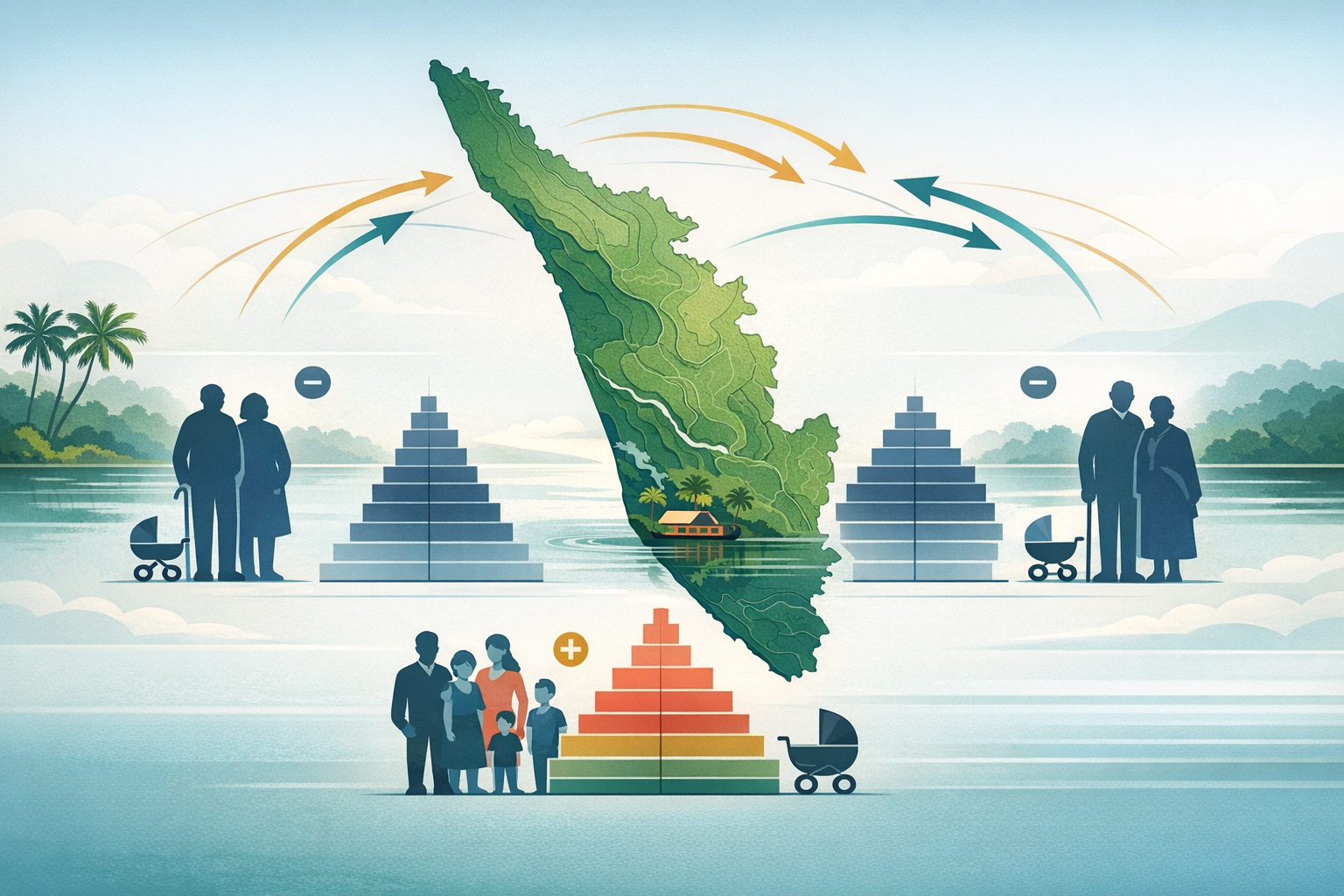
Kerala stands at a demographic crossroads that many advanced societies encounter late in their transitions: natural population growth is turning negative among Hindus and Christians, meaning deaths now outnumber births in these communities. Far from a sensational anomaly, this turning point reflects decades of social progresslow fertility, long life expectancy, near-universal education, and high-quality health carenow converging with an older age structure and sustained migration. Understanding what this shift does and does not mean is essential for responsible policymaking and for maintaining harmony across Kerala’s rich mosaic of faiths.
Natural growth refers specifically to the difference between births and deaths. When a population’s age structure becomes older and fertility remains below replacement, annual deaths can exceed annual births even with excellent health outcomes and low age-specific mortality rates. Kerala’s experience is a textbook case of late-stage demographic transition: crude indicators move because the population’s age composition moves, not because people are “dying earlier” or because health systems are failing.
Kerala has long been India’s demographic frontrunner. Fertility fell below replacement more than two decades ago, women’s educational attainment is among the highest in the country, and life expectancy exceeds the national average. NFHS-5 indicates a total fertility rate (TFR) near 1.8 in 2019–21, compared with 1.6 in 2015–16 (NFHS-4), reflecting long-term low fertility with a modest recent uptick. These aggregate shifts, combined with near-complete birth and death registration, make the state’s vital statistics especially sensitive to age-structure changes.
Two technical points guide an accurate reading of the trend. First, crude birth and death rates are age-composition dependent; when a population has a high share of older adults, the crude death rate rises even if age-specific mortality continues to improve. Second, improvements in Civil Registration System (CRS) completeness, already strong in Kerala, can increase reported deaths without any underlying deterioration in health, simply because more events are captured on time and in full.
Religious differentials in Kerala’s demography largely reflect differences in age structure and historical fertility patterns. Hindus and Christians, on average, have older age profiles due to earlier fertility decline and significant out-migration of younger adults over several decades. Muslims, while also experiencing a marked fertility decline, retain a relatively younger age distribution, which sustains higher births per year at present. These compositional effects are central to why natural growth can be negative for some communities and not others in the same state.
Available survey evidence underscores these gradients. NFHS-5 shows Kerala’s overall TFR near 1.8, with community differentials consistent with earlier surveys and administrative data: Hindus and Christians at or below replacement levels, and Muslims higher but steadily converging downward over time. The magnitude of these differences has narrowed over the past two decades, a well-documented feature of India’s demographic convergence.
Age structure translates arithmetic into outcomes. An older community will register more annual deaths simply because a larger share of its members live in age groups with higher baseline mortality risk, even under excellent clinical care. Conversely, a younger community will register more births while its large cohorts are in prime childbearing years, even if fertility per woman is falling. Put simply, natural growth is currently a function of who is old, who is young, and how many people sit in each bracket.
Migration amplifies these dynamics. Kerala has seen sustained out-migration of young adults for education and employmentboth to other Indian states and to the Gulfdisproportionately from communities with earlier educational gains and labor-market mobility. The departure of potential parents depresses local births; return migration of older adults can raise local deaths by shifting the residence of end-of-life years back to Kerala. These effects are compositional, not moral or ideological.
Vital statistics in Kerala are also influenced by high registration completeness and improved timeliness in the CRS. When registration quality rises from, say, 95% to near 100%, the reported number of deaths can increase even if the true number stays constant, closing historical gaps in measurement. Analysts therefore separate trend (real change) from completeness (better counting) before drawing conclusions about health or social behavior.
District-level patterns mirror these mechanisms. Older, historically low-fertility districts such as Pathanamthitta and Kottayam have long recorded low birth counts, and some years show more deaths than births as a statistical normal for late-transition populations. Younger-profile districts, or those with relatively higher recent fertility, maintain positive natural growth. None of this implies uniform trajectories within a faith; locality, income, education, and occupation all modulate outcomes.
Everyday life in Kerala offers recognizable signs of this shift. In many households, grandparents now outnumber toddlers at family gatheringsa quiet, human-scale indicator of population ageing. Neighborhood schools consolidate classes as cohorts shrink, while hospitals expand geriatric and palliative services. These lived changes are felt across communities and invite shared solutions rooted in empathy, evidence, and Kerala’s tradition of social solidarity.
From an analytical standpoint, three forces determine community size over time: fertility, mortality, and migration. A standard cohort-component model projects each age group forward, applying age-specific fertility and mortality while adding or subtracting migrants. With Kerala’s low fertility entrenched and mortality improving but the age pyramid already top-heavy, natural decrease among older-profile communities is a mathematically expected waypoint, not an existential cliff.
Decomposition methods, such as Kitagawa or Oaxaca-Blinder style approaches adapted to demography, can quantify contributions of age structure versus rate changes. In Kerala’s current context, age composition explains much of the rise in crude deaths, while small changes in age-specific mortality continue to reflect improving health. Similarly, declines in births stem primarily from fewer women in reproductive ages and postponed marriage/childbearing, rather than abrupt changes in desired family size alone.
Socioeconomic drivers reinforce these patterns. High female education, costly urban housing, dual-earner aspirations, and the opportunity costs of extended childcare lengthen birth spacing and reduce completed family size. Better child survival also lowers the perceived need for larger families. These factors affect all communities, albeit at different tempos depending on age structure, income, and migration history.
Economic and social implications are significant but manageable with foresight. An ageing population raises the old-age dependency ratio, reshapes consumption from schooling to healthcare, and shifts local labor supply. Kerala’s strength in education, nursing, and care work can be leveraged to build a world-class eldercare and palliative ecosystem, creating dignified jobs while meeting rising needs.
Policy responses that respect choice and equity work best. Evidence from other low-fertility settings suggests that modest, well-targeted measuresaffordable childcare, parental leave, flexible work, housing support near employment hubs, and high-quality early childhood educationhelp couples realize their desired family size without coercion. Simultaneously, investments in geriatric care, community health workers, home-based palliative services, and age-friendly public spaces will improve quality of life as longevity rises.
Data stewardship remains vital. Kerala’s CRS offers near-complete coverage, but analyses benefit from triangulation with Sample Registration System (SRS) indicators and large surveys such as NFHS. Transparent publication of age-by-religion population counts in the next Census release, alongside careful documentation of registration completeness, will strengthen the evidence base and reduce speculation.
Equally important is ethical communication. Demography should never be weaponized. Claims that ascribe intent to fertility differences ignore decades of scholarship and lived realities; they also erode social trust. Kerala’s shift reflects predictable, measurable processesageing, migration, and delayed childbearingthat cut across communities and invite shared, humane solutions.
Kerala’s civilizational ethos offers a path forward. Dharmic traditionsHinduism, Buddhism, Jainism, and Sikhismaffirm compassion, responsibility toward elders, and respect for diverse life choices. In the face of demographic change, those principles can guide interfaith cooperation: community kitchens that serve the elderly, volunteer transport to clinics, neighborhood day-care centers, and shared festivals that knit social bonds across belief systems.
In sum, negative natural growth among Hindus and Christians in Kerala is a hallmark of demographic maturity, not a cause for alarm. It arises from older age profiles, sustained low fertility, and migration patterns, all operating within a high-quality registration system. The task ahead is practical: align family-support policies with aspirations, expand eldercare capacity, and communicate with rigor and empathy. Done well, Kerala can convert a statistical milestone into a model of inclusive, dignified ageingand continue to lead India in humane, data-informed governance.
Inspired by this post on Struggle for Hindu Existence.
