
Across Hindu, Buddhist, Jain, and Sikh communities, conversations about whom to commemorate in temples and public spaces often orbit two complementary ideals: ahimsa (non-violence) and kshatra (protective courage). Rather than a binary choice, these values form a continuum in the dharmic traditions. Presenting boththrough figures such as Mahatma Gandhi and Chhatrapati Shivaji Maharajoffers a historically grounded, ethically balanced narrative that the next generation can internalize with confidence and pride.
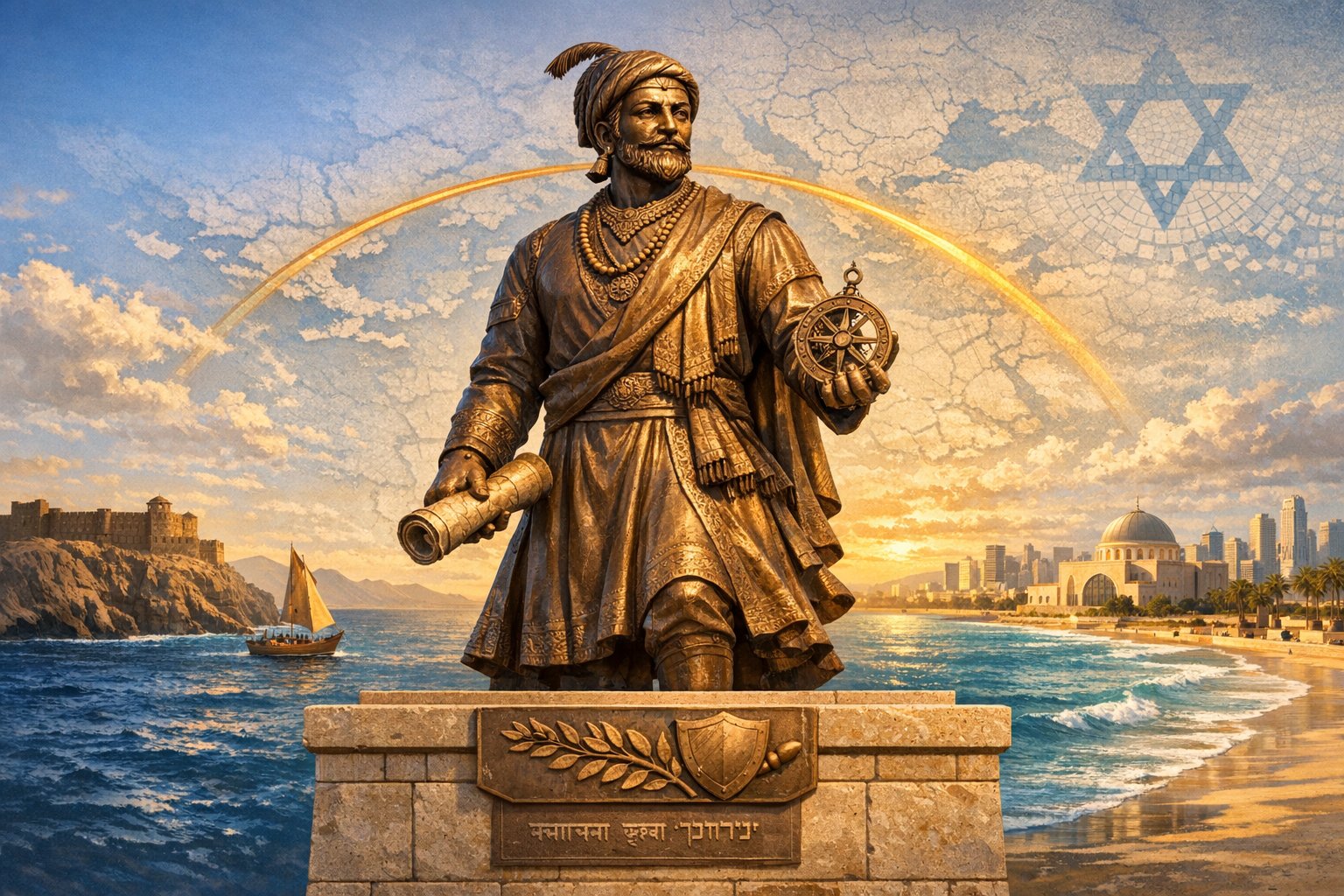
Recent reports from Israel about plans to install a statue of Chhatrapati Shivaji Maharaj have resonated widely because they foreground a 2,000-year arc of Jewish–Indian connections. For the Bene Israelone of India’s oldest Jewish communities with deep roots along Maharashtra’s Konkan coastthe commemoration is more than symbolic art. It affirms a shared history of maritime enterprise, service, and civic belonging that spans the Maratha Empire, the British Indian Army, and later, the State of Israel. In the sphere of international and cultural diplomacy, such memorials operate as powerful instruments of public memory and people-to-people ties in India–Israel relations.
Community traditions place the Bene Israel presence in the Konkan for roughly two millennia, with oral histories describing an early shipwreck and gradual settlement around Navgaon and Revdanda. Over centuries, they integrated linguistically and culturallyspeaking Marathi, adopting local dress, and earning the moniker “Shanwar Teli” for observing the Sabbath while working as oil presserswhile maintaining distinct religious practices. Synagogues in Mumbai and coastal Maharashtra, including Knesset Eliyahoo and Magen David, became enduring anchors of Jewish heritage within a wider Maharashtrian milieu.
Maritime and military service became a notable thread in this shared past. Community records and regional histories recount Bene Israel participation in coastal defense and shipbuilding within the Maratha polity that Shivaji founded, and later under his successors. The Maratha Navy’s coastal fortsSindhudurg and Vijaydurg among themsymbolize the strategic turn toward seaborne power on the Konkan coast. Within this ecosystem, Jewish artisans, sailors, and soldiers are remembered for contributing to logistics, navigation, and local defenseroles consistent with a broader Maratha emphasis on protecting littoral trade routes and communities.
During the colonial and late-colonial periods, many Bene Israel distinguished themselves in the British Indian Army and the Royal Indian Navy. Their service profilesranging from technical trades to commissioned ranksmirrored a larger trend of Jewish communities worldwide engaging in public service while cultivating excellence in education, medicine, and administration. This record of service continued after Independence, with Bene Israel also contributing to India’s civic, cultural, and economic life before successive waves of aliyah (migration) to Israel from the 1950s onward.
Against this backdrop, the proposed statue in Israel acquires layered meaning. It celebrates Chhatrapati Shivaji Maharaj as a strategist of statecraft and coastal security in the Maratha Empire while simultaneously acknowledging the Bene Israel’s Indian roots in Maharashtra. As heritage diplomacy, the memorial knits together multiple identitiesIndian, Jewish, Maharashtrian, and Israelidemonstrating how diasporas strengthen bridges between nation-states through shared memory, civic narratives, and cultural symbols.
These developments have clear implications for temples and community institutions across the global Hindu diaspora. Curating spaces that include figures of ahimsa (for example, Gandhi, the Buddha, Jain tīrthaṅkaras) alongside exemplars of ethical kshatra (for example, Chhatrapati Shivaji Maharaj, Sikh Gurus, Rani Durgavati, Rani Chennamma) yields a fuller picture of dharma in action. In Hindu philosophy, as the Bhagavad Gita’s notion of dharma-yuddha indicates, protective duty is ethically bounded and ultimately oriented toward the restoration of justice. When institutions present both compassion and courage as coequal civilizational virtues, youth audiences report greater clarity about identity and purpose.
Pragmatically, a balanced commemorative approach can be advanced through museum-quality panels, multilingual captions, and QR-linked primary sources. Short, age-banded storytelling sessions can juxtapose teachings on ahimsa drawn from Jain and Buddhist canons with case studies of kshatra drawn from Maratha and Sikh histories. Exhibitions can spotlight maritime history on the Konkan coast, the Maratha Navy’s role, and the Bene Israel’s distinctive contributions. This not only enhances educational value but also deepens intercultural respect within the broader Indian and Jewish diasporas.
Communities should further situate statues within robust protective and interpretive frameworks. Incidents of vandalism against public statuesincluding those of Gandhi in several countriesunderscore the need for preventive stewardship: discreet surveillance, community watch programs, rapid-response restoration protocols, and insurance. Contextual signage that explains why a figure is commemorated, how their ethics relate to dharmic traditions, and what lessons are relevant for contemporary civic life can significantly reduce misinterpretation and politicized misuse.
Ultimately, the reported installation of a Chhatrapati Shivaji Maharaj statue in Israel exemplifies how cultural heritage can advance mutual understanding. It honors the Bene Israel’s long residence in Maharashtra, highlights the maritime and military ingenuity of the Maratha Empire, and opens a wider conversation about how Hindu temples and dharmic institutions might curate figures representing both ahimsa and kshatra with academic rigor and spiritual sensitivity. The outcomewhen executed thoughtfullyis unity without uniformity and confidence without chauvinism, true to the civilizational ethos of Vasudhaiva Kutumbakam.
Related video resource: Israel Is Building A Shivaji Maharaj Statue (Associate Editor Radhika Dhawad). Watch here: http://www.hinduhumanrights.info/wp-content/uploads/2026/06/YTDown_YouTube_Israel-Is-Building-A-Shivaji-Maharaj-Sta_Media_kpHabsx-uUM_004_360p.mp4
Inspired by this post on Hindu Human Rights Blog.
