
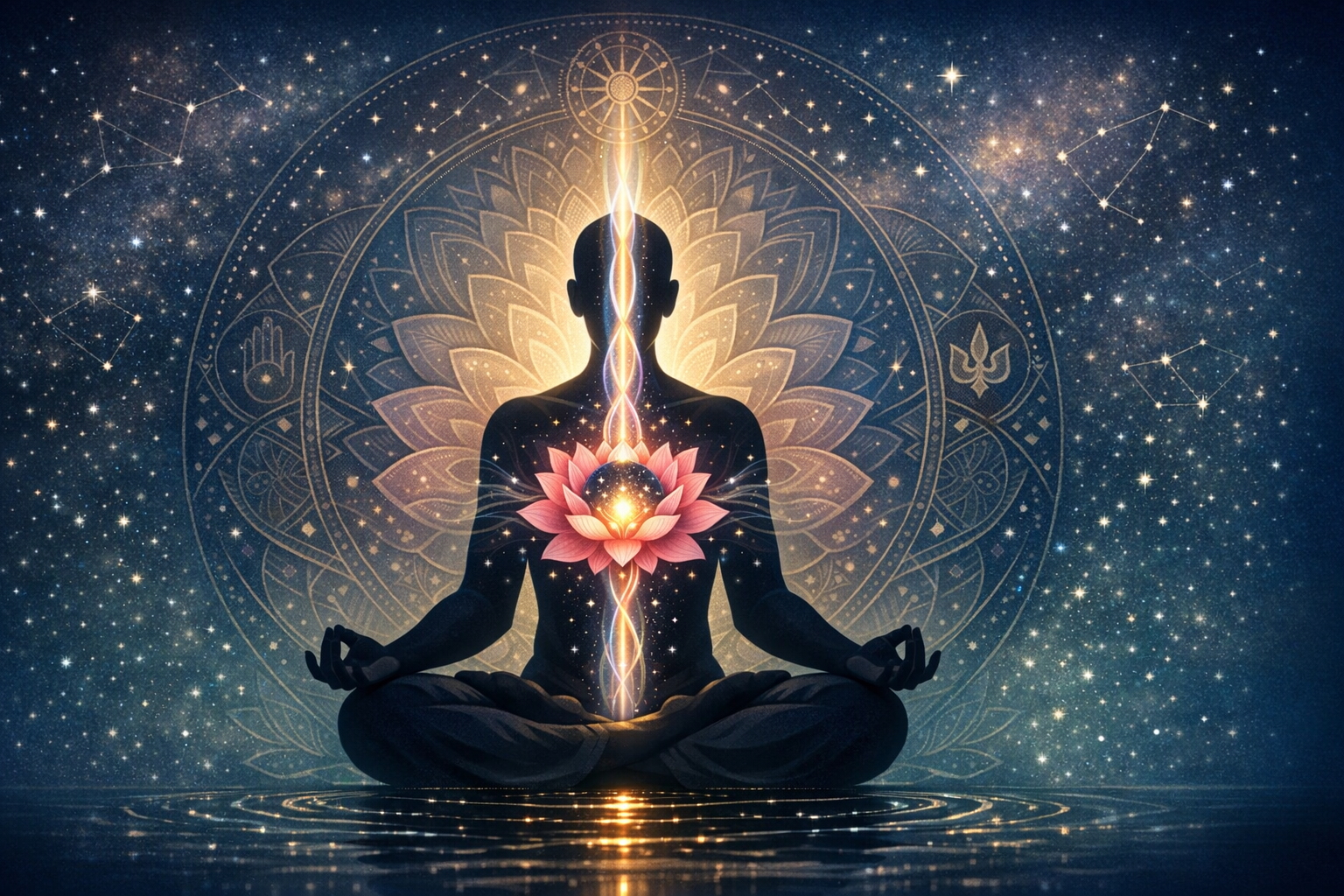
The Narayana Suktam, preserved in the Mahanarayana Upanishad within the Taittiriya Aranyaka, presents one of the most intimate portrayals of the Supreme: the heart as the living sanctuary of Nārāyaṇa. More than devotional lyricism, it encodes a precise contemplative map, linking Vedantic insight, yogic anatomy, and meditative praxis. Read as an Upanishadic guide rather than a mere hymn, the suktam interiorizes the cosmos, directing attention to the hridaya guha (the cave of the heart) and the dahara ākāśa (the subtle “space” within), where the infinite is known through the most immediate center of experience.
Textually, the Narayana Suktam circulates in the Krishna Yajurveda tradition, commonly associated with the Mahanarayana Upanishad (a portion of the Taittiriya Aranyaka). Across liturgical usage, especially in Vaishnava practice, it accompanies abhiṣeka, homa, and daily recitations. Its language unites the personal and the absoluteNārāyaṇa as both the all-pervading ground and the indwelling presenceensuring relevance for Bhakti, Yoga, and Advaita Vedānta alike.
At the heart of the text is an axial teaching: the Supreme dwells within. The suktam moves readers from macrocosm to microcosm, from the universal Nārāyaṇa to the immediate locus of realization, stating that the Divine is present “in the heart.” In classical hermeneutics, this is not an organ-centric claim but a pointer to the center of embodiment and awarenesshridaya as the convergent locus of attention, life-force, and intuitive discernment (prajñā).
This Upanishadic interiorization resonates with the Chandogya Upanishad’s dahara-vidyā, which points to the “small space” (dahara ākāśa) within the heart as the abode of the limitless Brahman. By holding together vastness and smallness, the tradition undermines spatial literalism: the finite vessel of the human frame becomes the mirror of the infinite, not by size but by depth of awareness. The Narayana Suktam stands squarely in this contemplative lineage.
Symbolically, the heart is envisioned as a lotus (hridaya-kamala)a perennial Vedic image for the self-revealing nature of consciousness. The lotus suggests purity amidst life’s turbulence, unfolding layers of comprehension, and the gentle ascent from embodied habit to awakened clarity. In later yogic language, the heart-lotus aligns with the anāhata center, the place of unstruck sound, where harmony is discovered rather than constructed. While enumerations vary across lineages, the image consistently orients contemplatives to quiet luminosity at the center of being.
Yogic anatomy offers an experiential crosswalk for the suktam’s metaphors. The sushumnā nāḍī is described as the central channel of ascent, with ida and piṅgalā harmonizing vital currents. The heart region (anāhata) is classically linked to balanced prāṇa and vyāna vāyus, affect regulation, devotion (bhakti), and compassionate discernment. Some traditions speak of viṣṇu granthia subtle “knot” at the heart signifying attachment to identity and relationshipwhich softens through mantra, breath, and contemplative surrender, allowing insight to rise unimpeded.
The Narayana Suktam repeatedly affirms that the indwelling is ultimate, not symbolic: Nārāyaṇa is both the transcendent light (jyotiḥ) and the immanent Self. Vaishnava exegetes thus find seamless continuity between personal devotion and Vedantic realization: devotion internalizes, Vedānta universalizes, Yoga stabilizes. The heart-lotus becomes the shared arena where seeming dualitiesworshipper and worshipped, finite and infiniteare integrated.
Practice-oriented readers can translate the suktam’s vision into method. One classical entryway is mantra, especially the eight-syllabled oṁ namo nārāyaṇāya, which tradition aligns with the steadying rhythms of breath and the unfolding of the heart-lotus. The aim is not autosuggestion but a gentle entrainment of attention, prāṇa, and meaning, allowing the heart center to clarify without strain.
A practical sequence may be outlined as follows. Preparation: a stable, dignified seat with the spine at ease and the chest unforced. Intention: recollect the suktam’s central viewNārāyaṇa abides within, not as a distant object but as the very ground of awareness. Let this orientation be simple, steady, and free from expectation.
Breath attunement: adopt smooth nasal breathing with a gentle equal ratio (for example, 4–4, later 6–6) without breath-holding initially. Allow the region around the sternum to relax as the shoulder girdle settles. The objective is not to breathe “into” the heart as a space, but to relax the somatic field so that attention can rest naturally in the heart center.
Mantra integration: synchronize soft mental recitation of oṁ namo nārāyaṇāya with the breath, letting meaning and sound resonate at the heart-lotus. If any affective intensity ariseswarmth, spaciousness, even bittersweet releaseallow it, neither grasping nor resisting. The suktam’s assurance that the Supreme abides within supports a non-striving presence.
Dhyāna: periodically release the mantra and rest in quiet awareness at the heart. If attention scatters, return to breath and mantra. Sessions of 12–20 minutes, practiced consistently, refine steadiness. Over time, the boundary between devotion and clarity thins; the inner sanctuary feels less like a place one “visits” and more like the ground one never leaves.
In temple liturgies, the Narayana Suktam commonly accompanies ablutions (abhiṣeka) and sanctifications (prokṣaṇa), enacting externally what the Upanishads enjoin inwardly: the revelation of the immanent. This reciprocityritual mirroring contemplationanchors communal life to the same heart-center the contemplative cultivates in solitude, harmonizing Bhakti’s affectionate form with Vedānta’s formless light.
The suktam’s heart-centered teaching also resonates across dharmic traditions, advancing a unitive vision. In Buddhism, Abhidhamma speaks of a “heart-base” (hadaya-vatthu) as the material support for mind processes in classical models, while Vajrayāna and later yogic streams describe a heart center where compassion and wisdom integrate. Although doctrinal frames differespecially regarding Selfthe contemplative interiority and heart-based stabilization show family resemblances in method and outcome.
Jain contemplative literature emphasizes the inward turn (śuddhopayoga) and steady abidance in pure awareness beyond bodily identification. While classical Jain metaphysics refrains from theistic assertions found in the suktam, many Jain yogic manuals encourage calm abiding and ethical purification that naturally soften the heart’s responses. Here again, the heart functions as a practical center of composure and insight, even where metaphysics diverges.
Sikh Gurbani repeatedly affirms that the Divine dwells within the heart of all. This inner immanence invites remembrance (simran) and virtue, converging with the Narayana Suktam’s core view that the sanctuary is within. Across Hinduism, Buddhism, Jainism, and Sikhism, the shared emphasis on interior realization, ethical maturation, and compassion underscores a dharmic unity-in-diversitydistinct in idiom, convergent in transformation.
Modern somatic and contemplative research cautiously aligns with these insights. Heart-centered meditation correlates with enhanced vagal tone and heart-rate variability (HRV), markers associated with emotional regulation and resilience. While the Upanishads do not argue physiologically, contemporary findings suggest that resting awareness at the heart can modulate stress responses, making the suktam’s guidance not only spiritually resonant but practically stabilizing.
Hermeneutically, choosing the heart rather than the head reflects more than metaphor. In the Bhagavad Gita, the Divine is said to abide “in the heart of all beings,” a pan-Indic motif that prioritizes intimacy and immediacy over abstraction. The Narayana Suktam extends this intimacy into contemplative method, tilting realization from conceptual heights to felt presencequiet, luminous, and near.
Lotus imagery deepens this pedagogy. In the suktam’s orbit, the heart-lotus is not a rigid anatomical claim but a meditative architecture: petals unfold as attention refines; the central pericarp is the silent witness; the enclosing waters symbolize the flux of life through which purity nevertheless emerges. Practitioners often report a sense of inner spaciousness or warmth at the sternum, a phenomenology that the lotus elegantly anticipates.
Common pitfalls are worth noting. Over-efforting around the chest can induce tension; the instruction is to relax around the heart, not to force sensation. Emotional material may surface; letting the mantra hold the space prevents overwhelm. If somatic distress or panic arises, shorten sessions, favor gentler breath, or consult an experienced teacher. The suktam’s stance is gracious: realization unfolds by receptivity, not compulsion.
Doctrinally, the Narayana Suktam permits multiple valid readings: Vaishnava devotion recognizes a personal indwelling Lord; Advaita reads the indwelling as ātman-Brahman identity; nondual Bhakti sees both at once. This polyvalence is a virtue, enabling communities to share a practice while honoring distinct metaphysical temperaments. The heart becomes common groundliterally and figuratively.
Ethically, heart-centered realization matures as compassion, discernment, and service (seva). The Upanishadic measure of knowledge is transformation: the one who recognizes Nārāyaṇa within cannot easily other or harm. Dharmic unity is thus more than intertextual harmony; it is lived solidarity across traditions, grounded in the same interior sanctuary.
Read in this fuller frame, the Narayana Suktam emerges as a compact Upanishadic manual: philologically rooted in the Taittiriya Aranyaka, contemplatively explicit about the heart as abode, yogically coherent with anāhata and sushumnā, and civilizationally unitive across Hinduism, Buddhism, Jainism, and Sikhism. Its instruction is at once exacting and mercifulprecise enough to practice, gentle enough to sustain.
Ultimately, the suktam’s promise is experiential. When attention settles and breath softens, the heart-lotus reveals what the text has always said: the sanctuary is already here. Whether one names it Nārāyaṇa, Brahman, inner light, or pure awareness, the discovery ennobles lifeclarifying thought, widening compassion, and restoring the felt unity at the core of dharmic traditions.
Inspired by this post on Hindu Blog.
