
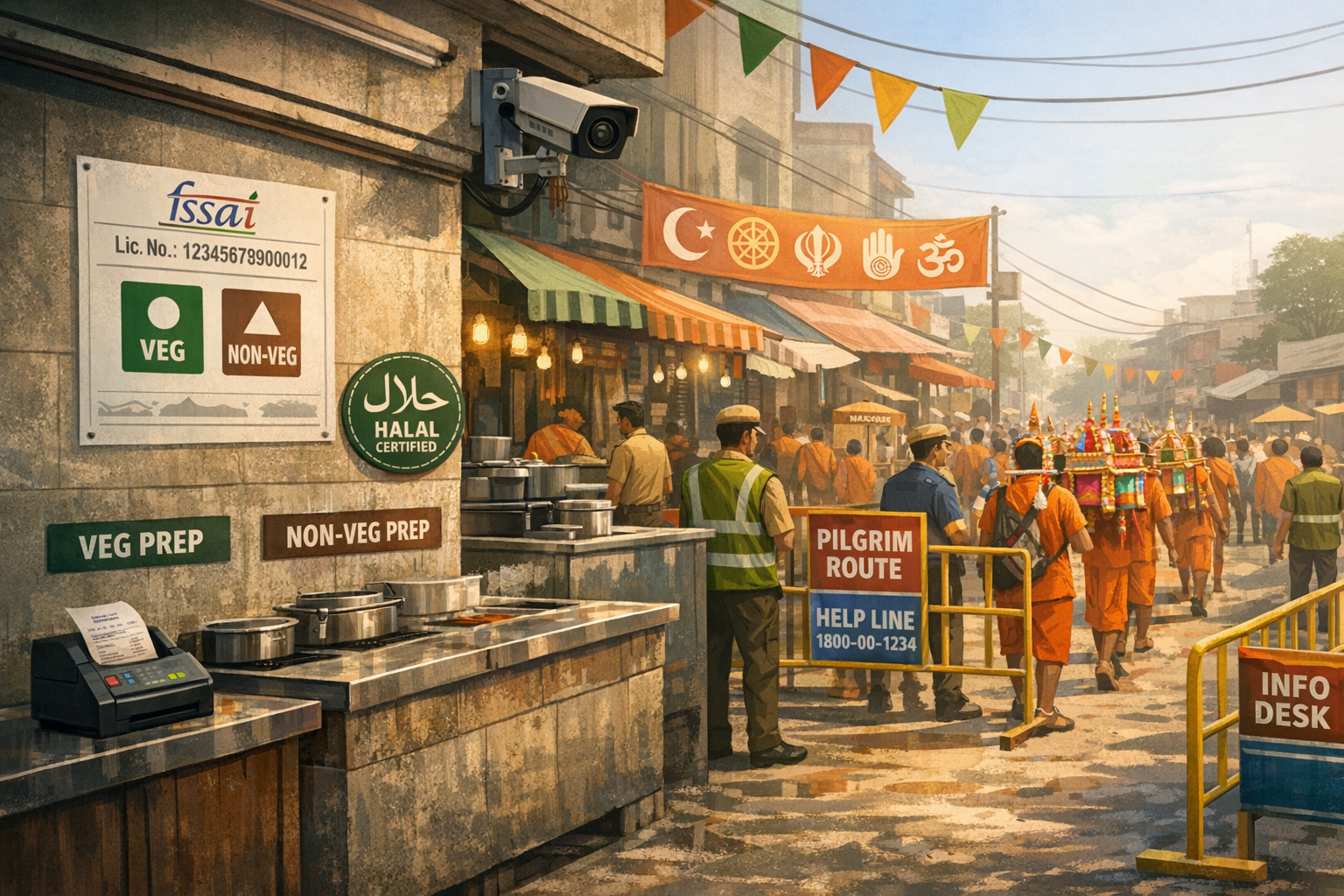
In Muzaffarnagar, Uttar Pradesh, a non-vegetarian eatery was reportedly vandalized by individuals associated with Hindutva activism. The flashpoint, according to local reporting, combined three combustible threads: heightened sensitivities during the Kanwar Yatra, disputes around halal labeling, and the allegation that the premises were rented or operated under a Hindu name. The incident has reopened a wider conversation about law and order, consumer transparency, and how pilgrim seasons intersect with marketplace practices in densely populated towns.
Kanwar Yatra is among North India’s largest annual Shaivite pilgrimages, bringing large numbers of Kanwariyas through western Uttar Pradesh, including Muzaffarnagar. Administrations typically issue traffic diversions, sanitation drives, and crowd-management protocols to balance devotional movement with urban life. In such periods, even routine commercial activity can be perceived through a religious lens, magnifying small misunderstandings into flashpoints if civic communication and business compliance are not meticulous.
Halal, in the Indian marketplace, functions primarily as a voluntary certification reflecting a particular method of slaughter and processing, parallel to other consumer-preference signifiers. It is distinct from statutory approvals: food safety in India is regulated by the Food Safety and Standards Authority of India (FSSAI), whose licensing, hygiene norms, and labeling rules apply to all food businesses regardless of religious affiliation. Indian packaging already uses the green/brown triangle icons for vegetarian and non-vegetarian products; halal or jhatka mentions are additional declarations aimed at specific consumers. Where such declarations exist, clarity and accuracy serve both religious pluralism and consumer rights.
Allegations that a shop traded under a name incongruent with the proprietor’s identity struck a nerve because naming, signage, and licensing act as trust signals in diverse neighborhoods. State-level Shops and Establishments Acts, municipal by-laws, and FSSAI licensing collectively require businesses to display the licensed name, address, and the FSSAI number at the premises and on invoices. Transparent documentationtrade name, ownership, rental agreements, GST details, and food licensesreduces suspicion and creates an auditable paper trail that protects proprietors and reassures patrons.
Whatever the grievance, extra-judicial retaliation remains unlawful. Damage to property, intimidation, or assault attracts provisions of the Indian Penal Code commonly invoked in such episodes (for example, mischief causing damage, criminal intimidation, and unlawful assembly). District administrations also rely on the Code of Criminal Procedure to impose preventive and prohibitory orders during sensitive periods. Grievances about mislabeling, nuisance, or licensing must be routed to food safety officers, municipal authorities, or the policenot to street justice.
It is prudent to acknowledge evidentiary limits in the public domain until official investigations conclude. Early narrativesoften propelled by short video clipscan omit timeline, context, and countervailing facts. Responsible civic discourse separates the policy questions raised by the episode from premature assignment of guilt, and it privileges verified orders, FIRs, and inspection reports over rumor.
From a socio-economic lens, pilgrim corridors depend on micro-enterprisestea stalls, sweet shops, water kiosks, dhabas, and small eateriesmany of which serve Kanwariyas, local residents, and travelers alike. Shared streets have historically thrived when routine accommodations are reciprocal: traders adjust delivery timings to decongest processional routes, pilgrim committees communicate route and schedule changes early, and police coordinate with mohalla committees to pre-empt friction.
Risk rises during Kanwar Yatra because of three factors: density (large crowds navigating tight urban arteries), symbolism (religious markers heightening group identity), and information velocity (social media accelerating claims and counter-claims). The same dynamics can be defused by over-communication: prominent display of licenses and trade names; plainly worded notices about vegetarian and non-vegetarian offerings; and quick, documented responses from authorities when complaints are lodged.
For food businesses operating near processional routes, a pragmatic risk-mitigation routine is effective: verify that the FSSAI license and registration certificates match the trade name on the shopfront and invoices; keep the FSSAI number visible; maintain high sanitation and odour control; clearly separate vegetarian and non-vegetarian preparation areas; comply with municipal signage norms; maintain CCTV coverage and receipt archives; and appoint a single point of contact to liaise with police and food safety officials during pilgrim weeks.
For district administrations, a pre-Yatra standard operating plan can integrate: outreach to market associations representing Hindu, Muslim, Sikh, and Jain traders; bilingual advisories on signage, licensing visibility, and traffic diversions; a designated helpline for rapid verification of mislabeling or nuisance complaints; an on-call food-safety inspection team; time-bound rumor-control bulletins; and a documented escalation ladder that prioritizes mediation before enforcement, and enforcement before any crowd action.
Civil society has repeatedly shown how interfaith gestures lower temperature. In many towns, shopkeepers across communities put out free water (jal) counters for Kanwariyas, while gurdwaras model inclusive seva through langar. Jain teachings on ahimsa, Buddhist emphasis on karuṇā, Sikh valor joined with seva, and the Hindu ethos of sarva dharma sambhava together provide a dharmic grammar for de-escalation: non-violence, truthful speech, voluntary service, and respect for diverse food practices without compulsion.
Digital hygiene matters as much as street-level protocols. Before sharing a provocative clip, residents can ask four questions: has the location been verified; does the clip include the precipitating event; has a police statement been issued; and does sharing add light or merely heat. Reporting directly to local police cyber cells rather than amplifying unverified content aligns with both law and the dharmic principle of restraint.
In terms of rights, peaceful protest remains a constitutional liberty; the boundary is unambiguous where non-violence ends and coercion begins. Organised campaigns that pressure businesses to comply with lawful transparency norms fall within democratic contestation; vandalism, intimidation, and threats do not. A rule-of-law framing preserves the space for ideological disagreementincluding over halal, jhatka, or festival-time sensibilitieswhile protecting livelihoods and safety.
Episodes like Muzaffarnagar should be studied not only as isolated law-and-order failures but also as signals for policy fine-tuning: clearer municipal signboard rules, harmonised inspections that are facilitative rather than merely punitive, and seasonal advisories co-authored with trader guilds and pilgrim committees. Data transparencypublishing anonymised summaries of complaints received, actions taken, and resolution timesbuilds institutional credibility across communities.
Ultimately, the shared objective for Uttar Pradesh, and for India at large, is simple and ambitious: to uphold religious freedom, consumer choice, and public order together. When businesses display licenses openly, administrations respond promptly, and citizens refuse rumor-mongering, the marketplace remains plural and the pilgrimage remains peaceful. That is how Hinduism, Buddhism, Jainism, and Sikhism have long coexisted in the subcontinent’s bazaars and sacred routesthrough empathy, clarity, and the discipline of non-violence.
Inspired by this post on Struggle for Hindu Existence.
