
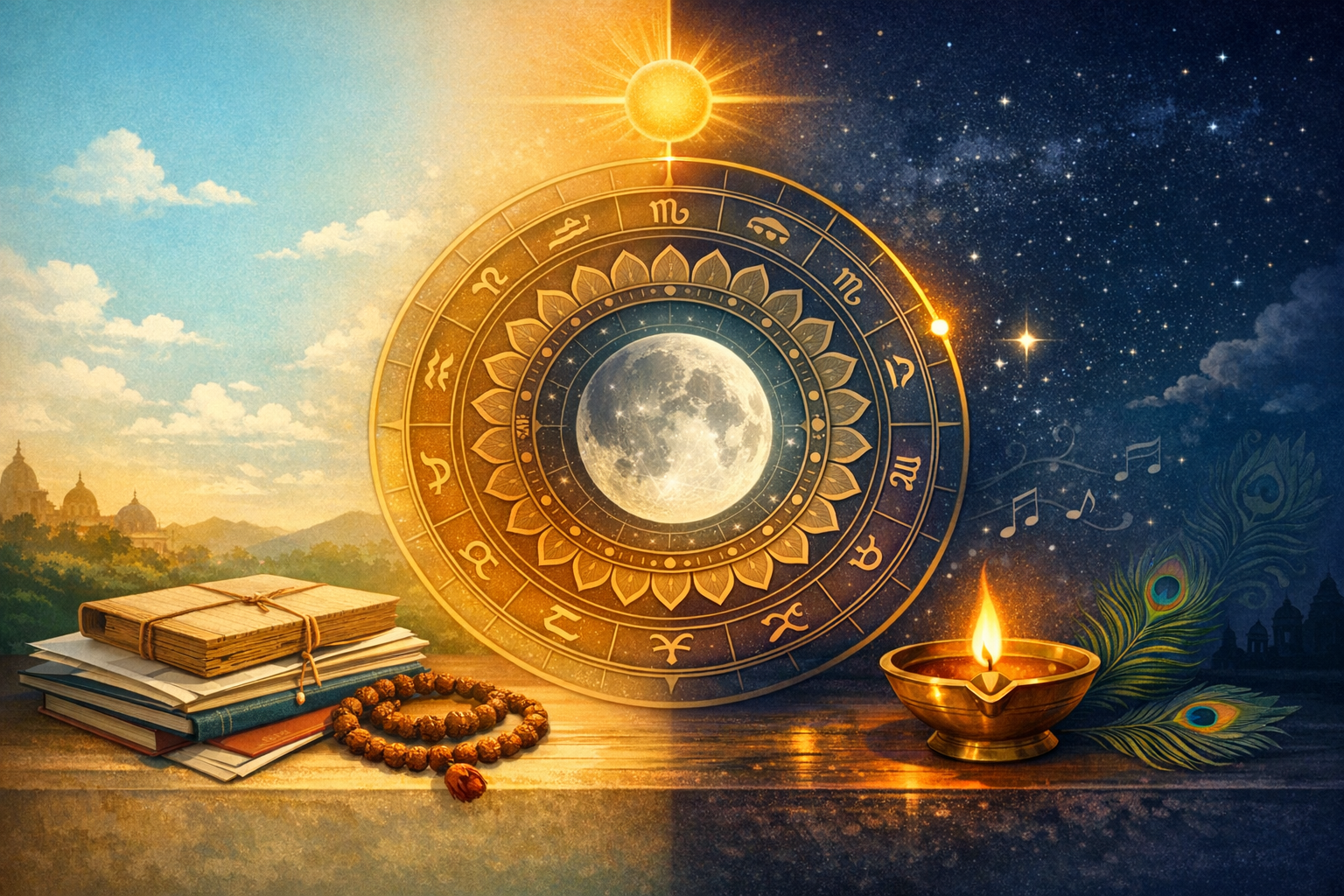
Friday, June 19, 2026, in the Hindu calendar (Panchang) is Shukla Paksha Panchami, the fifth lunar day of the waxing Moon, until 9:59 PM. From 9:59 PM onward, the day transitions to Shukla Paksha Sashti for the remainder of the night (timing applicable in most regions that follow Indian almanacs). This split day is common in lunisolar reckoning and is central to planning observances, vratas, and auspicious undertakings.
Panchang literally means the “five limbs” that determine the day’s qualitative energy: Tithi (lunar day), Vara (weekday), Nakshatra (lunar mansion), Yoga (sun–moon sum), and Karana (half-tithi segment). Together, these parameters guide decisions about rituals, travel, learning, commerce, health-related initiations, and community observances. While Tithi times are given here, Nakshatra, Yoga, and Karana vary with location; therefore, local almanacs or location-based panchang tools should be consulted for granular timing.
Astronomically, a tithi is defined by the elongation (angular separation) between the Moon and the Sun. Shukla Paksha Panchami corresponds to a sun–moon elongation greater than 48° and up to 60°. The moment the elongation exceeds 60°, the tithi shifts to Sashti. The stated 9:59 PM change marks the instant this threshold is crossed for the reference region. In practical terms, sacred activities that are tithi-specific should be anchored before or after this transition based on the intended phala (outcome).
Traditional tithi qualities are organized in a classical cycle: Nanda (1, 6, 11), Bhadra (2, 7, 12), Jaya (3, 8, 13), Rikta (4, 9, 14), and Poorna (5, 10, 15). Panchami is a Poorna tithitraditionally favorable for completion, consolidation, study, and stable beginnings. Its “filling/fulfilling” tenor supports learning commitments, documentation, restoring order, and formalizing agreements.
Sashti is a Nanda tithiassociated with refinement, beautification, and pleasing activitiesand is also the monthly day of Skanda (Kartikeya/Subrahmanya). Many households observe a regular Shukla Paksha Sashti vrata with simple fasting, japa, and lighting a lamp for Subrahmanya. The transition from Panchami to Sashti on this date allows one to time scholarly or closure-oriented tasks earlier and devotional Skanda-centered practices later in the evening, aligning intention with the respective tithi gunas.
Because the day is split between two auspicious tithis, planning can be nuanced. Activities aimed at settling accounts, concluding documentation, or committing to a study plan align naturally with Panchami prior to 9:59 PM. After the tithi change, devotional practices for Subrahmanya, mantra sadhana (such as reciting the Skanda Sashti Kavacham), or aesthetic choices (music, arts, design tasks) harmonize with Sashti’s Nanda quality.
Vara (weekday) further refines the day’s character. Friday (Shukravar) is governed by Shukra (Venus), traditionally linked to arts, relationship harmony, ornamentation, fragrances, music, and transactions involving value and comfort. In combination with a waxing Moon, Friday typically enhances sociability, aesthetic judgment, and the likelihood of consensus in negotiationsbearing in mind individual charts and local doshas for final decisions.
Good Time guidance on any day arises from combining Tithi, Vara, and daily doshas. A widely used anchor is Abhijit Muhurat, spanning a brief window around local solar midday; it is considered generally auspicious and can rescue otherwise average time bands. Because Abhijit depends on true local noon, it should be taken from a location-adjusted panchang rather than clock noon in time-zone convention.
Rahu Kaal, Yamaganda, and Gulika are daily avoidable periods for initiating important work. On Fridays, a commonly used approximation (for a 6:00 AM to 6:00 PM daylight span) places Rahu Kaal in the late morning (about 10:30 AM–12:00 PM), Gulika in the early morning (about 7:30 AM–9:00 AM), and Yamaganda mid-to-late afternoon (about 3:00 PM–4:30 PM). Actual spans should be recalculated from local sunrise and sunset; for precision, always prefer a location-specific Panchang.
Many communities also consult Choghadiya for quick daytime and nighttime selections. Favorable Choghadiyas include Amrit, Shubh, and Labh; avoid Kal, Rog, and Udveg for initiations. Combining a good Choghadiya with a supportive Tithi band and staying clear of Rahu Kaal yields layered auspiciousness without violating classical cautions.
Nakshatra and Rashi provide additional nuance. Nakshatra is the lunar mansion occupied by the Moon; it influences mood, interpersonal tone, learning style, and ritual suitability. Rashi (sign) indicates the Moon’s zodiacal backdrop and is used for muhurtas that require emotional steadiness or resonance with personal janma rashi. Because the Moon moves roughly 12–13 degrees per day, Nakshatra and, occasionally, Rashi can change within a date; hence local ephemeris-based data are essential.
Nitya Yogaformed from the sum of the longitudes of Sun and Mooncharacterizes the day’s composite dynamism, often guiding subtle aims such as diplomacy, restraint, bravery, or healing focus. Karanashalf-tithi segments like Bava, Balava, Kaulava, Taitila, Garaja, Vanija, and Vishti (Bhadra)shape task-level timing. In particular, Vishti (Bhadra) is generally avoided for compassionate or public-facing beginnings; if it occurs, practitioners delay initiations until a friendlier Karana begins. Determining Yoga and Karana for a specific place and hour is best done via a local Panchang.
Religious observance on Shukla Paksha Panchami often emphasizes vidya-sadhana (study and recitation). Devotees may begin a scripture reading plan, catalog learning goals, or perform a simple Saraswati dhyana. Because Panchami is a Poorna tithi, activities that “fill” and “stabilize” are considered especially aptarchiving, digitizing manuscripts, or organizing a family shrine’s texts are emblematic tasks.
After 9:59 PM, Shukla Paksha Sashti invites Kartikeya/Subrahmanya-centered devotion. A traditional home observance includes lighting a deepa, offering simple naivedya, and reciting Skanda mantras or the Skanda Sashti stotra. Where a local Subrahmanya or Murugan shrine is accessible, evening darshan on a Sashti is considered propitious; those observing a fast typically conclude it after their puja, consistent with family parampara.
For practical affairs, Panchami before the change suits document execution, study admissions, purchase of study tools, or initiating a structured routine. Post-transition Sashti, especially on a Friday, supports aesthetic selections, harmonizing conversations, fine arts programming, and devotional musicall of which resonate with Shukra’s tonalities.
Yearly context matters. Some regional almanacs in 2026 mark an Adhik Jyeshta Maas in late spring to the onset of monsoon, which can shift how month names are labeled between amanta (month ends on Amavasya) and purnimanta (month ends on Purnima) systems. The tithi sequence and transition time remain the same, but the civil-month label in a sankalpa may differ by region. When drafting sankalpa, align the month name to the local tradition followed in the family or temple.
Shared lunisolar sensibilities connect Dharmic traditions. Hindu Panchang, Jain calendars (which also organize vratas and paryushana by tithis), and many Indic Buddhist traditions that schedule Uposatha by lunar days all reflect a common civilizational intuition: time is qualitative as well as quantitative. Even within Sikh practice, while the contemporary Nanakshahi calendar is solar, several Gurpurab observances in community usage have historically referenced the Bikrami lunisolar framework. Appreciating these convergences fosters unity and mutual respect across Hinduism, Buddhism, Jainism, and Sikhism.
For the diaspora and travelers, two principles preserve accuracy: first, compute Tithi and doshas from local sunrise/sunset; second, treat Abhijit Muhurat as true local noon, not clock noon. When following a temple’s published schedule in a different time zone, prioritize the temple’s posted Panchang for that locale, as priests will have already reconciled the ephemerides.
A stepwise approach to June 19, 2026 can be simple and effective: (1) note the Panchami-to-Sashti transition at 9:59 PM, (2) shortlist a purpose-aligned time windowPanchami for completion and study; Sashti for Subrahmanya devotion and aesthetics, (3) exclude Rahu Kaal and other dosha spans recalculated from local sunrise, (4) prefer an Amrit/Shubh/Labh Choghadiya if using that system, and (5) when feasible, take advantage of Abhijit around local midday for compact, high-value beginnings.
For a home sankalpa, many retain a two-part structure on split days, explicitly naming “Shukla Paksha Panchami” for a rite performed before the change and “Shukla Paksha Sashti” if performed after. The month name (per local amanta or purnimanta usage), weekday (Shukravar), place name, and deity focus (for example, Subrahmanya after the transition) make the intention precise and coherent with tradition.
In summary, June 19, 2026 offers a well-balanced Panchang: a Poorna Panchami supporting scholastic and consolidating aims through the day, followed by a Nanda Sashti favoring Subrahmanya-centered devotion and aesthetic undertakings at nightall under the grace of Shukravar. With mindful avoidance of daily doshas and attention to local Nakshatra, Yoga, and Karana, the day can be shaped into a sequence that is both spiritually resonant and practically successful. This integrated reading honors shared Dharmic wisdom that time, rightly understood, aligns human intention with cosmic rhythm.
Inspired by this post on Hindu Blog.
