
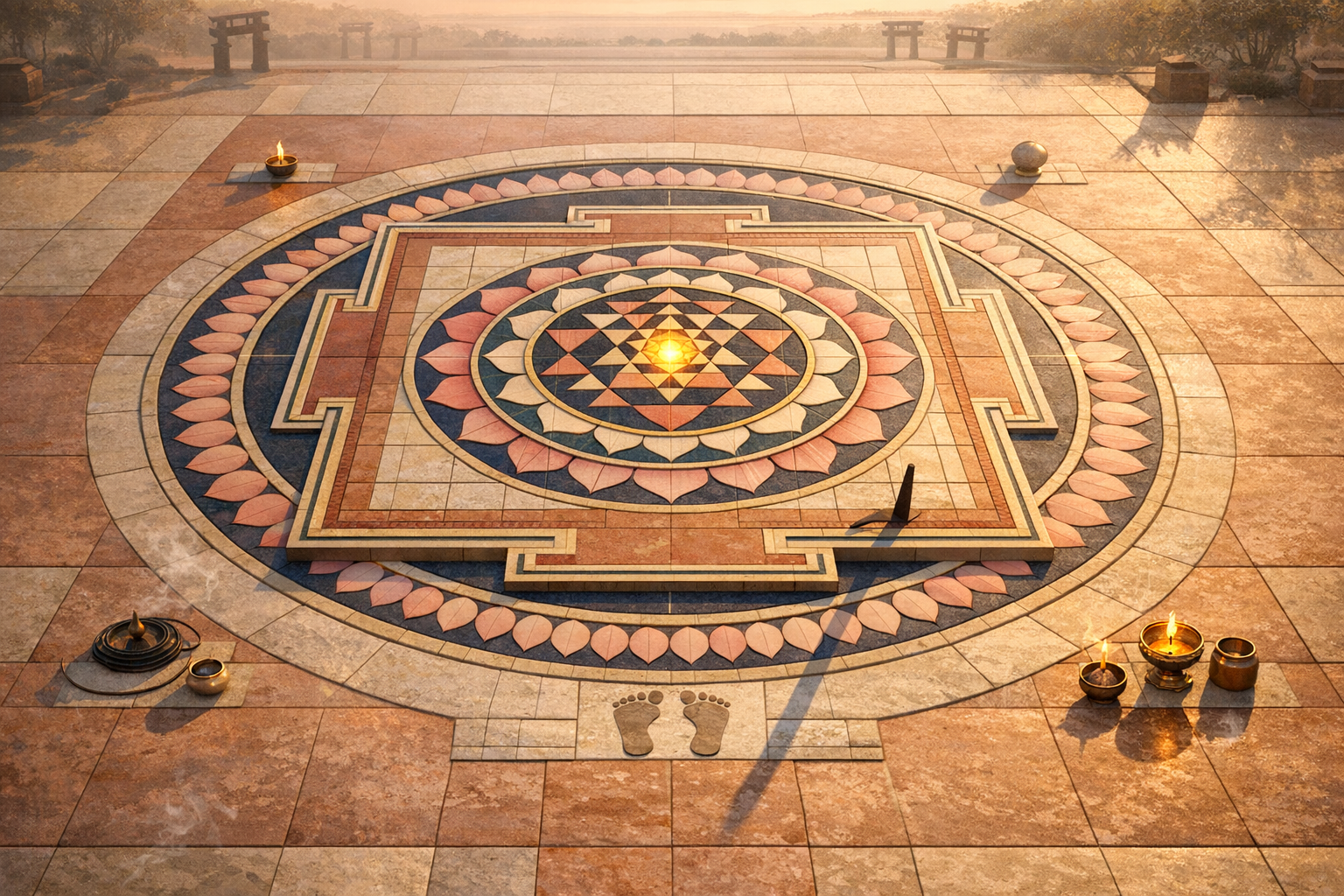
The term “kranta” (Sanskrit: krānta) arises from the verbal root √kram, “to step, stride, or cross,” and in classical usage its participial sense extends to what is “stepped upon,” “occupied,” or “crossed over.” In Tantric contexts, this semantic field evolves from a mere act of contact with the earth into a precise theory of demarcation, enclosure, and sacral occupation of space. By linking the embodied act of stepping to the metaphysical act of ordering, krānta articulates how terrestrial ground becomes a ritually bounded field of meaning aligned with cosmic order.
Related Sanskrit formations illuminate this conceptual constellation. Saṃkrānti denotes an ingress or crossing (famously the solar ingresses that mark calendrical thresholds), while parikrama/pradakṣiṇā describes circumambulatory “stepping around,” and vikrama evokes heroic stride. Together, these terms show how the simple action of “stepping” expands into technical and sacred operationscrossing thresholds, binding perimeters, and orienting the body to the cosmoscentral to Tantrism, Hindu scriptures, and allied ritual traditions across the dharmic world.
Within Tantric ritual science, krānta functions as a grammar for consecrated territory. The ground first undergoes bhū-śuddhi (purification) and is then bounded through dik-bandha (directional sealing) and rākṣā-cakra (protective circle). As the space is measured, gridded, and oriented, it becomes a maṇḍalaan inhabited cosmogram. The deity’s presence, invoked by mantra and stabilized by nyāsa and prāṇa-pratiṣṭhā, “occupies” the terrain; the sanctified zone is thus krānta in the technical sense: stepped into, claimed, and ordered by the divine.
Vāstu and Tantra converge here. The Vāstu Puruṣa Maṇḍalaan architectural cosmogram subdivided into padasmaps the cosmos onto the ground. Dikpālas (directional deities) anchor orientation, while proportional canons (pramāṇa) regulate shape. In this schema, krānta appears not as an isolated label but as the lived logic of sacred geometry: once the grid is cast, the ground is no longer inert surface but a hierarchized field, a kṣetra marked off for worship, meditation, and transformative presence.
Ritual manuals in the Śaiva–Śākta Āgamas and Pāñcarātra literature underscore these operations: leveling and measuring the site, establishing the caturasra (square) or trikona (triangle), drawing the bhūpura (outer enclosure), seating the yantra, and performing āvaraṇa-pūjā through nested circumferences. Each phase articulates an intensification of occupancy: the practitioner crosses in, the mantra crosses through, and the deity abides within. The end-state is not simply “a place to perform rites,” but a topologically distinct, spiritually resonant enclosure.
Practitioners and temple priests frequently note a perceptible shift when crossing the maṇḍala’s threshold: speech quiets, movement slows, and attention draws inward. This experiential register mirrors the technical one; a space that has been ritually partitioned and protected functions as a container for subtle states. In effect, krānta names both the technical completion of sanctified layout and the felt quality of inhabiting it.
In Śākta traditions, the Śrīcakra exemplifies this principle with precision. Its navāvaraṇa (nine enclosures) are traversed layer by layer, physically and mentally, as worship proceeds from the outermost bhūpura to the bindu (point) at the center. Each enclosure demarcates and refines presence; mantra, mudrā, and nyāsa coordinate embodiment with geometry so that the worshipper’s progressive “stepping” mirrors the deity’s steady “abiding.”
Beyond the ritual platform, sacred geography extends the logic of krānta to landscapespīṭhas, kṣetras, and tīrthas. When a site is ritually claimed by a lineage, its borders are conceptually bound, its paths normatively fixed (for example, pradakṣiṇā routes), and its mythic memory anchors guardianship. The resulting “occupied” geography is not exclusive; it is integrative, linking local terrain to pan-Indian cosmology through processions, festivals, and seasonal crossings aligned with saṃkrānti.
Temple architecture renders these ideas in stone. The garbhagṛha (sanctum) concentrates divinity; the maṇḍapa (hall) invites assembly; and the pradakṣiṇā-patha (circumambulatory path) choreographs movement. Toranas and thresholds (sīmā-bandhana) signal passage into progressively refined precincts. In Tantric terms, the temple is a stratified volume in which each crossing matters; every step reaffirms the ethical and contemplative shift from profane dispersion to sacred concentration.
A dharmic comparative lens shows consonant logics. Vajrayāna Buddhism employs intricate maṇḍalas for abhiṣeka (empowerment), situating practitioners within a meticulously partitioned cosmos. Jain temples arrange prākāras (enclosures) and circumbulatory paths that encode vows of restraint and purity. Sikh gurdwaras, governed by maryada (discipline), coordinate movement around the Guru Granth Sahib and through sarovar precincts in a reverent, boundary-aware flow. Across Hinduism, Buddhism, Jainism, and Sikhism, sacred space is carefully demarcated to cultivate humility, attention, and unity.
Philosophically, krānta presupposes a living ontology of space. In Kashmir Śaiva vocabulary, spanda (vibratory consciousness) animates reality; Vedic and Tantric discourse more broadly assume that consciousness can pervade form. Partitioning a field does not fence the divine; it enables clarity by aligning human bodies, speech, and minds with cosmic pattern. The “occupancy” of space is thus an ethical-aesthetic actordering space to order awareness.
Temporal thresholds reinforce this spatial grammar. Saṃkrāntiparticularly Makara Saṃkrāntimarks celestial crossings that reorganize ritual calendars and agrarian rhythms. When communities traverse these temporal boundaries with fasts, baths, and offerings, they repeat in time what the maṇḍala accomplishes in space: a measured crossing into auspicious alignment. Krānta, then, is not only about “where” but also about “when” and “how” to cross.
Sacred geometry gives krānta its visible rigor. The caturasra square signifies stability; the aṣṭadala and ṣoḍaśadala lotuses unfold relational layers; the ardhacandra arc and bhūpura frame the limits of entry. Proportions are calculated in aṅgula and hasta, and alignments are tested against cardinal axes and shadow lines. The result is a cosmogram that is legible to eye, hand, and heartan architecture that guides movement as it refines meaning.
Tantric procedure integrates mantra, mudrā, and nyāsa to “install” presence. Nyāsa places seed-syllables upon the body and upon the maṇḍala, synchronizing microcosm and macrocosm. Mudrās act as kinetic seals, marking micro-boundaries in gesture. Mantras, sounded and contemplated, delimit and fill the space at oncenaming, invoking, and stabilizing the deity’s occupancy. Prāṇa-pratiṣṭhā crowns the process, after which the space is no longer merely accessibleit is inhabited, and must be crossed with mindfulness.
Household practice preserves these principles in distilled form. A pañcāyatana altar arrays five deities in a compact maṇḍala; thresholds are crossed with the right foot; lamps are placed to articulate direction; and simple rakṣā-sūtra lines discreetly mark sacred corners. Even modest domestic shrines enact krānta: the altar becomes a precinct whose boundaries invite quiet, and whose crossings reset intention.
Pilgrimage culture amplifies this dynamic. Entering a temple town, bathing at a tīrtha, joining a ratha-yātrā, or circumambulating a hill are all choreographies of sacred crossing. Each gate, ghat, and path is a cue to reorder attention. The cumulative effect is communal alignmentan enactment of unity within diversity that mirrors the nested enclosures of the maṇḍala writ large upon the landscape.
There is also an ecological resonance. Bhū-śuddhi elevates care for the earth from hygiene to reverence; boundaries discourage casual profanation; offerings emphasize reciprocity. When sacred space is understood as krānta“occupied” by presencestewardship follows naturally. The ethic is unifying: all dharmic traditions honor the ground they cross, seeing in its partitioning an invitation to responsibility and restraint.
Terminologically, it is helpful to distinguish shades of meaning. Krānta signals “stepped across/occupied”; ākrānta adds “pervaded”; saṃkrānti names calendrical ingress; parikrama/pradakṣiṇā emphasize ordered movement around a center. Textual usage varies by lineage and period, yet the shared root √kram ensures a coherent semantic backbone: stepping, crossing, and ordering remain the core.
For contemporary design and community life, these insights are practical. Thoughtful placement of entrances, clear processional routes, and layered thresholds can transform schools, community centers, and places of worship into humane, contemplative environments. In urban apartments as in monumental temples, the same principle holds: the way space is measured and crossed educates the senses and steadies the mind.
Scholarly inquiry can deepen this map by correlating Śaiva–Śākta Āgamas, Pāñcarātra Saṃhitās, Vāstu treatises, and field studies of ritual performance across Hindu, Buddhist, Jain, and Sikh settings. Comparative attention to maṇḍala diagrams, altar topologies, and circumambulatory rites will show how a shared dharmic intuitionspace as morally and spiritually shapeablefinds diverse yet harmonious expression.
In sum, krānta does not reduce to a footprint on soil. It identifies a method for turning space into sanctuary: measure, mark, invite, and inhabit. Tantric geometry and ritual choreography bind ground to cosmos so that each step is meaningful. Read in this way, the concept strengthens unity across dharmic traditionsnot by erasing differences, but by revealing a common grammar of sacred crossing through which communities align body, mind, and world.
Inspired by this post on Hindu Blog.
