
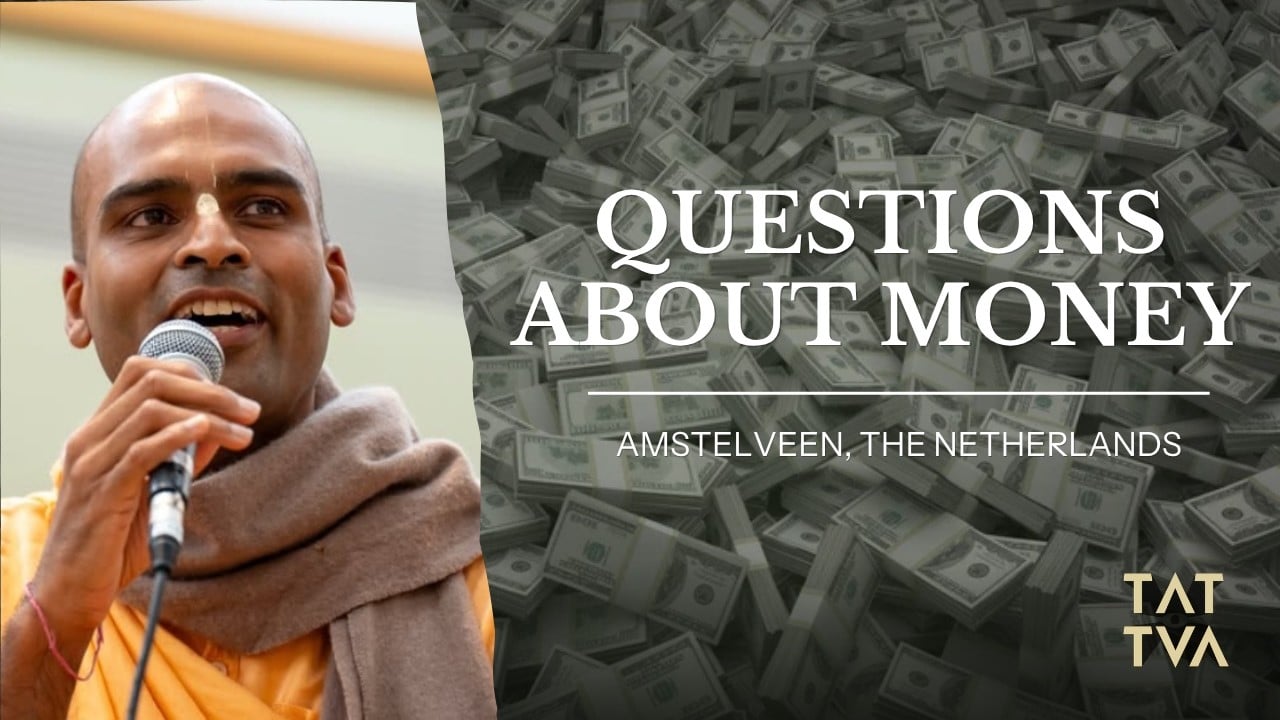
On 1 June 2026 in Amstelveen, Netherlands, Svayam Bhagavan Keshava Maharaja addressed a timely themeQuestions About Moneyunder the channel Tattva by Keshava Maharaja. The session examined how wealth can be pursued, managed, and shared without compromising spiritual integrity. Set within a global, multicultural context, the discussion spoke directly to professionals, families, and students seeking clarity on ethical earning, conscious spending, and purposeful giving, framed through the shared values of Hinduism, Buddhism, Jainism, and Sikhism.
The talk positioned money as a morally neutral instrument whose meaning is defined by intention and use. Within the classical puruṣārtha framework, artha (material prosperity) must be guided by dharma (ethical order), so that kāma (desire) is harmonized rather than allowed to dominate, and mokṣa (liberation) remains the ultimate orientation. This hierarchy does not reject prosperity; it locates prosperity within a disciplined and compassionate life that honors personal duty (svadharma) and social responsibility (lokasaṅgraha).
Drawing on scriptural anchors from the Bhagavad Gita, the session emphasized karma-yoga as the core technology for transforming work and wealth into spiritual practice: yajñārthāt karmaṇo ’nyatra loko ’yaṁ karma-bandhanaḥ (Gita 3.9) and karmaṇy-evādhikāras te mā phaleṣu kadācana (Gita 2.47). Stewardship, rather than attachment, is deepened by the Īśāvāsya Upaniṣad’s visionĪśāvāsyam idaṁ sarvam … tena tyaktena bhuñjīthā mā gṛdhaḥ kasya svid dhanamurging non-covetous enjoyment and shared custodianship. In this view, Lakṣmī is not hoarded but respectfully engaged in service (seva) to the Divine and society.
The presentation also highlighted unifying principles across dharmic traditions. In Buddhism, Right Livelihood (sammā-ājīva) guides earning away from harm-intensive trades toward service and compassion. In Jainism, Aparigraha (non-possessiveness) curbs acquisitiveness, while meticulous ahimsā provides a rigorous standard for ethical enterprise. Sikh teachings condense the ethic into Kirat Karni (earn righteously), Vand Chhakna (share with others), and Naam Japna (anchor life in remembrance), with dāsvandh embodying regular philanthropy. These strands, far from competing, illuminate a common ethic of conscientious prosperity.
A practical evaluative lens introduced during the session applies the guṇa model to money decisions. Sattva-aligned flows of money emphasize clarity, service, sustainability, education, health, and community well-being. Rajas-dominant flows may create growth but can veer into status-anxiety and over-leverage if unchecked. Tamas-oriented flows obscure accountability and often accompany harmful or exploitative activity. A periodic “guṇa-audit” of income sources, expenditures, and investments can reveal whether financial life is trending toward light, agitation, or inertiaand guide corrective action.
On ethical earning, the discussion translated Right Livelihood into contemporary screens for professionals and entrepreneurs. Work that systematically violates ahimsāthrough environmental harm, addiction profiteering, trafficking in deception, or violencefails the dharmic test even if it is legal or lucrative. By contrast, enterprises that enhance human capability, preserve dignity, and strengthen social trust embody the synthesis of artha under dharma. For global teams navigating complex supply chains, transparency, verifiable traceability, and fair labor practices are essential features of ethical business.
At the macro level, the Arthasastra offers a complementary lens: artha is foundational for social order, but revenue extraction must be just, predictable, and growth-supportive. While composed for a different era, Kautilya’s insistence on administrative integrity, calibrated taxation, and prudent statecraft maps well to today’s emphasis on institutional trust, policy stability, and public interest regulation. For leaders, the take-away is clear: ethical governance and ethical commerce are mutually reinforcing.
The session proposed a simple but robust personal frameworkearn ethically, allocate mindfully, invest responsibly, give purposefully. This cycle transforms wealth management into a sādhana, where attention, restraint, and generosity mature together. The guiding question is not “How much can be taken?” but “How can prosperity circulate to maximize welfare without fueling craving?”
For day-to-day budgeting, a dharmic adaptation of familiar rules can be effective. One working model sets aside a dedicated share for dāna and community care, a stable band for essentials, a measured portion for aspirations aligned to growth and learning, and a disciplined allotment for savings and resilience. Rather than rigid percentages, the emphasis is on conscious trade-offs, intergenerational responsibility, and relief from the anxiety that uncontrolled consumption often breeds.
Consumption was reframed through Aparigraha: minimize what does not serve clarity or compassion. Simplicityfar from deprivationprotects attention and reduces frictional costs (time, stress, conflict). Debt was treated with caution: while judicious leverage can enable productive assets, high-cost or opaque borrowing entangles the mind (rna-bandhana) and constrains freedom. A dharmic approach favors transparent terms, buffers for shocks, and repayment plans that preserve dignity.
Responsible investing extends the same ethic: prefer instruments and funds that avoid harm-centric industries and actively support education, healthcare, clean energy, and livelihoods with dignity. While modern ESG offers a starting vocabulary, dharmic screens ask deeper questions: does the activity reduce suffering, honor truth, and sustain ecosystems? Community-oriented financingcooperatives, mutual-aid trusts, and microenterprise creditwas highlighted as a living continuity between tradition and modernity.
On giving, the session connected Gita’s call to selfless offering (yat karoṣi … tat kuruṣva mad-arpaṇam, Gita 9.27) with the Buddhist dāna pāramitā, Jain community charities grounded in non-violence, and Sikh langar and dāsvandh. Effective philanthropy was defined by regularity, humility, and proximity to real needsannadāna (food), vidyādāna (education), and ārogyadāna (health) create compounding social returns. Administrative efficiency matters, but presence, accountability, and dignity in delivery are decisive.
Family finance education emerged as a cornerstone of gṛhastha-dharma. Children who observe honest work, balanced aspiration, and cheerful sharing internalize a resilient money culture. Treating Lakṣmī as an honored energynot an idol for hoardingencourages gratitude, orderliness, and right relationship to possessions.
Several recurring questions received careful treatment. Is wealth incompatible with spirituality? Noprosperity is a powerful catalyst when aligned with service and non-attachment. How much is enough? A sufficiency line set by vocation, duties, and season of life helps convert endless craving into purposeful contentment. What marks exploitation? Systematic harm, deception, coercion, or disregard for externalized costs are red flags regardless of profitability.
Participants also asked about lending, interest, and financial intermediation. While traditions differ on permissibility and form, a shared standard emerges: clarity of terms, consent without desperation, fair risk-sharing, and pathways to dignity. Where borrowers are vulnerable, compassionate designnot maximal extractionreflects dharma.
On speculative waveswhether real estate frenzies or digital assetsthe counsel was to examine motive and method. If the driver is greed, fear, or envy, the endeavor will disturb mind and relationships; if the driver is long-term stewardship, transparency, and social usefulness, the same tool may serve. The test remains interior poise and exterior benefit.
Simple practices can stabilize money life. Monthly reflection on earnings and spend through the guṇa lens, a gratitude ledger noting where Lakṣmī has allowed service, a standing dāna allocation that is honored before discretionary outlays, and a periodic “digital detox” for financial news can collectively reduce anxiety and improve decisions.
Measurable guardrails foster accountability: keep debt-service within humane bounds; target a living emergency buffer; aim for a steady generosity ratio; track how much timenot just moneygoes to seva; and periodically realign investments to avoid industries that corrode well-being. Progress is not perfection but direction: trending toward sattva, expanding circles of care, and calmer hearts.
The atmosphere in Amstelveen reflected these insights. Young professionals voiced relief at a framework that honors ambition without sacrificing ethics; parents appreciated language to teach children courage and restraint; elders recognized the continuity between ancestral prudence and modern tools. The shared recognition across Hindu, Buddhist, Jain, and Sikh participants was striking: prosperity acquires meaning only when it uplifts others.
The session closed on a unifying note: when work becomes offering and wealth becomes service, money is sanctified. In that spirit, the moral of the gathering was neither ascetic rejection nor indulgent embrace, but a middle path of disciplined abundanceethical wealth that advances personal clarity, family stability, and social harmony.
This synthesis reflects the themes presented by Svayam Bhagavan Keshava Maharaja in Amstelveen and the wider dharmic conversation on artha, integrating Bhagavad Gita guidance, Arthasastra insights, and the living practices of Aparigraha, Right Livelihood, Kirat Karni, and dāna. It offers an academic yet practical lens for Hindu Economics and wealth management that cultivates unity across dharmic traditions while equipping readers with actionable clarity.
Inspired by this post on Dandavats.
