
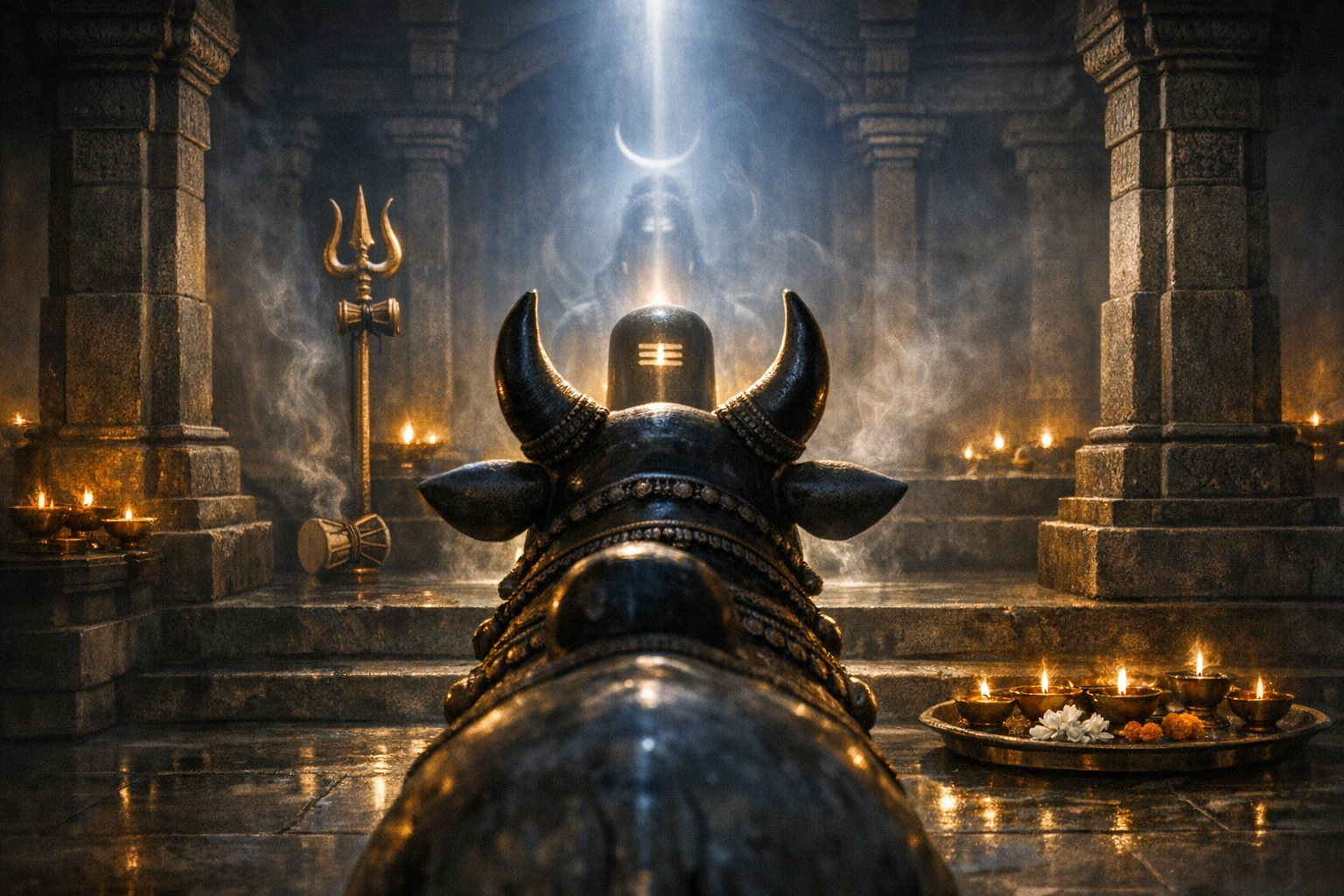
The enduring image of Mahadeva Shiva seated with serene authority upon the bull (Vrishabha) and never upon a horse is not a matter of artistic whim; it is a precise statement within the symbolic, scriptural, and ritual grammar of Sanatana Dharma. Across the Puranas, the Shaiva Agamas, and temple iconography, Nandithe blissful bullemerges as Shiva’s vahana, anchoring the Lord’s paradoxical presence as both the ascetic Adiyogi and the cosmic transformer. Exploring why the horse (ashva), so central to Vedic sovereignty and rajas, is absent from Shiva’s canonical vehicle immediately opens a window into the metaphysics of dharma, the yogic map of the gunas, and the carefully codified practices of Hindu iconography.
Scriptural and ritual sources converge on this point. The Shiva Purana and Linga Purana narrate Nandi’s origin and devotion, while the Shaiva Agamastexts such as the Kāmikāgama and Suprabhedāgamaprescribe the presence of the Nandi Maṇḍapa precisely aligned with the garbhagriha (sanctum). In living temple traditions from Kashi to Chidambaram, the devotee’s gaze is guided to the Shiva-linga through the horns of Nandi, ritually reinforcing the inseparability of Shiva and the bull. In this canonical world, a horse as Shiva’s vahana is simply not part of the liturgical design.
Names and etymology deepen the meaning. “Nandi” is widely understood as linked to ānanda (bliss), the state that Shiva embodies and bestows. “Vrishabha,” the bull, is equally significant: vrisha in Sanskrit also means righteousness. In the Mahabharata and later Purānic literature, dharma itself is often personified as a bull, a powerful metaphor for steadiness, truth, and moral order. Thus, Shiva’s mount is not only an animal companion but the very throne of dharma upon which the Lord of Yogins abides.
The yuga-dharma imagery adds a further layer: dharma in the form of a bull stands firmly on four legs in Satya Yuga, gradually losing legs through Treta and Dvapara, and remaining on a single leg in Kali Yugaa poetic way of saying that righteousness becomes increasingly difficult to uphold. Nandi seated unwaveringly before Shiva’s presence signifies that even under the weight of time’s decline, dharma can be stabilized through conscious alignment with the Lord’s grace and the path of yoga.
A historical-archaeological echo resonates from the Indus Valley “Pashupati” seal, often interpreted cautiously by scholars as a proto-Shaiva image of a horned yogic figure amidst animals. Regardless of the undecided academic consensus, the convergence of motifslordship over beings (Pashupati), yogic stillness, and the prominence of the bull in ancient Indic cultureharmonizes with later textual and ritual Shaivism. The bull becomes the archetype of tamed strength, ethical ballast, and meditative stillness.
Yogic readings illumine the choice of vahana further. Shiva, as Adiyogi, represents mastery over prāṇa (vital force) and manas (mind). The bull’s calm, grounded presence mirrors the stabilized breath of pranayama and the equipoise of meditation. In yogic parlance, the passage from restlessness to absorption requires the soothing of rajas (agitation) and the refinement of tamas (inertia) into sattva (clarity). Nandi, steady and unhurried, symbolizes that transmutation: power governed, senses harmonized, life-energy yoked to awareness.
By contrast, the Vedic and classical symbolism of the horse is unmistakably rajasic and sovereign. The Rig Veda’s celebrated hymn to the horse (RV 1.163) extols its swiftness and solar vitality; the Ashvamedha yajna historically marked royal sovereignty and expansive worldly order; Surya’s chariot is drawn by horses; the Ashvins race across the dawn; and in later Purānic eschatology, Vishnu as Kalki appears astride a white horse to restore cosmic order. The horse thus gathers meanings of speed, conquest, administration, and outward dominionprecisely the domains Shiva does not primarily represent.
This is not a value judgment but a functional differentiation within Sanatana Dharma’s iconographic language. Shiva presides over nivritti mārga (the inward-turning path), tapas (austerity), and the dissolution required for renewal. The horse, emblematic of pravritti mārga (the outward-turning path)kingly expansion, political sovereignty, and ceaseless motionwould muddle the clarity of Shiva’s metaphysical role. The bull, on the other hand, renders visible the ethics and energy suitable for yoga: strength yoked to discipline, dynamism grounded in silence, and authority expressed as guardianship rather than conquest.
Temple architecture translates these ideas into space. Shaiva Agamas specify the Nandi Maṇḍapa on axis with the sanctum, often slightly lower, so that vision flows from devotee to Nandi to Shiva. This alignment is not merely aesthetic; it is pedagogical. One learns, bodily and visually, that devotion (bhakti), ethical steadiness (dharma), and yogic attention (ekāgratā) are the pathway to the Lord. Many devotees describe a change in breath and mood when pausing beside Nandithe mind seems to settle, the steps slow, and the gaze becomes steady. That felt experience is itself a commentary on the symbol.
Nandi is not only vehicle but also gatekeeper and teacher. Shaiva lore hails Nandikeśvara as the leader of Shiva’s gaṇas and, in dance tradition, the seer associated with texts like the Abhinaya Darpana. The continuity from Nataraja’s cosmic dance to Nandi’s rhythmic stillness shows a philosophy of motion and rest: in Shiva’s universe, time’s dance is held by consciousness, and that consciousness is steadied on the back of dharma. It is a seamless integration of aesthetics (nṛtta), ethics (dharma), and metaphysics (tattva).
Agrarian symbolism further clarifies the choice. In an Indic civilizational landscape where the cow and bull sustained community life, the bull condensed values of provision, reliability, and right conduct. A king may gallop to victory on a horse, but a household and a village endure by the bull’s patience. Shiva, as the guardian of thresholdsthe cremation ground, the forest, the mountain caveembodies the promise that what endures is not speed but steadiness, not dominion but depth. Nandi articulates that civilizational memory in stone.
The gunas offer a technical lens. The horse is an emblem of rajas: kinetic, projecting, managerial, excellent for organizing space and power. The bull, while capable of tamasic weight and rajasic force, is ritually refined into sattva by its position before Shivaits latent power is stilled, clarified, and turned toward contemplation. Iconography here is a lesson in sāṁkhya and yoga: energies are not rejected; they are reoriented through devotion and insight.
One occasionally hears of regional exceptions in folk art or festival tableaux, yet the normative Shaiva canonboth textual (Agamas, Puranas) and liturgical (temple praxes from the Nandi Maṇḍapa to the darshan protocol)presents no enduring association of Shiva with a horse. This stands in constructive contrast with deities and avatāras for whom the horse is central, underscoring a deliberate distribution of symbols across the Hindu pantheon. Diversity of vehicles thus becomes a map of complementary functions within Sanatana Dharma.
There is also a unifying resonance across dharmic traditions. In Jainism, the first Tirthankara, Rishabhanatha (Ādinātha), bears the bull (rishabha) as his lanchhana (emblem), reflecting primordial instruction in crafts, ethics, and community life. In Buddhism, the horse Kanthaka serves the Bodhisattva’s renunciation, carrying the future Buddha to the city’s edgehere the horse signifies the moment of leaving worldly power, a meaning distinct from Vedic kingship yet still dignified. Sikh teachings emphasize steadiness, seva (service), and truthful livingvirtues that the Nandi archetype, as disciplined strength, can also evoke. While each tradition is unique, these shared symbols encourage mutual respect and illuminate a broader Indic ethos grounded in dharma and inner freedom.
For many visitors in a Shiva temple, a simple practice conveys the teaching without words: standing behind Nandi, palms joined, and letting the gaze flow to the Shiva-linga. The noise of the outer world recedes; breath slows; attention rests. That doorway of stillness, so often described in personal experience, is precisely what the vahana was designed to teach. Iconography becomes pedagogy; pedagogy becomes transformation.
A philosophical synthesis may be stated succinctly. Shiva, as Swayambhu and Mahadeva, is beyond the three gunas yet manifests as their master. The bull of dharma signifies the stabilized field in which yoga flowers; the horse of rajas signifies worldly order at speed. Were Shiva to ride the horse, his image would be drawn into the grammar of conquest and temporal sovereigntyroles already honored elsewhere in the pantheon. By riding the bull, Shiva crowns dharma, upholds yoga, and instructs seekers to exchange velocity for vision.
Textual anchors support this reading. The Rudra Saṁhita of the Shiva Purana narrates Nandi’s origin and consecration as chief of Shiva’s attendants; the Linga Purana reiterates Nandi’s centrality; the Kāmikāgama and allied Agamas specify Nandi’s placement and the devotee’s line of sight. The Rig Veda’s aśva hymns and the ritual prominence of the Ashvamedha define the horse’s semantic field. Taken together, these sources show a deliberate, coherent symbolic architecture rather than ad hoc mythmaking.
Iconographers often note that Nandi’s square, grounded form also stabilizes the vertical axis of the lingathe union of earth and sky, prithvi and ākāsha. In yogic anatomy, that suggests a movement from mūlādhāra (root) steadiness through the central channel toward expanded awareness. The vahana here serves as the base-note of a rāga: without its drone, the melody soars without reference; with it, the composition becomes intelligible and deep.
Finally, the cultural memory encoded in the bull-and-Lord pairing is civilizational, not sectarian. It stores insights about how power is to be held (as guardianship rather than domination), how movement is to be governed (by attention rather than impulse), and how dharma is to be sustained (through steadiness rather than spectacle). In a plural landscape where Hinduism, Buddhism, Jainism, and Sikhism have long conversed, such symbols offer a common language for ethics, contemplation, and community well-being.
Therefore, Shiva does not ride a horse not because the horse is rejected, but because the horse speaks a different sacred dialect. In the carefully orchestrated chorus of Sanatana Dharma, Shiva’s voice is the still, thunderous center, and Nandi is the drone of dharma that makes that voice audible in the heart. To encounter this icon is to learn that the highest speed in spiritual life is stillness, and the surest strength is the one that bows.
Inspired by this post on Hindu Blog.
