
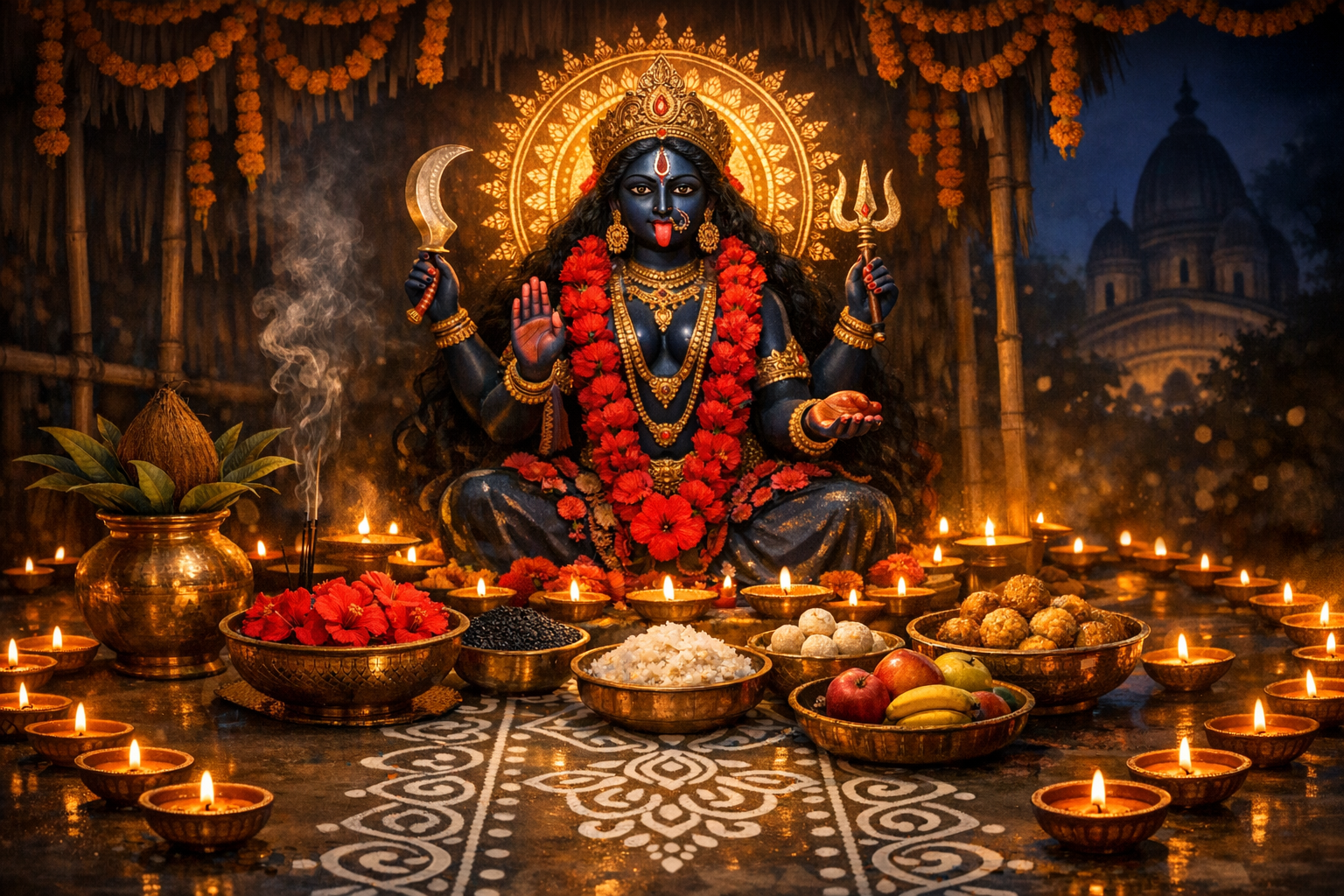
Dipanwita Kali Puja, widely known as Kali Puja or Shyama Puja, is a major Hindu festival venerating Goddess Kali and is observed most prominently across West Bengal, Odisha, Assam, Tripura, and parts of Bihar. The festival falls on Kartik Amavasya, the new moon night of the Kartik month, aligning exactly with Diwali (Deepavali) celebrated elsewhere in India. This calendrical convergence creates a singular pan-Indian night of lamps and devotion, while allowing regionally distinct ritual emphases to flourish.
The name “Dipanwita” evokes a landscape adorned with lampsdipa (lamp) and anvita (adorned or accompanied)and signals the festival’s central practice: illuminating homes, temples, and public spaces to welcome the transformative presence of the Divine Mother. In the eastern states, these lights frame the midnight worship of Kali, whose fierce iconography and compassionate protection together symbolize dissolution of fear and renewal of courage.
Ritually, the core worship occurs during Nishita Kaal, a late-night muhurat around midnight considered especially potent for Shakti sadhana on Kartik Amavasya. While exact timings vary by location and panchang, communities consistently gather after nightfall for japa, offerings, and arati that culminate near or within Nishita Kaal. The nocturnal ambienceoil lamps flickering against the Amavasya skyamplifies the theological motif that light (jnana) triumphs precisely where darkness (avidya) seems most complete.
Dipanwita Kali Puja’s regional character complements the broader Diwali tapestry. In much of India, the same Amavasya night is dedicated to Lakshmi Puja, whereas in Bengal, Lakshmi is traditionally worshipped earlier during Kojagari Purnima. The simultaneity of Lakshmi and Kali observances across regions underscores a shared civilizational ethos: prosperity and protection, beauty and power, grace and fearlessness, all honored within a single lunar gateway.
Historical and textual references to Kali worship are found in sources such as the Kalika Purana (with strong associations to Kamarupa/Kamakhya), the Mahanirvana Tantra, and later Bengali Tantric collections that codified procedures and mantras. Scholarly consensus places the widespread public prominence of Kali Puja in Bengal between the 16th and 18th centuries, with figures such as Krishnananda Agamavagisha contributing to ritual systematization. Royal and zamindari patronageespecially under Raja Krishnachandra of Nadiagave the festival civic stature, while devotional poetry, notably the Shyama sangeet of Ramprasad Sen in the 18th century, suffused Kali worship with intimate, tender bhakti.
By the late 19th and early 20th centuries, urban centersmost famously Kolkatasaw Kali Puja evolve alongside the growth of public “sarbojonin” celebrations. Artisanal neighborhoods such as Kumartuli refined clay idol-making techniques, while community committees experimented with pandal architecture and thematic installations. The festival’s sensory languagesoundscapes, alpona designs, lamps, and fragrancehas since become an enduring hallmark of eastern India’s festive calendar.
Theologically, Dipanwita Kali Puja most commonly invokes Dakshina Kali, depicted with four arms, a garland of skulls, and a girdle of severed arms, standing upon the inert body of Shiva. In two hands she wields the khadga (sword) and a severed headthe destruction of ego and ignorancewhile the other two offer abhaya (fearlessness) and varada (boons). The imagery is not a celebration of violence but a daring metaphysics: the Absolute, beyond time (Kala), manifests as Kali to dissolve fear, restore dharma, and grant inner freedom.
The midnight setting deepens this metaphysical reading. Amavasya symbolizes the limit of visibility; to choose worship and light precisely then is to align with the transformative path where courage and compassion are awakened. Devotees often describe the arati during Nishita Kaal as a visceral moment when the fierce Mother’s grace feels palpable, quieting inward turmoil and kindling steadfastness for the year ahead.
Several temples anchor the festival’s sacred geography: Kalighat Kali Temple and Dakshineswar Kali Temple in Kolkata, Kamakhya Temple in Guwahati (Assam), Tripura Sundari (Matabari) Temple in Udaipur (Tripura), and Maa Bhadrakali Temple in Bhadrak (Odisha). Communities also erect large pandalstemporary temple-structuresthat frame elaborate murtis and ritual platforms, turning neighborhoods into immersive devotional corridors where art, music, and ritual scholarship meet.
On the eve of Amavasya, Bengal observes Bhoot Chaturdashi, when families light fourteen lamps (choddo prodip) to honor ancestral presences and ward off inauspicious influences. The practice parallels the protective ethos of Naraka Chaturdashi (Kali Chaudas) observed in western India, revealing a shared Indic logic of lamp-lighting as spiritual safeguarding on the dark fortnight’s threshold.
In households, preparations for Shyama Puja begin with cleaning, alpona (rice-paste floor designs), and arranging the altar. Many establish a ghata (kalash) with mango leaves, install a picture or murti of Kali, and decorate with red flowersespecially hibiscus (jaba), which tradition regards as beloved to the Goddess. Oil lamps, incense, and natural fragrances create a contemplative setting for sankalpa (ritual intention) after sunset.
Offerings are both regional and seasonal: red hibiscus, black sesame, rice, pulses, fruits, sweets, and homemade bhog such as khichuri, labra (mixed-vegetable preparation), luchi, sandesh, and narkel naru. In many homes, symbolic substitutes are used where older bali traditions once prevailed; white pumpkin or ash gourd (kumro) is commonly offered as a non-violent, sattvik stand-in that preserves ritual structure while aligning with contemporary ethical sensibilities.
Mantra-japa sustains the midnight focus. A widely recited formula is “Om Krim Kalikayai Namah” (ॐ क्रीं कालिकायै नमः), with practitioners counting beads until the Nishita Kaal window. The japa’s phonetic forceespecially the bija “Krim”is held to purify inner channels, steady the mind, and invoke Kali’s protective presence. Many households also meditate silently between offerings, allowing the soundscape of diyas and chanted names to settle into deep attention.
The home puja typically proceeds through avahana (invocation), upacharas (sequential acts of reverent service), pushpanjali (floral offerings), deepa-dana (lamp offering), and naivedya (food offering), culminating in arati. Families then share prasad, extending the Goddess’s grace through food. Devotees often recount that this communal sharingelders blessing children, neighbors exchanging sweetsanchors the night’s theology in lived warmth and solidarity.
Beyond households, public pandals curate dramatic narrative scenes drawn from Puranic and Tantric motifs, while traditional temples maintain scripturally precise homas and Tantric kriyas under trained archakas and sadhakas. Both spacescommunity and templeconverge in a pedagogical function: they transmit ritual grammar, regional idioms, and the disciplined joy of collective worship to younger generations.
Environmental stewardship has become integral to contemporary observance. Communities increasingly prefer clay idols with natural dyes, oil lamps over disposables, and quieter celebrations that respect seniors, children, wildlife, and urban health. In Tripura, for instance, awareness drives around Kalyan Sagar near the Tripura Sundari Temple emphasize balanced celebrations that honor sacred ecology. Such choices reflect the dharmic insight that reverence for divinity and care for the biosphere are inseparable.
Dipanwita Kali Puja also embodies a broader dharmic unity in diversity. On the same Diwali night, Jains commemorate the nirvana of Bhagwan Mahavira, Sikhs observe Bandi Chhor Divas, and Newar Buddhists in Nepal light diyos during Tihar. While the ritual languages differ, the luminous center is sharedself-mastery, liberation, remembrance, and compassionaffirming a civilizational ethos in which many paths are welcomed, dialogued with, and mutually enriched.
Assam’s celebrations present their own textures, especially in and around Kamakhya, where Shakta traditions are woven into community life. In Odisha, Kali Puja aligns with long-standing temple customs and neighborhood gatherings, while in Bengal, Kolkata’s pandals showcase an evolving artistry that ranges from classical iconography to contemporary thematic innovations. Tripura’s Udaipur (Matabari) remains a pilgrimage focal point, its Diwali mela and lakeside lamps creating powerful visual testimony to the night of Amavasya.
The diaspora extends these practices globallyfrom London and Toronto to New York and Singaporewhere Bengali associations, temple trusts, and interfaith partners host Shyama Puja with local adaptations. Devotees often note that participating abroad intensifies the festival’s emotional register: the fragrance of diyas, the cadence of Shyama sangeet, and the taste of familiar prasad become bridges that join memory with present belonging.
Economically and artistically, the festival sustains traditional crafts: clay-sculpting lineages in Kumartuli, shola pith artisans, alpona artists, and makers of ritual samagri. These skills are archives of technique and faith, each idol or motif carrying forward historical memory and communal aesthetics into contemporary cityscapes.
In practical terms, those wishing to perform Shyama Puja at home benefit from three guidelines. First, consult a reliable regional panchang for local Nishita Kaal and Kartik Amavasya timings. Second, privilege sattvik, eco-friendly materials, and consider symbolic substitutes where older practices conflict with present-day ethical or ecological concerns. Third, center the night on contemplation, mantras, and shared prasadtransforming the ritual from performance into inner alignment.
At its heart, Dipanwita Kali Puja is a study in courage and compassion. The Goddess’s fierce form is not an end in itself, but a mirror for overcoming fear, cutting through illusion, and protecting all beings. Families routinely describe the night’s final arati as quietly transformative: a reminder that the same lamp which dispels darkness in the room can also illumine the mind, refining clarity, devotion, and care for the broader dharmic family.
Inspired by this post on Hindu Pad.
