
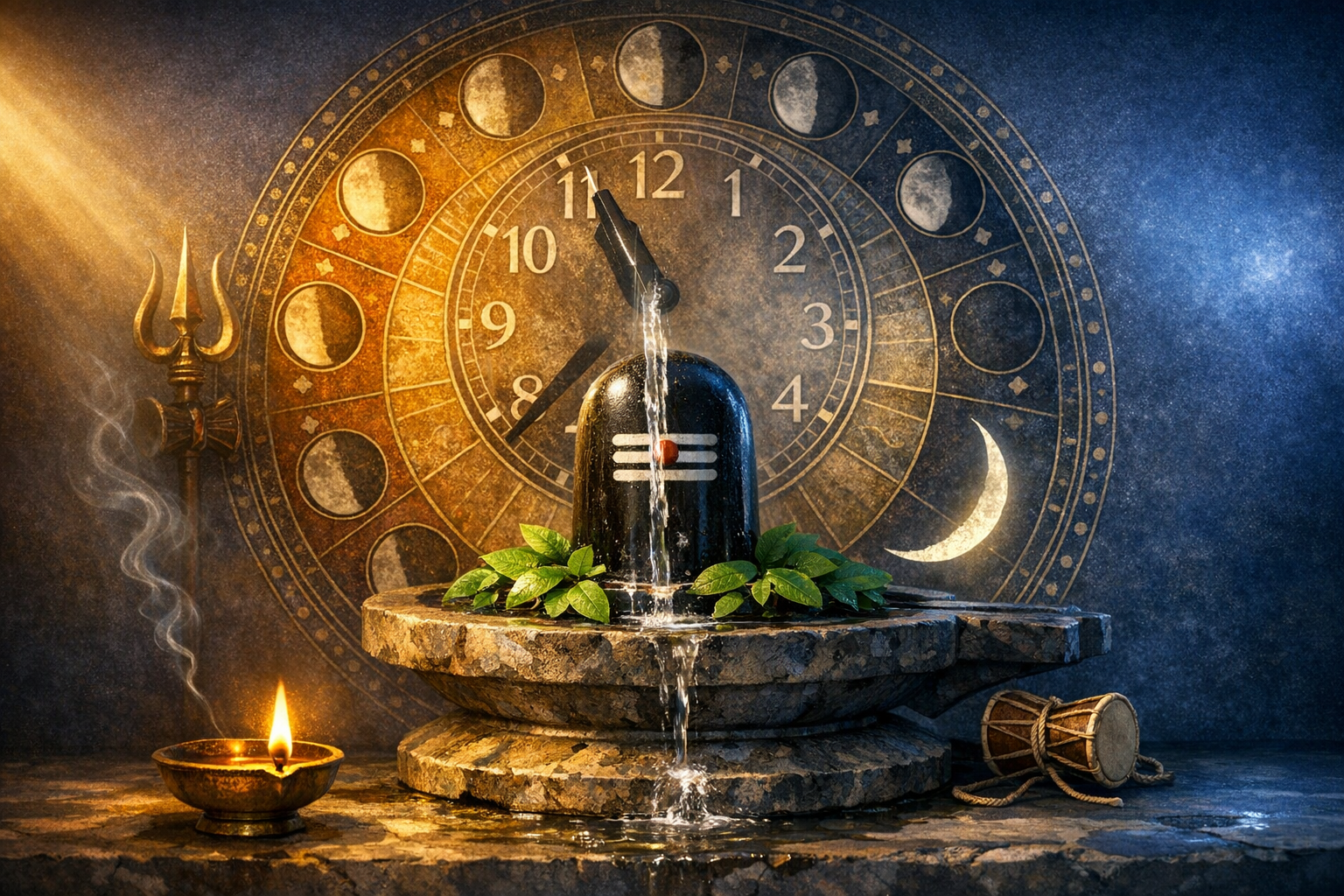
Saturday, June 13, 2026, in the Hindu Panchang marks Krishna Paksha Trayodashi (the thirteenth lunar day of the waning phase) until 11:37 AM, after which it transitions to Krishna Paksha Chaturdashi for the remainder of the day and night in most regions. The timings reflect commonly used Indian Panchang conventions; slight variations may occur by city and computational tradition (Drik versus Vakyam), so local verification is recommended.
This tithi change in the middle of the day carries practical implications for observances. Trayodashi is classically associated with Pradosh Vrat when Trayodashi prevails during the evening twilight known as Pradosh Kaal (approximately the 1.5 hours after sunset). Because Trayodashi ends at 11:37 AM, most regional almanacs will not treat the evening of June 13 as a Pradosh Vrat (i.e., no Shani Pradosh), since the qualifying tithi does not extend into Pradosh Kaal.
With Krishna Paksha Chaturdashi beginning before noon and continuing through the night, many traditions observe the monthly Masik Shivaratri if Chaturdashi prevails after sunset and into the night. Devotees inclined toward Shiva-puja may therefore plan evening worship, abhishekam, and japa of “Om Namah Shivaya,” subject to confirmation of Chaturdashi’s presence during the night hours in the local Panchang for their city.
Good Time (Shubh Muhurat) selection on June 13, 2026, benefits from standard Panchang safeguards: avoid Rahu Kaal, Yamaganda, and Gulika Kaal; prefer Abhijit Muhurat around local solar noon; and, where helpful, consult day Choghadiya, prioritizing Shubh, Labh, and Amrit segments. Because these muhurta windows depend on sunrise, sunset, and local latitude, the most reliable approach is to compute them for the specific location rather than rely on fixed clock times.
Rahu Kaal, Yamaganda, and Gulika Kaal are obtained by dividing the daylight interval (sunrise to sunset) into eight equal parts and then assigning the proscribed segment(s) according to the weekday. As a mnemonic for Saturday when assuming a canonical 6:00 AM sunrise, Rahu Kaal typically falls around 9:00–10:30 AM, Yamaganda around 10:30 AM–12:00 PM, and Gulika Kaal around 3:00–4:30 PM; for actual practice, scale these windows precisely to the local day length to maintain accuracy.
Abhijit Muhurat is centered on local solar noon and is traditionally regarded as a versatile auspicious period for time-sensitive undertakings when other muhurta options are constrained. It spans roughly 24 minutes before and after true local noon (approximately a total of 48 minutes), and should be selected only after ensuring it does not overlap with Rahu Kaal or other inauspicious segments in the observer’s locale.
Choghadiya, common in western and northern muhurta selection, further refines the day. On a Saturday, householders generally seek Shubh, Labh, and Amrit during the daytime sequence begun from local sunrise. Because the sequence advances in fixed rotations of about 96 minutes, a location-specific Choghadiya computed from sunrise provides a practical complement to the core Panchang factors.
Nakshatra and Rashi for June 13, 2026, vary by time and place and are determined by the Moon’s precise ecliptic longitude. Nakshatra divides the zodiac into 27 segments of 13°20′ each; Rashi divides it into 12 signs of 30° each. For an accurate sankalpa (statement of intent) and for aligning personal observances, check the Nakshatra and the Moon’s Rashi for the chosen time window in a location-aware Panchang or at a nearby temple; these parameters meaningfully complement the tithi-based assessment of the day.
From a dharmic-ritual perspective, Krishna Paksha Chaturdashi, especially if it extends through the night, is well suited for Shiva-centered sadhana: simple water abhishekam, Panchamrita, Bilva Patra offering, and quiet meditation. Many householders find that lighting a deepa at dusk, maintaining sattvic diet through the evening, and dedicating a period to mantra-japa fosters inner steadiness and an auspicious close to the waning fortnight.
Panchang diversity should be expected. Northern India generally follows the Purnimanta month convention (months begin the day after Purnima), while much of southern India follows the Amanta convention (months begin the day after Amavasya). As a result, the same tithi can bear different month names across regions, even though the lunar day itself is identical. Observers are best served by following the system customary to their family or locale, thereby honoring parampara while aligning with accurate local computations.
The unity of the broader dharmic family is reflected in the shared reverence for lunar rhythms. Hindu Panchang observances on Trayodashi–Chaturdashi resonate with Buddhist Uposatha (observance days around quarter and new/full phases), Jain upavas and pratikraman cycles aligned to the lunar fortnight, and Sikh cultural practices that often acknowledge pan-Indic festival rhythms. Recognizing these convergences nurtures mutual respect across Hinduism, Buddhism, Jainism, and Sikhism, affirming the common quest for inner discipline and compassion grounded in time-honored calendars.
Technically, a tithi is defined by the angular elongation between the Moon and the Sun; each tithi spans 12 degrees of the Moon–Sun separation. Differences between Drik Panchang (observational/astronomical) and Vakyam Panchang (traditional mean motions) can shift start and end times by minutes, occasionally more. Topocentric corrections for the observer’s longitude and latitude also refine precision. This is why temple schedules and regional almanacs, both grounded in established computational standards, remain the authoritative reference for local observances.
As a practical guide for June 13, 2026: initiate auspicious activities outside Rahu Kaal, consider Abhijit Muhurat for urgent tasks, and, if planning Shiva-puja, prefer the evening and night hours provided Krishna Paksha Chaturdashi prevails locally. Ritual intensity can be adjusted to circumstancefrom a simple diya and a few moments of dhyana to a full abhishekamwhile maintaining the essential focus on clarity of sankalpa and inner quietude.
Key takeaway: June 13, 2026 is Krishna Paksha Trayodashi until 11:37 AM and Krishna Paksha Chaturdashi thereafter. Pradosh Vrat does not apply in most regions because Trayodashi does not prevail during Pradosh Kaal. If Chaturdashi continues through the night, Masik Shivaratri is typically observed with Shiva-puja and mantra-japa. For Nakshatra, Rashi, and muhurta fine-tuning, compute city-specific values to ensure fidelity to the local sky and tradition.
Inspired by this post on Hindu Blog.
