
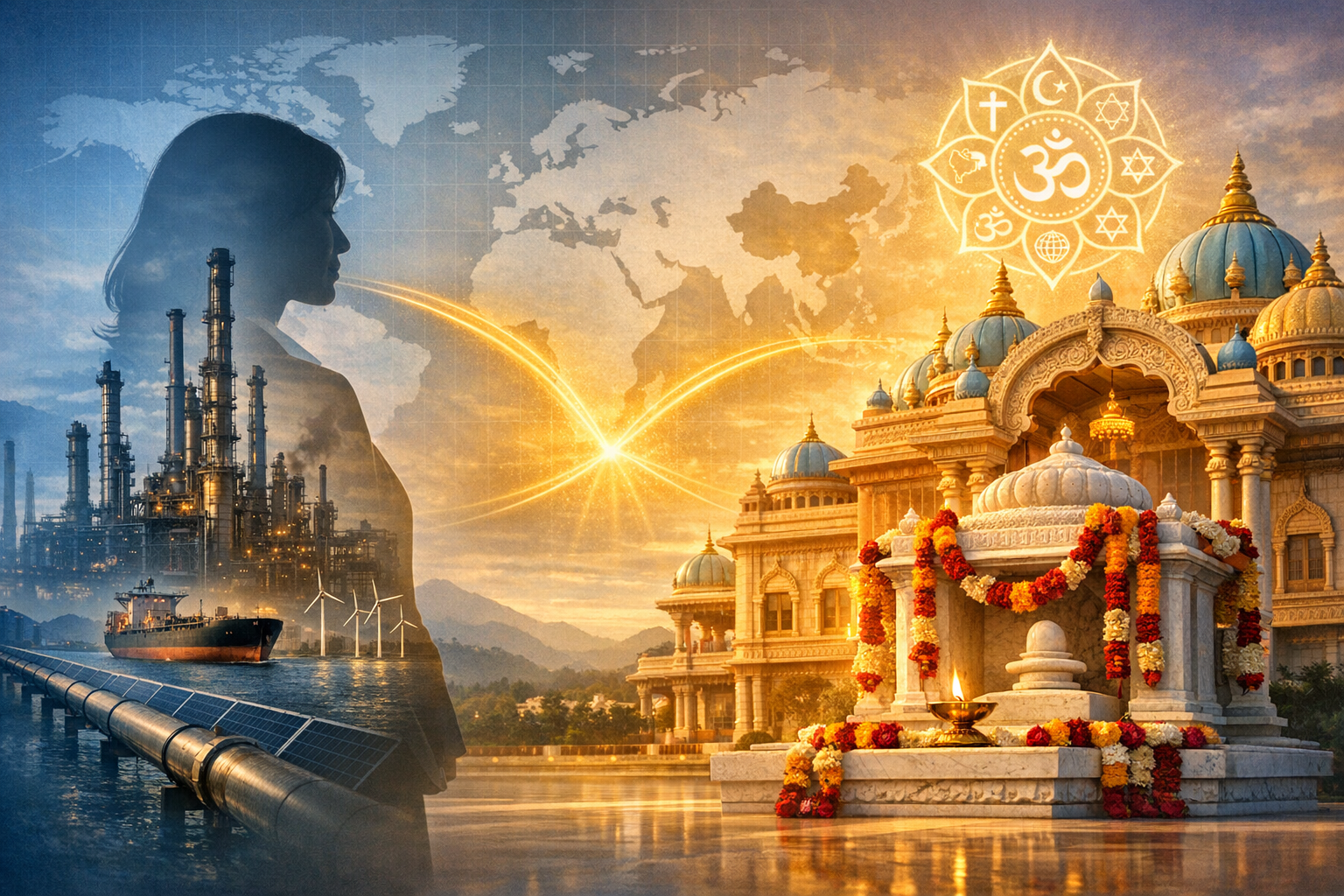
Across continents, interest in Hindu spiritual traditions has grown steadily for decades, long before the Beatles popularized Eastern mysticism. With India’s global profile rising, the adoption of dharmic practices such as yoga, meditation, and seva is accelerating, accompanied by increased public engagement with contemporary gurus including Sadhguru and Sri Sri Ravi Shankar. This expansion invites both curiosity and skepticism across ideological lines, yet it ultimately underscores a shared pluralist ethos at the heart of Hinduism, Buddhism, Jainism, and Sikhism.
As Venezuela’s Acting President Delcy Rodriguez commences a high-profile visit to India focused on energy cooperation, trade, and investment, analysts have also begun to examine a parallel thread: her sustained spiritual association with the late Indian guru Sathya Sai Baba.
That association leads not to Delhi’s corridors of statecraft but to Prasanthi Nilayam in Puttaparthi, Andhra Pradesha town widely known as the spiritual home of Sathya Sai Baba and a nucleus for global seva initiatives. For many international visitors, the ashram functions as a contemplative counterpoint to policy meetings in the capital, offering a setting where ethical intent, public service, and inner discipline converge.
According to publicly available communications from the Sri Sathya Sai Central Trust, Rodriguez visited Prasanthi Nilayam in August 2023 during a broader trip to India and returned in October 2024 while serving as Venezuela’s Executive Vice President. During the 2024 visit, she offered prayers at Sai Baba’s Mahasamadhi and spent time engaging with ashram activities. Such recurring, non-ceremonial visits distinguish personal spiritual interest from routine protocol.
In the dharmic context, Mahasamadhi denotes the conscious departure of a realized master from the physical body; a shrine or memorial at the site symbolizes continuity of teaching beyond bodily life. Prasanthi Nilayam’s focus on disciplined sadhana, interfaith harmony, and social service frames these observances as practices that integrate devotion (bhakti) with ethical action (dharma).
Sathya Sai Baba’s movement is best understood through its synthesis of inner transformation and societal uplift. The Sri Sathya Sai Central Trust and affiliated institutionswell known for initiatives in health care, education, and drinking-water accesslink spiritual development with tangible service (seva). This linkage resonates across dharmic traditions: compassion (karuṇā), non-violence (ahimsa), selfless service, and the pursuit of truth are shared civilizational values rather than sectarian claims.
The ashram’s emphasis on Sarva Dharmarespect for multiple pathsparallels the pluralism embedded in Hindu, Buddhist, Jain, and Sikh thought. That ethos is not merely theological; in practice it fosters civic-mindedness, cross-cultural dialogue, and the habit of cooperation that modern diplomacy increasingly requires.
From a policy perspective, Rodriguez’s ashram visits illustrate how spiritual affiliations can complement formal diplomacy. In Joseph Nye’s framework, such affiliations contribute to soft power by shaping perceptions, building trust, and signaling ethical commitments. When public leaders demonstrate familiarity with India’s spiritual institutions, it can strengthen people-to-people ties that undergird trade, technology partnerships, and long-term energy security.
This is particularly relevant to India–Venezuela relations. India is among the world’s largest energy importers, and Venezuela holds some of the largest proven hydrocarbon reserves. Even as the global energy system diversifies, discussions on crude supply, refining compatibility, and investment frameworks remain central to bilateral engagement. Cultural literacy and spiritual diplomacy do not replace technical negotiations, but they can create a cooperative atmosphere for complex conversations on energy transition, debt, and regulatory clarity.
Latin America has seen steady growth in Indian spiritual organizationsamong them Sai centers, yoga institutes, and bhakti movementswhich host service projects and interfaith dialogues. These platforms function as Track II or Track 1.5 channels, connecting citizens, scholars, entrepreneurs, and policymakers outside official conference rooms. Over time, such interactions mature into networks that help resolve misunderstandings, identify shared interests, and support inclusive development.
For political figures managing intense schedules and high-stakes negotiations, a contemplative pause at Prasanthi Nilayam offers psychological reset and ethical alignment. The practice reflects a broader human pattern: leaders often seek reflective spacesmonasteries, gurdwaras, viharas, templeswhere long-term purpose is clarified and short-term incentives are tempered. In that sense, Rodriguez’s visits exemplify a relatable search for balance between the inner life and public responsibility.
Any large, charismatic movement attracts scrutiny, and the Sathya Sai community has faced rigorous public debate over the decades. A balanced, evidence-led view distinguishes between controversy, verifiable institutional outcomes, and the lived experience of devotees. For observers of diplomacy, the salient point is not adjudication of contested claims but recognition that service-centric institutions can, and often do, contribute to social capital, health outcomes, and educational access.
Prasanthi Nilayam’s model of spirituality-in-action maps closely to the aims of dharmic unity. The ethical grammar of seva, satya (truth), and daya (compassion) is legible across Hindu, Buddhist, Jain, and Sikh traditions, making it a practical bridge for interfaith respect. When state visits acknowledge this shared moral vocabulary, they create opportunities for cooperation in public health, disaster response, education, and community mediation.
Readers interested in audiovisual context can view a related video recording here: http://www.hinduhumanrights.info/wp-content/uploads/2026/06/YTDown_YouTube_Delcy-Rodriguez-India-Visit-The-Sai-Baba_Media_TUpU7LaR4To_004_360p.mp4
Ultimately, the convergence of India–Venezuela energy diplomacy with a visible, values-centered spiritual association offers a case study in integrated statecraft. It shows how cultural familiarity and dharmic pluralism can coexist with hard-edged negotiations on oil, investment, and technology, producing a more resilient relationship architecture. In a multipolar GlobalSouth, such combinations of principle and pragmatism are not peripheral; they are increasingly the point.
Keywords for context: Delcy Rodriguez India visit, India–Venezuela relations, Sathya Sai Baba, Prasanthi Nilayam, Puttaparthi, Sri Sathya Sai Central Trust, Mahasamadhi, soft power, energy security, Hindu spirituality, Andhra Pradesh.
Inspired by this post on Hindu Human Rights Blog.
