
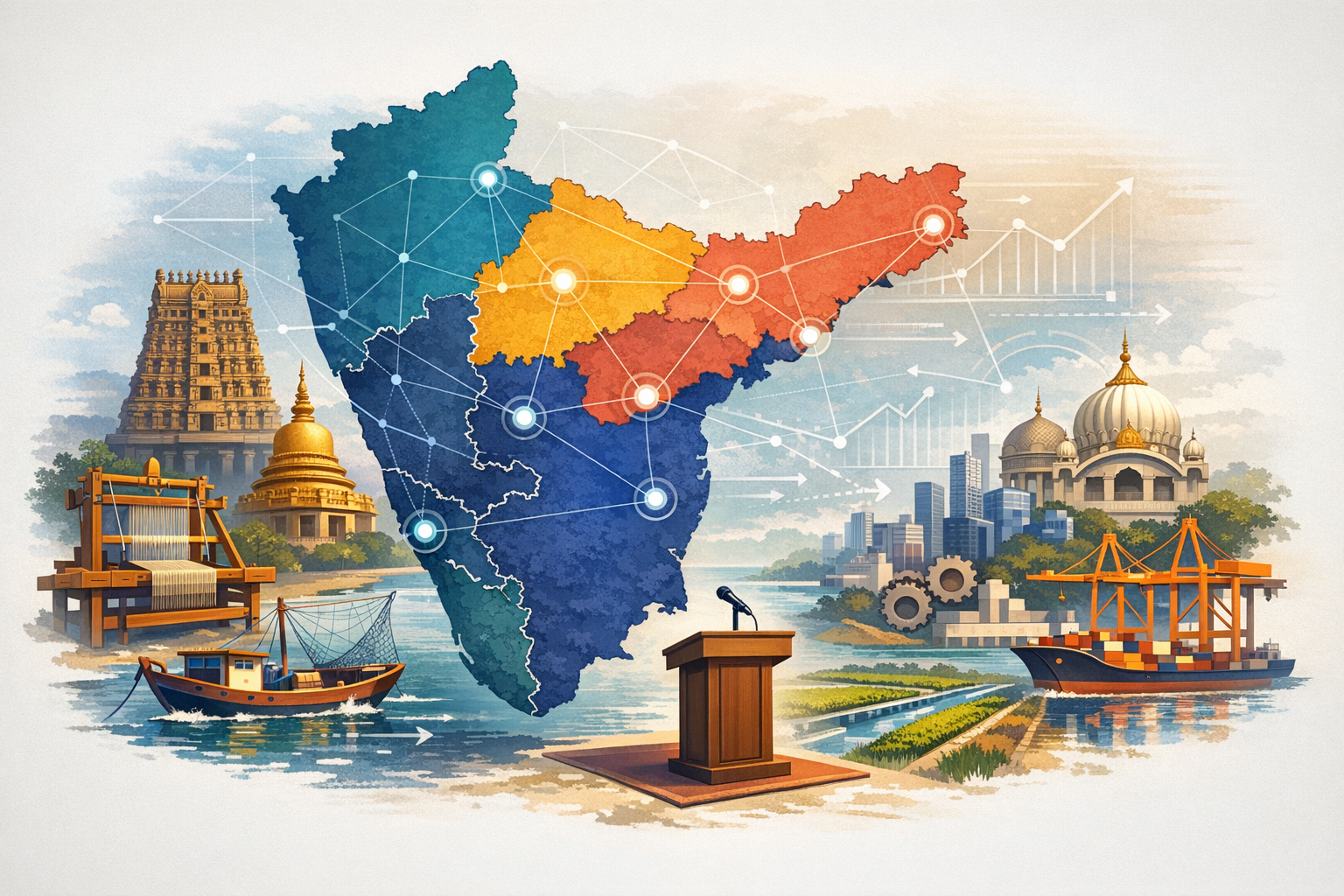
Reports of K. Annamalai’s exit from the Bharatiya Janata Party (BJP) have sharpened an already pivotal question in Indian politics: can the party’s Hindutva strategy truly achieve durable gains across South India without its most visible Tamil Nadu face? The development is a stress test for a decade-long southern outreach that has mixed civilizational messaging, welfare politics, and organizational expansion with varying degrees of success across Tamil Nadu, Kerala, Karnataka, Telangana, and Andhra Pradesh.
Any rigorous assessment benefits from reframing the idea of “conquest.” In the southern contextrich with distinct linguistic identities, Dravidian political traditions, and plural religious practicesenduring success depends less on electoral sweeps and more on respectful embedding. A sustainable strategy is one that advances unity among dharmic traditionsHindu, Buddhist, Jain, and Sikhwhile honoring constitutional pluralism and regional federalism.
K. Annamalai rose as an energizing organizational node for the BJP in Tamil Nadu. A former IPS officer with an assertive communication style and an emphasis on probity, he professionalized local party structures, amplified youth and urban outreach, and reframed the BJP as a credible challenger within a Dravidian-dominated arena. His ground travelogues, digital fluency, and targeted issue campaigns helped the party convert national resonance into state-level attention.
The significance of his departure lies less in the symbolic loss and more in the composite roles he played: message entrepreneur, fundraiser, recruiter of technocratic and civil-society talent, mediator with allies, and a consistent presence for booth-level cadres. In electoral systems characterized by finely segmented caste coalitions, localized patronage ecologies, and micro-issues by constituency, such multi-role leaders accelerate diffusion of organizational routines and voter recall.
Even so, the BJP’s southern project predates and will outlast any single leader. Over the past decade, the partyand its wider sangathan ecosystemhas invested in social-service networks, cultural outreach, legal advocacy on temple management and heritage protection, and welfare-delivery narratives framed as “good governance” rather than mere ideological posture. The core question now is one of institutional redundancy: can distributed leadership and systems substitute for a charismatic node without erosion in mobilization intensity?
Tamil Nadu remains the hardest laboratory. The state’s competitive equilibrium has long been structured by DMK–AIADMK alternation, linguistically rooted federalism, and a civic imagination wary of central encroachment. Any Hindutva politics that aspires to legitimacy here must be Tamil-firstgrounded in the syncretic Bhakti inheritance of Shaiva and Vaishnava traditions, respectful of social-justice idioms, and alive to the nuances of caste coalitions among Thevars, Vanniyars, Kongu Gounders, Nadars, and others.
Voter behavior in Tamil Nadu is also shaped by competitive welfarism, municipal service performance, and micro-credibility of candidates. Conversations in tea stalls across Coimbatore’s industrial belts, Kanchipuram’s weaving clusters, and Madurai’s wholesale markets convey a pattern: ideology can open doors, but delivery and local rootedness decide whether voters will cross the threshold.
Kerala presents a different configuration. Historically inhospitable terrain for the BJP, it nonetheless signaled a breakpoint with a landmark Lok Sabha victory in Thrissur in 2024. That outcome was less an endorsement of raw polarization and more a consequence of calibrated candidate credibility, outreach among micro-communities (including artisanal and small-enterprise networks), and issue-based campaigning on heritage, livelihoods, and infrastructure. Future growth will hinge on expanding coalition bandwidth while foregrounding religious harmony and constitutional rights.
Karnataka is the BJP’s most mature southern base, where organizational density, Lingayat and diverse OBC outreach, and urban middle-class consolidation have produced repeatable performance at the national level. Yet the 2023 Assembly setback demonstrated that the southern playbook cannot rely on nationalized campaigning alone; state-specific delivery, social coalitions, and leadership texture remain decisive. The lesson is instructive for Tamil Nadu and Kerala: institutional muscle must be matched with locally resonant governance narratives.
Telangana’s trajectory underscores urban and peri-urban alignments in a post-formation polity seeking growth, jobs, and probity. The BJP’s expansion here has married anti-corruption frames with service-class aspirations and micro-outreach in GHMC zones and emerging corridors. That templateanchored in performance signals rather than identity maximalismhas the highest portability to other southern metros if adapted to distinct municipal ecologies.
In Andhra Pradesh, the 2024 reconfiguration via alliance politics (with TDP and Jana Sena) illustrates a second pathway to relevance: co-governance stakes over standalone visibility. For the BJP, southern presence can be cumulativesome states via coalition leverage, others via incremental standalone growthso long as ideological signaling is harmonized with regional priorities on irrigation, ports, fisheries, industrial corridors, and social protection.
Across the South, the organizational architecture remains the crucial variable. Volunteer pipelines, booth committees, cultural and temple-outreach cells, legal task forces on heritage conservation, and digital content studios in local languages must be scaled to compensate for any leadership churn. Distributed leadership not only hedges attrition risk but also increases cultural fluency across districts from Kanyakumari to Karimnagar.
Messaging architecture requires similar fine-tuning. A three-layer stack tends to be effective: a civilizational layer that frames Hindutva as an inclusive dharmic continuum (embracing Hindu, Buddhist, Jain, and Sikh traditions); a governance layer translating that ethos into probity, efficiency, and service delivery; and a local layer that addresses constituency-specific livelihoods, from MSME credit in Tiruppur to coastal safety and sustainable fisheries along the Malabar.
Temple governance reform is a prominent, sensitive plank. Where reform efforts prioritize transparency, community participation, heritage conservation, and equal dignity for diverse sampradayas, public receptivity improves. Conversely, if framed as centralized control or sectarian exclusion, reform can trigger backlash. The South’s faith-ecosystem is a living archivefrom Divya Desams to ancient Shaiva kshetras to Jain basadisdemanding stewardship that is inclusive, scholarly, and locally accountable.
Social coalition arithmetic is another non-negotiable. Southern caste matrices are competitive and granular; minor vote shifts among two or three mid-sized groups often flip constituencies. The BJP’s growth vectors have historically attached to upwardly mobile OBC segments, aspirational women voters, first-time electors in IT and services, and micro-entrepreneurs in manufacturing belts. Maintaining cross-caste bridges while avoiding zero-sum rhetoric is essential to long-run acceptance.
Language and federalism sensitivities must be treated as foundational, not tactical. Promises on classical language preservation, mother-tongue-first schooling with strong English optionality, and devolution in urban planning and fiscal transfers often resonate more than ideological abstraction. In voter conversations along Chennai’s OMR and Bengaluru’s ORR, policy credibility on mobility, pollution, safety, and housing carries outsized weight.
Women’s political agency has widened across the southern states, mediated by self-help groups, educational gains, and safety expectations. Policy planks that protect inheritance rights, expand primary healthcare, reduce gendered time poverty through transit and childcare, and catalyze microfinance for home-based enterprises can produce durable alignment independent of ideological identity cues.
For youth cohorts, especially in technology and vocational tracks, three deliverables dominate: skill portability, placement density, and predictable urban services. University-industry bridges, apprenticeship credits, and start-up incubation in tier-2 cities from Madurai to Warangal can convert soft sympathy into recurring voter loyalty. Symbolic politics without employability pipelines tends to plateau.
From a risk perspective, leadership attrition can depress cadre morale, donor confidence, and alliance negotiations. However, such shocks are survivable when mitigated by bench-building (district-level faces with media competence), institutional memory (SOPs for campaign, booth logistics, and grievance redress), and diversified fund-raising (small-donor digital streams alongside traditional patrons).
Alliance calculus in Tamil Nadu remains pivotal. Seat conversions are more likely via calibrated partnerships with players such as PMK or select regional formations, provided ideological priors are reconciled with community aspirations on education, jobs, and local autonomy. The AIADMK question, though volatile, is ultimately a function of mutual incentives around vote-transfer discipline and leadership optics.
Scenario analysis suggests three broad pathways in Tamil Nadu over the medium term. In a best-case institutionalized scenariorobust bench leadership, credible alliances, and service-delivery signalingvote share can move into the mid-teens with runner-up finishes in multiple constituencies and selective breakthroughs. A base-case of steady organizational accretion could sustain low-to-mid double digits in vote share with sporadic second-place finishes. A worst-case of fragmentation and narrative drift risks reversion toward single-digit vote share in competitive three- or four-cornered contests. These are directional, not predictive, ranges and depend on candidate quality and local coalitions.
Kerala’s expansion vector is narrower but real. Consolidation around a handful of winnable Lok Sabha and Assembly seatsmarried to institution-building in cooperative sectors, temple-heritage stewardship with academic rigor, and civic service deliveryoffers the most plausible path to sustained relevance. The ethos must emphasize dharmic inclusivity, interfaith harmony, and constitutional protections for all communities.
In Telangana, deepening urban governance credentialstraffic management, lake rejuvenation, stormwater and flood control, crime analytics, and entrepreneurship enablementcan entrench the party’s foothold. Translating national welfare schemes into hyperlocal wins, while cultivating bilingual outreach in Telugu and Urdu where appropriate, will likely yield higher marginal returns than identity escalation.
Karnataka’s key requirement is performance renewal at the state level: agricultural resilience (micro-irrigation, FPOs, horticulture value chains), urban service discipline, and corruption control. Maintaining a stable Lingayat base while widening OBC and Vokkaliga bridges through programmatic delivery is the lowest-risk route to protect national-level strength.
Andhra Pradesh calls for alliance steadiness and administrative co-ownership: ports-led logistics, MSME modernization, aquaculture sustainability, and skilling pipelines keyed to Visakhapatnam–Kakinada hubs. Demonstrable contributions within a coalition government will matter more than standalone branding.
Across the South, cultural diplomacy remains an underutilized lever. Initiatives like the Kashi–Tamil Sangamam showed how civilizational exchange can build goodwill without electoral bombast. Extending such programsTamil–Kannada classical forums, Vaishnava–Shaiva scholarship bridges, Jain and Buddhist heritage restoration consortia, Sikh martial-heritage showcasesreinforces a dharmic unity frame that is inclusive rather than sectarian.
The emotional center of southern politics is distinctly local. For fisherfolk along Kerala’s coast, safety and fair pricing outrank national slogans. For weavers in Kanchipuram, design upgradation and market access determine dignity. For first-generation engineers on Chennai’s OMR, commute time and housing affordability shape life choices. Hindutva politics that listens first and then integrates solutions into its moral vocabulary will find more durable acceptance than slogans that arrive pre-packaged.
The dharmic case for unitySanatana Dharma’s capaciousness that embraces multiple marga and sampradayatravels well across southern societies when married to humility and service. Buddhism’s ethical clarity, Jainism’s ahimsa and enterprise ethos, Sikhism’s seva tradition, and Hinduism’s plural pathways together articulate a civic, not sectarian, horizon. A politics that channels these shared values into public policyjustice, compassion, stewardship of heritage, and opportunitywill tend to accumulate legitimacy over cycles.
Ultimately, the question is not whether the BJP can “conquer” the South after Annamalai’s exit, but whether it can embed. Embedding means leaders who sound, think, and solve like the neighborhoods they seek to serve; alliances that respect local pride; policy programs that deliver tangibles; and a civilizational narrative that heals rather than hardens social lines. Leadership departures slow momentum; resilient institutions restore it.
The near-term playbook is consequently straightforward in design, difficult in execution: replace personality centrality with bench depth; recode messaging from contestation to competence; invest in women’s agency and youth employability; and demonstrate daily that dharmic unity strengthens constitutional pluralism. If those conditions are met, southern breakthroughs need not be episodic. They can be cumulativeand lasting.
Inspired by this post on Struggle for Hindu Existence.
