
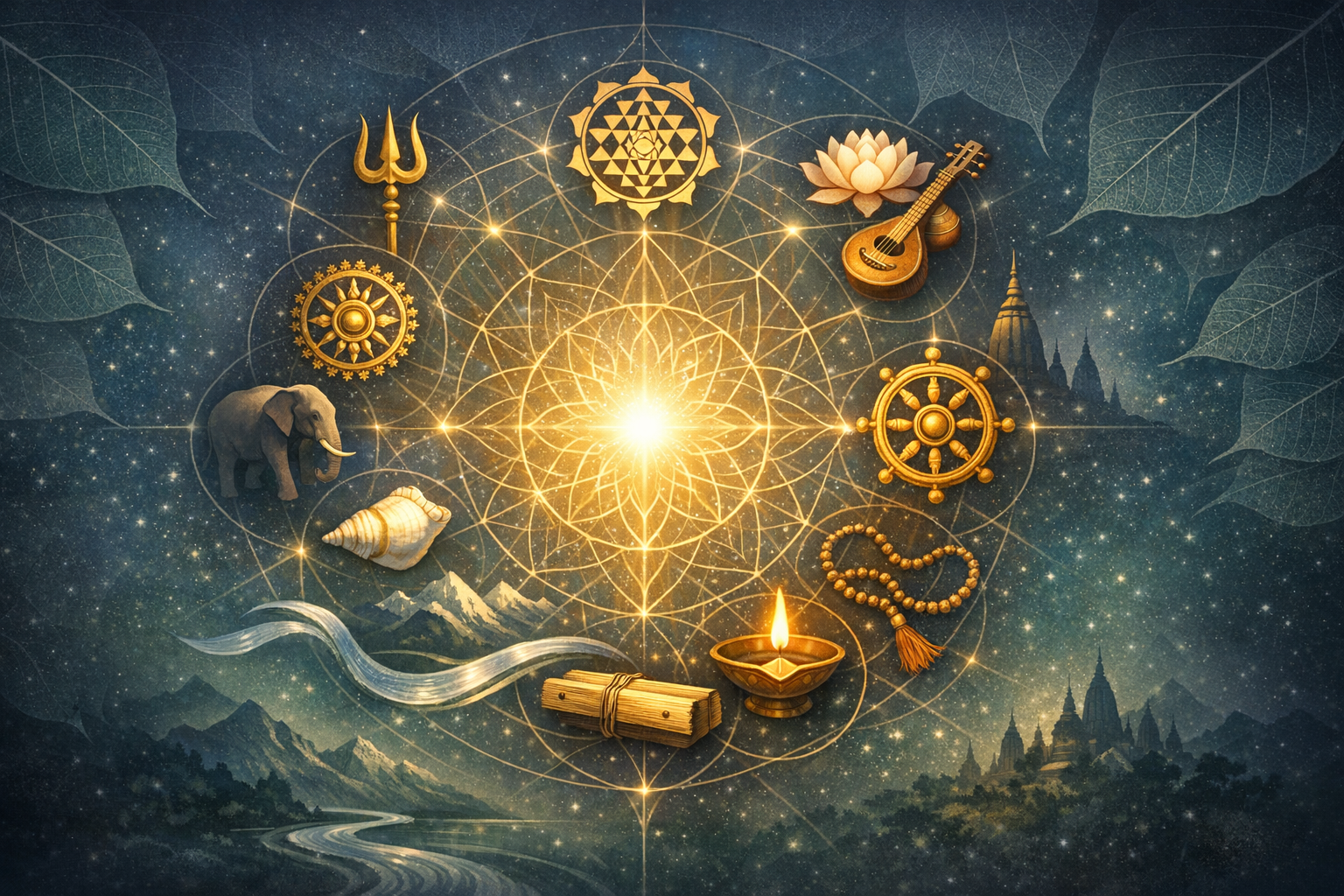
The enduring questionwhy Hinduism names and venerates so many deitiesinvites an answer that is at once textual, historical, cognitive, and social. Far from being a random proliferation, the multiplicity of devas operates as a precise cultural technology that sustains spiritual depth, social harmony, and civilizational continuity.
At the heart of Vedic literature stands the principle: “Ekam sat viprā bahudhā vadanti” Truth is one; sages call it by many names (Rig Veda 1.164.46). This statement frames Hindu philosophy of unity-in-diversity. The many gods function as names, forms, and functions through which an indivisible Reality becomes relationally accessible.
Hindu thought distinguishes between Nirguṇa Brahman, the attributeless Absolute, and Saguṇa Brahman, the same Absolute apprehended with attributes for the sake of devotion and practice. Deities in the Purāṇas and Āgamas are embodiments of that Saguṇa modality, making the ineffable teachable, memorable, and loveable.
A frequent question concerns the phrase “330 Million Gods in Hinduism.” The Vedic expression is “trayastrinśat koti,” where “koti” can mean “class” or “category” in addition to “crore.” Early Brāhmaṇa texts enumerate thirty-three deities as functional categorieseight Vasus, eleven Rudras, twelve Ādityas, with Prajāpati and Vashatwhile later devotional literature expands names and forms without implying separate, competing supremacies. In practice, multiplicity denotes semantic richness rather than an arithmetic census of divine individuals.
Historically, the plural pantheon reflects a sophisticated model of cultural integration. Across millennia, India’s regions contributed local gramadevatā traditions that were woven into Vedic-Purāṇic frameworks. Temples of Śiva, Viṣṇu, Devī, Gaṇeśa, and Skanda exist alongside guardians, rivers, mountains, and village protectors, creating a federated sacred geography. This integrative method preserved local memory while aligning it with pan-Indian dharma.
Anthropology describes this as accretive syncretism: instead of replacing earlier cults, newer articulations reframed them. A river like Gaṅgā remained a living presence, now also connected to cosmology, ethics, and pilgrimage circuits. Such layering explains why the same deity may carry multiple names, forms, and mythic biographies that resonate with different linguistic and regional communities.
Cognitive science adds another dimension. Human minds readily attribute agency to forces in the environmenta tendency sometimes called hypersensitive agency detection. Conceptualizing rainfall as Indra, learning as Sarasvatī, or wealth as Lakṣmī makes abstract processes concrete and ethically contextualized. Research on memory shows that minimally counterintuitive, personified agents are easier to remember and transmit, helping traditions endure across generations.
Psychology also clarifies why “Ishta in Hinduism” matters. Ishta-devatāthe chosen form of the Divinealigns spiritual practice with individual temperament, culture, and life-stage. Personalized devotion improves motivation, emotional salience, and adherence over time, much like individualized learning pathways improve educational outcomes. Crucially, personal choice does not imply exclusivism; it formalizes diversity as a path to common realization.
From the perspective of systems theory, polycentric devotion enhances resilience. A civilization with many sacred entry points functions like a distributed network: when one node weakens, others sustain the flow of meaning. Festivals, pilgrimages, and household puja together create redundancy and fault tolerance, ensuring that wisdom persists despite political upheavals or social change.
Language and semantics reinforce this architecture. In Sanskrit, “deva” derives from the root “div,” to shine. Sahasranāma traditions, such as the Viṣṇu or Lalitā Sahasranāma, present a thousand epithets for a single deity, each foregrounding a distinct attribute or cosmic function. The practice trains attention to the One through contemplation of the Many.
Ritual practice offers embodied confirmation. The sensory choreography of āratī, mantra, darśan, and prasāda regulates attention and emotion, often shifting practitioners toward calmer, more prosocial states. While neuroscience continues to investigate mechanismsbreath, rhythm, synchronized movementthe lived effect is widely reported: devotion in varied forms nurtures ethical orientation and communal cohesion.
Socially, religious diversity in Hinduism functions as an instrument of coexistence. Multiple devas allow neighborhoods, professions, genders, and life-stages to be mirrored in the sacred world, legitimizing many honorable ways of living. Diversity at the altar thus prefigures diversity in society, softening boundaries and lowering the cost of intergroup cooperation.
This plural logic also supports unity among Dharmic traditions. Buddhism’s many Buddhas and Bodhisattvas, Jainism’s Tīrthaṅkaras, and Sikhism’s affirmation of Ik Onkār with countless Names mirror the same civilizational intuition: an ineffable ground of being is approachable through numerous compassionate forms. Such consonance helps communities share festivals, ethics, and vocabularies while honoring distinct paths.
Philosophically, these structures converge on nondual insights. The Upanishads describe Brahman as the substratum of all names and forms, while devotional theologies teach that loving any form wholeheartedly reveals the formless. In practice, worship of Śiva, Viṣṇu, Devī, or Gaṇeśa becomes a disciplined method for interiorizing the Upanishadic “neti neti” until distinctions relax into recognition of a single, all-pervading Consciousness.
It is important to address popular numerological claims. Attempts to equate the number of Hindu deities with biological countssuch as human chromosomeslack textual, historical, and scientific basis. Humans have forty-six chromosomes in most cells, and this figure bears no relation to Vedic enumerations. The wisdom of many gods rests not on numerology but on demonstrable advantages in pedagogy, memory, social integration, and contemplative accessibility.
In everyday life, this becomes tangible. A family may greet Gaṇeśa at the doorway for auspicious beginnings, light a lamp to Lakṣmī on a festival evening as a practice of gratitude, and meditate on Śiva or Viṣṇu during quiet mornings to cultivate clarity and steadfastness. The multiplicity does not fragment devotion; it situates meaning across the day’s activities, saturating time with remembrance.
History confirms the benefits. As empires rose and fell, as languages evolved, and as populations moved, the polycentric structure of Hindu devotion preserved core ethical commitmentsahimsā, satya, dāna, and tapaswhile remaining open to new forms of articulation. The result is a robust, living tradition that can converse with modern science, democratic pluralism, and global civil society without ceding its center.
Accordingly, the question, “Is there any scientific reason behind many gods in Hinduism?” yields a nuanced answer. There is no single cause; rather, multiple disciplines illuminate complementary reasons. Anthropology explains accretion and integration; cognitive science clarifies memorability and motivation; network theory models resilience; philology decodes semantics; and philosophy articulates the unity that diversity serves.
Put simply, the plurality of devas is a civilizational design principle. It invites every person, village, and vocation into the sacred conversation, while keeping the conversation oriented toward one Reality. In that light, “330 Million Gods in Hinduism” is best understood as poetic shorthand for infinity, not arithmetic literalism.
This perspective strengthens interfaith friendship within the Dharmic family and beyond. When communities see their treasured forms as distinct windows opening to a shared horizon, mutual respect grows naturally. Diversity ceases to threaten unity; it becomes the method by which unity is recognized.
Many gods, one Realitythis is the grammar of Hindu spirituality. It is time-tested, psychologically astute, socially integrative, and philosophically profound. Engaged with responsibly, it continues to offer a sustainable pathway to inner freedom and collective harmony.
Inspired by this post on Hindu Pad.
