
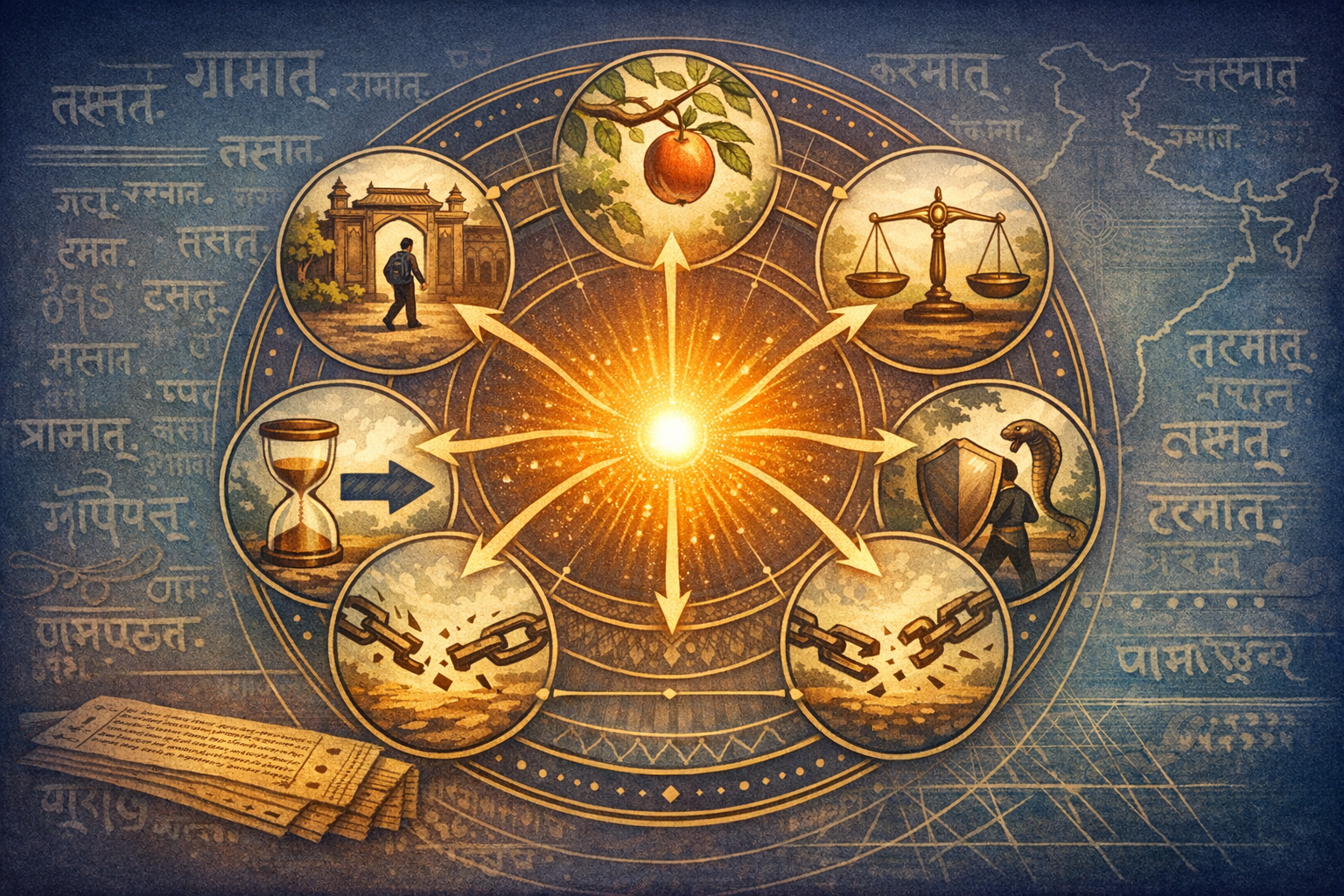
Apādāna is classically glossed as ‘taking away, removal, ablation’, and by semantic extension it denotes the source from which something is removed, separated, or departs. In the Sanskrit grammatical tradition (Vyākaraṇa), apādāna is the technical designation for the semantic role prototypically realized by the fifth, or ablative, case (pañcamī).
In precise grammatical terms, apādāna identifies a noun whose relation to an action is that of a fixed point or locus from which departure, separation, diminution, or release takes place. This understanding goes beyond physical motion; it generalizes the ‘from’ relation to encompass spatial origin, temporal inception, causal release, comparison, and deprivation. Thus, apādāna stands at the intersection of meaning (kāraka) and morphology (vibhakti), anchoring the syntax–semantics interface in Sanskrit.
Within the Paninian framework, the principle apādāne pañcamī succinctly captures the alignment: when a nominal functions as the source or point of separation, the ablative case marks it. At the same time, Vyākaraṇa carefully distinguishes semantic roles from case endings. A single vibhakti can, in different constructions, signal distinct roles; conversely, the apādāna relation can occasionally be expressed periphrastically or through alternative patterns in earlier and poetical registers. Treating apādāna as a semantic relation and pañcamī as its canonical morphological exponent preserves both clarity and analytical flexibility.
Morphologically, the ablative appears with characteristic endings across declensions. For a-stems (masculine/neuter), the ablative singular is -āt (rāmāt, gṛhāt, vanāt). For feminine ā-stems, it is -āyāḥ (latāyāḥ). For feminine ī-stems, it is -yāḥ (nadyāḥ). For i-stems and u-stems, it is -eḥ and -oḥ respectively (hareḥ, guroḥ). For ṛ-stems, genitive and ablative often coincide in form (pituḥ, mātuḥ). In the dual, the ablative merges with the dative and instrumental as -bhyām; in the plural, as -bhyaḥ. Pronominal paradigms preserve the ‘from’ sense transparently: kasmāt, tasmāt, yasmāt, asmāt.
Semantically, apādāna is triggered first and foremost by predicates of movement, separation, and removal. Verbs such as gacchati ‘goes’, āgacchati ‘comes’, patati ‘falls’, utkrāmati ‘departs’, harati ‘takes away’, apanayati ‘removes’, uddhṛṇoti ‘extracts’, and mucyate ‘is released’ profile a source that the ablative identifies. The same logic governs transitions of state (from which a quality is relinquished), as well as relief from constraints or burdens.
Classical usage extends apādāna to non-spatial domains. With comparatives, the standard of comparison is ablative, reflecting conceptual separation on a scale (bhīmaḥ yudhiṣṭhirāt balīyān, ‘Bhīma is stronger than Yudhiṣṭhira’). Verbs of fear and protection select an ablative complement naming that from which fear arises or from which one is shielded (sarpāt bibheti; māṁ śatroḥ trāhi). Adjectives of deprivation or separationhīna, rahita, vivarjitagovern the ablative (dhanāt hīnaḥ, ‘devoid of wealth’). Temporal apādāna appears with particles like prabhṛti and ārabhya to denote inception (‘from this time onward’), while interrogative kasmāt highlights causal motivation (‘for what reason?’).
Illustrative sentences crystallize these patterns in context: सः ग्रामात् आगच्छति (saḥ grāmāt āgacchati, ‘he comes from the village’); फलम् वृक्षात् पतति (phalam vṛkṣāt patati, ‘the fruit falls from the tree’); भीमः युधिष्ठिरात् बलीयान् (bhīmaḥ yudhiṣṭhirāt balīyān, ‘Bhīma is stronger than Yudhiṣṭhira’); सर्पात् बिभेति (sarpāt bibheti, ‘he fears the snake’); मां शत्रोः त्राहि (māṁ śatroḥ trāhi, ‘protect me from the enemy’); अस्मात् कालात् प्रभृति अध्ययनं प्रवर्तते (asmāt kālāt prabhṛti adhyayanaṁ pravartate, ‘from this time forward the study proceeds’); कस्मात् विलम्बः (kasmāt vilambaḥ, ‘why is there a delay?’). In each case, the ablative surfaces the ‘from’ relation in space, quality, time, or cause.
A frequent point of learning involves form–function ambiguity. In several declensions (e.g., i-, u-, and ṛ-stems), genitive and ablative singular endings are identical (śatroḥ can be ‘of the enemy’ or ‘from the enemy’). Disambiguation rests on semantics and the requirements of predicates or adjectives: trāhi ‘protect!’ expects an apādāna complement; vivarjita or hīna likewise impose an ablative. Thus, interpretive precision emerges from the interaction of lexical selection and constructional semantics rather than from endings alone.
It is also instructive to separate apādāna (semantic role) from the broader inventory of ablative uses. Sanskrit permits the ablative to encode nuances such as cause, comparison, and source in idiomatic ways that sometimes diverge from a strict spatial metaphor. Conversely, apādāna itself can be paraphrased using indeclinables (e.g., prabhṛti, ārabhya) or compounded expressions that highlight origin or release. This elasticity reflects the depth of kāraka theory: roles are conceptual anchors, while cases are the grammatical resources recruited to signal them.
Across the Dharmic linguistic continuum, the apādāna concept reveals a shared heritage. In Pāli grammar, the ablative has long been described in apādāna terms, and Middle Indo-Aryan morphology preserves ‘from’ markers through alternants such as -ā (gāmā ‘from the village’) and -mhā/-smā (rukkhamhā ‘from the tree’). In Jaina Prakrit traditions, comparable ablative strategies express source and separation with the same underlying logic. In New Indo-Aryan languages, the inherited semantic profile persists through postpositions: Hindi uses se, while Punjabicentral to Sikh textual cultureuses tō̃/ton to mark ‘from’. The forms differ, but the cognitive grammar of apādāna remains strikingly continuous across Hindu, Buddhist, Jain, and Sikh milieus.
A brief note on terminology helps avoid confusion: in Theravāda literature, Apadāna (with the same phonetic shape) is also the name of a canonical Pāli text comprising biographical and hagiographical narratives. That textual title is unrelated to the grammatical role discussed here, though both are native to the broader Dharmic intellectual world. Context clarifies the distinction: apādāna in grammar signals ‘source/separation’; Apadāna as a title denotes a literary collection.
For learners and readers, a practical strategy is to ask four diagnostic questions whenever pañcamī appears: from where (spatial origin)? from what (material or container)? since when (temporal inception)? because of what (cause or reason)? If the predicate semantically encodes release, removal, comparison, fear, or protection, an apādāna reading is typically correct. This approach aligns form with function and keeps the analysis faithful to the Paninian tradition without over-relying on endings alone.
Ultimately, apādāna exemplifies how Sanskrit grammar models thought: it captures a pervasive human intuition of origin and separation, then articulates it with morphological elegance. That same intuition travels through Pāli, Prakrits, and modern Indo-Aryan languages, nurturing a quiet unity across the Dharmic traditions of Hinduism, Buddhism, Jainism, and Sikhism. Recognizing this shared grammatical thread deepens philological accuracy and strengthens an appreciation of the civilizational consonance that binds these traditions in both language and learning.
Inspired by this post on Hindu Blog.
