
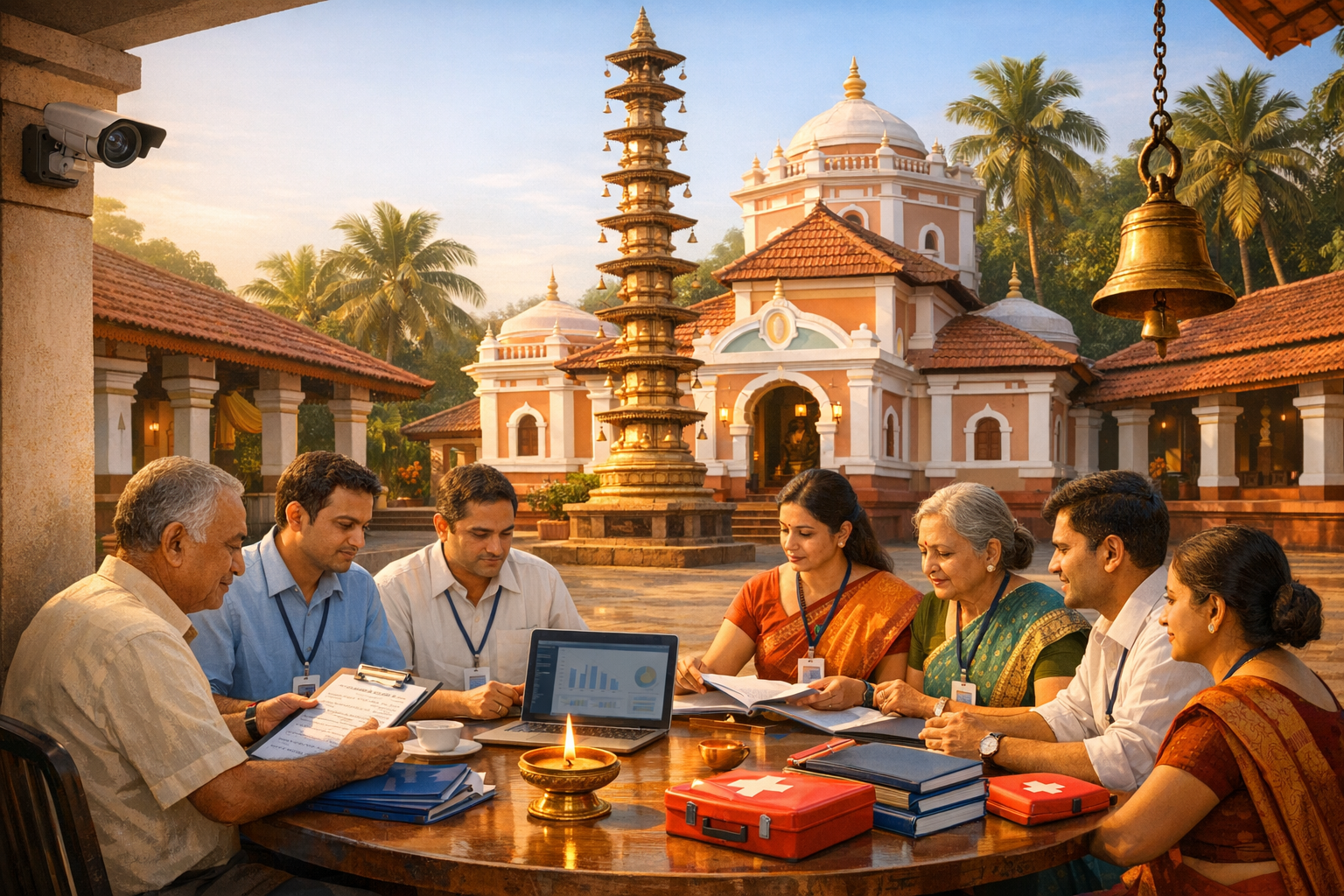
The state-level Temple Conference in Mardol, Goa, concluded with a clear consensus: temple trustees and Hindu organisations across the state must operate with greater unity, accelerate temple protection, preserve Dharma, and expand temple-based awareness and organisational capacity. The proceedings reflected a pragmatic, solutions-focused ethos grounded in cultural responsibility and collaborative action.
Set amid Goa’s living landscape of Hindu Temples and historic shrines, the Mardol venue offered more than convening space; it served as a reminder that temples function simultaneously as sacred sites, community anchors, repositories of Cultural Heritage, and centres of seva. The conference’s state-level format ensured that discussions connected local operational realities with a broader strategic horizon for coordinated stewardship.
The call for greater unity among temples addressed a structural challenge often faced by trustees: the fragmentation of governance, security, and outreach efforts across numerous independent institutions. Shared risksicon theft, encroachment, custodial disputes, safety lapses, crowd-management bottlenecks, and digital misinformationdemand common standards and mutual aid. A statewide network strengthens resilience, amplifies Dharma preservation, and enhances public trust.
Resolutions adopted at the conference centred on three convergent themes: (a) temple protection through robust physical, legal, and administrative safeguards; (b) Dharma preservation via education, community engagement, and continuity of sampradaya practices; and (c) statewide strengthening of temple-based awareness and organisational capacity to sustain these commitments beyond the immediate news cycle. The spirit of these resolutions naturally extends to the broader dharmic family, where shared civilisational values can be advanced through cooperation and knowledge exchange.
From an institutional perspective, temples operate within the framework of Articles 25, 26, and 27 of the Constitution of India, which protect freedom of religion and the right of religious denominations to manage their own affairs. These constitutional guarantees intersect with state-level endowments and devasthan regulations and, where applicable, heritage statutes for protected sites. A unified approach enables trustees to interpret and implement these provisions consistently, reducing legal vulnerabilities while upholding ritual autonomy and public accountability.
Good governance remains a foundational pillar of temple protection. Standardised accounting practices, timely audits, conflict-of-interest disclosures, and transparent procurement protocols help ensure that donor confidence is merited and sustained. Clear charters for trustee responsibilities, grievance-redress mechanisms, and periodic policy reviews provide a rules-based environment consistent with dharmic ethics and contemporary compliance expectations.
Physical security measures are most effective when layered. Appropriate lighting, controlled access points, CCTV with secure data retention, and trained volunteer patrols deter opportunistic threats. Simple, repeatable checklists for opening and closing procedures, key control, and movement of valuables reduce the scope for error. Where feasible, coordination with local law enforcement and heritage authorities creates a rapid-response ecosystem grounded in prevention and early warning.
Asset protection extends beyond the premises to the sacred objects themselves. High-quality photographic documentation of murtis, jewellery, and ritual implements; inventory ledgers with provenance notes; secure storage protocols; and appropriate insurance coverage collectively reduce risk. Digital inventories with redundant backups and, where lawful and practical, forensic marking of artefacts add further deterrence and aid recovery in the event of loss.
Life-safety and crowd-management are integral to temple protection and darshan experiences. Periodic electrical and fire audits, lightning protection where indicated, evacuation mapping, first-aid readiness, and trained marshals for peak traffic days lower the probability and impact of incidents. Structured ingress and egress corridors, barrier-free access, and multilingual visitor information improve safety, dignity, and inclusion during high-footfall utsavs and yatras.
Ritual integrity and inclusivity can be harmonised through clear standard operating procedures that respect archaka traditions while welcoming diverse devotees. Training for priestly and support staff on etiquette, child safety, and respectful communication strengthens the sanctity and accessibility of worship. When combined with environmental stewardship (e.g., prasad and flower waste management), these practices reinforce the perception of temples as well-run, compassionate institutions.
Dharma preservation thrives when knowledge flows. The conference emphasis on temple-based awareness supports study circles, children’s and youth programs, and senior outreach that share foundational dharmic valuesahimsa, satya, shraddha, and seva. Cross-sampradaya dialogues and cooperative learning with allied dharmic institutions (including Buddhist viharas, Jain derasars, and Sikh gurdwaras) strengthen societal cohesion without diluting distinct practices, embodying unity in diversity.
Digital transformation is no longer optional. Responsible use of social media, timely updates on temple schedules, transparent online reporting, secure digital payments, and cyber hygiene training for administrators enhance trust and reach. When paired with privacy-conscious data practices and clear communication protocols, digital channels extend Dharma outreach while safeguarding community information.
Capacity building was framed as a continuous process rather than a one-time exercise. Structured training for volunteers on security basics, first aid, crowd flow, and hospitality; peer-to-peer exchanges among trustees; and statewide resource hubs for legal templates and SOPs accelerate learning curves. A culture of seva, innovation, and mutual assistanceparticularly across smaller and larger templesensures that best practices propagate quickly.
Environmental ethics align with Dharma and public expectations. Eco-conscious festivals, waste segregation, water conservation for abhishekam logistics, responsible use of materials, and collaboration with local civic bodies reflect stewardship of both sacred and shared spaces. Such measures also reduce operational costs and risks, creating a virtuous cycle of sustainability and reverence.
Measurable outcomes translate intent into impact. Useful indicators include reductions in security incidents; percentage of assets documented and insured; number of trained volunteers; improvements in women’s and youth representation; frequency of audits; extent of digital transparency; and counts of inter-dharmic collaborative initiatives. Periodic public reporting nurtures accountability and strengthens community partnership.
Although the conference focused on Hindu Temples, its approach to temple protection and Dharma preservation resonates across the wider dharmic ecosystem. Shared ethical frameworks enable collaborative civic initiatives, from heritage walks and educational programs to blood-donation drives and disaster-relief preparedness hosted by temples, viharas, derasars, and gurdwaras. This cooperative dharmic lens advances social harmony while honouring distinctive ritual lineages.
A practical roadmap can sustain momentum: within 90 days, baseline risk assessments and asset documentation; within 6–12 months, standardised SOPs, volunteer trainings, and digital transparency dashboards; within 24 months, a federated statewide network that shares legal, security, and outreach resources. Such staging recognises diverse starting points while ensuring that every institution progresses along a common, evidence-based arc.
For trustees, volunteers, and devotees, the stakes are both spiritual and civic: safeguarding a sanctum is inseparable from safeguarding a living community. The Mardol conclave therefore matters beyond Goa; it models how Hindu Unity can be expressed through lawful governance, compassionate service, and cultural continuity. If the adopted resolutions are carried into daily practice with rigour and empathy, temple protection and Dharma preservation will evolve from aspiration to durable statewide capability.
Inspired by this post on Hindu Jagruti Samiti.
