
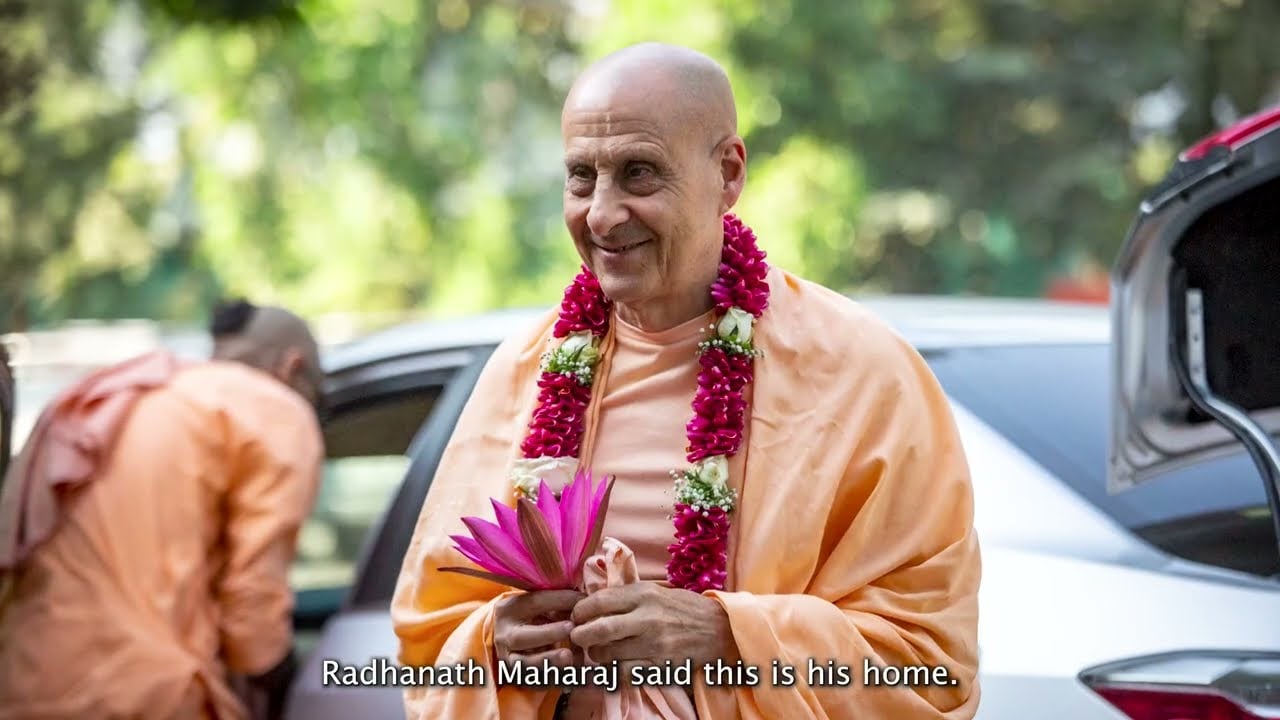
Revival – Govardhan Eco Village Short Film, presented by the Wisdom in Bhakti channel, offers a precise and deeply felt portrait of Govardhan Ecovillage (GEV) in Maharashtra, India, where sustainable living and spiritual practice are purposefully integrated. The film frames GEV as a living laboratory of dharmic ecologya place where environmental stewardship, cultural continuity, and inner transformation reinforce one another.
Situated against the serene backdrop of the Sahyadri foothills, GEV demonstrates how regenerative design can be harmonized with time-honored spiritual disciplines. Rather than treating ecology and spirituality as parallel tracks, the narrative shows them as interdependent systems, cultivating resilience in land, community, and consciousness. This synthesis echoes the civilizational ethos of Vasudhaiva Kutumbakam, positioning human society as kin with the natural world.
The film’s core contribution lies in system-level integration. Built form, water, energy, waste, agriculture, education, and sadhana are not isolated programs but mutually supportive loops. Each design elementvernacular architecture, water-sensitive planning, decentralized energy, and organic agriculturefeeds into a circular economy model that reduces external inputs and minimizes ecological footprints.
Architecture at GEV emphasizes climate-responsive, low-embodied-energy construction. Passive design strategiesorientation for solar gain control, shaded courtyards, natural cross-ventilation, and thermally massive wall assemblieswork in tandem with locally appropriate materials (including earth-based systems, stone, lime, and bamboo) to reduce operational energy and enhance thermal comfort. The result demonstrates how traditional building wisdom can meet modern performance expectations without sacrificing aesthetic or cultural integrity.
Water management is presented as a watershed-scale endeavor rather than a building-by-building afterthought. The film highlights rainwater harvesting, contour bunds and trenches, percolation features, and on-site storage that together slow, spread, and sink monsoon flows. Greywater is polished through natural reed-bed treatment, while blackwater and organic residues feed biogas digestersclosing nutrient loops and reducing both freshwater demand and downstream pollution.
Energy and waste systems are similarly decentralized and circular. Solar photovoltaic arrays provide clean electricity, while biodigesters convert kitchen waste and cow dung into biogas for cooking. Vermicomposting transforms organic matter into fertile soil amendments. These coordinated interventions shift material streams from “take–make–dispose” to “recover–reuse–regenerate,” aligning daily life with circular economy principles and measurable carbon reductions.
Agriculture at GEV foregrounds soil health and biodiversity conservation. The short film points to multi-cropping, mulching, composting, and natural inputs that nurture microbial diversity and build soil organic matter over time. The gaushala and Panchgavya-based practices exemplify a gentle, locally appropriate nutrient cycle rooted in ahimsa and ecological responsibility. These approaches strengthen climate resilience while improving food quality and on-farm livelihoods.
Social infrastructure is treated as carefully as physical infrastructure. The narrative underscores capacity-building, skill transfer, and community livelihoods as co-equal aims with environmental outcomes. Spaces for collective learning, seva, and cultural arts help preserve intangible heritage while equipping residents and visitors with practical tools to reduce waste, conserve water, and steward local ecologies.
The film frames spiritual practicebhakti-yoga, kirtan, mindful japa, and reflective studyas the motivational core sustaining ecological discipline. By cultivating inner stability and compassion, practitioners maintain the daily habits that make conservation durable. Yoga and Ayurveda further complement this orientation, emphasizing balance, restraint, and holistic well-being as foundations for sustainable living.
Importantly, the film’s ethos is inclusive across dharmic traditions. Shared principles such as ahimsa (non-harm), aparigraha (non-possessiveness), dana and seva (service) are portrayed as universal anchors. The resulting culture of respect readily welcomes Hindus, Buddhists, Jains, and Sikhs into a common endeavor of ecological care and inner growthstrengthening unity while honoring diversity in practice and belief.
The pedagogical dimension is explicit. GEV functions as a demonstration site where farmers, students, professionals, and policy thinkers can observe whole-systems design at village scale. The short film positions the campus as a replicable blueprint: start with local soils and seeds; add rainwater harvesting, decentralized renewables, and organic inputs; embed cultural practices that sustain discipline; and measure outcomes transparently.
Methodologically, the film’s claims map onto established assessment frameworks. Practitioners can benchmark against the Sustainable Development Goals (notably SDGs 2, 6, 7, 11, 12, 13, and 15), track water budgets (harvested vs. consumed), monitor energy intensity (kWh per capita, renewable share), quantify waste diversion and compost yields, assess biodiversity through transects and pollinator counts, and evaluate well-being using health and participation indicators. This data-centric culture makes spiritual ecology empirically legible.
Visually, Revival adopts a contemplative aesthetic. Slow, lingering shots of earthen walls, shaded colonnades, and terraced greens convey an atmosphere of calm productivity. The soundscapebirdsong, soft percussion, and congregational voicesfunctions as evidence of place-making, inviting viewers to feel the texture of a daily life that is both restrained and joyful. The editorial rhythm mirrors the design thesis: minimal waste, maximal integrity.
Comparatively, GEV sits within a global movement of ecovillages and regenerative settlements while retaining a distinctly dharmic character. Its synthesis of bhakti, Yoga, Ayurveda, and circular systems illustrates how civilizational knowledge can inform contemporary transitions to low-carbon, high-resilience living. The film arguesimplicitly yet convincinglythat spiritual motivation reduces behavior–impact gaps that often stall sustainability in purely technocratic models.
Policy relevance emerges naturally from the narrative. The GEV model aligns with decentralized governance, livelihood diversification, and climate adaptation priorities in rural India. Water-secure villages reduce disaster risk; agroecology lowers input costs; and vernacular construction supports local economies. Such convergences illustrate how cultural continuity can accelerate public goals without erasing regional distinctiveness.
For many viewers, the most affecting sequences are ordinary: hands turning compost; children learning under a banyan’s shade; elders leading kirtan at dusk. These scenes make the argument relatable. The film does not cajole; it invites. Audiences are encouraged to imagine balcony composters in apartments, greywater reuse in housing societies, rooftop solar where feasible, and community gardens tended as acts of shared seva.
As a communication artifact, Revival is careful and specific, yet emotionally resonant. It avoids grandstanding, instead documenting a culture of disciplined care. By connecting inner work and outward practice, it offers a credible pathway for households, campuses, and gram panchayats seeking low-cost, high-impact sustainability transitions that honor dharmic values and scientific rigor alike.
In sum, the short film presents Govardhan Ecovillage as a coherent model of eco-friendly living in India, grounded in bhakti yet open to the shared moral universe of Hinduism, Buddhism, Jainism, and Sikhism. It demonstrates that environmental conservation, circular economy design, and spiritual growth need not be parallel pursuits; integrated thoughtfully, they become mutually reinforcing disciplines capable of transforming both landscapes and lives.
Inspired by this post on Dandavats.
