
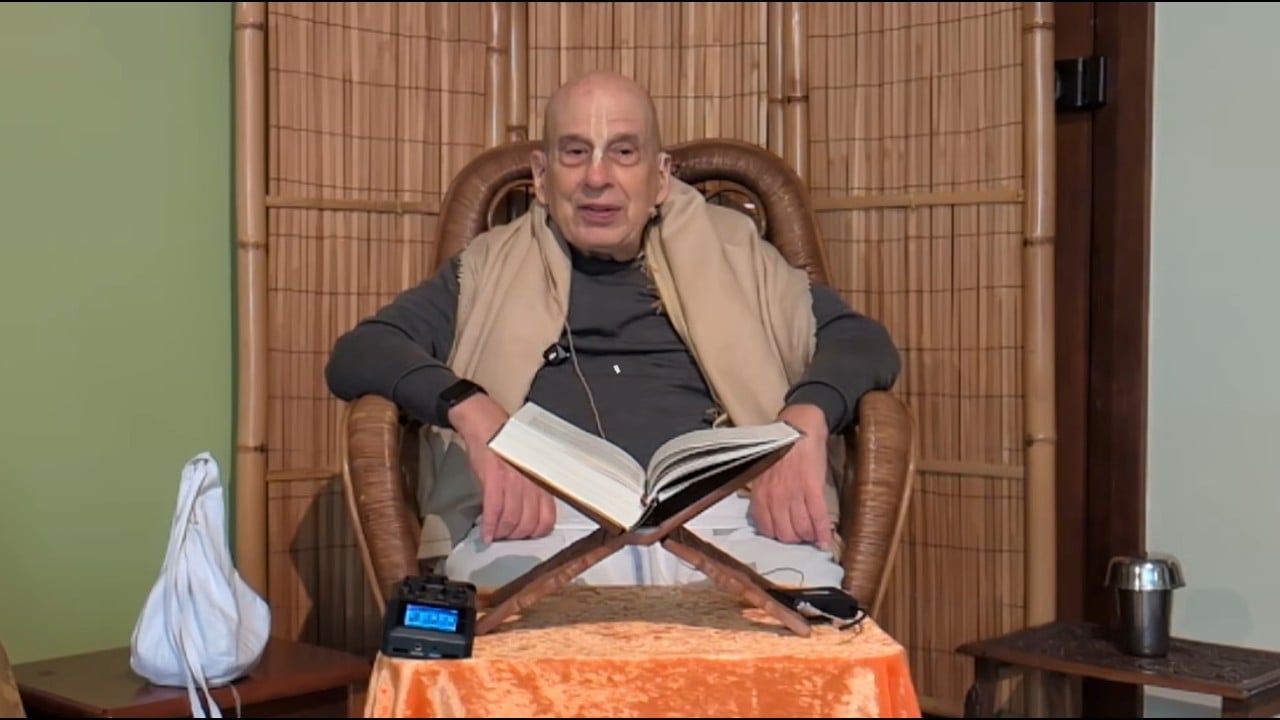
His Grace Bhurijana Dasa, a senior ISKCON educator and a disciple of His Divine Grace A.C Bhaktivedanta Swami Srila Prabhupada who has practiced bhakti since 1968, presents Caitanya-caritamrta as both a rigorous theological treatise and a living guide to devotional life. The session emphasizes careful, text-centered inquiry while remaining accessible to contemporary seekers who value clarity, compassion, and practical application.
Caitanya-caritamrta, authored by Krsnadasa Kaviraja Gosvami, weaves Bengali narrative with Sanskrit citations to articulate the philosophy and practice of Gaudiya Vaishnavism. It is structured in three sectionsAdi-lila (foundations and ontology), Madhya-lila (teachings and outreach), and Antya-lila (internal devotional intensification)and functions simultaneously as biography, theology, and pedagogy. In ISKCON’s curriculum and practice, this text stands alongside core Scriptures as a primary reference for the life and teachings of Sri Caitanya and His associates.
A key contribution highlighted in the class is the tripartite architecture of spiritual knowledgesambandha (the ontological relationship between the individual soul, the Supreme, and the world), abhidheya (the disciplined practice of bhakti that arises from that understanding), and prayojana (the ultimate goal of pure love for Krishna). This mapping gives the work unusual coherence; each narrative episode is not merely historical but didactic, inviting readers to translate insight into disciplined, compassionate conduct.
The theological heart of Caitanya-caritamrta is acintya-bhedabheda, the doctrine of inconceivable simultaneous oneness and difference between the Divine and the individual soul. This both-and framework resists rigid binaries, encouraging intellectual humility and an ethos of dialogue. By normalizing complexity and complementarity, it provides a philosophical basis for respectful engagement across the family of dharmic traditionsHinduism, Buddhism, Jainism, and Sikhismwhere devotion, ethics, and contemplative insight are honored in diverse forms.
The text’s devotional center is Sri Caitanya, understood in Gaudiya Vaishnavism as the combined compassion of Sri Radha and Sri Krishna. Within the narrative, the yuga-dharmanama-sankirtana, the congregational chanting of the holy namesappears as the primary method for spiritual awakening in the present age. Verses such as “trnad api sunichena taror iva sahisnuna” from the Siksastaka instill a disciplined humility indispensable for steady practice, social harmony, and inner peace.
Consistent with ISKCON pedagogy, the class underscores the triad of authorityguru, sadhu, and sastraand the need to corroborate insights through this parampara-based method. In practical terms, this means approaching the Caitanya-caritamrta with reverence for Srila Prabhupada’s purports, cross-referencing earlier Gosvami literature, and applying reason in service to revelation rather than in opposition to it. Such hermeneutics cultivate integrity, coherence, and deep learning.
Specific episodes frequently examinedSarvabhauma Bhattacarya’s transformation, Ramananda-samvada on the gradations of spiritual love, the empowerment of Rupa and Sanatana Gosvamis, the deliverance of Jagai and Madhai, and the Ratha-yatra meditationsserve as case studies in how scholarship, compassion, and disciplined practice converge. Each account functions as a mirror: proud intellectualism gives way to wisdom tempered by humility; social outreach becomes inseparable from personal purity; and aesthetic theology (rasa) is anchored in ethical responsibility (dharma).
The class also situates the Caitanya-caritamrta within a broader Gaudiya textual ecology, especially Rupa Gosvami’s Bhakti-rasamrta-sindhu and the Sanatana-Rupa exegesis on practice (sadhana) and goal (sadhya). Technical distinctionssuch as vaidhi-bhakti (rule-governed practice) and raganuja-bhakti (spontaneous practice guided by realized exemplars)are explained not as abstractions but as developmental possibilities aligned to temperament, guidance, and grace.
Progress in bhakti is charted through stages widely referenced in Vaishnava pedagogy: adau sraddha (initial faith), sadhu-sanga (holy association), bhajana-kriya (regulated practice), anartha-nivrtti (clearing impediments), nistha (steadiness), ruci (taste), asakti (attachment), bhava (spiritual emotion), and prema (pure love). The class frames these stages as a realistic pathway, where setbacks are contextualized and perseverance is normalized, supporting sustainable growth over sudden enthusiasm.
Practical sadhana receives sustained attention: attentive nama-japa, kirtana, study (svadhyaya), seva (service), and community life that fosters mutual accountability. Learners often report that the humility imperativespeaking gently, listening carefully, serving without expectationtransforms family dynamics, workplace collaboration, and civic engagement. In this way, Caitanya-caritamrta speaks directly to the moral psychology of modern life.
The class responsibly addresses nama-aparadha (offenses to the holy name), not to induce fear, but to articulate the psychology of reverence. Avoiding slander of sincere practitioners, honoring Scriptures, and sustaining gratitude toward guides are taught as protective disciplines that refine attention and deepen devotion. Such guardrails align with wider dharmic virtues: ahimsa (non-harm), satya (truthfulness), and daya (compassion).
Methodologically, the session acknowledges that Caitanya-caritamrta is hagiographic as well as historical. Rather than reading it as a simple chronicle, it is approached as normative theology conveyed through sacred biography. This academically balanced stancevaluing both literary form and theological contentallows students to appreciate its genre while engaging its claims with rigor and respect.
The unity of the dharmic family is a recurring subtext. Nama-sankirtana resonates with Sikh nama-simran in its focus on the Divine Name; Vaishnava compassion finds natural kinship with Buddhist karuna; disciplined non-possessiveness and non-violence parallel Jain aparigraha and ahimsa. The class presents these convergences as invitations to mutual learning, reinforcing harmony without diluting doctrinal specificity.
From a community-development perspective, Caitanya-caritamrta also functions as a charter for ethical leadership: scholarship wedded to humility, service prioritized over prestige, and devotion expressed through care for people and planet. Participants frequently find that steady chanting, study, and service reduce anxiety, support healthier habits, and nourish a sense of belongingoutcomes aligned with the Hare Krishna Movement’s global emphasis on compassionate living.
For study strategy, the class recommends paced, contemplative reading: begin with Adi-lila to anchor ontology, progress through the teaching-rich Madhya-lila, and then enter the interiority of Antya-lila. Keeping a journal of questions, cross-referencing purports, and discussing insights in satsanga produce durable retention and actionable clarity. Many find that pairing daily japa with short, consistent reading windows stabilizes both mind and schedule.
Within ISKCON’s educational ethos, Srila Prabhupada’s translation and purports are foregrounded for their fidelity to parampara and their ability to connect metaphysical depth with contemporary life. The class leverages this strength, guiding learners to move from information to transformationcultivating qualities like patience, gratitude, and long-view resilience that empower spiritual progress.
In sum, the Caitanya-caritamrta class by His Grace Bhurijana Dasa exemplifies academically responsible devotion: precise about doctrine, honest about genre, and generous in application. It models how a classical Scripture can inform modern ethical life, strengthen unity within the dharmic family, and guide seekers toward a practiced love that is emotionally mature, intellectually grounded, and socially constructive.
Inspired by this post on Dandavats.
