
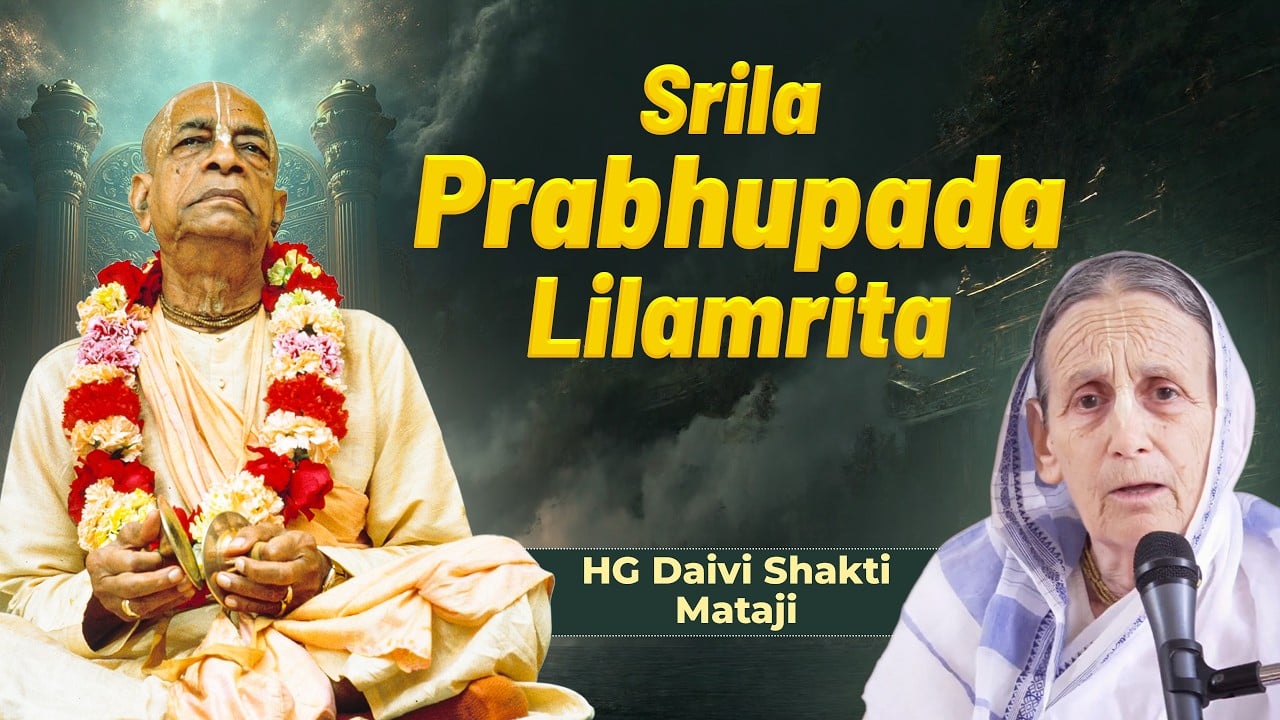
On 31.05.2026 in ISKCON Vrindavan, HG Daivi Shakti Mataji presented a carefully structured reflection on Srila Prabhupada-lilamrita, bringing together eyewitness memory, temple history, and textual scholarship to illuminate A. C. Bhaktivedanta Swami Prabhupada’s life and mission. The presentation highlighted how the Hare Krishna Movement emerged at the intersection of scriptural fidelity, disciplined practice, and institution-building, offering enduring guidance for contemporary seekers within Sanatana Dharma and the wider Dharmic family.
As a biographical corpus, Srila Prabhupada-lilamrita occupies a central place in understanding modern Gaudiya Vaishnavism. HG Daivi Shakti Mataji’s recollections, anchored in Vrindavan’s living tradition, function as a complementary oral history that adds texture to established records. This dual lensdocumented biography alongside temple-based memoryenables a clearer view of how teachings from the Bhagavad-Gita and Srimad Bhagavatham were translated into viable communities of practice on multiple continents.
Key milestones provide the historical frame. Born Abhay Charan De in 1896 in Calcutta (now Kolkata), later initiated by Srila Bhaktisiddhanta Sarasvati Thakura in 1933, and accepting sannyasa in 1959 as A. C. Bhaktivedanta Swami, he embarked for the West aboard the Jaladuta in 1965. In 1966, the International Society for Krishna Consciousness (ISKCON) was incorporated in New York, inaugurating a period of rapid growth based on sankirtana, scripture-centered education, and community outreach through prasadam distribution and the Back to Godhead magazine.
The theological center of this work is Gaudiya Vaishnavism’s achintya-bheda-abheda, the doctrine of simultaneous oneness and difference between the Supreme and the individual self. This personalist Vedantic vision, grounded in the Bhagavad-Gita and Srimad Bhagavatham, situates bhakti as a rigorous yoga pathway. HG Daivi Shakti Mataji underscored how this framework coheres with wider Dharmic ethicsseva, satya, ahimsa, and disciplined inner cultivationresonating with shared values found across Hinduism, Buddhism, Jainism, and Sikhism.
Recollections of daily sadhana were especially instructive. The standardized practices Srila Prabhupada institutedjapa on the Hare Krishna maha-mantra, adherence to four regulative principles, and the morning devotional programformed a reproducible culture of devotion across diverse geographies. Emphasis on the Guru-Shishya Tradition ensured that philosophical understanding, etiquette, and practice were transmitted through living association, enabling depth rather than mere diffusion.
Publishing served as the movement’s intellectual spine. With the Bhaktivedanta Book Trust (BBT) formed in the early 1970s, translation, commentary, editing, typesetting, and global distribution followed a disciplined workflow. The result was an unprecedented proliferation of Vaishnava literatureover several dozen volumes, including the Bhagavad-gita As It Is, multi-volume Srimad-Bhagavatam, and the Sri Chaitanya-charitamritasupporting both academic study and congregational learning. Methodologically, Srila Prabhupada’s hermeneutic of presenting the text “as it is” foregrounded parampara integrity while engaging contemporary readers.
Institutional architecture amplified these ideals. The establishment of the Governing Body Commission (GBC) in 1970, a coherent temple network, and a robust letter-based governance culture exemplified a rare synthesis of spiritual vision and managerial clarity. From a comparative perspective within religious studies, ISKCON’s early growth provides a case study in how doctrine, practice, and governance can be mutually reinforcing in transnational movements.
Vrindavan’s Krishna-Balaram Mandir, inaugurated in 1975, exemplifies how sacred geography shapes devotional life. HG Daivi Shakti Mataji’s Vrindavan-centered memories situate Srila Prabhupada’s leadership within a living tirtha, where temple worship, scriptural classes, and kirtan formed an integrated ecumene of bhakti. The mandir’s rhythms demonstrate how heritage conservation, congregational participation, and pedagogy coalesce into a sustainable spiritual ecosystem.
Equally central was outreach through sankirtana and prasadam, aligning spiritual hospitality with community health and social cohesion. This praxis-oriented approachrooted in compassion, cultural arts, and scriptural discoursescaled effectively because it preserved core principles while flexibly accommodating local languages, aesthetics, and civic contexts, a hallmark of yukta-vairagya in Gaudiya Vaishnavism.
HG Daivi Shakti Mataji’s role illustrates the essential contributions of women to ISKCON’s historical developmentteaching, kirtan, archana, education, and literary service. These contributions, in continuity with Sanatana Dharma’s emphasis on mutual upliftment, demonstrate how inclusive participation strengthens tradition, scholarship, and community resilience without compromising philosophical rigor.
A unitive Dharmic ethos was repeatedly evident. Values cherished across Hinduism, Buddhism, Jainism, and Sikhismtruthfulness, compassion, self-discipline, seva, and remembrance of the Divineprovide a shared platform for dialogue and collaboration. The principle of Vasudhaiva Kutumbakam, understood as the world family bound by dharma, invites mutual respect for distinct paths while celebrating a common ethical core.
From a historiographic standpoint, the reliability of Srila Prabhupada-lilamrita benefits from triangulation: letters, diary entries, audio recordings, photographs, and contemporaneous press accounts. Oral histories such as those curated by HG Daivi Shakti Mataji enrich this record by adding experiential nuance and cultural context, which are vital for understanding lived religion and the transmission of tradition.
The leadership pattern that emerges is analytically clear: doctrine articulated with precision; sadhana standardized; education institutionalized; governance formalized; culture celebrated through music, dance, and festivals; welfare advanced through prasadam and accessible teaching. This design, grounded in the Bhagavad-Gita and Srimad Bhagavatham, allowed ISKCON to remain philosophically coherent while culturally adaptive across societies.
Practical takeaways for contemporary practitioners are direct and measurable: cultivate steady daily sadhana; invest in scriptural study that leads to practice; serve communities through compassionate outreach; honor the Guru-Shishya Tradition; and engage in collaborative, accountable governance. These steps benefit individual transformation while fostering unity-in-diversity across the Dharmic landscape.
Taken together, the insights shared by HG Daivi Shakti Mataji render Srila Prabhupada’s legacy both historically accessible and practically actionable. The enduring relevance of Srila Prabhupada-lilamrita lies in demonstrating how timeless teachings can be embodied in institutions, literature, and compassionate service. In emphasizing unity, shared ethics, and respectful pluralism, the narrative affirms a living Sanatana Dharma that welcomes cooperation among Hindu, Buddhist, Jain, and Sikh traditions while remaining rooted in the Bhakti Tradition’s philosophical clarity and devotional depth.
Inspired by this post on Dandavats.
