
Across the long arc of the Vijayanagara Empire’s history, the durability of statecraft and the continuity of sacred life rested not only on sovereigns but also on a cadre of ministers and generals whose combined military acumen and administrative prudence formed an indispensable backbone of governance. Their recorded attributesprowess, loyalty, foresight, generosity, and a principled commitment to Dharmasurface repeatedly in inscriptions that celebrate both their victories and their ethical conduct. This corpus makes clear that the political narrative of Vijayanagara is inseparable from the biographies of its functionaries, whose service safeguarded the realm and sustained cultural life for centuries.
Titles borne by these figures help map the imperial hierarchy and division of responsibilities: Odeyar (Master), Nayaka (Leader), Mantri and Amatya (Minister), and Daṇḍanāyaka (Commander). The Daṇḍanāyakaalso rendered as Dandanayaka, Daṇḍanātha, Daṇḍādhiśa, Daṇḍeśa, and Daṇḍādhipatiwas a pivotal officer who often combined military leadership with civil-administrative duties, including fort management, protection of trade corridors, revenue oversight in assigned territories, and the maintenance of local order. Although institutional arrangements evolved over time, these offices collectively underpinned Vijayanagara’s mixed civil–military model that paired battlefield readiness with everyday governance.
Within this constellation of officials, Gunda Daṇḍanātha stands out as a commander whose reputation rests almost entirely on inscriptional evidence rather than on extensive biographical detail. The absence of information about his birth or lineage contrasts sharply with the vivid accounts of his conduct and standing, attesting to a commemorative practice that privileged demonstrable service over personal background. Such sources, while poetic in tone, preserve key data points about how rank was earned, authority was exercised, and cultural obligations were fulfilled.
A long Kannada inscription from Belur dated 1397 CEcomposed during the reign of Harihara II (r. 1377–1404 CE)presents Gunda Daṇḍanātha in the exalted language of royal eulogy (praśasti). It compares his relationship to Harihara II with the trusted bond of Sumantra to Daśaratha and evokes the Rāma–Māruti (Hanuman) paradigm to frame ideals of virtuous kingship and devoted service. Though rich in literary hyperbole typical of its genre, the inscription conveys a historically consistent core: Gunda Daṇḍanātha’s office was earned through battlefield merit and sustained through exemplary loyalty and administrative competence.
An earlier inscription from Channapattana dated 1395 CE reinforces his stature in civil administration. It records that during the reign of “the Maharajadhiraja Raja-paramesvara, Master of the Four Oceans, Vira-Harihara-Maharaya [Harihara II], and the great minister Gundappa Daṇṇāyaka Odeyar,” a grant was executed at Malaur-sthala to Kaliyappa-Setti, the senior merchant of Horapattanagiri, “by the hand of the Eighteen country,” i.e., an administrative unit comprising eighteen districts. This notice places Gunda Daṇḍanātha not only at the center of military affairs but also within the routine circuitry of commerce-friendly governance, adjudication, and local orderfunctions essential to imperial resilience.
These paired recordsBelur (1397 CE) and Channapattana (1395 CE)illustrate a twofold profile that recurs in Vijayanagara’s institutional culture: commanders who fought external threats while simultaneously stewarding internal stability and economic exchange. The inscriptions’ specific language and ceremonial epithets should be read within the conventions of praśasti composition; yet their concrete references to offices, places, and administrative units make them dependable anchors for reconstructing careers and policies.
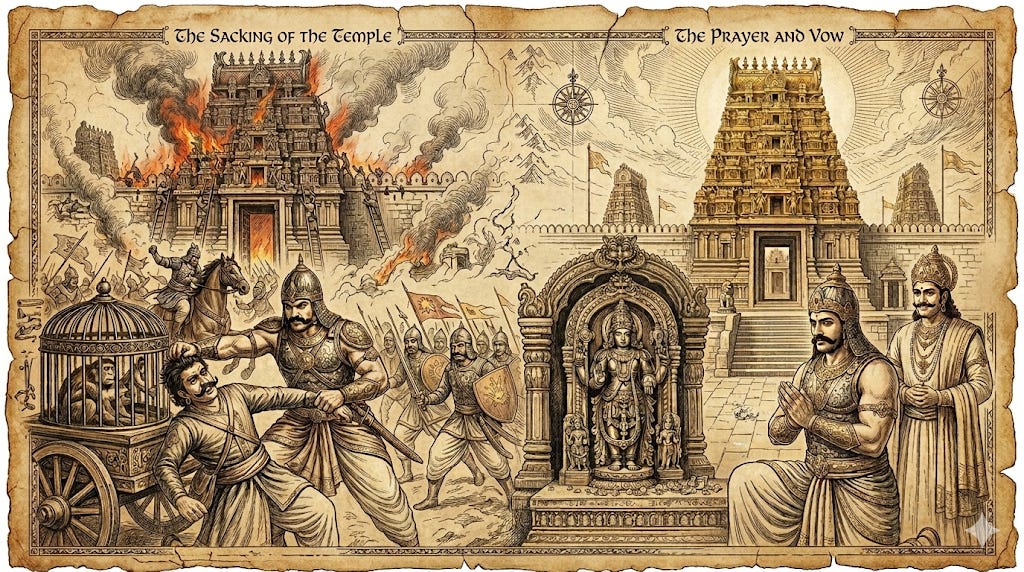
Regional geopolitics provide the backdrop to Gunda Daṇḍanātha’s most consequential campaign. In 1397 CE, Tāj-ud-dīn Fīrūz Shāh ascended the Bahmani throne at Gulbarga, precipitating hostilities with Vijayanagara. The Belur inscription explicitly states that during this conflict the celebrated Chennakeshava Temple at Belur suffered assault, naming “that Turuka Ganga-Śālar [Salar Gangu] from Kallubarage [Gulbarga]” as responsible for burning its main door and toppling its tower. As with many inscriptional claims, the passage preserves the Vijayanagara side of events; however, it aligns with the broader pattern of temple-targeting during raids and counter-raids in late-medieval Deccan warfare.
Within the same text, Gunda Daṇḍanātha’s counteroffensive is described through vivid martial metaphors signifying the rout of invading forces and the reassertion of Vijayanagara’s security perimeter. While such combative imagery is conventional to royal inscriptions, its narrative thrust is clear: by arms and organization, he neutralized the immediate threat, extended punitive expeditions into hostile zones, and commemorated the victories with Jaya-stambhas (pillars of triumph). These markers, widespread in medieval India, functioned not only as symbols of conquest but also as geographical signposts of regained stability.
What follows in the inscription is an act that exemplifies the empire’s duty toward cultural continuity: after expelling the aggressors, Gunda Daṇḍanātha sought and obtained Harihara II’s sanction to undertake a comprehensive restoration of the damaged Chennakeshava Temple at Belur. The sequencedefense, stabilization, and sacred restorationreveals a coherent policy logic. Restoration here is best understood as a multi-pronged operation: repairing structural elements (gateways, superstructure where applicable), re-endowing ritual cycles, supporting temple personnel, and, when needed, re-establishing associated craft and merchant ecosystems that sustained temple towns.

Technically, the Belur Chennakeshava complexfounded under the Hoysalas and revered across generationsrepresents a high watermark of South Indian temple architecture. Its star-plan platform (jagati), lathe-turned pillars, chloritic schist (soapstone) sculptural program, intricate friezes, and narrative panels reflect advanced artisanal organization and long-honed guild knowledge. Damage to such a monument has consequences far beyond a single sanctuary; it disrupts patrons, guilds, ritual specialists, and regional trade, making restoration an economic and social imperative as much as a devotional one.
Placed alongside other long-remembered figuresSaluva Thimmarasu (Appaji), Gopanna Dandanayaka (Gopanarya), Irugappa Dannayaka, and Lakshmidhara AmatyaGunda Daṇḍanātha’s profile fits a recognizable pattern of Vijayanagara leadership: the synthesis of kṣātra (protective valor) and seva (service) directed toward safeguarding the polity and regenerating sacred institutions. This synthesis is echoed in the inscription’s Rāma–Māruti simile, which encapsulates a theory of statecraft wherein upright sovereignty and devoted, competent service operate in tandem to realize Dharma in public life.
From a historiographical standpoint, the Belur and Channapattana inscriptions underscore methodological cautions and opportunities. On one hand, praśasti diction leans toward magnification, requiring cross-checks with additional sources when available. On the other hand, the inscriptions provide precise names, locales, titles, and administrative constructsBelur, Malaur-sthala, Horapattanagiri, the “Eighteen country,” and titulature like “Maharajadhiraja Raja-paramesvara”that allow historians to triangulate chronology, map jurisdictional layers, and infer procedural norms in grant-making and temple patronage.
The case also invites a broader reflection on civilizational ethics shared across the dharmic spectrumHindu, Buddhist, Jain, and Sikh traditionswhere stewardship of sacred spaces and care for community institutions are seen as civic virtues. In this light, Gunda Daṇḍanātha’s program of protection followed by restoration exemplifies an ethic of resilience through constructive action. The repair of shrines, reactivation of ritual calendars, and reconstitution of livelihoods sustained by sacred precincts serve not as acts of retaliation but as affirmations of cultural continuity and pluralistic public good.
In policy terms, three elements of Vijayanagara’s approach stand out. First, the empire linked frontier defense and interior stability, recognizing that secure trade and temple towns were essential to revenue and social cohesion. Second, it empowered senior officersDaṇḍanāyakas among themto act as both military commanders and local governors capable of making timely grants and industrially relevant decisions. Third, it invested in heritage restoration as a deliberate state responsibility, acknowledging the economic multiplier effects of reviving sacred–civic hubs such as Belur.
For readers familiar with the sculpted eaves and rhythmic friezes of Belur, the inscriptional memory of injury and renewal adds another layer to the experience of walking its corridors. The site becomes a palimpsest of devotion, artistry, disruption, and rebuildingeach phase legible in stone, each renewal a testament to organized care. Seeing the temple’s survival through the lens of Gunda Daṇḍanātha’s service reveals how individual agency, imperial policy, and community participation converged to protect and regenerate a living monument.
Ultimately, Gunda Daṇḍanātha emerges as the “armour” of Vijayanagara under Harihara IIhis arms raised in defense when war arrived, his hands turned to restoration when peace returned. The inscriptions do more than praise a commander; they document a governance model that braided military readiness, administrative clarity, and heritage stewardship into a single fabric. For contemporary discussions on cultural heritage management and inter-community harmony, this episode offers a historically grounded blueprint: protect what is essential, restore what sustains shared life, and prioritize institutions that embody ethical order for all.
Inspired by this post on Dharma Dispatch.
