
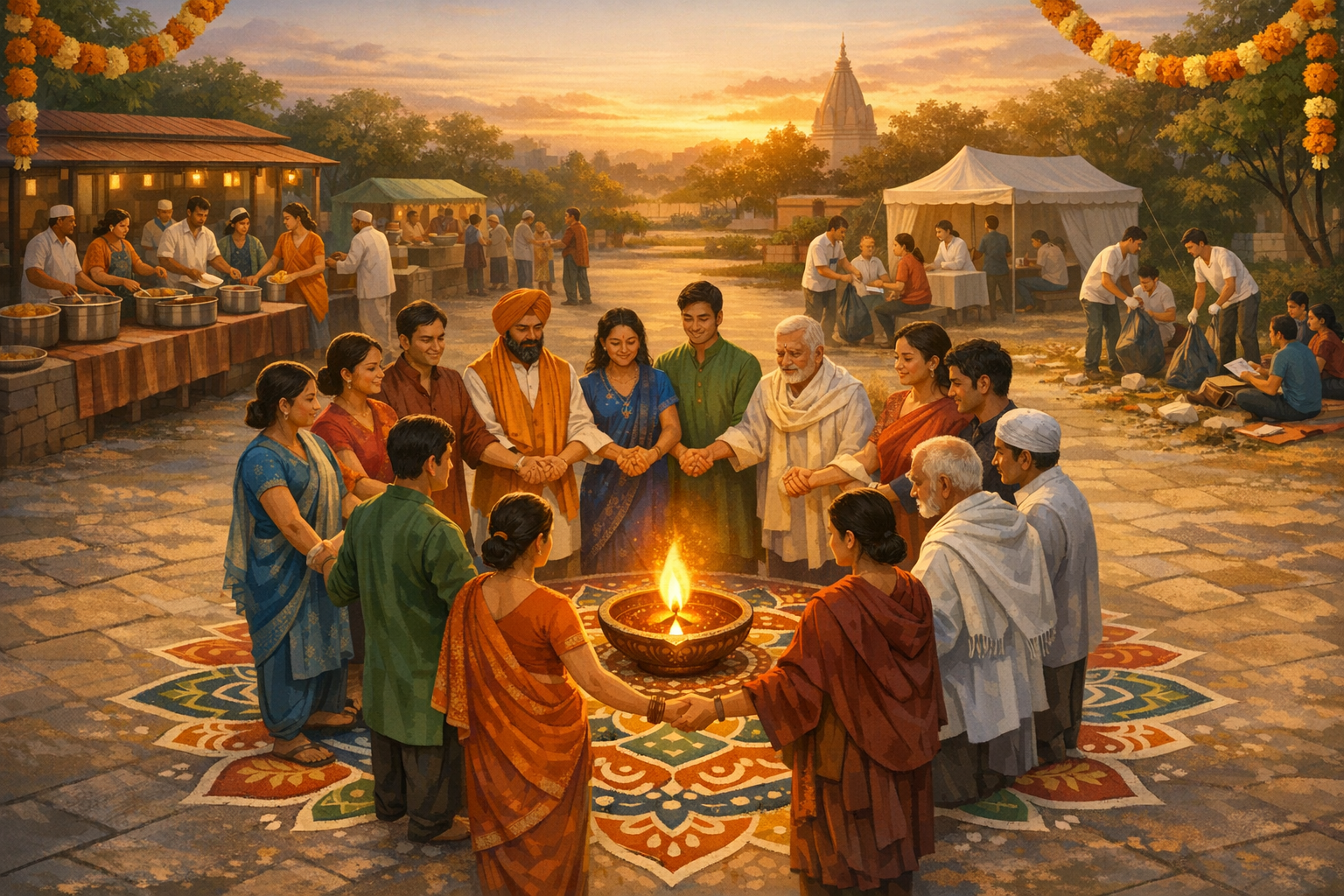
The Virat Hindu Sammelan in Navi Sangvi featured a clear and disciplined appeal by Shri. Sunil Ghanwat to transcend caste-based divisions and consolidate unity. The intervention framed social cohesion as a moral and civic imperative, linking cultural confidence with collective responsibility. Within this frame, unity was presented not as uniformity, but as shared ethical purpose grounded in dharma.
Viewed through a wider civilizational lens, the call resonates across dharmic traditions of Hinduism, Buddhism, Jainism, and Sikhism. Each tradition offers complementary insights into compassion, responsibility, and servicean integrated ethos that strengthens community cohesion, social harmony, and unity in diversity. The Sammelan’s message therefore aligns with an inclusive dharmic vision: cultivating solidarity while safeguarding plural paths and practices.
From a social-scientific perspective, caste-based segmentation lowers social capital, inhibits trust, and fragments collective problem-solving. Reducing these frictions enables communities to mobilize more effectively for education, health, livelihood, and disaster resilience. This is not merely a moral question; it is a practical one tied to measurable outcomes such as volunteerism rates, cross-community initiatives, and equitable access to institutions.
Dharmic ethics provide a robust foundation for this agenda. Ahimsa and karuna nurture non-violence and compassion; dana and seva cultivate giving and service; anekantavada encourages intellectual humility and multi-perspectival understanding; and the Sikh ideal of sarbat da bhala emphasizes the welfare of all. Together, these principles orient communities away from sectarian identity and toward shared purpose, strengthening Hindu Unity while honoring diversity in spiritual practice.
Historically, inclusive practices have long served as bridges across social boundaries. Open community kitchens (langar), anna-dana at temples and mathas, and village-level sabhas demonstrate how everyday service dissolves social distance. Such practices generate repeated, positive contactthe most consistent predictor of reduced biasand translate ideals of unity into lived experience.
Contemporary obstacles are well documented: persistent social sorting, endogamy, and local micro-segregation in education, housing, and even communal spaces. Addressing these patterns requires institutional commitment: charters against discrimination, transparent selection processes for community leadership, and grievance mechanisms that emphasize reconciliation and restorative outcomes.
A practical roadmap emerges from the Sammelan’s emphasis on unity beyond caste. First, scale shared-seva initiatives with mixed teamshealth camps, cleanliness drives, skill-building workshops, and community kitchenswhere roles rotate to avoid reproducing hierarchies. Second, foster joint observances and study circles that spotlight common dharmic values rather than differences in ritual form. Third, integrate caste-sensitivity and dignity-of-labor modules in youth programs to preempt bias formation.
Fourth, use multilingual and locally resonant communication to ensure accessibility across communities, especially for first-generation learners. Fifth, encourage inter-community mentorship networks that pair professionals and students across social groups, linking aspiration with solidarity. Sixth, convene periodic unity audits that assess representation, participation, and satisfaction across segments, converting ideals into measurable practice.
Institutionalizing progress requires governance reforms in community bodies and temple trusts: codes of conduct with zero tolerance for discrimination; inclusive appointment norms; public reporting of participation metrics; and third-party facilitation for conflict resolution where needed. Diaspora partnerships can add capacityknowledge exchanges, leadership training, and digital infrastructurewithout displacing local agency.
Communication strategy is equally pivotal. Narratives that foreground dignity, shared ancestry, and mutual uplift are more effective than oppositional frames. Case studies of joint service, women-led collaboration, and youth leadership should be documented and shared widely to normalize unity as best practice. Positive storytelling reinforces a pro-social identity that outcompetes divisive scripts.
Safeguards help sustain credibility: eschew politicization, uphold constitutional values, respect lawful freedoms of belief and association, and maintain a strict focus on service delivery and coexistence. Unity in spiritual diversity must remain the non-negotiable center of gravity, ensuring that community-building efforts do not inadvertently marginalize any group within the dharmic family.
The anticipated dividends are substantial. Reduced social distance correlates with better public health uptake, higher educational continuity, safer neighborhoods, and resilient local economies. Trust-rich communities innovate faster, coordinate better during crises, and cultivate a culture of service where youth experience pride rooted in contribution rather than exclusion.
The Sammelan’s references to strengthening Hindutva and discussions around the Hindu Rashtra discourse can be understood, in an inclusive frame, as a call to ethical and cultural stewardship in public life. Grounded in constitutional pluralism and mutual respect among Hinduism, Buddhism, Jainism, and Sikhism, such stewardship prioritizes compassion, equality of dignity, and rule of lawmoving from slogan to service, and from identity to responsibility.
In sum, the Virat Hindu Sammelan at Navi Sangvi acts as a catalyst for renewed commitment to unity beyond caste divisions. By centering dharmic ethics, operationalizing inclusive service, and measuring progress transparently, communities can convert aspiration into durable structures of cooperation. The path ahead is clear: unite in purpose, honor diversity in practice, and build a social fabric strong enough to safeguard cultural heritage and advance the common good.
Inspired by this post on Hindu Jagruti Samiti.
