
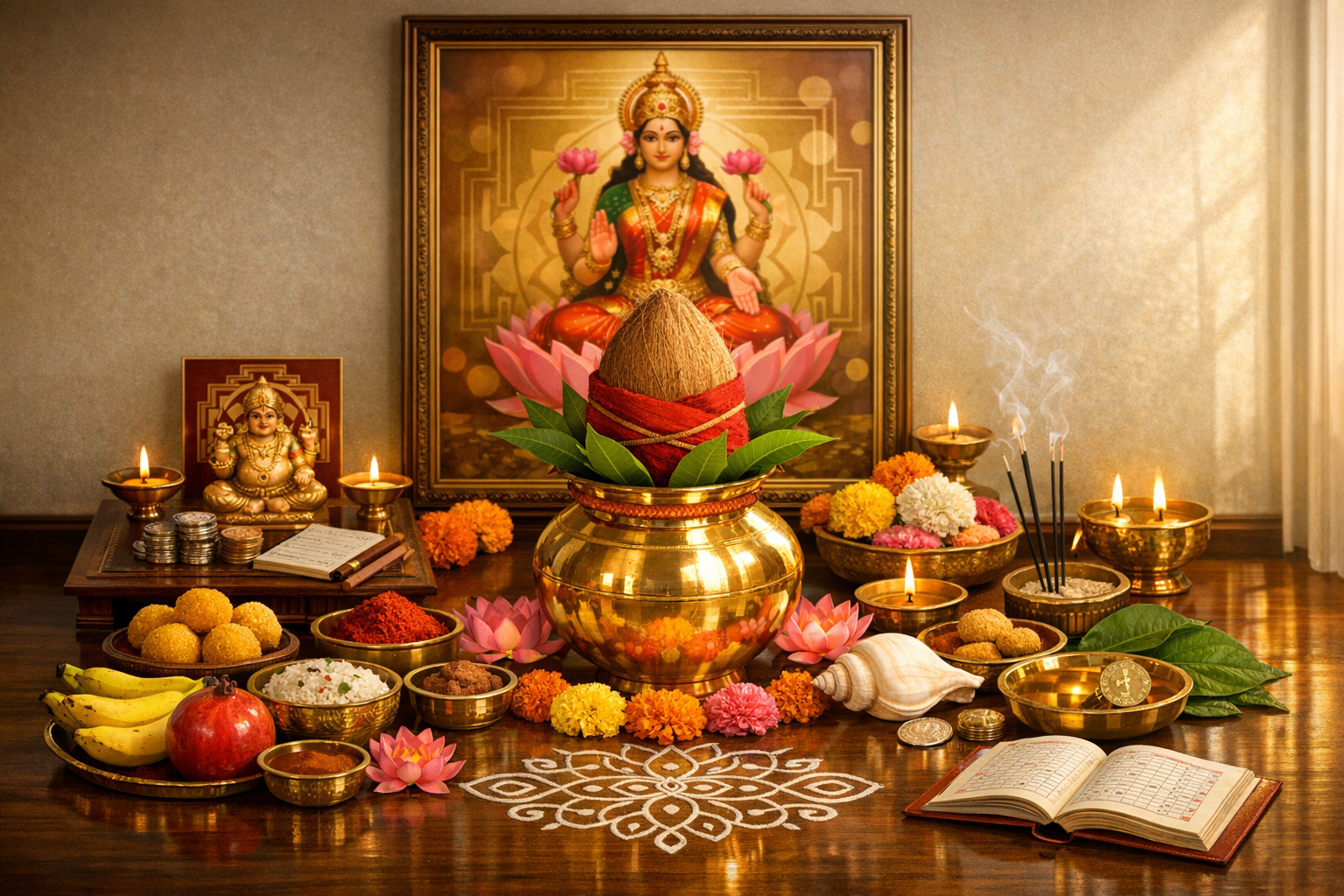
Akshay Tritiya, also known as Akshaya Trutiya, is widely revered as a day dedicated to Goddess Lakshmi, with Lakshmi Puja regarded as the principal observance. Falling on Vaishakh Shukla Tritiya (the third lunar day of the bright fortnight), the festival is celebrated across India and the wider dharmic world as a sarva-siddha muhurtaan auspicious window believed to support endeavors that lead to long-lasting, “akshaya” (imperishable) prosperity and well-being.
The term “Akshaya” signifies that which does not diminish. Within household and temple traditions, this vision of inexhaustible grace is cultivated through Lakshmi Puja, Kubera worship, charitable giving, and consciously beginning virtuous undertakings. The “Lakshmi Tantra” (a Pancharatra Agama text) emphasizes Sri-Lakshmi as the generative source of prosperity; liturgical traditions further portray Lord Kubera, the treasurer of the devas, as venerating Lakshmi, which is why many households perform Kubera-Lakshmi Puja together on this day.
Akshaya Trutiya is observed in April–May and is associated in several regions with additional observances that reinforce its sacred tenor. In Odisha, it marks the commencement of the Ratha Yatra chariot-construction at Puri and the agricultural rite “Akhi Muthi Anukula.” Many sampradayas also observe Parashurama Jayanti on this date, while Vaishnava lore remembers unfailing divine support exemplified in narratives such as Draupadi’s Akshaya Patra. These complementary traditions collectively frame the day as one of renewal, steadfastness, and ethical abundance.
The day’s spirit resonates across dharmic lineages. In Jain tradition, Akshaya Trutiya commemorates the Varshi Tapa Parana of Tirthankara Rishabhanatha (Adinatha), who is believed to have ended a prolonged fast with sugarcane juice offered by Shreyanshaenshrining dana (generosity) as a civilizational ideal. The Buddhist dāna pāramitā and the Sikh emphasis on seva and langar further illuminate a shared ethic: prosperity is most sacred when it nurtures community, dignity, and compassion.
Calendrically, Akshaya Trutiya is defined by the tithi of Vaishakh Shukla Tritiya prevailing during local daylight hours. Many almanacs note that the Sun typically resides in Mesha (Aries) during this period, with the Moon often transiting Vrishabha (Taurus), a configuration traditional astrologers regard as strengthening the day’s auspiciousness. In practice, householders align Puja with the Tritiya tithi, using a trusted panchang to confirm the timing at their location.
While customs vary by region, Lakshmi Puja on Akshay Tritiya or Akshaya Trutiya follows a coherent, time-honored structure. The following field-tested outline presents a technically precise, home-friendly vidhi while allowing flexibility for family parampara and local guidance.
Step 1: Purification and Space Preparation. After a bath, clean the Puja space, draw a simple kolam or rangoli, and light a ghee lamp. Arrange a clean cloth on the altar, placing an image or murti of Sri-Lakshmi and, if available, a Sri Yantra or Shree Chakra. Keep water, turmeric, kumkum, akshata (rice mixed with turmeric), incense, flowers (preferably lotus or red/yellow flowers), sandalwood paste, fruits, sweets (kheer, sheera, or ladoo), and a coin of gold or silver ready.
Step 2: Sankalpa. Facing east, sit in a calm posture and state the intention (sankalpa) for the Pujanaming place, date (per local panchang), and wish for lasting prosperity, ethical livelihood, and community well-being. This moment anchors resolve to use wealth for dharmic purposes, education, healthcare, and annadanam (feeding).
Step 3: Kalasha Sthapana. Place a kalasha (pot) filled with clean water, add a few grains, a pinch of turmeric, and a coin. Cover with mango leaves and a coconut wrapped in a new cloth. The kalasha symbolizes abundance and life-sustaining waters; it functions as a focal vessel for divine presence during worship.
Step 4: Dhyana and Invocation. Offer mental salutation to Lakshmi and Vishnu. A concise bija-based invocation may be used: “Om Shreem Mahalakshmyai Namah.” Chant gently, with steady breathing, to cultivate one-pointedness and a serene affective state. Families frequently recite Kanakadhara Stotram or Sri Sukta to harmonize the mind and space.
Step 5: Shodashopachara (or Panchopachara) Puja. Proceed through the classical sequenceavahana (invocation), asana, padya, arghya, achamaniya, snana (abisheka if appropriate), vastra, alankara, gandha, pushpa, dhupa, deepa, naivedya, tambula, and visarjanaadapting to household feasibility. When time is limited, Panchopachara five offerings with gandha, pushpa, dhupa, deepa, and naivedya remains fully respectful.
Step 6: Archana with Namavali. Perform archana using Lakshmi Ashtottara Sata Namavali, offering flowers, akshata, or tulasi leaves with each name. This meticulous recitation reorients attention toward virtues embodied as Ashta-LakshmiDhana, Dhanya, Gaja, Santana, Vijay, Vidya, Dhairya, and Adi-Lakshmiwhile reinforcing a holistic understanding of “wealth.”
Step 7: Kubera Puja. Place a small image or yantra of Kubera slightly to the north or northwest of Lakshmi. Offer yellow or white flowers, chandan, and naivedya while reciting a Kubera mantra such as: “Om Yaksha-Rajaaya Vidmahe Kuberaaya Dhimahi Tanno Dhaneshah Prachodayat.” In many homes, counting and organizing coins near the altar symbolizes responsible stewardship and transparent financial ethics.
Step 8: Naivedya and Aarti. Offer naivedyasweet rice, fruits, and waterfollowed by aarti. Distribute prasada among family members and neighbors. Sharing prasada expresses the core ethic that prosperity expands by circulation and care, not by hoarding.
Step 9: Dāna and Annadanam. Conclude with tangible acts of generosityfood distribution, support for education or healthcare needs, aid to artisans, or contributions to community kitchens. This aligns the Puja’s inner intent with actionable social uplift, a point emphasized in Vaishakha Mahatmya passages across Puranic literature and mirrored in Jain, Buddhist, and Sikh praxis.
Minimalist Home Puja Option. When time or resources are limited, a simple Lakshmi-Kubera worship with a lamp, flowers, a coin, and recitation of Sri Sukta or the seed mantra “Om Shreem Mahalakshmyai Namah” suffices. The festival’s potency is traditionally attributed as much to sincerity, satvik offerings, and ethical follow-through as to procedural elaboration.
Muhurta Guidelines in Practice. Although Akshaya Trutiya is famed as sarva-siddha muhurta, householders typically prefer to perform Lakshmi Puja while Tritiya tithi prevails at their location. Additionally, many align rituals with a sthira lagna (Taurus, Leo, Scorpio, Aquarius), or within the midday period, to symbolize stability. If scheduling constraints arise, the devotional focus can remain on Tritiya’s daylight span, with pradosh worship used as a supplementary window.
Why Lakshmi and Kubera Together. The liturgical pairing reflects complementary principles: Lakshmi as the cosmic source of śri (beauty, order, flourishing) and Kubera as the guardian and allocator of resources. Worshiping both emphasizes that abundance must be ethically mobilizedkept in right measure, audited with honesty, and circulated to benefit family and society.
Gold Purchase, New Ventures, and Ethical Prosperity. Tradition encourages the initiation of ventures, acquisition of tools, or purchase of gold on Akshaya Trutiya to symbolize lasting growth. Yet scriptural counsel consistently pairs acquisition with dharmafair wages, ecological restraint, and commitments to charity. Many families prefer “productive assets” or skill investments alongside symbolic gold, integrating prosperity with purpose.
Mantra, Mind, and Method. The phonetics of “Shreem” in Lakshmi mantra practice is associated in traditional commentaries with the nurturing, harmonizing aspect of śakti. Slow, rhythmic chanting coupled with lamp-gazing and gentle breath awareness fosters a parasympathetic responsecalm attention and emotional steadinesswhich, in turn, supports lucid intention-setting and judicious decision-making about wealth.
Family Participation and Cultural Memory. Children often help arrange flowers, count coins, or light lamps, learning that Lakshmi Puja is as much about gratitude, orderliness, and sharing as it is about receiving. Households commonly recount stories of auspicious new beginnings or timely assistance experienced in previous years, reinforcing collective confidence and cultural continuity.
Common Pitfalls and How to Avoid Them. Confusing the tithi window or overlooking local sunrise-based calculations are typical errors; a reliable panchang or a consultation with a family priest helps. Overemphasis on material acquisition without a dana plan can dilute the festival’s essence; balancing purchases with annadanam and service restores the day’s intended equilibrium.
Regional Variations Enrich the Core. Whether observed through Chandan Yatra rituals in Odisha, Parashurama Jayanti in many regions, or agricultural rites that sanctify the sowing season, diverse practices converge on one axis: honoring Lakshmi by embedding prosperity within ethics, ecology, and service.
Akshaya Tritiya 2026 Planning Note. As dates shift annually on the lunisolar calendar, households preparing for Akshaya Tritiya 2026 should confirm the Vaishakh Shukla Tritiya span and preferred Puja window via a trusted local panchang. Aligning the ritual within the tithi while maintaining satvik conduct, annadanam, and Kubera-Lakshmi worship preserves both textual fidelity and living tradition.
In essence, Lakshmi Puja on Akshay Tritiya or Akshaya Trutiya integrates devotion, disciplined ritual, and social responsibility. By honoring Sri-Lakshmi and Kubera through mantra, upacharas, and dana, households embody the festival’s central promise: abundance that does not diminish because it flowsgrowing families, enabling livelihoods, nourishing communities, and deepening the unity across Hindu, Buddhist, Jain, and Sikh traditions through a shared ethic of generosity and service.
Inspired by this post on Hindu Pad.
