
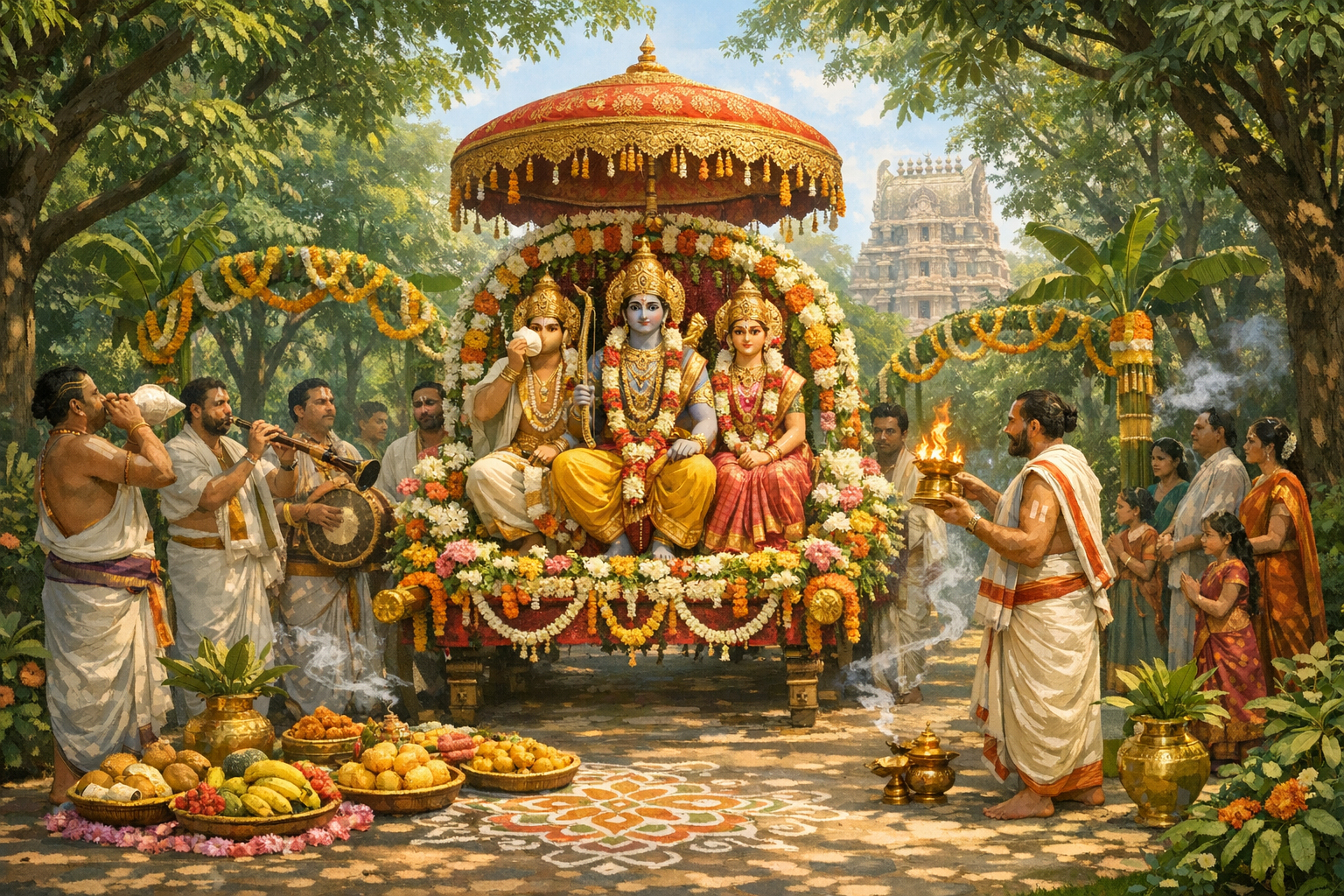
On Saturday, 4 April 2026, Tirupati witnessed the “Repakula Subbamma Thota Utsavam” (Garden Festival) for Sri Sita, Rama, and Lakshmana at the Sri Kodandarama Swamy Temple, observed with pronounced devotional intensity and meticulous ritual order. The celebration is a significant feature of the spring festival cycle in Andhra Pradesh and showcases the living continuity of Vaishnava temple traditions that harmonize nature, community, and sacred time.
At 9:30 AM, the processional deities (Utsava Murthies) of Sri Sita Rama and Lakshmana commenced the ceremonial procession, offering devotees an opportunity for darshan in a verdant, garden-like setting. The movement of the Utsava Murthies beyond the sanctum is central to public worship, enabling a wider circle of participation in seva through viewing, singing, and offerings. Traditional elements typically associated with such processionsVedic recitations, mangala-vadyam (auspicious music), harati, and naivedyamreinforce the shared, participatory ethos of the occasion.
Thota Utsavam, in essence, integrates ritual aesthetics with environmental sensibilities. The thota (garden) setting functions as a seasonal and symbolic space of coolness, fragrance, and reposequalities emphasized in the spring months of Chaitra. Within the broader Vaishnava ritual calendar, garden and sandalwood-themed observances are widely attested, aligning with practices that aim to create a soothing ambience for the deities and the community. This seasonal ritual ecology expresses a classical ideal: divinity is honored not only with words and rites but also through the cultivation of serene, natural surroundings.
The epithet “Repakula Subbamma Thota” points to a distinct local devotional legacy. Across South Indian temple towns, named gardens and endowed groves have historically supported festivals by providing floral resources, shaded spaces, and venues for processions. While the particulars of patronage and naming can vary in oral and archival accounts, the consistent thread is a culture of community stewardshipwhere benefactors, volunteers, and temple administrators collaborate to sustain ritual life over generations.
Situated in the heart of Tirupati, the Sri Kodandarama Swamy Temple is a noted Vaishnava shrine dedicated to Sri Rama, accompanied by Sita and Lakshmana, and is administered within the institutional framework familiar to Tirupati’s sacred landscape. Architecturally, the temple embodies hallmarks of Dravidian style, while ritually it participates in the wider Vaishnava agamic continuum. Its festival schedule throughout the year engages residents, pilgrims, and students of culture alike, making it a vital node in the region’s temple network.
Theologically, the triad of Sri Sita, Rama, and Lakshmana conveys complementary virtuesdharma, compassion, and steadfast sevawhich the garden festival subtly mirrors. The curated environmentflowers, shade, soft light, and the cadence of sacred soundilluminates a key liturgical principle: sensory refinement can orient the mind toward contemplation. In this sense, Thota Utsavam is not merely a public procession; it is a carefully composed field of devotion where aesthetics serve inner stillness.
Observers frequently describe a palpable calm as the procession moves through the garden precinctfragrances intermingling with Vedic chant, the gentle rhythm of percussion guiding collective attention. Families, elders, and children share the experience, narrating impressions of serenity, gratitude, and cultural belonging. Such lived accounts underscore how processional worship functions as both religious practice and intergenerational education.
The festival’s reverence for nature and emphasis on communal seva resonate with shared values across dharmic traditionsHinduism, Buddhism, Jainism, and Sikhismwhere care for living beings, disciplined mindfulness, and gratitude for the natural world are recurrent themes. This consonance strengthens social cohesion, encourages ecological responsibility, and highlights the inclusive heart of India’s civilizational heritage without asserting any single, exclusive path.
For prospective visitors, it is prudent to track timings announced by temple authorities, arrive early for orderly darshan, and observe customary etiquette regarding sanctity, dress, and photography restrictions. Given the seasonal climate, carrying water and opting for eco-conscious practices (such as minimizing single-use plastic) enhances both personal comfort and environmental stewardshipan apt extension of the Thota Utsavam spirit.
As a living tradition in Tirupati, the “Repakula Subbamma Thota Utsavam” continues to serve as a bridge between scriptural ideals and contemporary community life. By celebrating Sri Sita, Rama, and Lakshmana in a garden setting, the festival affirms a timeless vision: devotion flourishes where the sacred, the natural, and the social meetsustaining cultural memory, nurturing ethical sensibilities, and inspiring unity across the diverse strands of the dharmic family.
Inspired by this post on Hindu Pad.
