
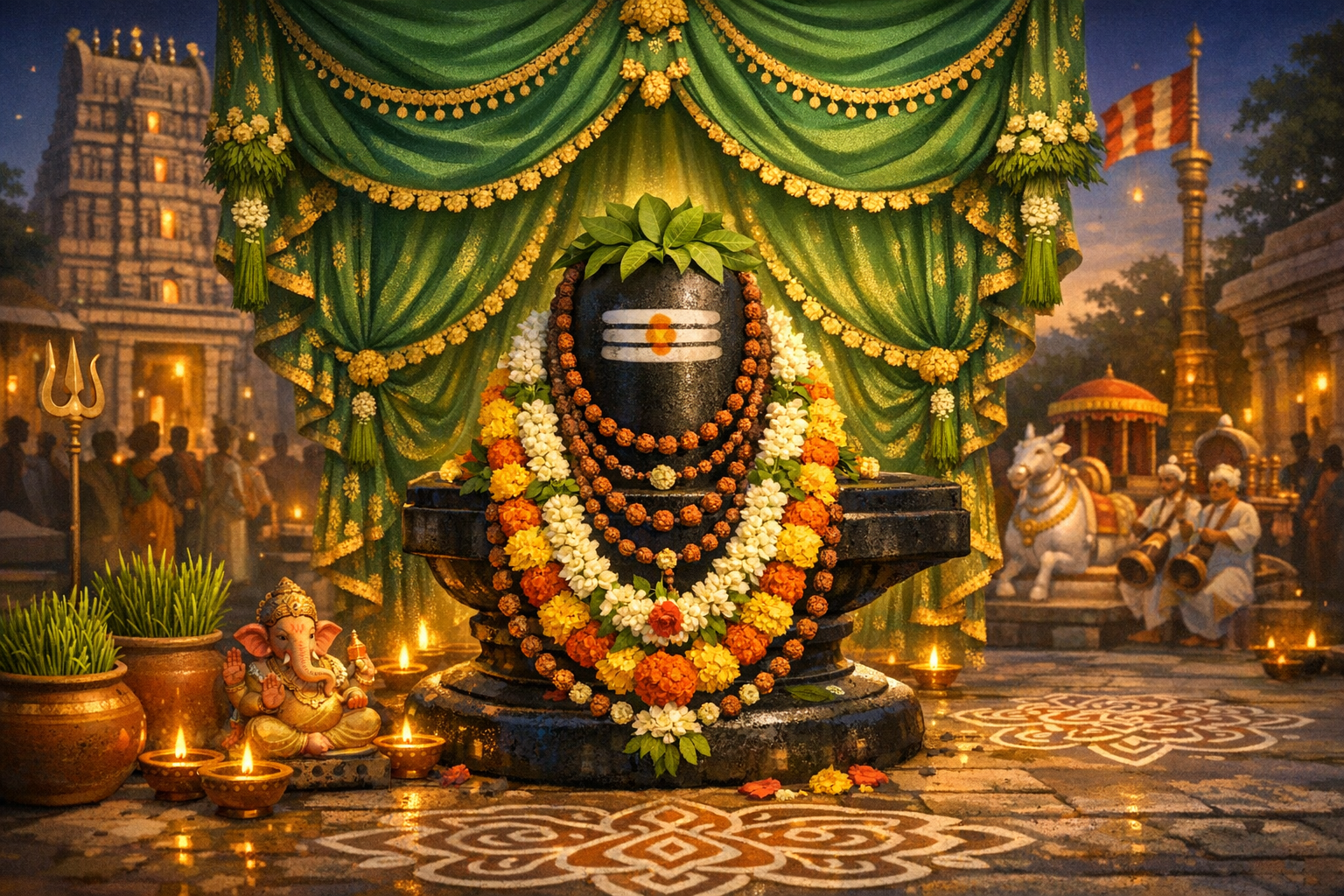
The annual Brahmotsavams of Sri Agastheeswara Swamy, together with Goddess Maragadavalli and in sacred association with Sri Kalyana Venkateswara Swamy Temple, will be celebrated at the Narayanavanam Mandal headquarters from April 21 to April 30. As per tradition, the festivities are preceded by Ganapati Puja and Ankurarpanam (the preliminary ritual) on April 20 from 6:00 PM to 8:30 PM, invoking auspicious beginnings for the ten days that follow.
Narayanavanam, situated in the Tirupati region of Andhra Pradesh and near Puttur, is a historic confluence of Shaiva and Vaishnava devotion. The Agastheeswara Swamy Temple venerates Shiva in the aspect sanctified by the seer Agastya, while the nearby Sri Kalyana Venkateswara Swamy Temple recalls the sacred marriage lore of Sri Venkateswara and Sri Padmavathi. The Brahmotsavam at Narayanavanam thus unfolds within a regional landscape renowned for inter-sect harmony and a living temple culture that nourishes both faith and community.
Theologically, Agastheeswara signifies Shiva as revealed to Sage Agastya, whose Puranic narrative ties the spiritual geography of South India to the wider dharmic cosmos. Agastya’s mission to the southern landsoften associated with restoring balance at the time of Shiva–Pārvatī’s weddingbecame a cornerstone for the transmission of Vedic learning and temple worship in the Tamil and Telugu regions. Maragadavalli, the consort in this kshetra, embodies the emerald-hued grace of the Divine Mother, and is traditionally invoked for prosperity, well-being, and inner steadiness.
In South Indian temples, Brahmotsavam (Brahma + Utsava, a “grand festival”) marks the temple’s annual cycle of renewal, thanksgiving, and public veneration. While programmatic details vary by temple, the liturgical architecture typically includes Ankurarpanam (seed-sowing and sankalpa), Dhwajarohanam (ritual flag hoisting), daily homas, abhishekam, alankaram, naivedyam, and processions of the utsava-murti on various vahanams, culminating in Dhwajavarohanam (flag lowering) that ritually concludes the festival. At Shaiva kshetras, the vahana-sevas and accompanying mantras, music, and temple arts together manifest Shiva’s anugraha (grace) for the entire community.
The April 20 Ankurarpanam, preceded by Ganapati Puja, is the ceremonial genesis of the Brahmotsavam. In Vedic ritual logic, the sowing of auspicious seeds (often navadhanyas) in sanctified vessels symbolizes the intention that dharma, health, and collective merit take root and flourish during the festival. Ganapati Puja, performed first, ensures removal of obstacles and a serene, well-ordered commencement for all subsequent rites.
From April 21 to 30, devotees can expect the hallmark cadence of a traditional Brahmotsavam: morning abhishekam to Sri Agastheeswara Swamy and Goddess Maragadavalli, alankaram and archana with Vedic recitations, and evening utsava processions accompanied by nadaswaram, tavil, and community participation. Although the precise day-wise vahana schedule is temple-specific and announced locally, the devotional experience consistently centers on darshan, mantra-shravanam, and prasadamritual acts that collectively renew social bonds and spiritual purpose.
Devotees frequently describe the Brahmotsavam at Narayanavanam as a stirring blend of scholarship, devotion, and community life. The settingfragrant with incense, resounding with sacred syllables, and illuminated by lampsinvites reflective silence as well as joyous participation. Families, elders, and children alike share prasadam and stories, and many recount a distinct sense of inner equilibrium on witnessing the utsava-murti in processionan experience of darshan that is both intimate and communal.
Practical considerations enhance the pilgrimage. Narayanavanam lies approximately 35–40 km from Tirupati and a short distance from Puttur (rail connectivity via Puttur Railway Station). The nearest airport is Tirupati (Renigunta, TIR). APSRTC and private buses serve the corridor, with local autos and taxis available for last-mile access. April in Andhra Pradesh is peak summer, so light cotton attire, sun protection, and hydration are advisable. Observing temple decorummodest dress, footwear removal, and respectful silence during homas and recitationspreserves the sanctity of the space.
In spirit and practice, the Brahmotsavam underscores unity-in-diversity within dharmic traditions. The association of Sri Agastheeswara Swamy Temple with Sri Kalyana Venkateswara Swamy Temple highlights harmony between Shaivism and Vaishnavism, while shared idealsseva (service), dayā (compassion), self-discipline, and collective well-beingresonate across Hindu, Buddhist, Jain, and Sikh pathways. Community annadanam, mutual respect, and mindful conduct reflect a civilizational ethos that welcomes all sincere seekers.
Sustainable pilgrimage practices support both heritage and environment: carrying reusable water bottles, minimizing single-use plastics, and following queue systems ease crowding and reduce waste. Photography norms, if any, should be honored, and offerings should conform to temple guidelines to maintain ritual integrity and ecological care.
Devotees are encouraged to check temple notice boards and local announcements for the day-wise vahana-seva schedule, special darshan timings, and any additional cultural programs or discourses that often accompany Brahmotsavam. With Ganapati Puja and Ankurarpanam on April 20 (6:00 PM to 8:30 PM), and festival days running April 21–30, the Agastheeswara Swamy Brahmotsavam at Narayanavanam offers a rare opportunity to experience sacred time, rigorous ritual, and living heritage in one luminous continuum.
Inspired by this post on Hindu Pad.
