
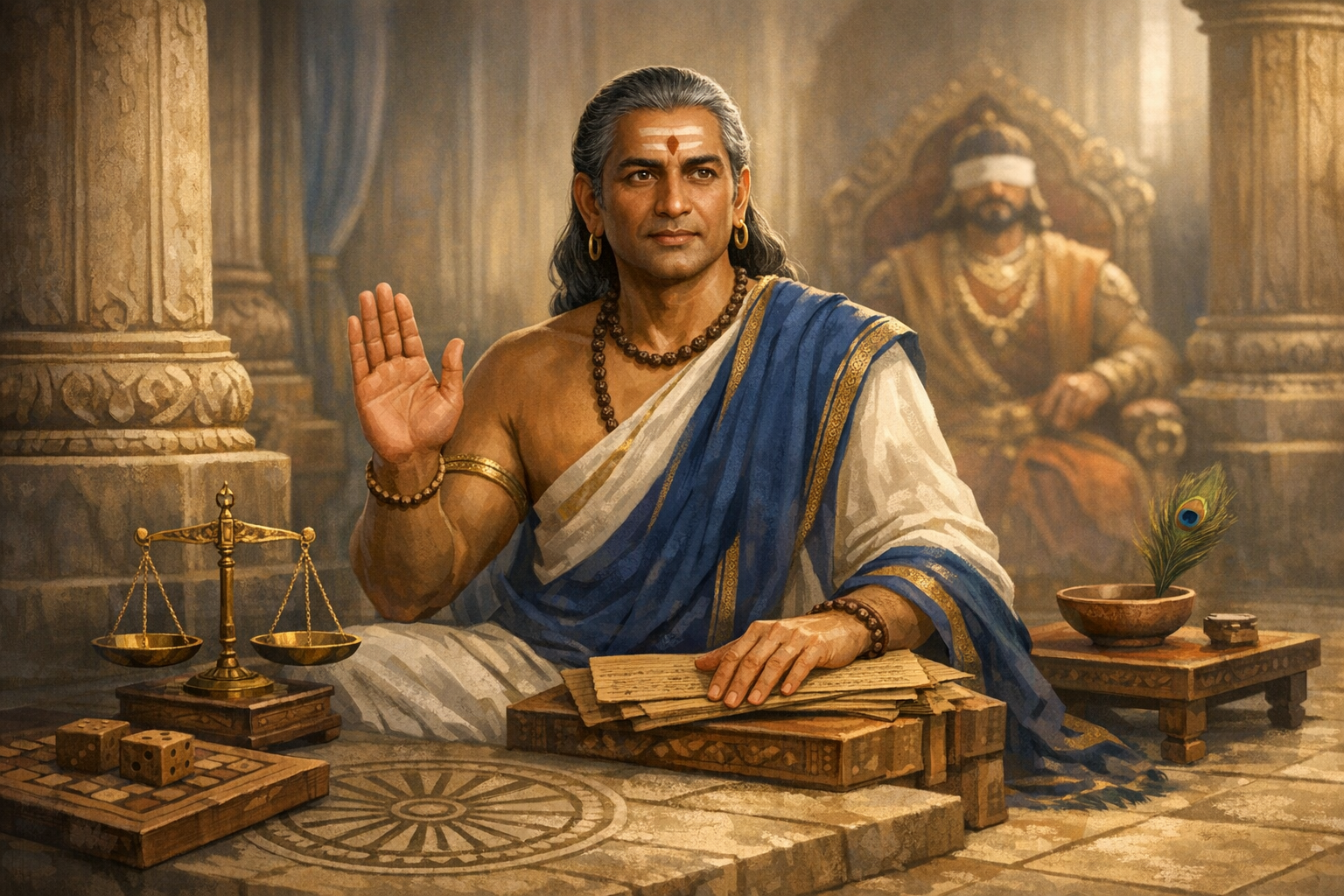
In the vast moral and political universe of the Mahabharata, Vidura emerges as a singular figure whose strength is truth and whose refuge is integrity. Neither a conquering warrior nor a sovereign king, he stands instead as Hastinapura’s ethical conscience, counseling rulers in moments when vanity, fear, and ambition cloud judgment. His presence demonstrates that statecraft, when untethered from dharma, inevitably corrodes both public trust and private character.
Vidura’s birth, under the institution of niyoga, is narrated with unusual frankness in the epic. Born to a maidservant when the queens declined the second union with Veda Vyasa, Vidura’s life subverts superficial readings of birth and status by insisting that character, not caste or lineage, grounds authority. His ascent to become the principal counselor of the Kuru court underscores a persistent Mahabharata theme: dharma, when steadfastly practiced, transcends social constraints and reshapes political destiny.
Tradition widely holds that Vidura is an incarnation of Dharma or Yama, born on earth due to a sage’s curse, a belief that deepens his literary and philosophical profile. Whether taken literally or symbolically, this association casts his counsel as an embodiment of moral law embedded within a human life. The narrative resonance with Yudhishthira, himself born of Dharma, further suggests an inner kinship between insight and power, between the principled word and the practical deed.
In Hastinapura, Vidura’s role extends beyond advice; he represents the governance ideal wherein kingship rests upon restraint, justice, and foresight. He consistently weighs policy against ethical first principles, reminding Dhritarashtra that long-term legitimacy cannot be purchased by short-term victories. Across crises small and immense, his voice functions as a barometer of collective welfare, insisting that what is expedient is not always right, and what is right is ultimately most expedient.
Early in the saga, Vidura’s prudence preempts catastrophe in the Lakshagraha episode. Perceiving the mortal danger of the lacquer house plot, he communicates in coded speech and enables contingency planning that saves the Pandavas. The episode illustrates a key dimension of Vidura-niti: ethical governance is not passive idealism; it is active vigilance that anticipates risks and protects life through discreet, lawful strategy.
Vidura’s unbending clarity is again on display during the dice-game assemblies. He denounces the manipulation that leads to Draupadi’s humiliation, branding the proceedings adharma, no matter how ceremonially legitimate they appear. By exposing the gap between ritual form and moral substance, he articulates a standard binding on all power family ties, political pressures, and courtly decorum cannot license injustice.
Those sessions also reveal Vidura’s method: he does not trade in flattery, nor does he retreat into silence. He speaks truth to power without animus, appealing to reason, precedent, and the king’s duty to protect the vulnerable. The moral demand is not vengeance but correction an insistence on restraint, apology, and restitution as conditions of durable peace.
Vidura-niti, preserved in the Udyoga Parva, is his most systematic counsel, offered to Dhritarashtra on the eve of calamity. There he delineates a statesman’s discipline: choosing peace when victory is uncertain, resisting greed, curbing anger, selecting advisors on merit, maintaining transparent justice, and measuring policies by their impact on those with the least power. The text’s elegance lies in its fusion of ethical clarity with practical wisdom a blueprint for rulership that refuses to separate public interest from personal virtue.
Sense-control forms the foundation of Vidura’s program. He warns that a ruler who cannot master desire, wrath, pride, and envy will be mastered by courtiers, factions, and accidents. In modern terms, this maps onto conflict-of-interest management: a leader’s inner governance of appetites is the quiet architecture that sustains outer governance of institutions.
Vidura is equally exacting about counsel. He outlines the profile of a trustworthy advisor learned yet humble, independent yet loyal to the commonweal, firm in private candor yet measured in public speech. He cautions against echo chambers and partial counsel, urging the king to triangulate views, reward dissent informed by evidence, and keep crucial offices free from familial capture.
On justice and welfare, Vidura’s guidance is expansive. He frames revenue not as extraction but stewardship, endorses moderation in taxation, and treats legal impartiality as a public good more vital than military might. Protecting subjects especially women, elders, and the poor is not ornament to rule but its moral center. The measure of prosperity, for Vidura, is security without fear and dignity without price.
Regarding war and diplomacy, Vidura applies a sober calculus. He examines the costs of conflict beyond battlefield arithmetic, weighing morale, legitimacy, supply, and the corrosion of social bonds. He favors negotiated settlement when the expected loss from war outweighs the uncertain gain from prideful victory, a precept that anticipates modern risk analysis and ethical realism.
Embedded within these maxims is a doctrine of contentment as the antidote to greed. Vidura argues that avarice multiplies risks, distorts judgment, and erodes loyalty. By restoring sufficiency over acquisition as a public ethic, leaders can resist cycles of corruption that ensnare both the palace and the marketplace.
In diplomatic method, Vidura’s approach aligns with classical upaya reconciliation, incentive, division of hostile coalitions, and force but he subordinates all techniques to the primacy of dharma. Strategy without ethics is, in his analysis, brittle; ethics without strategy is naive. Durable peace requires both, with justice as the non-negotiable frame.
Vidura’s hospitality toward Krishna during the peace embassy has become emblematic in cultural memory. Later devotional retellings highlight his satvika simplicity in receiving the divine envoy, contrasting sincerity with the court’s ostentation. The episode captures a recurrent Mahabharata theme: reverence for truth is better signaled by plain sincerity than by ceremonial spectacle.
As Duryodhana hardens his stance, Vidura’s forthrightness provokes hostility, and he withdraws from court rather than enable adharma. His departure is not abdication but testimony: there are moments when the only ethical way to serve the state is to refuse to legitimize its injustice. The choice foreshadows the tragedy of the Kurukshetra War while preserving the integrity that gives counsel its authority.
After the war, the epic moves into elegiac reflection. In the Ashramavasika Parva, Vidura’s final union with stillness is narrated with spiritual resonance, and his kinship with Yudhishthira both bearing the mark of Dharma is portrayed as a metaphysical convergence. The suggestion is clear: ethical counsel and ethical rule are two faces of the same truth.
Vidura-niti’s ethical architecture resonates across dharmic traditions. With Buddhism, it shares the ideal that ethical restraint and truth-telling are prerequisites to peace, echoing the spirit of sabba pāpassa akaraṇaṁ, kusalassa upasampadā, sacitta pariyodapanaṁ. With Jainism, it converges on aparigraha and ahimsa, recognizing that non-possessiveness and non-violence are engines of social trust rather than mere private vows. With Sikh tradition, it aligns with sat, seva, and the fearless rejection of partiality, showing that statecraft grounded in truth and service nurtures courage without hatred.
Far from sectarian, Vidura’s message is dharmic in the broadest sense: truth before tribe, duty before desire, compassion before conquest. The Mahabharata’s moral grammar thus becomes a shared inheritance for Hindus, Buddhists, Jains, and Sikhs alike, inviting unity around principles that dignify life and restrain power.
For readers navigating contemporary institutions governments, courts, companies, universities Vidura-niti offers a rigorous template. Recruit for character and competence rather than proximity; separate oversight from execution; welcome principled dissent; codify conflict-of-interest norms; invest in the welfare of the least powerful; and treat transparency not as performance but as policy.
In professional life, moments arise that mirror Hastinapura’s dilemmas: the pressure to look away, the temptation to rationalize a convenient injustice, the fear of speaking an unwelcome truth to a beloved elder or influential superior. Vidura’s example affirms that courage in counsel, delivered without malice and grounded in the common good, is not only possible but profoundly transformative.
At the personal level, Vidura reframes success as mastery of the self. When contentment moderates craving, when empathy softens judgment, and when truth disciplines speech, families heal and institutions become trustworthy. The quiet heroism of integrity often unseen in the moment becomes the architecture of a life that does not fracture under pressure.
Ultimately, Vidura’s legacy within the Mahabharata is not merely the negation of wrong but the positive construction of right order. By bridging morality with method, compassion with competence, and restraint with resolve, he bequeaths a canon of practical wisdom that remains startlingly current. In times that often reward noise over nuance, Vidura’s voice endures as a compass: act justly, advise fearlessly, and let dharma make power worthy of the people it serves.
Inspired by this post on Hindu Blog.
