
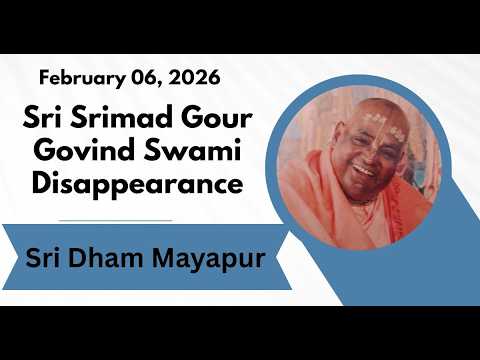
On February 06, 2026, ISKCON Mayapur observes the Disappearance Festival of Sri Srimad Gour Govinda Swami Maharaj, honoring a revered Gaudiya Vaishnava teacher whose life and work continue to inspire devotion, scholarship, and service. This commemoration, known within Gaudiya Vaishnavism as a sacred remembrance, invites deeper reflection on guru-tattva, the guru–shishya parampara, and the living continuity of bhakti across generations.
Sri Srimad Gour Govinda Swami Maharaj is widely respected for his rigorous commitment to guru, shastra, and sadhu, his lucid expositions of Srimad-Bhagavatam and Bhagavad-Gita, and his tireless kirtan and outreach, especially in Odisha and beyond. His legacy within ISKCON exemplifies the blending of precise scriptural understanding with heartfelt practicean approach that has shaped devotional communities and encouraged disciplined, compassionate spiritual lives.
In Gaudiya Vaishnavism, a disappearance day is not framed as an end but embraced as virahaan experience of presence through separation. Such remembrance strengthens sambandha (relationship) with the parampara, deepens sraddha (faith), and refines sadhana (practice). By contemplating the teachings and character of Sri Srimad Gour Govinda Swami Maharaj, practitioners internalize the essence of bhakti, cultivating humility, service (seva), and steady remembrance (smarana) of Sri Krishna.
At ISKCON Mayapur, observances on this day typically include sankirtan, guru-puja, discourses by senior Vaishnavas, offerings of prasadam, and reflective readings. In 2026, the program is expected to focus on the Swami Maharaj’s contributions, drawing attention to core themes of Gaudiya Vaishnavismdevotional sound (kirtan), scriptural insight, and compassionate community serviceso that participants can align personal practice with the broader spiritual mission.
The values elevated by this festivaldevotion, discipline, compassion, and truthfulnessresonate across the dharmic traditions of Hinduism, Buddhism, Jainism, and Sikhism. Shared emphases on contemplation, ethical conduct, reverence for teachers, and community service illustrate a unifying dharmic ethos. In this spirit, the day becomes a bridge of understanding, strengthening unity in diversity and encouraging mutual respect within the wider dharmic family.
Many devotees describe how collective remembrance clarifies purpose and instills resilience: hearing hari-katha offers intellectual clarity, kirtan softens the heart, and seva fosters social harmony. Such experiences, though personal in feeling, commonly lead to communal upliftpassing on lived wisdom, preserving cultural memory, and nurturing intergenerational continuity in spiritual practice.
For those unable to attend in person, meaningful observance at home may include attentive japa or kirtan, a studied reading from Srimad-Bhagavatam or Bhagavad-Gita, a simple vegetarian offering prepared with gratitude, and acts of kindness that embody seva. These practices align with the festival’s purpose: to honor Sri Srimad Gour Govinda Swami Maharaj through sincere remembrance, ethical action, and deepened commitment to bhakti.
By honoring Sri Srimad Gour Govinda Swami Maharaj at ISKCON Mayapur’s Disappearance Festival 2026, communities reaffirm a shared dedication to spiritual excellence and unity. The remembrance strengthens Gaudiya Vaishnava identity while harmonizing with the broader dharmic visioncultivating wisdom, compassion, and cohesive social well-being.
Inspired by this post on Dandavats.
