
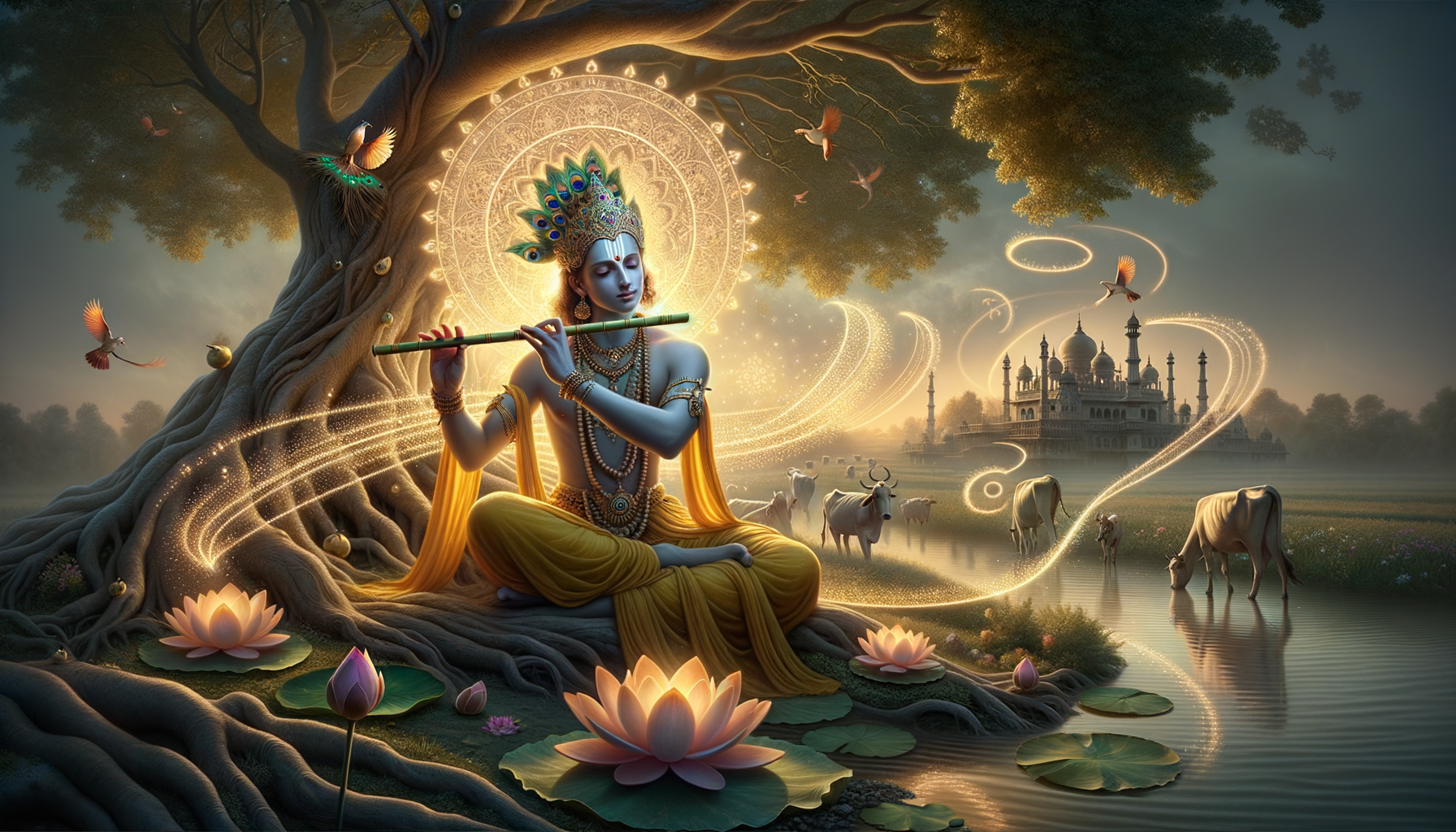
Madana Mohana, the form of Sri Krishna renowned as the enchanter who captivates even Kamdev, stands as a luminous emblem of divine beauty within Hinduism. This theological idea affirms that attraction, aesthetic delight, and refined emotion can serve as legitimate pathways to transcendence. Rather than dismissing beauty and romance as impediments to spiritual growth, Hindu traditionsespecially those shaped by the Bhakti Traditionunderstand them as catalysts that elevate the heart from worldly attachment to sacred love (prema).
In this vision, Madana Mohana signifies not indulgence in desire but its transformation. The very impulse that binds one to the senses is gently redirected toward the Absolute. The language of rasacentral to Vaishnava theologyexplains how human responsiveness to beauty is refined into a contemplative, devotional sensibility. As devotees contemplate Sri Krishna’s form, the pull of attraction becomes a disciplined, luminous focus, allowing kama to yield to prema and aesthetic experience to ripen into wisdom.
Scriptural and poetic traditions elaborate this ideal with extraordinary nuance. The Srimad-Bhagavatam celebrates Krishna’s flute melodies, pastoral grace, and compassionate play in Vraja as revelations of the Supreme’s intimacy with creation. Within Gaudiya Vaishnavism, the epithet “Madana Mohana” encodes a theology of beauty: the Divine enchants the principle of enchantment itself, locating the highest truth not in abstraction alone but in a relationship of love, remembrance, and surrender.
The cultural history of Vrindavan illuminates this theology in lived practice. The Madan Mohan Temple is closely associated with the early Gaudiya acharyas and the devotional renaissance that linked rigorous philosophy with embodied worship, kirtan, and seva. Iconography, music, and sacred drama (rasa-lila) converge to make beauty a pedagogical forcewhat is seen, heard, and felt becomes a contemplative gateway. In this devotional ecology, Madana Mohana is not merely an image but a guiding principle that refines perception and anchors attention in the sacred.
Psychologically, this journey may be described as the movement from attraction to absorption. First, the mind recognizes its susceptibility to beauty; then it learns to stabilize that response through remembrance (smarana), sacred sound (nama-japa, kirtan), and mindful devotion. Over time, attention settles into a quiet, expansive awareness marked by gratitude and non-attachment. Thus, the aesthetics of Sri Krishna’s form deepen ethical clarity and contemplative steadiness, harmonizing emotion and insight.
This integrative vision resonates with the wider dharmic family. Buddhism articulates a parallel transformation of craving into compassion and clarity through mindful attention; Jainism elevates inner purity and aparigraha, guiding desire toward restraint and empathy; Sikhism uplifts Shabad-kirtan and Naam as means to refine the heart’s longing into remembrance of the One. Across these traditions, beauty, music, and disciplined devotion converge to transform longing into liberation, underscoring a shared civilizational commitment to inner freedom and unity in diversity.
Aesthetics and metaphysics meet in the practice of darshan. Devotees report that beholding the murti of Madana Mohana, hearing kirtan, or contemplating the lila narratives encourages a gentle, sustained attention that calms the senses and clarifies purpose. In this mode, the arts are not decorative but transformative. Poetry, dance, sculpture, and raga become deliberate vehicles for insight, embodying the insight that truth is not only known but also felt, celebrated, and shared.
Many describe a subtle yet unmistakable shift when immersed in Vrindavan’s sacred atmosphere or in the quiet of daily practice. What begins as admiration for Sri Krishna’s divine beauty matures into relational trust, ethical concern, and compassionate action. Emotional life becomes more resilient, not because emotion is suppressed, but because it is refinedabsorbed into a larger horizon of meaning where longing is honored and guided toward the highest good.
Practical application follows naturally from this understanding. Reflecting daily on the name and form of Sri Krishna, singing kirtan with sincerity, engaging in seva, studying foundational texts, and cultivating gratitude can anchor attraction in awareness. These practices welcome seekers from diverse backgrounds and temperaments, honoring the plurality that has always characterized Hinduism and the broader dharmic traditions. The path is personal yet inclusive, aesthetic yet disciplined, intimate yet universal.
Madana Mohana thus offers a coherent spiritual psychology and an elegant ethic: beauty is not an obstacle but a bridge. When guided by remembrance and love, it leads from restlessness to repose, from possession to presence, and from self-centered desire to compassionate participation in the world. In celebrating Sri Krishna’s enchanting form, this teaching affirms a shared dharmic aspirationto transform desire into sacred love, and to discover, within and among all, the radiance of the Divine.
Inspired by this post on Hindu Blog.
