
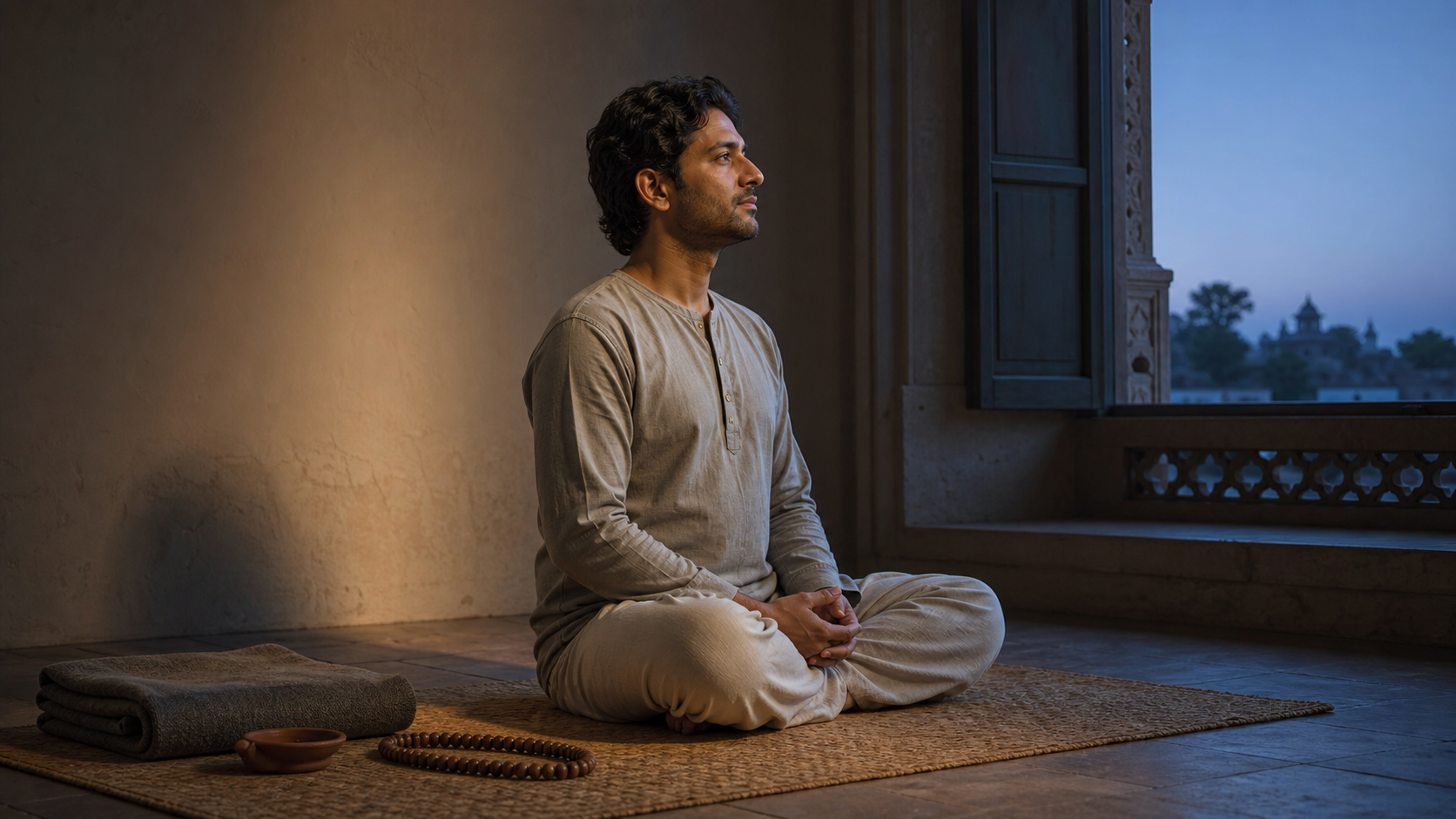
You rise for japa or meditation, take your seat, and discover that your body wants sleep more than your mind wants silence. Should you resist the heaviness, change the practice, or return to bed? Treating every tired morning as laziness can damage both health and sadhana. Treating every impulse to lie down as wisdom can quietly turn rest into inertia.
Yogic rest gives you a better test. Rest is useful when it restores the clarity required for remembrance, ethical conduct, study, service, and meditation. The aim is neither heroic sleep deprivation nor indulgent withdrawal. It is a rhythm in which effort and release support each other.
Key takeaways
- Sleep is not the enemy of sadhana. The Bhagavad Gita places yoga between the extremes of sleeping too much and sleeping too little.
- Judge rest by its result. Sattvic rest leaves you fresher and steadier; tamasic rest leaves you heavier, more avoidant, and less discerning.
- Ordinary sleep, deep sleep, turiya, the cosmic yoganidra of sacred imagery, and contemporary Yoga Nidra are related ideas, but they are not interchangeable.
- Match contemplative technique to your condition: audible japa for dullness, quiet and measured japa for agitation, and mental repetition when wakeful clarity is already present.
- Protect the transition into sleep. A light evening, reduced stimulation, gentle breath, and a repeatable closing ritual usually serve practice better than forcing one more demanding spiritual exercise into the day.
Do not confuse sleep, deep sleep, and awakened awareness

The first discipline is conceptual honesty. Falling asleep during meditation is not samadhi, and waking with no memory of the night is not proof of realization. Sleep can teach you about consciousness without automatically liberating you.
The Mandukya Upanishad maps waking, dreaming, deep sleep, and turiya as jagrat, svapna, sushupti, and the nondual ground that is not merely another passing state. In sushupti, the ordinary traffic of distinct objects and desires subsides. That absence of mental division can reveal how much of our daily agitation depends on incessant subject-object cognition. Yet deep sleep does not ordinarily provide the lucid discernment associated with awakening. Its peace is an experiential clue, not a certificate of spiritual attainment.
Patanjali gives nidra an equally precise place in contemplative psychology. Yoga Sutra I.10 classifies sleep as a vritti grounded in the cognition of absence. Sleep is therefore not simply a blank outside the mind’s life. Yoga Sutra I.38 allows experiences connected with dream and sleep to become supports for meditative steadiness. The operative word is support: you examine what those states disclose about attention, identification, and mental content without pretending that unconsciousness is realization.
The word yoganidra also needs care. In Puranic and Shakta imagery, Vishnu’s repose and Mahamaya as yoganidra express latent cosmic power. The stillness is fertile rather than vacant: manifestation rests in potential. Contemporary Yoga Nidra is a structured contemplative method, commonly using bodily awareness, breath observation, sankalpa, and imagery to guide attention toward profound relaxation. It can honour the sacred intuition that stillness contains power, but it should not be presented as identical to the theological yoganidra of the Puranas.
Before beginning, decide what you actually need. If you are biologically exhausted, you need sleep. If your body is tense and your mind overstimulated, a contemporary Yoga Nidra session may help you downshift. If you are alert and investigating the threshold between waking and sleep, a contemplative observation of that transition may be appropriate. Naming the need prevents a relaxation method from becoming a disguised test of spiritual achievement.
This distinction also protects ordinary sleep from contempt. Deep non-REM sleep participates in bodily restoration, while REM sleep contributes to memory, learning, and emotional integration. A mind deprived of those functions is not made purer simply because the lost sleep was sacrificed in the name of practice. The yogic question is whether your schedule creates the balanced rest from which clarity and steadiness can emerge.
Let the morning reveal whether rest was sattvic

You cannot judge yogic rest only by how pleasant it feels while you are lying down. Judge it by what it makes possible afterward. The gunas provide a practical vocabulary for that assessment.
| What you notice | Likely pattern | Useful adjustment |
|---|---|---|
| You wake fresher, can begin your duties, and sustain attention without unusual strain. | Sattva: rest has restored clarity and proportion. | Preserve the timing and evening conditions that produced it. |
| You are tired but internally accelerated; thoughts jump, the breath feels hurried, and you keep reaching for stimulation. | Rajas: activity continued inwardly even while the body tried to rest. | Reduce evening input and use slower breath or softly articulated japa before bed. |
| You have slept yet remain heavy, confused, avoidant, or eager to return to bed without clear need. | Tamas: rest has tipped toward inertia or another problem is impairing restoration. | Use an upright posture, brighter articulation, and gentle activation; also examine whether sleep quality or health needs attention. |
These labels are observations, not accusations. Tamas is not a moral identity, and rajas is not proof of productive strength. Both are movements to be understood and redirected. A night of necessary recovery during illness should not be condemned as tamasic merely because it was long. Likewise, lying in bed while repeatedly postponing a manageable duty does not become sattvic because it has been called self-care.
Use functional questions when the answer is unclear. Can you remember the mantra rather than merely move the beads? Can you meet family and colleagues without disproportionate irritability? Can you study, work, worship, and make ordinary decisions with reasonable steadiness? Do you become more available for seva and ahimsa, or more withdrawn and negligent? The difference between sattvic restoration and tamasic heaviness becomes visible through these consequences.
Persistent insomnia, repeated breathing interruptions during sleep, or daytime sleepiness that makes driving or other safety-sensitive work dangerous warrants assessment by a qualified health professional. A spiritual routine can support wellbeing, but it is not a substitute for evaluating a sleep disorder, medication effect, or physical or psychological illness.
Build a threshold between activity and nidra

Most difficult nights do not begin when your head reaches the pillow. They begin when work, argument, entertainment, food, and notifications are allowed to run without a closing boundary. The nervous system receives no clear signal that outward activity has ended.
A useful evening threshold is simple enough to repeat:
- Close the field of activity. Silence unnecessary notifications, dim the room, and stop introducing tasks that can wait. Pratyahara begins with declining fresh sensory demands.
- Keep the evening meal light, warm, and easy to digest. The purpose is not dietary severity. It is to avoid making digestion the dominant labour of the night.
- Prepare the place of practice. Clear the seat, place the mala where you will use it, and remove visible clutter that invites unfinished-business thinking.
- Settle the body before asking the mind to settle. Relax the jaw and tongue. Let the breath remain nasal and unforced. A brief preparation of two to three minutes, with a comfortable exhalation of roughly four to six seconds if that feels natural, can reduce the friction at the start of japa.
- Choose one quieting method. Use gentle nadi shodhana, bhramari, soft japa, or simple breath awareness. Calm forward folds, a supine twist, or supported Viparita Karani may also help the body release effort.
- Let the ritual end. Do not turn bedtime into a contest for an unusual experience. Once body and attention have settled, allow sleep to perform its proper work.
Pre-sleep pranayama should favour ease. Stimulating techniques and prolonged kumbhaka are better reserved for a more appropriate time of day. If breath retention creates strain, air hunger, dizziness, or anxiety, stop it. The evening purpose is calm clarity, not domination of the body.
Ayurveda places nidra beside ahara and brahmacharya among the supporting pillars of life. This makes sleep part of disciplined living rather than a private inconvenience that serious practitioners should overcome. Proper rest supports vitality, cognitive steadiness, and the capacity to hold attention. Too little can aggravate instability and depletion; too much can deepen heaviness and dullness.
Rhythm matters, but rigidity is not rhythm. Dinacharya favours a dependable winding-down period and rising in time for quiet practice. Brahma muhurta and the Sikh discipline of Amrit Vela both recognize the contemplative value of the pre-dawn period, when obligations and ambient noise are often reduced. But waking early while repeatedly refusing an adequate bedtime defeats the purpose. Pre-dawn practice must be supported by the previous evening.
Season and condition also matter. Long daytime sleep is generally less helpful when it increases kapha-like heaviness, particularly in damp or cool conditions. Daytime rest may be more appropriate during intense summer heat, convalescence, or genuine depletion. The governing principle is ahimsa informed by results: adapt without using adaptation as an excuse for chronic disorder.
Match the contemplative method to the state you actually have
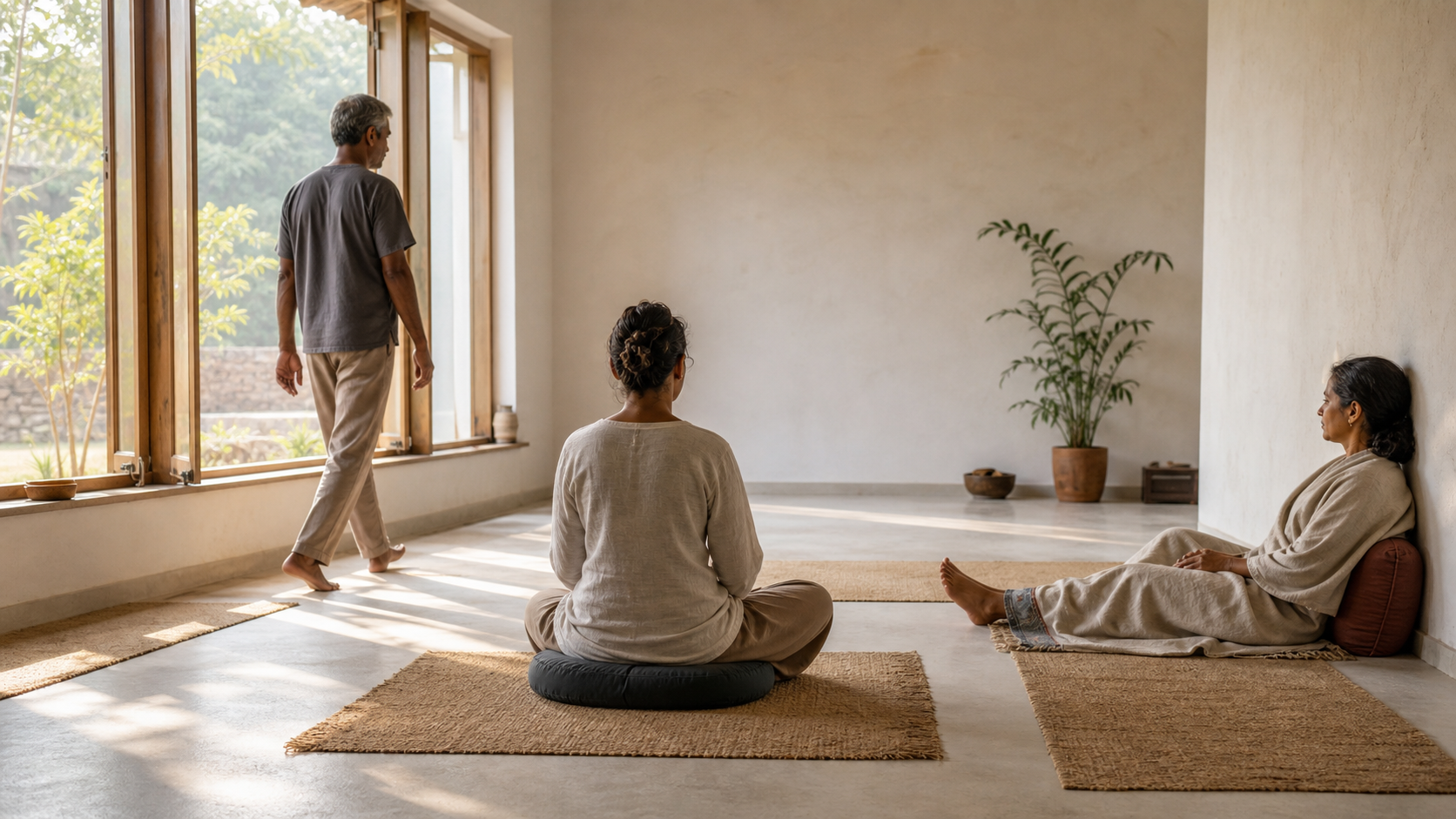
A fixed discipline does not require a mechanically identical technique in every condition. Method can change while the vow to practise remains intact. Japa is especially adaptable because audible, whispered, and mental repetition place different demands on attention.
When dullness is pulling you toward sleep
Sit upright rather than reclining. Use vacika japa: make the mantra audible, articulate the consonants, and let your own ears receive each repetition. A slightly brighter cadence and the tactile movement of the mala give attention several anchors at once. Sound, breath, and touch form a closed loop that is harder for a sleepy mind to abandon.
Do not rush merely to complete a count. A mala commonly carries 108 beads, with 54- and 27-bead forms serving as submultiples, but numerical completion loses its purpose when the mantra becomes unrecognizable. If your lineage prescribes a count, preserve it with intelligible pronunciation and attention rather than racing toward the final bead.
If genuine sleep loss is the cause, louder chanting may help you finish an essential minimum, but it does not repay the biological debt. Restore the sleep schedule instead of building a spiritual identity around exhaustion.
When the body is tired but the mind is restless
Use upamsu japa, the softly whispered or subvocal mode. Slow the vowels, keep the bead cadence even, and allow the exhalation to lengthen without force. The mantra should become a narrow channel through which scattered attention can return, not another source of speed.
This is where a short sankalpa is useful. State the intention plainly: to remember the Divine Name, to cultivate compassion, or to remain present for the appointed practice. Avoid ambitious declarations about controlling sleep or achieving an altered state. A workable intention gives rajas direction without feeding its appetite for accomplishment.
When wakeful clarity is already present
Manasa japa, or mental repetition, can refine attention when internal hearing remains crisp. If the mantra starts dissolving into unrelated thought or blankness, return to a whisper or audible voice. Moving from audible to whispered to mental repetition can guide attention from gross to subtle, but there is no merit in remaining subtle after clarity has disappeared.
Devotional meaning matters here. Gentle remembrance of a divine quality, a lila, compassion, nonviolence, or the purpose of Naam can warm repetition without forcing visual imagery. Hindu japa, Buddhist mantra, Jain recitation, and Sikh Naam Simran retain distinct theologies, yet each asks that repetition reshape attention and conduct. Stay faithful to the meaning and discipline of your own lineage rather than blending sacred formulae into an undefined relaxation technique.
When you need conscious downshifting more than formal sitting
Contemporary Yoga Nidra can help when accumulated activation makes seated meditation needlessly combative. A typical progression withdraws attention from outward tasks, moves awareness through the body, observes breath, introduces a concise sankalpa, and uses guided imagery or spacious awareness before returning. Its practical strength is systematic pratyahara: the body releases effort while attention retains a light thread of participation.
Use it as a complement to sleep and seated practice, not as a claim that sleep is no longer necessary. If you fall asleep, accept the information: the body may have needed sleep more than a lucid transitional exercise. If you remain awake but emerge calmer and clearer, carry that condition into quiet japa, prayer, or bedtime rather than immediately reopening the stream of stimulation.
Hard days require proportion rather than abandonment. Illness, travel, guests, grief, household disorder, and crowded obligations all reduce attentional bandwidth. Protect a minimum core of formal practice, then add repetition during a suitable walk or quiet transit period if your tradition permits it. A compact mala can preserve continuity while travelling. The choice among audible, whispered, and mental japa lets the form respond to your condition without surrendering the devotional thread.
Starting tonight, change one part of the threshold rather than rebuilding your entire life. Note when you lay down, how you felt on waking, and which form of practice produced genuine steadiness. Keep what improves clarity. Revise what repeatedly produces agitation or inertia. That is contemplative discipline applied to rest: neither worshipping sleep nor waging war against it, but arranging it in service of awareness.
References
- DharmaRenaissance Blog – Sacred Science of Nidra: Yogic Sleep in Vedas, Upanishads, and Ayurveda for Whole-Person Wellbeing
- Dandavats – Bliss, Boredom, and Breakthroughs: An Evidence-Based Guide to Japa Practice