

You may have seen a rainbow-coloured chakra chart and wondered whether it faithfully represents Indian tradition, whether your chakras are “blocked,” or whether you should be trying to open them. A steadier approach is to treat the seven chakras as a map for disciplined attention, not as seven invisible switches that must all be turned on.
That distinction changes how you practise. The map becomes useful when it helps you notice your condition, direct your attention, and choose a grounded response. It becomes misleading when every pain, conflict, or difficult emotion is treated as proof of an energetic defect.
Start with the right category: subtle practice, not anatomy
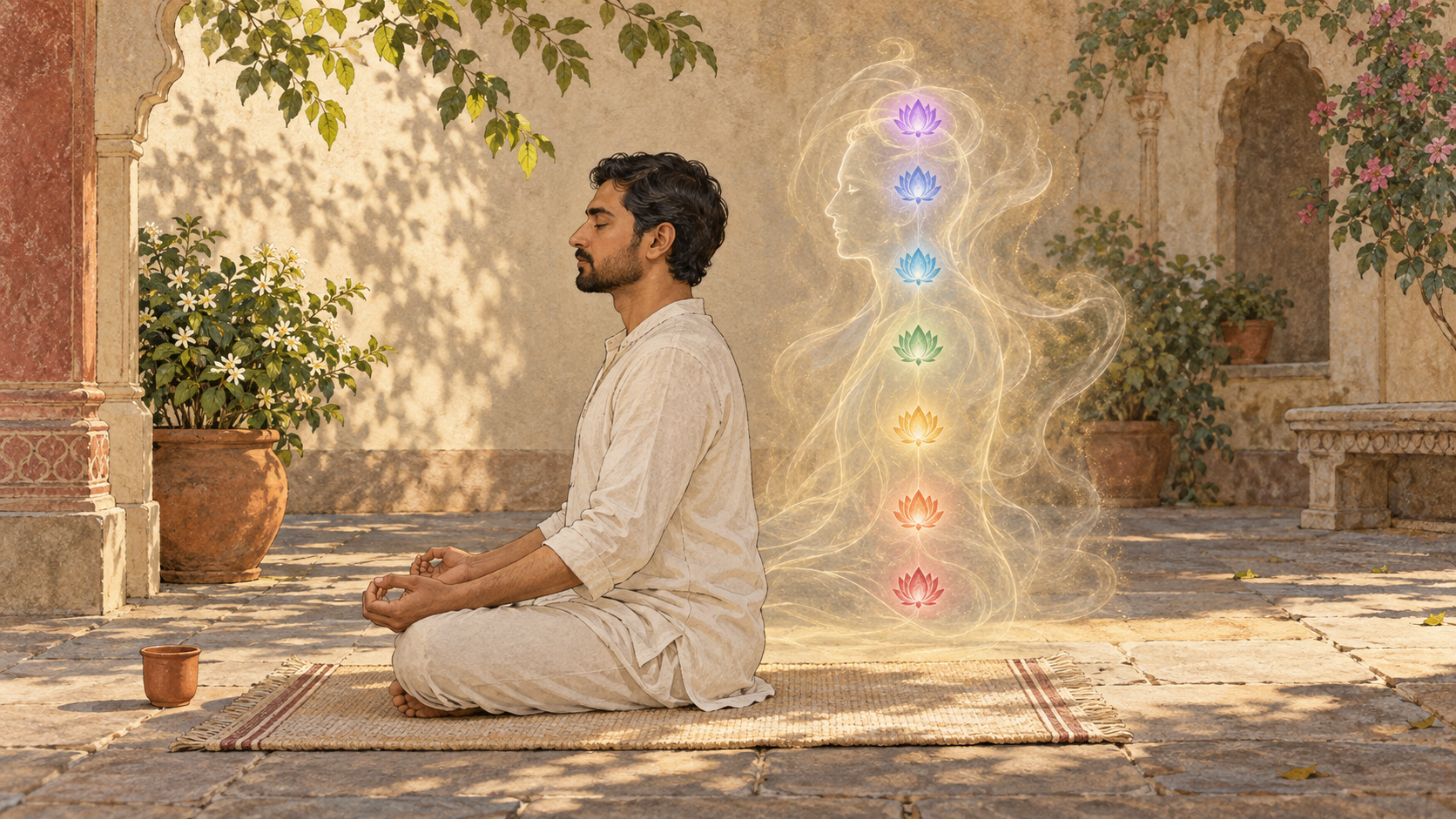
The Sanskrit word chakra means “wheel” or “disc.” In traditional Indian systems including yoga, tantra, and Ayurveda, chakras are understood as centres or focal points associated with the movement of prana. They belong to a subtle account of embodied life: a way of working with breath, attention, vitality, emotion, and consciousness.
A chakra is therefore not simply another name for a nerve, organ, or gland. A centre may be contemplated near the heart, throat, or navel, but that does not make the physical organ in that region identical to the chakra. Modern diagrams sometimes place subtle and anatomical systems side by side; resemblance should not be mistaken for equivalence.
The same care is needed with the phrase “blocked chakra.” It can be useful as shorthand for a recurring difficulty in attention or conduct. It is not a medical diagnosis, a measurable verdict about your body, or an explanation that automatically outranks ordinary causes such as stress, conflict, fatigue, or illness.
Indian spiritual traditions also aren’t one uniform system. Yoga, tantra, and Ayurveda may share language concerning prana and embodied practice without using every chakra scheme in precisely the same way. The familiar ascending sequence of seven is a valuable orientation, but it should not erase differences among teachings, lineages, and purposes.
Read the seven centres as a sequence of attention

The following table presents the commonly taught seven-centre sequence. Spellings, locations, symbols, and interpretations can vary. The questions in the final columns are practical prompts, not claims that each chakra has only one fixed meaning.
| Centre | Approximate focus | Question for reflection | Grounded response |
|---|---|---|---|
| Muladhara, the root centre | Base of the torso or pelvic floor | What in my life needs steadiness rather than drama? | Address one neglected routine, responsibility, or boundary. |
| Svadhishthana, the pelvic or sacral centre | Lower abdomen and pelvic region | What feeling or desire needs honest acknowledgment? | Name it without shame, then choose neither automatic indulgence nor reflexive suppression. |
| Manipura, the navel centre | Navel or middle torso | What can I responsibly influence here? | Make one decision that is actually within your control. |
| Anahata, the heart centre | Centre of the chest | Where must care and a clear boundary meet? | Offer support, attempt a repair, or give an honest no. |
| Vishuddha, the throat centre | Throat | What needs to be spoken, and what needs to be heard? | Prepare one plain sentence and leave room for the response. |
| Ajna, the brow centre | Between the eyebrows or brow region | What am I observing, and what am I merely assuming? | Separate the known facts from fear, hope, and interpretation. |
| Sahasrara, the crown centre | Crown of the head or just above it | What larger principle places this moment in context? | Return to silence, prayer, contemplation, or a value greater than immediate impulse. |
The order can be read as a movement from foundational embodiment toward increasingly expansive attention. It should not become a ranking in which the lower body is treated as impure and the crown as the only spiritual destination. “Lower” identifies position in the map, not moral worth. Stability, emotion, agency, relationship, expression, discernment, and contemplation all require cultivation.
This also explains why chasing an extraordinary crown experience while neglecting ordinary duties is a poor use of the system. If contemplation leaves you less truthful, less responsible, or less capable of meeting daily life, the attractive experience has not yet matured into integration.
Turn the map into a sober daily practice

You don’t have to manufacture heat, colours, visions, or spinning sensations. Begin with normal breathing and honest observation. A simple base-to-crown practice is enough to discover whether the map helps you pay better attention.
- Choose the purpose. Name one real situation you want to understand: a decision, a strained relationship, a repeated reaction, or difficulty concentrating. Do not begin by deciding that a chakra must be defective.
- Establish physical steadiness. Sit or stand in a position you can maintain without strain. Feel the body’s contact with the floor, seat, or ground.
- Let the breath remain natural. Notice its movement without forcing it, holding it, or trying to produce an unusual state.
- Move attention from root to crown. Pause at each approximate region. Notice sensation, emotion, imagery, resistance, or the absence of any distinct experience.
- Use one question at each centre. Ask the corresponding question from the table, then wait long enough for a simple response. You are looking for clarity, not spectacle.
- Select the most concrete insight. Choose the observation that connects most directly to your actual situation. A practical truth such as “I need to state my limit clearly” is more useful than an elaborate energetic story you cannot test.
- Translate insight into conduct. Decide on one proportionate action: hold a conversation, repair an error, restore a routine, make a decision, or set aside time for contemplation.
- Close deliberately. Feel the whole body, notice your surroundings, and return to the next ordinary task. Practice should increase your capacity to inhabit life, not make it harder to re-enter it.
You may notice a great deal at one centre and nothing at another. Neither result proves spiritual advancement or failure. Sensitivity changes with mood, attention, familiarity, and expectation. The disciplined response is to record what happened without turning it immediately into a permanent identity.
If concentration on the body or breath produces significant distress, disorientation, or panic, stop the exercise and return to ordinary sensory contact with your surroundings. Don’t force breath retention, intense visualisation, or prolonged inward focus. A qualified teacher can modify the spiritual practice; a licensed health professional is the appropriate person for persistent physical or psychological symptoms.
Interpret what you notice without inventing a diagnosis

The most common interpretive error is circular. You feel tightness near the throat, declare the throat chakra blocked, and then use the tightness as proof of the declaration. Nothing has actually been clarified.
A more reliable method separates three layers:
- Observation: What did you directly notice in the body, breath, attention, or emotion?
- Interpretation: What meaning are you assigning to that observation, and what other explanations remain possible?
- Response: What small, ethical, real-world action would help whether or not the energetic interpretation is correct?
Suppose your throat feels tense while you think about a difficult conversation. “My Vishuddha is blocked” closes the inquiry too early. “I noticed tension while imagining that conversation; I may be afraid to speak plainly” remains open to correction. You can then draft the sentence you need to say, choose a calm time, and listen carefully to the reply. The chakra has functioned as a focal point for inquiry without pretending to supply a medical or infallible explanation.
The same restraint applies to claims about colours, crystals, seed sounds, personality types, and instant chakra opening. Such correspondences may serve a particular teaching or aid concentration, but don’t assume every attractive chart represents an ancient, universal consensus. Before adopting a system, ask:
- Which tradition or lineage is this practice drawn from?
- Is the seven-centre scheme central to that system, or is it an introductory teaching device?
- Which correspondences are essential within that system, and which are optional aids?
- How is chakra practice connected to conduct, disciplined attention, and daily responsibility?
- What does the teacher recommend when a practice causes distress or aggravates an existing condition?
A trustworthy explanation should be able to name its context and its limits. Be cautious when someone turns every hardship into a chakra problem, promises a cure, ranks people by supposed energetic purity, or makes you dependent on repeated paid “clearing.” Chakra practice can support spiritual reflection, but it should never replace appropriate medical or psychological care.
Your next step does not need to be dramatic. Take one real concern through the seven-centre inquiry, write down only what you directly notice, and choose one grounded action. If the map makes you more attentive, truthful, compassionate, and responsible, it is already doing meaningful work.
Key takeaways
- Chakras are focal points within Indian subtle-body traditions, not anatomical organs or medical diagnoses.
- The familiar seven-centre sequence is a useful map, but its details and applications vary among traditions.
- Lower and higher describe position in the sequence, not inferior and superior human worth.
- You don’t need unusual sensations to practise; normal breath, careful attention, and honest reflection are sufficient.
- Separate direct observation from interpretation, then choose a practical response that remains sound even if your interpretation changes.
- Use chakra practice to deepen responsible living, not to avoid health care, difficult conversations, or ordinary duties.
References

Leave a Reply
You must be logged in to post a comment.