
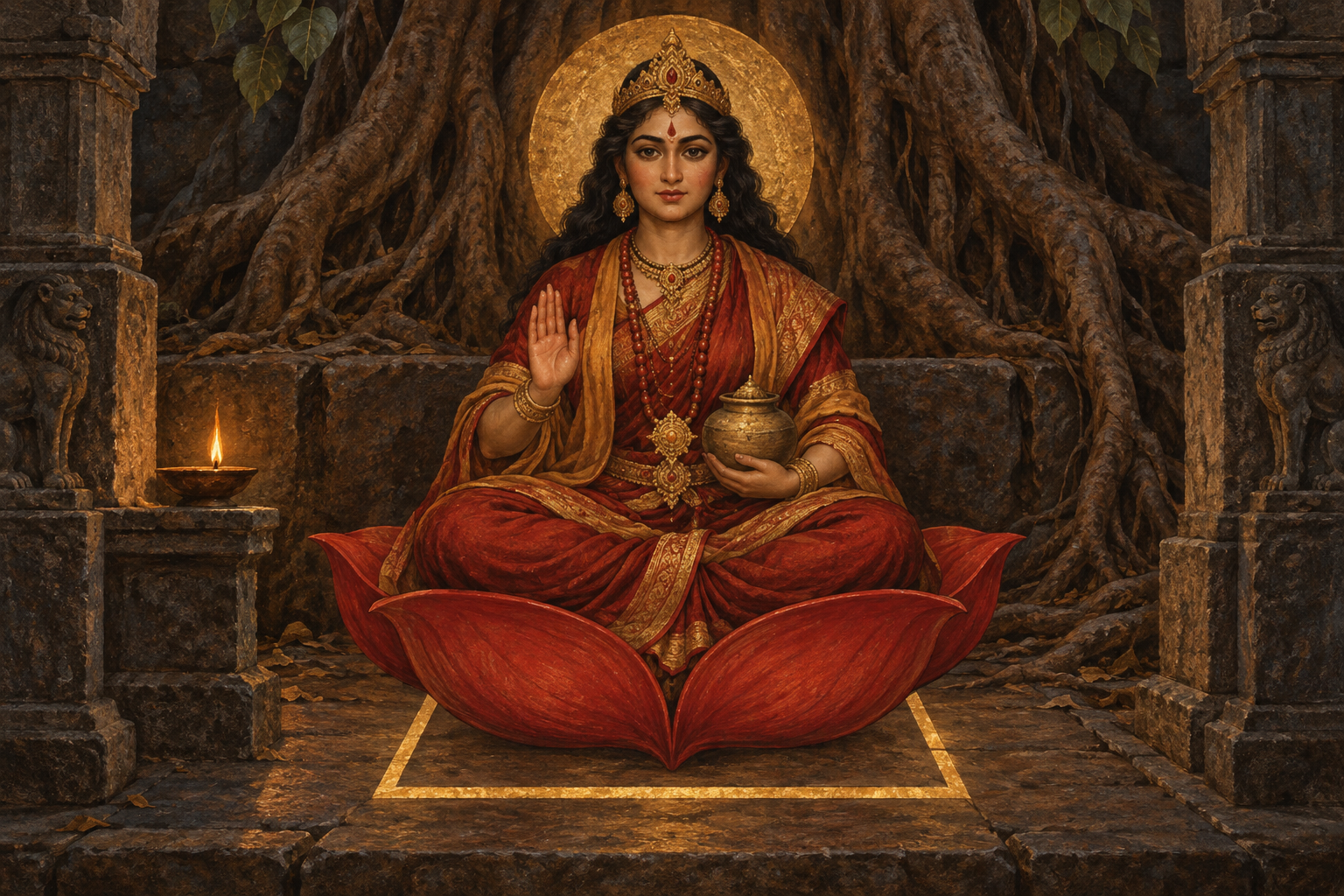
You may have arrived with a simple question: why is Shakini Devi linked to Muladhara, and what should that change in your practice? The useful answer is not another chakra chart to memorise. It is a way of approaching the root centre without reducing sacred symbolism to anatomy or chasing dramatic sensations.
In the map considered here, Shakini is the Shakti who dwells at Muladhara, keeps its sacred seat, and expresses the wisdom of earth. Her presence turns root practice into a question of relationship: can you receive support, remain steady, protect what is sacred, and give your spiritual commitments a dependable place in daily life?
The root is a sacred seat, not a problem to fix

Popular chakra language often divides people into the blocked and the unblocked. That vocabulary may sound practical, but it can flatten a sacred cosmology into a self-diagnosis system. Muladhara is not merely a defective mechanism awaiting adjustment.
The chakra vision used here understands the subtle body as a living spiritual terrain arranged through seven centres along the spinal axis. Each centre is a peetha: a seat or throne inhabited by a particular Shakti or Yogini in an elemental form. This is sacred geography. It concerns how consciousness, embodiment, divine presence, and the elements are contemplated together.
That distinction gives you three useful boundaries:
- Do not treat Muladhara as a physical lump, gland, or hidden organ that can be located by pressing or straining the body.
- Do not use a chakra label as a diagnosis for fear, fatigue, pain, financial stress, or psychological distress. Those conditions have ordinary causes that deserve appropriate practical or professional attention.
- Do not assume that earth means something spiritually dull. In this symbolism, earth is the ground that bears weight, receives life, establishes limits, and makes sustained action possible.
Before beginning any practice, decide what you are actually doing. A lineage ritual should follow that lineage’s instructions. A devotional act should honour the deity as deity. A personal contemplation may use the symbolism to examine your conduct, but it should not be presented as an ancient initiation or secret tantric procedure.
What Shakini changes in your understanding of Muladhara
Muladhara is foundational, not inferior
A vertical diagram places Muladhara at the root, but spatial position is not spiritual rank. A throne at the foundation remains a throne. If a house depends on its ground, spiritual discipline likewise depends on conditions that can carry it: attention, restraint, responsibility, and the willingness to return after distraction.
Notice how you speak about foundational life. If you call food, shelter, work, bodily limits, or household duties unspiritual, you may be using transcendence to avoid responsibility. Root practice asks for a more integrated response. Attend to the neglected duty that makes sustained worship harder. Establish the boundary that protects your time for sadhana. Repair the ordinary disorder that repeatedly scatters your attention.
The goddess is not a decorative chakra label
When Shakini is understood as the resident Shakti of a peetha, the centre is no longer an impersonal switch. You approach it as a place of presence. That changes the practitioner’s posture from control to reverence.
You do not have to manufacture a vision of the goddess. You also do not need to claim that an emotion, twitch, dream, or rush of heat proves that she has appeared. A respectful practice can be quieter: inwardly offer attention, acknowledge the sacred ground, and allow that relationship to correct how you live.
If deity-centred language is not part of your practice, be honest about the limit. You may contemplate Shakini symbolically, but do not erase her divine identity and then present the result as the complete traditional meaning. Intellectual clarity is itself a form of respect.
Keep one chakra map at a time
You may encounter another diagram that assigns a different Yogini to Muladhara or places Shakini elsewhere. Chakra systems are not one universally standardised chart. Names, locations, images, and ritual instructions can vary across texts and lineages. A conflicting diagram does not automatically prove that one tradition is careless.
Do not solve the difference by blending every version into a composite. Instead, record four things together: the text or teacher, the chakra named, the presiding deity, and the practice instruction attached to that system. Then use the map as a coherent whole. Importing a deity from one system, a mantra from another, and a visualisation from a third may produce an attractive chart, but it no longer faithfully represents any of them.
A careful Shakini-centred contemplation

The following sequence is a simple devotional contemplation built from the symbolism of sacred ground. It is not a recovered tantric rite, a substitute for diksha, or a claim that every lineage worships Shakini in this manner. If your sampradaya has given you a specific practice, follow that instruction instead.
- Establish the boundary of the practice. Sit somewhere stable and reasonably quiet. Let the breath remain natural. Decide that you are here to offer attention and examine your foundation, not to force an altered state.
- Notice support. Feel the places where the body is supported by the seat and floor. Notice weight without searching for a special point inside the body. Let contact with the ground become an immediate reminder that practice begins with receiving support.
- Acknowledge Shakini respectfully. Use ordinary devotional language unless your tradition has supplied a mantra. You might inwardly ask Shakini Devi to help you recognise and protect the ground of dharma in your life. Treat this as a personal prayer, not as a traditional mantra.
- Bring one foundational matter into view. Ask where your spiritual intention currently lacks a dependable base. It may be an unkept promise, a neglected household responsibility, a disorderly worship space, an avoidable conflict, or a practice you begin repeatedly but do not sustain.
- Choose a proportionate deed. Select one action that can be completed before you return to this contemplation. Clean and prepare the place where you worship. Keep a promise. Repair an ordinary responsibility. Set a clear limit around the distraction that repeatedly consumes your practice time.
- Close without hunting for evidence. Offer gratitude, release the visual or verbal focus, and return to ordinary awareness. The next step is the chosen deed. Do not sit longer merely to obtain tingling, heat, pressure, or a vision.
This method deliberately joins contemplation to conduct. Without that bridge, root-centre practice can become another form of consumption: collecting diagrams, experiences, and initiatory language while the actual foundation of life remains unattended.
If breath attention or bodily concentration causes dizziness, pain, panic, numbness, or persistent distress, stop the exercise and return to ordinary breathing and movement. Recurrent or concerning symptoms belong with an appropriate healthcare professional. Chakra vocabulary should not be used to diagnose them or to replace medical or psychological care.
Judge the practice by what becomes steadier

A vivid sensation is easy to remember, but it is a poor measure of spiritual maturity. After practising for a while, look for changes that actually correspond to sacred ground. Are you more dependable in a duty you accepted? Is your place of practice better cared for? Can you remain present with an ordinary task without immediately seeking stimulation? Has devotion become easier to sustain because you gave it a stable place in the day?
Also watch for distortion. Pause and seek guidance if the practice makes you contemptuous of ordinary responsibilities, obsessed with proving that an awakening occurred, or certain that every bodily sensation carries a supernatural message. Shakini’s association with a sacred root should deepen humility and steadiness, not confer a status to announce.
Key takeaways
- In this chakra map, Muladhara is a peetha, or sacred seat, and Shakini is its indwelling Shakti.
- The subtle-body map is spiritual geography, not a substitute for physical anatomy or clinical diagnosis.
- Earth symbolism points toward support, limits, continuity, and the conditions that allow practice to endure.
- When chakra charts disagree, keep each text or lineage’s deity, location, and instructions together rather than blending them.
- A useful Shakini-centred contemplation should lead to one concrete act that strengthens the foundation of your dharmic life.
At your next sitting, leave the question of extraordinary experience aside. Place one neglected foundation before Shakini Devi, choose the smallest honest action that would strengthen it, and complete that action before seeking another teaching.
References

Leave a Reply
You must be logged in to post a comment.