
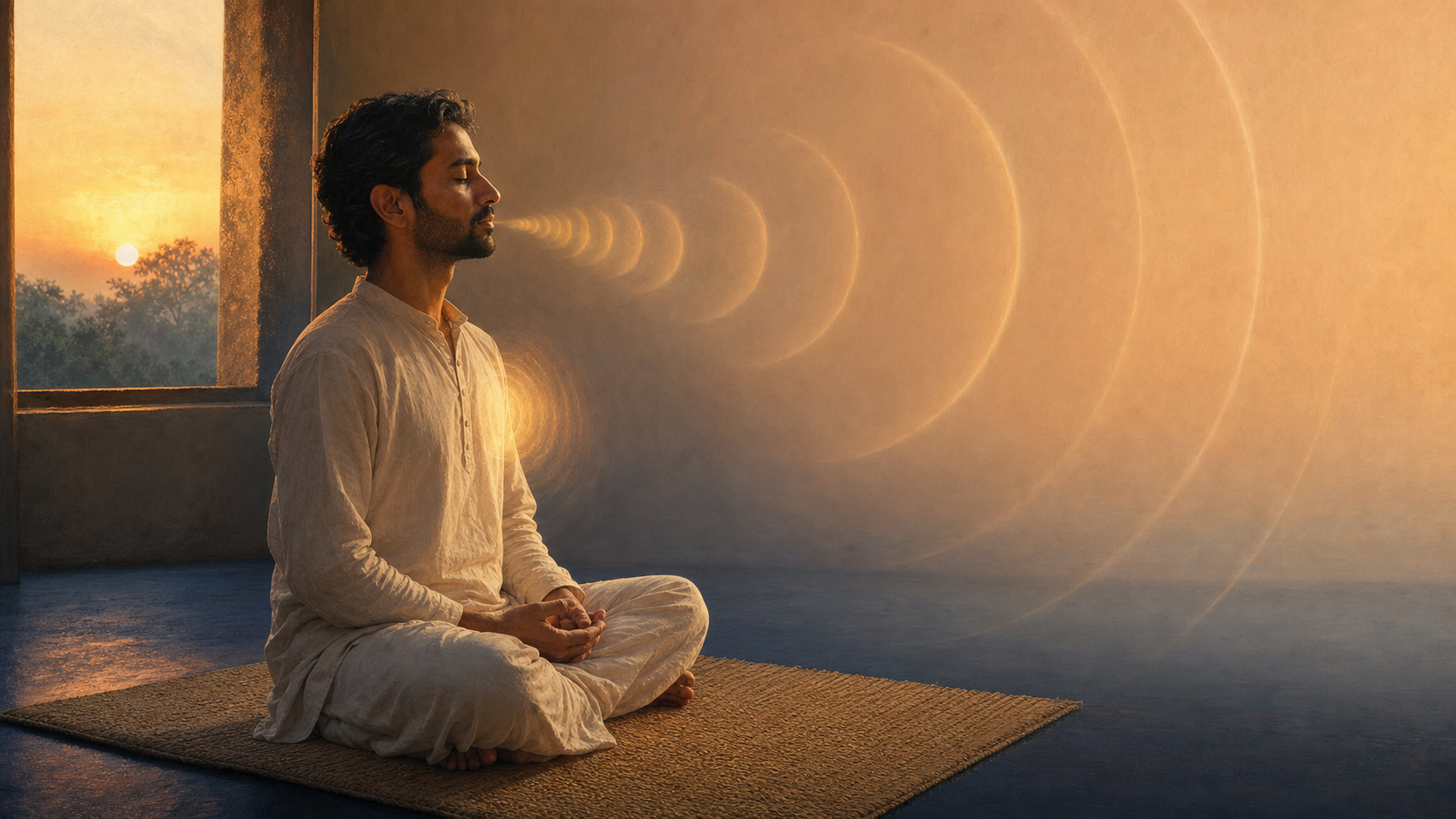
You may have been told to chant Om for calm, yet still wonder what you are supposed to do with the sound. Should you follow the vibration, regulate the breath, contemplate its meaning, or listen to the silence that follows? In Pranavopasana, these are not competing methods. They are successive parts of one movement of attention.
You do not need to manufacture a trance or wait for an unusual experience. Begin with sound, let the sound become subtle, and notice the awareness in which sound and silence appear. That distinction is what turns pleasant chanting into a serious Dharmic practice.
Om is a map of experience, not merely a sacred sound

Pranava is the sacred syllable Om, written as ॐ. Pranavopasana is its sustained contemplation: a disciplined movement from articulated sound through resonance into silence. Recitation gives the mind an object, but meaning gives the practice its direction.
The Mandukya Upanishad presents A-U-M as a map of the whole field of experience. A corresponds to waking, U to dream, and M to deep sleep. The silence in which the syllable resolves points to turiya, the non-dual ground of awareness.
| Element | Field of experience | What to notice in practice |
|---|---|---|
| A | Waking | The body, senses, surroundings, and other outwardly known objects |
| U | Dream | Thoughts, memories, images, and the mind’s subtle world |
| M | Deep sleep | The subsiding of differentiated experience, without mistaking blankness for liberation |
| Silence | Turiya | The awareness in which waking, dream, and deep sleep are known to come and go |
In the Advaita Vedanta reading, turiya is not a fourth passing episode that you must produce after the other three. It is the ever-present reality because of which every changing state can be known. Waking changes, dreams change, and deep sleep comes and goes. Pranavopasana directs you to ask what remains present through their succession.
This is why the silence after M matters. If you treat it as an empty interval before the next repetition, Om remains principally an acoustic exercise. If you listen without reaching for the next sound, the interval becomes an opening for inquiry. Silence is not the final component of a code. It points beyond every component to that which knows them all.
Advaita therefore treats Om as more than a device for relaxation. When joined to Upanishadic teaching and clear inquiry, it can serve as a means of knowledge. The aim is not to persuade yourself that you are Brahman through repetition. It is to loosen identification with changing experiences until the witnessing awareness is recognized as self-evident.
Dharmic kinship without erasing differences
Om also appears within distinct Dharmic settings. Patanjali’s Yoga tradition identifies Pranava as the designation of Ishvara and uses its repetition as a doorway to devotion and collected attention. Shaiva and Vaishnava mantras such as Om Namah Shivaya and Om Namo Narayanaya place the syllable within a loving relationship with the Divine.
In Mahayana and Vajrayana Buddhism, Om opens the mantra Om Mani Padme Hum. Jain practice recognizes Om as a later compressed emblem of the Namokar Mantra and its reverence for the five supreme beings. Sikh teaching centres on Ik Onkar, affirming the One Reality pervading existence. Ik Onkar should not be reduced to a Sikh spelling of Om, just as Buddhist, Jain, Yogic, devotional, and Advaitic uses should not be collapsed into one doctrine.
The family resemblance lies elsewhere: sound is disciplined by reverence, attention is gathered, and ordinary self-centredness is placed under a larger vision of reality. If you practise within a lineage, retain that lineage’s meaning rather than constructing a generic mixture. Dharmic unity becomes stronger when real distinctions are respected.
Let each Om travel from articulation into attention
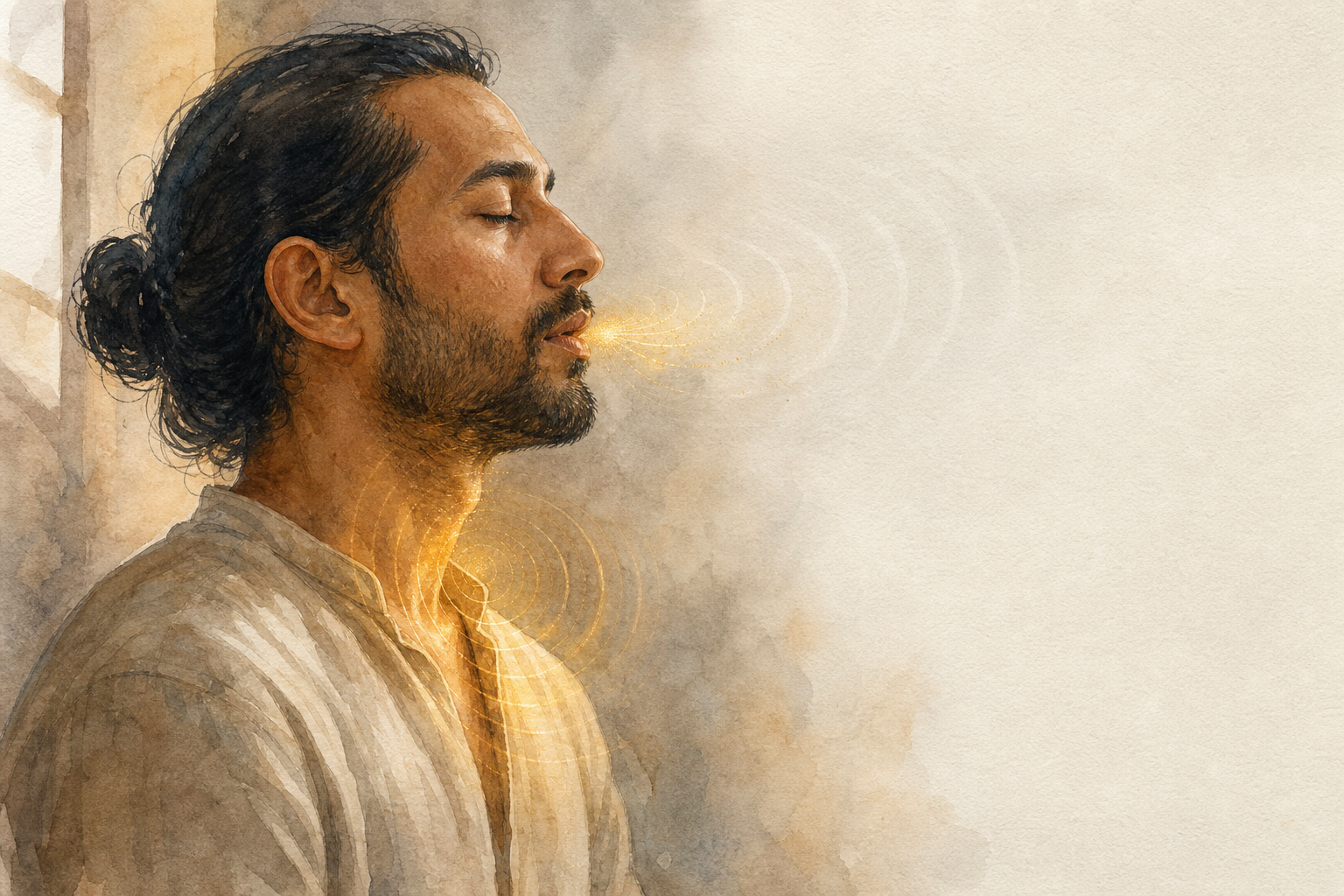
A well-formed Om has an arc. A begins openly in the throat. U rounds the sound through the palate and lips. M closes the lips and leaves a gentle nasal resonance. The vibration then fades without being abruptly cut off.
- Let A open easily. Do not press the throat or try to make the chant impressive.
- Allow A to flow continuously into U rather than pronouncing three separate, clipped letters.
- Close into M gently and feel the resonance without forcing it into the head.
- Let M disappear on its own. Do not squeeze out the last reserve of breath.
- Remain attentive after the sound has ended. Let silence complete the round before the next natural inhalation.
The sound provides a concrete object for a restless mind. Its resonance draws attention inward. Its fading teaches the mind to release rather than grasp. The ensuing quiet reveals whether you can remain awake without immediately manufacturing another thought, sound, or expectation.
Slow vocalization also tends to lengthen the exhalation. Sustained humming and comfortable resonant breathing are associated with parasympathetic settling, vagal activity, heart-rate variability, and reduced stress reactivity, although research designs and findings vary. Treat calm as a supportive condition for contemplation, not as proof of liberation and not as a substitute for medical or psychological care.
If counting helps you settle, you can try a comfortable four-count inhalation and six-count exhalation, sounding Om on the out-breath. The ratio is optional. If it produces air hunger, dizziness, chest discomfort, or strain, stop counting and return to normal breathing. Clarity is the purpose; endurance is not.
Do not add forceful breath retention merely to make the session seem advanced. Longer ratios and kumbhaka should be learned gradually under experienced guidance, especially if you have a cardiovascular or respiratory condition. Om can ride the natural breath perfectly well.
A repeatable nine-to-21-minute Pranavopasana practice
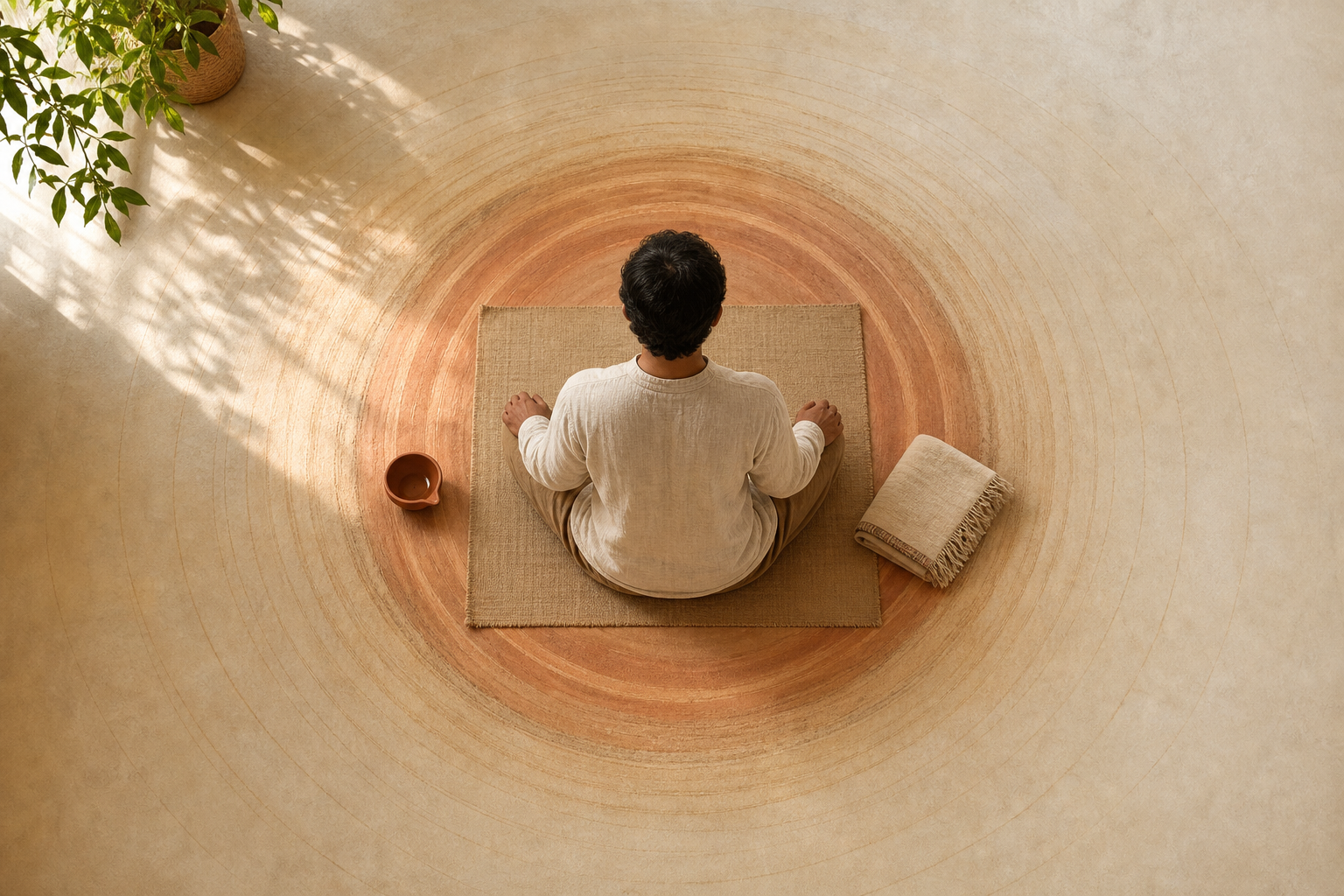
The most useful routine is one you can perform without redesigning it every morning. Choose a duration between nine and 21 minutes, keep the order stable, and let sensitivity develop through repetition.
- Choose a fixed place and a reasonably consistent time. Brahma-muhurta is traditional, but a dependable evening sitting is better than an ideal morning practice you repeatedly miss.
- Take any stable seated posture. Keep the spine upright without stiffness, and let the hands rest without effort.
- Soften or close the eyes. Release unnecessary tension in the jaw, throat, shoulders, and abdomen.
- Observe natural breathing for one to two minutes. Do not manipulate it immediately.
- Begin audible Om-japa on an easy exhalation. Follow the continuous movement of A into U, U into M, and M into silence.
- After every repetition, listen to the after-sound. Start again when the next breath arrives naturally, not because you are trying to maintain a rapid count.
- When attention becomes collected, reduce the volume. Move from audible chanting to a whisper, and then to mental repetition if the mind remains clear.
- If mental japa becomes vague, sleepy, or crowded by other thoughts, return to audible chanting. Moving back to a coarser support is intelligent adjustment, not failure.
- End with a brief period of silence. Close with gratitude and choose one ordinary action in which you will carry greater steadiness, truthfulness, or patience.
The timer defines the container; it does not set a quota of repetitions. Rushing through more Oms usually weakens the most important part of the round: the attentive release into silence. Consistency matters more than volume, speed, or dramatic intensity.
If irregularity is your main obstacle, use a 40-day mandala as a practical commitment. Keep the same time and approximate duration. After each sitting, record only three things: whether you sat, which mode of japa held attention best, and whether the resulting steadiness reached your next interaction. This keeps the discipline accountable without turning meditation into a performance metric.
Progress means less grasping, not more unusual phenomena

The traditional modes of japa help you match the method to the condition of the mind. Vaikhari, audible repetition, is useful when attention is scattered. Upamshu, whispered repetition, requires finer listening. Manasika, mental repetition, gathers attention into a subtler stream. Ajapa-japa is effortless remembrance that may emerge as practice matures; it is not something to imitate by maintaining a strained internal chant all day.
A related model describes four levels of speech: vaikhari, articulated sound; madhyama, subtle ideation; pashyanti, pre-conceptual apprehension; and para, source-silence. These terms describe a movement from gross expression toward its unmanifest ground. Do not turn them into ranks you can claim. Their practical value is to remind you that the syllable is a ladder, not the destination.
Inner sound, vibration around the heart or brow, a sense of upright energy along the spine, unusual quiet, and other subtle events may occur. Traditional language may relate such experiences to anahata-nada, ajna, or sushumna nadi. Treat them as passing conditions. Chasing their return divides attention and strengthens the very sense of acquisition that Pranavopasana is meant to thin.
- If repetition becomes mechanical, reconnect A-U-M with waking, dream, deep sleep, and the awareness that illumines all three.
- If the mind is highly distracted, chant audibly and listen to the entire syllable instead of forcing mental japa.
- If the practice becomes dull, sit upright, open the eyes slightly, and give renewed attention to articulation.
- If you become preoccupied with lights, sounds, vibrations, or spiritual status, return to the plain sequence of sound, fading, silence, and natural breath.
- If calm disappears as soon as another person frustrates you, take that reaction as part of the practice rather than evidence that the sitting was wasted.
Conduct is the harder and more trustworthy test. Advaita places Pranavopasana within viveka, discernment between the changing and the unchanging; vairagya, freedom from compulsive grasping; the disciplines of shama, dama, uparati, titiksha, shraddha, and samadhana; and mumukshutva, the desire for liberation. Yoga likewise places contemplative work within yama and niyama, including non-violence, truthfulness, contentment, discipline, and self-study.
If chanting makes you calmer during the session but more proud, impatient, or careless afterward, the practice has become unbalanced. Use the next disagreement, temptation, or inconvenience to test whether Om has reached your conduct. Inner quiet that never becomes ahimsa, restraint, clearer judgement, or compassion remains incomplete.
For an Advaita practitioner, the transition from upasana to jnana requires inquiry. A clear and steady mind can examine the great Upanishadic declarations without reducing them to slogans. When a sensation, role, memory, or emotion appears, ask whether it is the knower or something known. Pranavopasana prepares this examination by repeatedly showing that every object arises, changes, and subsides while awareness is not encountered as another passing object.
Key takeaways for your next sitting
- Contemplate Om as a complete arc: A, U, M, and the silence in which they resolve.
- Use the Mandukya mapping to examine waking, dream, deep sleep, and their ever-present ground rather than merely memorizing correspondences.
- Practise for nine to 21 minutes at a consistent time; begin with one to two minutes of natural breath awareness.
- Match the form of japa to your mind: audible when scattered, whispered when collected, and mental when stable.
- Keep breathing comfortable. A four-in, six-out rhythm is optional, and forceful retention is unnecessary for a sound daily practice.
- Measure progress by reduced reactivity, clearer discernment, and more ethical action, not by visions, vibrations, or spiritual claims.
Choose your sitting window now and keep it for 40 days. At the end of each session, let the next conversation, duty, or irritation become the final phase of Pranavopasana. The sound has done its work when the silence travels with you into action.