
You sit to meditate, but attention keeps climbing into ideas while your breath, body, schedule, and immediate responsibilities remain unattended. A practice meant to bring clarity can then make you feel scattered, overly inward, or impatient for a dramatic experience.
If that is happening, you probably do not need a more advanced technique. You need a firmer base. Prakriti, subtle anatomy, and Muladhara offer a practical way to rebuild that base without confusing spiritual symbolism with physical medicine or chasing energy for its own sake.
Ground before asking the mind to become subtle
Grounding is not the opposite of spiritual depth. It is the ability to remain in contact with weight, breath, sensation, place, duty, and ethical consequence while attention becomes quieter. Without that contact, concentration can turn into withdrawal, imagination, or another form of restlessness.
The yogic map places Muladhara at the base of the spine and associates it with support, the earth element, smell, and the seed sound Lam. These correspondences give attention several ways to return to its foundation: bodily pressure, stable posture, the rhythm of breathing, a sensory anchor, or mantra. You do not need to use every correspondence at once.
Nor should you treat Muladhara as a medical organ whose condition can be diagnosed from a checklist. It is more useful as a contemplative map. Ask whether your practice is making you steadier in ordinary life. Can you maintain a routine, make a proportionate decision, care for the body, keep a commitment, and respond without immediate panic or compulsion? Those questions reveal more than an elaborate visualization.
Key takeaways
- Begin with gross, unmistakable experience: feet, weight, breath, sound, and the physical space around you.
- Use subtle anatomy as a practice map, not as a substitute for medical or psychological assessment.
- Do not measure grounding by unusual sensations. Measure it by steadiness, proportionate action, reliable routines, and less compulsive reactivity.
- Move from body to subtler observation only after attention can remain present without strain.
- Complete the practice through truthful conduct, restraint, service, and responsible care of shared resources.
Keep Prakriti, the koshas, and Muladhara distinct
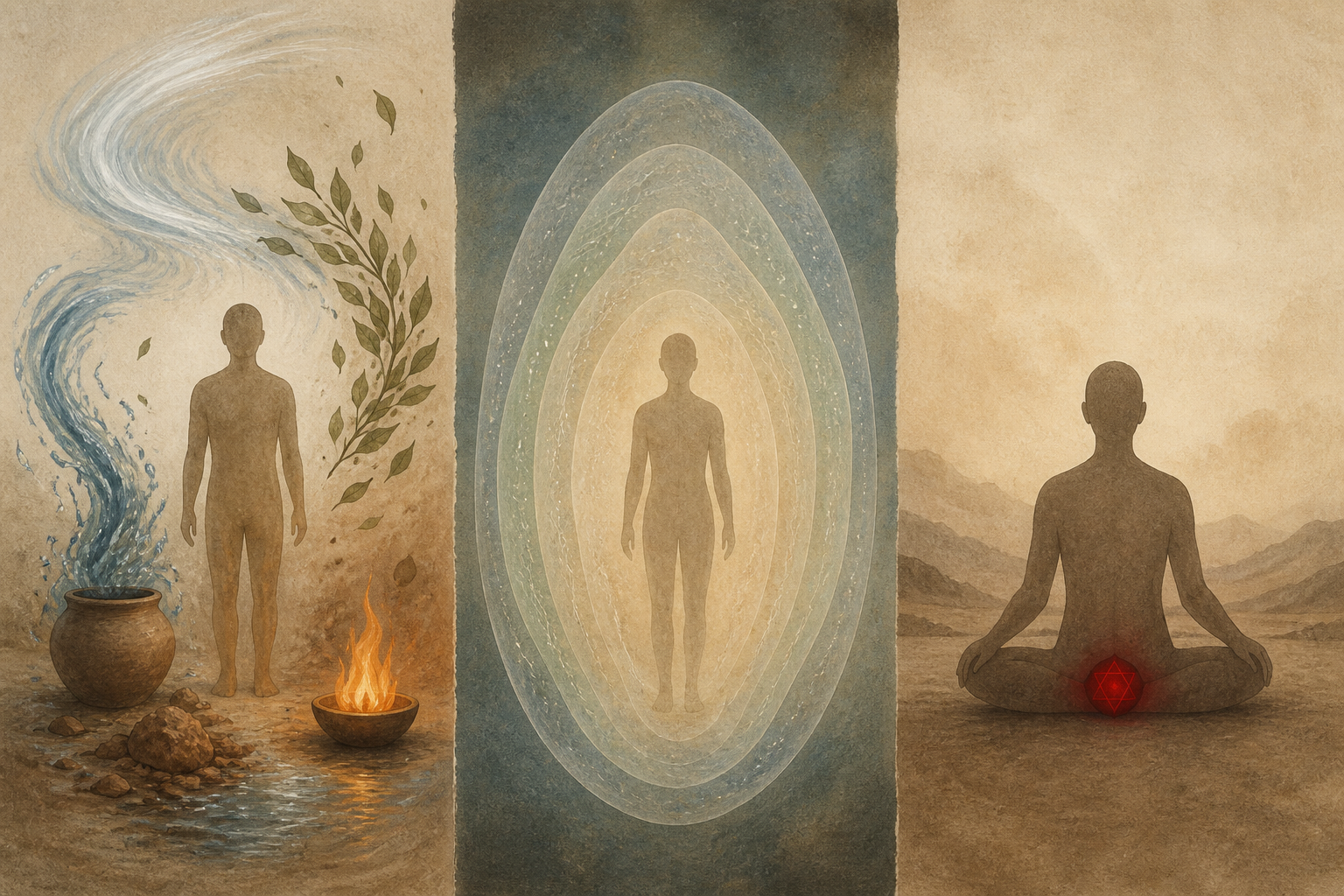
Several Dharmic maps can illuminate the same practice, but they are not interchangeable diagrams. Keeping their purposes distinct prevents a common mistake: mixing philosophical analysis, meditative experience, and symbolic anatomy into one supposedly literal system.
| Map | Question it helps you ask | Practical use | Common mistake |
|---|---|---|---|
| Prakriti | How is experience being formed and presented? | Observe senses, thought, reaction, and the conditions shaping them. | Treating every movement of mind as consciousness itself. |
| Indriyas and tanmatras | How does sensory contact become a known experience? | Notice seeing, hearing, touch, taste, and smell before preference takes over. | Assuming that subtle always means superior, supernatural, or vague. |
| Pancha Kosha Viveka | Which layer of experience am I identifying with now? | Discern body, breath, mind, intellect, and the blissful sheath without rejecting any layer. | Trying to escape the body instead of seeing each sheath clearly. |
| Muladhara | Is there enough embodied stability for deeper attention? | Work with posture, breath, routine, restraint, and the symbolism of rootedness. | Diagnosing a physical or mental condition as a blocked chakra. |
In Sankhya-inflected analysis, Prakriti is far more than outdoor nature. It is the dynamic field through which cognition and perception become possible. The indriyas and subtle determinants of experience arise within this field, while subtle constituents give rise to gross elements. Your body, senses, memories, preferences, and reactions therefore belong to the field being observed. Awareness is not reduced to any one of those movements.
This distinction changes how you work with distraction. A sound appears. The sense of hearing registers it. Recognition names it. Preference decides that it is pleasant, irritating, or important. Attention follows. Instead of declaring, “I cannot meditate,” you can observe the sequence as an activity within Prakriti. That small change turns interruption into material for discernment.
Pancha Kosha Viveka gives you another direction of inquiry. You begin with the bodily layer, notice breath and vitality, recognize mental activity, examine the discriminating intellect, and remain attentive even to refined ease or bliss. The aim is not to despise the outer layers. It is to stop mistaking any conditioned layer for the whole of what you are.
Muladhara gives this inquiry a starting condition: stability first. Its earth symbolism reminds you to work with what is concrete before pursuing what is dramatic. If your feet are tense, your exhalation is forced, or your daily obligations are being neglected, an elaborate inner ascent is unlikely to correct the imbalance. Return to the base.
Use this six-to-nine-minute grounding sequence
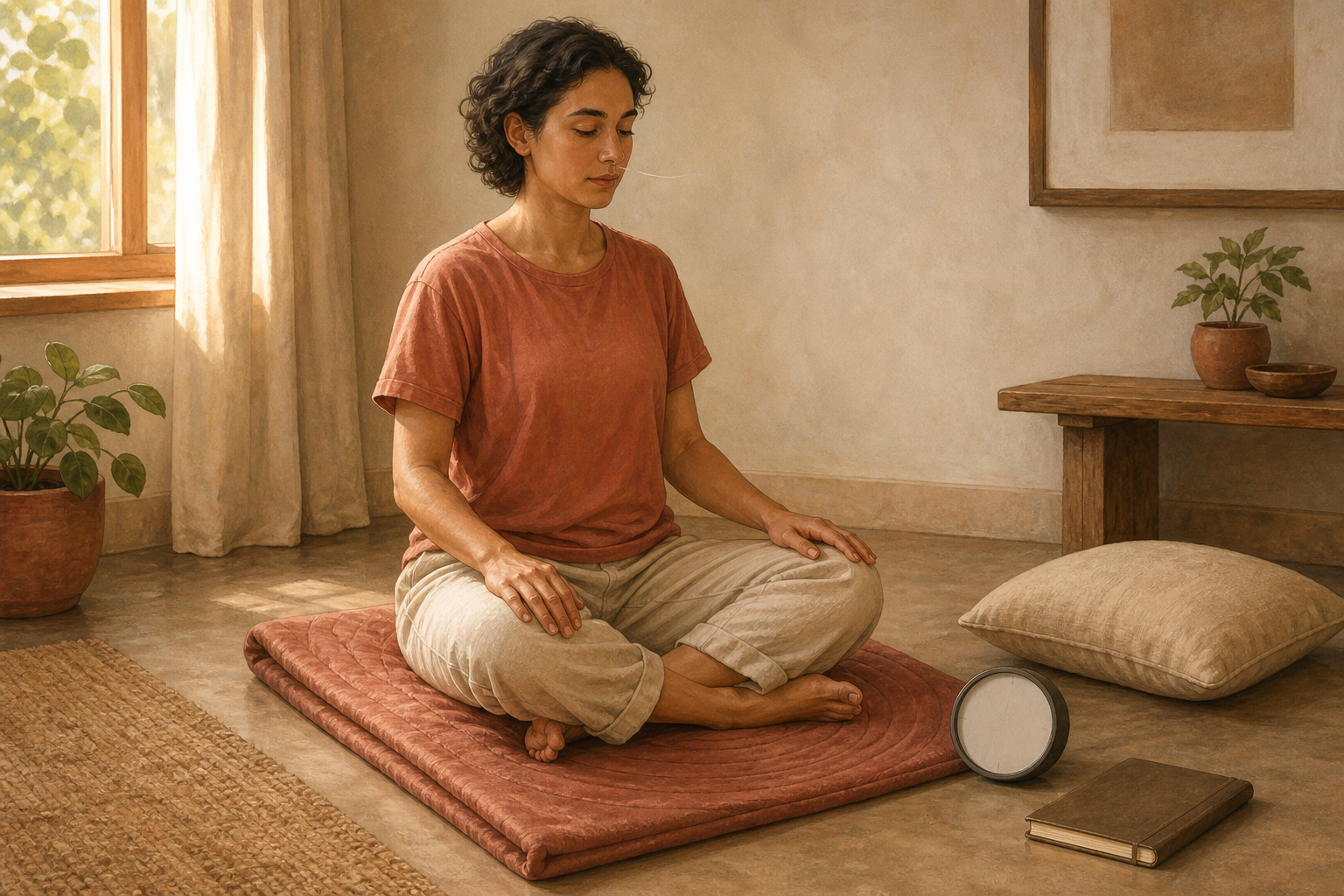
This sequence is intentionally modest. It combines one to two minutes of gentle breathing, three to five minutes of standing asana, and two minutes of seated attention. The short format makes repetition possible and leaves less room for strain or spiritual performance.
- Breathe gently for one to two minutes. Sit or stand in a position that does not compress the breath. Let the lower abdomen move without pushing it outward. If counting is comfortable, inhale for four counts and exhale for six. Keep both phases smooth. If the count creates hunger for air, tension, or light-headedness, stop counting and return to natural breathing.
- Spend three to five minutes in weight-bearing postures. Choose two or three from Tadasana, Virabhadrasana I or II, Vrikshasana, and Malasana. In Tadasana, feel the floor beneath both feet before adjusting anything else. In a Warrior posture, notice whether effort remains distributed through the legs rather than collecting in the jaw and shoulders. Use a wall for Tree Pose if balance is uncertain. Enter Garland Pose only as far as the hips, knees, and ankles comfortably permit.
- Sit for two minutes with one clear anchor. Choose either a body scan at the pelvis and legs or a soft mental repetition of Lam. If visualization supports attention, imagine a steady red glow near the base of the spine. If it produces effort or fantasy, omit it. Pressure, temperature, contact, and breath are sufficient.
- Name one grounded action. Before getting up, identify one concrete act that will carry steadiness into the day: prepare a wholesome meal, keep a promise, review an avoidable expense, clean the place where you practise, tell the truth in a delayed conversation, or perform a small act of seva. Choose something you can actually complete.
The order matters more than variety. Breath gathers attention. Standing posture gives that attention weight and direction. Seated observation permits a subtler register. Ethical action prevents the practice from ending as a private mood.
This routine deliberately avoids forceful breathing, prolonged retention, and attempts to drive Kundalini upward. The traditional image of dormant potential at Muladhara places ascent after the establishment of a stable foundation. If you are new to pranayama or subtle-body work, gentle repetition is a sounder basis than intensity.
You can also practise outside, but do not turn barefoot contact into a test of commitment. Walk barefoot only where the surface is safe. Otherwise, ordinary footwear does not prevent you from feeling pace, balance, contact, temperature, and the movement of the legs.
Read the feedback without turning it into a diagnosis
Subtle anatomy becomes useful when it sharpens observation. It becomes unhelpful when every difficulty receives a chakra label. Restlessness, anxiety about livelihood, unreliable routines, rigidity, hoarding, aimlessness, and disconnection can be treated as prompts for inquiry, but none proves that an energy centre is blocked.
If you feel agitated or scattered
Reduce the number of techniques. Keep your eyes softly open during standing practice, emphasize the pressure of the feet, and let the exhalation lengthen only if it remains easy. Do not add stronger mantra, breath retention, or complicated visualization merely because attention is unsettled. In daily life, restore one repeatable anchor such as a regular practice place, meal, or bedtime routine.
If you feel rigid or preoccupied with control
More heaviness is not necessarily the answer. Muladhara symbolism includes security, but security can be distorted into possession and inflexibility. Bring in aparigraha by releasing one unnecessary form of holding. It could be an unused object, an avoidable demand, or the insistence that practice must feel a particular way. Pair steadiness with generosity or seva so that grounding remains relational rather than defensive.
If you feel dull or disconnected
Choose sensory clarity over abstraction. Walk mindfully, notice the transfer of weight from one foot to the other, or practise Tadasana and Warrior postures before sitting. Use one distinct sound, physical contact point, or natural scent as an anchor. The task is not to manufacture an energetic sensation. It is to restore honest contact with experience as it is.
If you feel stable
Let stability open into pratyahara rather than excitement. Choose one sense and notice the difference between receiving an impression and chasing it. When a sound arises, hear it without constructing a story. When bodily pressure changes, observe the change without immediately correcting it. This is the movement from gross experience toward subtle discernment.
Persistent anxiety, severe distress, or disconnection that interferes with daily functioning warrants help from a qualified medical or mental-health professional. Yoga and meditation may accompany appropriate care, but chakra language should not replace assessment or treatment.
Let conduct and community complete the practice

You are not grounded merely because you feel calm while seated. The stronger test arrives when someone disappoints you, money feels uncertain, work becomes tedious, or an obligation competes with personal preference. Grounded practice should make the next action clearer and more proportionate, not give you a spiritual reason to avoid it.
Ahimsa and satya are practical stabilizers because trustworthy conduct reduces the conflict between what you contemplate and what you do. Responsible stewardship of food, money, possessions, time, and the natural environment gives earth symbolism a lived form. Gratitude prevents stability from becoming entitlement. Seva prevents inwardness from becoming isolation.
The wider Dharmic family offers parallel ways to cultivate this foundation without erasing doctrinal differences. Hindu Yoga can move from asana and sensory regulation into dhyana and kosha discernment. Buddhist mindfulness attends closely to body and sense experience, revealing how reactions are constructed and how clinging operates. Jain Samayik, ahimsa, and aparigraha connect collected attention with nonviolence and restraint. Sikh Simran and seva root remembrance in community, work, and the recognition of the One.
You do not need to combine all four paths into a single hybrid routine. Work faithfully within your own lineage while noticing the shared discipline: embodied attention, ethical clarity, reduced compulsion, and service beyond the isolated self. Similar practical functions do not make distinct teachings identical.
Prakriti also places your practice within a larger ecology. The field that supports the body includes food, soil, water, seasons, other beings, and human relationships. Time in nature can help you observe rhythm and interdependence, but reverence becomes credible only when it changes how you use resources and care for the places that sustain life.
Begin today with the small sequence: gentle breath, standing weight, seated attention, and one ethical action. Keep it simple enough to repeat. When that foundation starts appearing in your decisions and relationships, let pratyahara and dhyana deepen naturally from steadiness rather than from urgency.
References
- DharmaRenaissance Blog — Master the Inner Science of Prakriti: A Complete Path to Infinite Consciousness
- HinduPad — Muladhara (Root) Chakra: The Complete, Proven Guide to Grounding, Security, and Stability
