
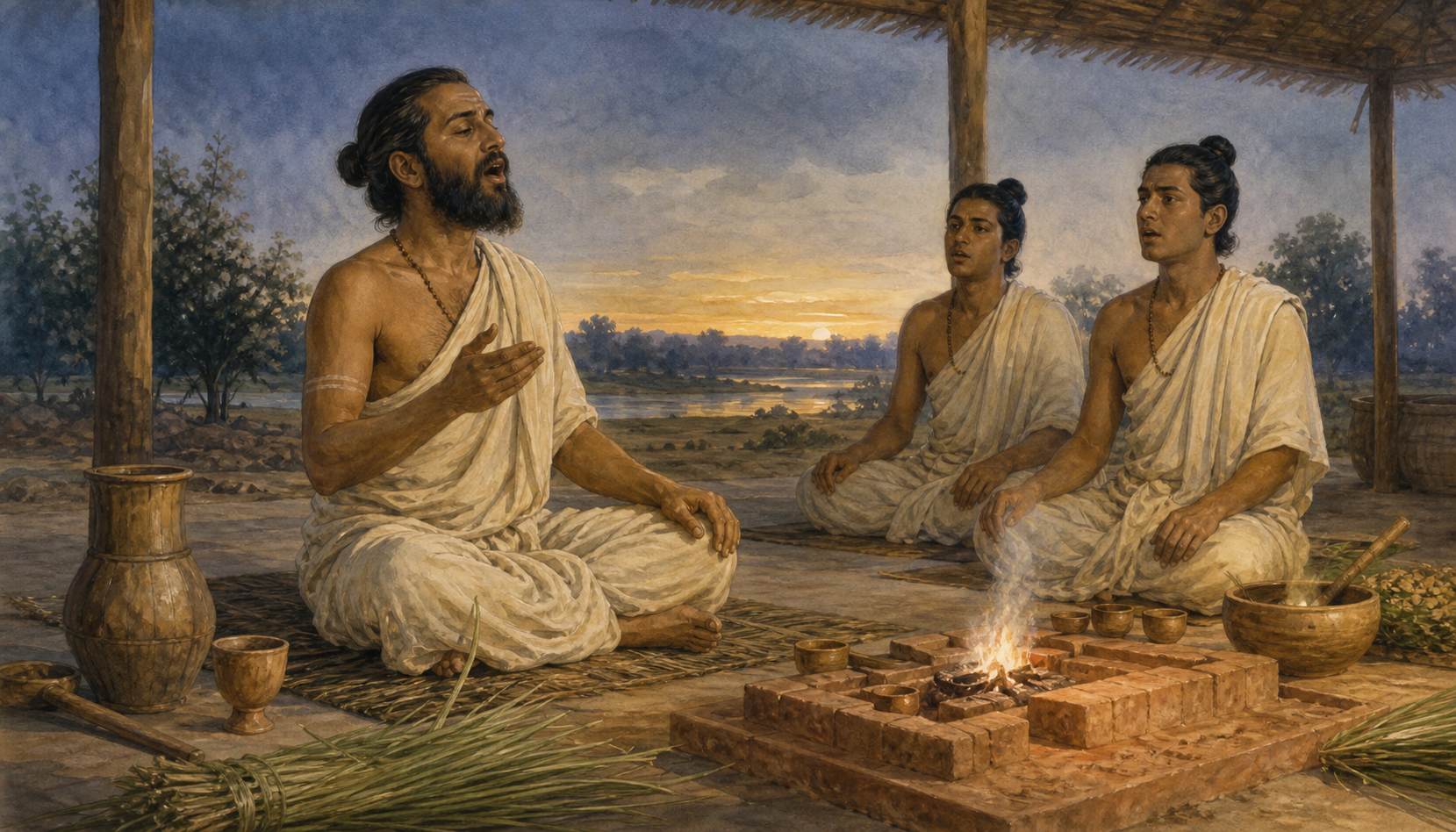
You hear a Sāman begin with a compact, carefully voiced “Him.” Is it a mantra, a musical warm-up, or merely a cue before the important part? That question is best answered by following what happens next.
Hinkara belongs to the ritual action itself. It carries the chanting across a threshold: silence gives way to ordered sacred sound, the priestly performance comes into focus, and the melodic sequence begins. Once you know where to listen, the opening no longer sounds like an expendable syllable.
Hinkara opens a sequence; it does not stand alone

Hinkara is the name given to the intoned syllable rendered here as “Him.” In descriptions of the Soma sacrifice, it stands at the opening of the Sāman and comes immediately before the Prastava, with the Udgitha among the components that follow. Its significance therefore depends on placement as much as sound.
A new listener can hold the basic movement in mind as follows:
- Ritual readiness and silence establish the threshold.
- Hinkara formally initiates the vocal movement.
- Prastava carries the Sāman forward.
- Later components include the Udgitha.
This is an orientation, not a complete performance manual. The Sāman is a coordinated liturgical form in which the Udgatri and associated priests bring together melody, metre, breath, timing, and prescribed action. Isolating “Him” from that architecture is rather like keeping an opening gesture while discarding the rite it opens.
Hinkara also belongs to the wider class of stobha syllables used in Sama Veda chanting. A stobha is non-lexical: you should not expect it to behave like an ordinary Sanskrit word that delivers a proposition through dictionary meaning. But non-lexical does not mean meaningless. Here, sound performs several exact functions at once:
- Ritual function: it marks the formal beginning of the Sāman sequence.
- Musical function: it prepares the voice and the melodic line, contributing to cadence and pitch.
- Respiratory function: it helps align breath with the vocal movement about to unfold.
- Attentional function: it gathers the officiants and listeners around a single transition.
The useful question is therefore not only, “What does Hinkara mean?” Ask, “What does Hinkara do here?” Its meaning is inseparable from its work.
How to listen for Hinkara instead of listening past it
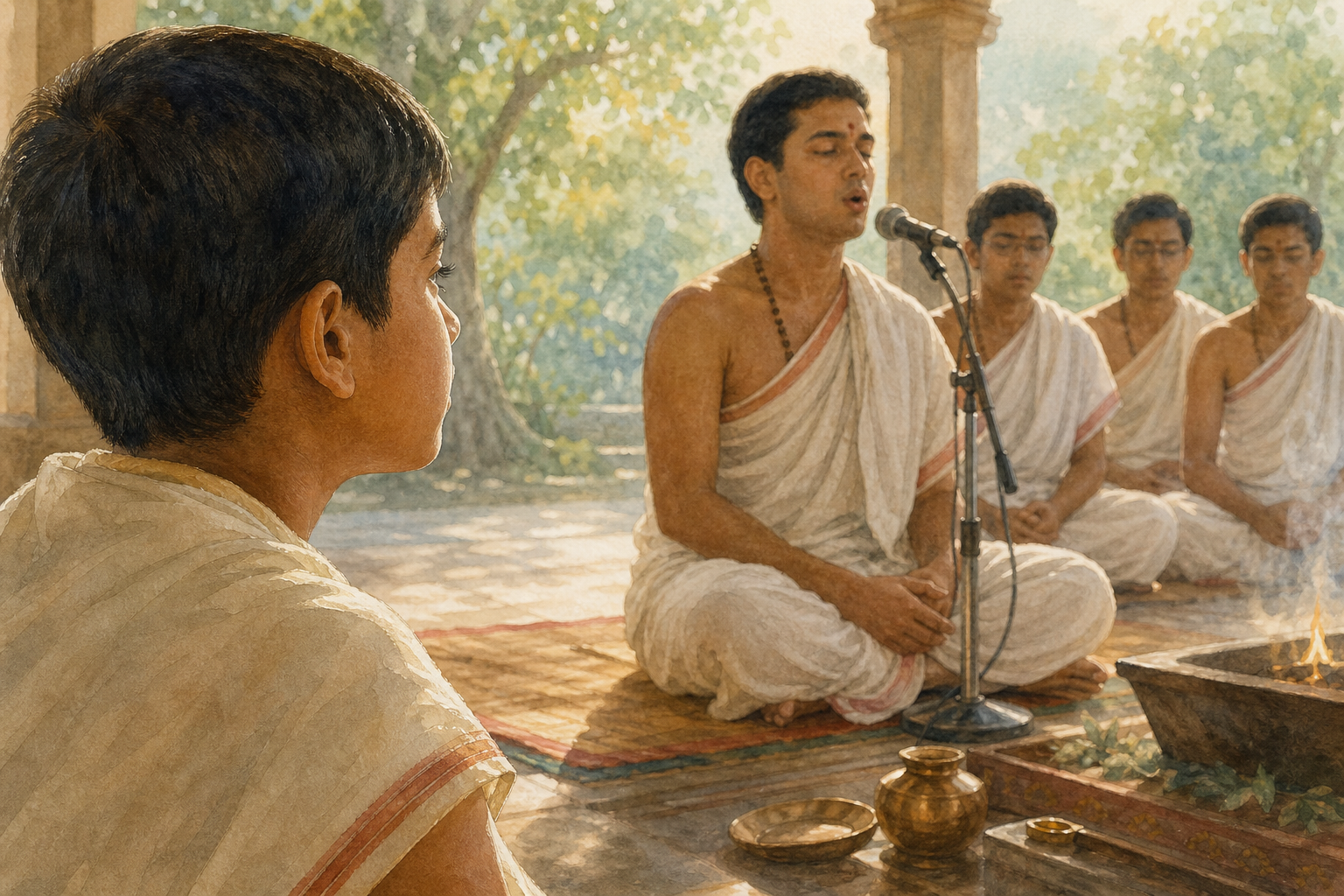
If you are hearing Sama Veda chanting for the first time, the shortness of Hinkara can make it easy to miss. Replaying only the syllable will not necessarily help. Listen to the transition around it.
- Begin with the preceding silence. Notice the state of the ritual space before the voice enters. Hinkara is a threshold precisely because it changes that state.
- Identify the “Him” sound without forcing a translation. Hear it as a deliberately placed vocal act, not conversational language.
- Follow its movement into the Prastava. The handoff reveals more than the syllable heard in isolation. You are listening for continuity: the opening sound readies and releases the next component.
- Attend to breath, pitch, and cadence together. Do not reduce the moment to pronunciation alone. Its precision is musical and respiratory as well as phonetic.
- Notice the shared attention it creates. The room’s stillness, the priests’ coordinated voices, and the expectation of the coming Sāman are part of how the transition is experienced.
This method also guards against an easy romantic mistake. A feeling of calm may arise as the sound enters and settles, but calm is not a promised mechanical result of pronouncing a syllable. In the rite, stillness grows from disciplined preparation, coordinated performance, and attentive listening. The setting matters.
At a live sacrifice, remain silent unless the officiants or hosts explicitly invite participation. Joining the sound because it appears simple can disrupt a role-bound sequence, and imitation is not the same as transmitted recitation. If you are studying a recording, replay the short passage from silence through Hinkara into Prastava rather than extracting “Him” as an audio fragment. That preserves the relationship you are trying to understand.
Four common misreadings and how to correct them
Searching only for a dictionary definition
A lexical translation cannot carry the whole explanation because Hinkara functions as a stobha syllable. If a glossary gives you a neat English equivalent but says nothing about the Sāman sequence, it has left out the decisive information. Locate the syllable before Prastava and ask how it shapes the opening.
Dismissing it as a singer’s warm-up
Hinkara does prepare breath and voice, but “warm-up” makes that preparation sound incidental and replaceable. Its place is prescribed within the ritual movement. Hear the preparation itself as sacred action: the voice is not rehearsing outside the rite but commencing it.
Turning it into a self-contained meditation formula
The syllable can focus attention, yet that does not automatically make an isolated repetition equivalent to Sama Veda practice. Treat Hinkara first as a liturgical component. If you want to learn its recitation, learn its placement, melodic setting, breath, accent, and relationship to the neighboring components from a qualified teacher. Do not build a private technique from the spelling alone and label it a transmitted Vedic practice.
Making all dharmic chanting interchangeable
Hindu mantra recitation, Buddhist chanting, the Jain Navkar Mantra, and Sikh gurbani kirtan all show the importance dharmic communities give to disciplined sacred sound. That family resemblance is worth noticing, but it does not erase differences in theology, text, authority, or liturgical structure.
For a responsible comparison, ask the same concrete questions of each tradition: What text or sound is voiced? Where does it belong in worship? Who leads it? What do melody, breath, memory, and congregational response contribute? This approach reveals shared habits of attentive listening and devotional remembrance without claiming that every practice has the same origin or function.
Why lineage preserves more than the printed syllable
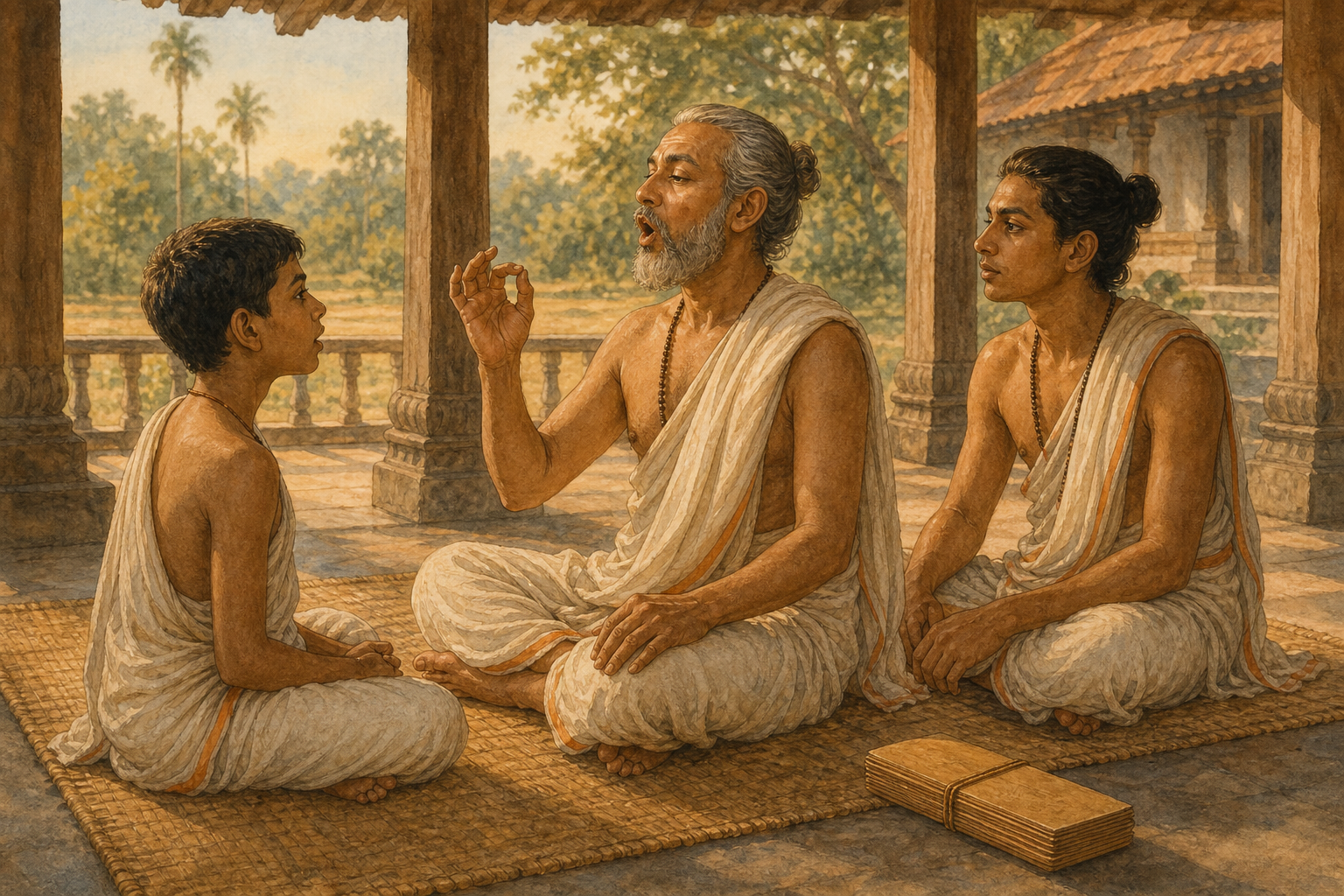
“Him” is easy to put on a page. The page does not by itself preserve pitch, cadence, Vedic accent, breath, timing, priestly coordination, or the precise point at which the sound gives way to the next component. Those dimensions explain why guru–shishya transmission and a living ritual culture remain central to Sama Veda chanting.
Your next step should match what you are actually trying to do:
- If you are listening: learn the names Hinkara, Prastava, and Udgitha, then use them to follow the movement rather than treating the chant as an undifferentiated stream.
- If you are studying: record the syllable’s location, ritual function, and musical function separately in your notes. This prevents “non-lexical” from being mistaken for “unimportant.”
- If you want to recite: seek a teacher competent in Sama Veda chanting and the relevant ritual practice. Ask to learn the surrounding sequence, not only the attractive opening sound.
- If you are presenting the tradition to others: distinguish clearly between an observation, a simplified listening aid, and an actual performance instruction. Do not present an approximation as lineage-based recitation.
This distinction protects both understanding and continuity. Technical accuracy is not opposed to contemplative depth here. The disciplined breath, exact sound, and prescribed sequence are the means through which the contemplative and ritual dimensions become perceptible.
Key takeaways
- Hinkara is the carefully intoned “Him” that initiates a Sāman in Vedic sacrificial chanting.
- It stands before Prastava, while Udgitha belongs to the later unfolding of the sequence.
- As a stobha syllable, it is non-lexical but still performs ritual, musical, respiratory, and attentional work.
- You will understand it more clearly by listening from the preceding silence through the transition into Prastava.
- Its authentic recitation depends on trained transmission; a printed syllable or isolated recording cannot preserve the full practice.
The next time you hear a Sāman, start listening before the first sound. Mark the silence, receive Hinkara as the opening action, and follow its movement into Prastava. If you want to move from listening to chanting, take that whole transition—not merely the syllable—to a trained teacher.
References
