You may have come to Aim Hrim Klim because your mind feels scattered, your speech lacks precision, your heart is unsettled, or desire keeps pulling you in conflicting directions. The useful question is not which wish these syllables can grant. It is how to practise them so that thought, feeling, and intention begin moving in a dharmic direction.
Use the triad as a discipline of inner alignment: Aim for clarity, Hrim for integration, and Klim for desire refined into loving, ethical will. That threefold movement of knowledge, centred power, and attraction gives you a practical standard. The mantra should make your conduct more coherent, not turn spiritual practice into a technique for controlling events or other people.
Know what each bija asks of you
A bija is a seed syllable: a compact sonic form of devata-shakti rather than a word with an ordinary dictionary definition. Its work involves sound, breath, attention, intention, and the quality represented by the associated deity. That is why pronunciation matters, but pronunciation alone is not the whole practice.
| Bija | Traditional orientation | Optional focus | Test in daily life |
|---|---|---|---|
| Aiṁ, commonly written Aim | Sarasvati, knowledge, insight, learning, and articulate speech | Throat or brow | Is your speech becoming clearer, more truthful, and less careless? |
| Hrīṁ, commonly written Hrim | Mahamaya or Bhuvaneshvari, the heart, integration, and empowered action | Centre of the chest | Are knowledge, intention, and action becoming less divided? |
| Klīṁ, commonly written Klim | Krishna or Lalita Tripurasundari, attraction, affection, desire, and loving will | Lower abdomen or heart | Is desire becoming less compulsive and more compatible with dharma? |
Aim clarifies
Aim is associated with jnana-shakti, the power of knowing. It is traditionally connected with Sarasvati, speech, learning, discrimination, and luminous articulation. Give it attention when you need to understand before speaking, to distinguish a sound motive from a confused one, or to express something without distortion.
The practical test is not whether you feel pressure or light around the brow. Notice whether you listen more carefully, choose words more precisely, and become less willing to repeat what you have not understood. Those changes express the quality of Aim more reliably than an unusual sensation.
Hrim integrates
Hrim is often called the heart-bija. In Shakta practice it is associated with Mahamaya and Bhuvaneshvari, the power that reveals and veils, forms and dissolves. It brings will, knowledge, and action into relationship. Its centre is therefore not sentimentality but an intelligent heart capable of remaining present while circumstances change.
Use Hrim to examine inner division. You may know what is right but lack the courage to act, act intensely without sufficient understanding, or want something that contradicts your professed values. Hrim asks you to bring those movements into one field of awareness before proceeding.
Klim refines attraction
Klim is known as the kama-bija and is associated with Krishna, Lalita Tripurasundari, prema, and iccha-shakti. Kama here must not be reduced to the attempt to obtain a particular person. Attraction is a broad movement of consciousness: what you seek, what you repeatedly notice, which relationships you cultivate, and where your life-force flows.
The dharmic use of Klim is refinement rather than coercion. It asks whether your desire can become devoted will, whether affection respects another person’s freedom, and whether the opportunities you pursue are wholesome. If a proposed use depends on overriding someone else’s judgement or consent, the intention is already out of alignment with the mantra’s higher orientation.
The triad can also be contemplated through the waking, dreaming, and deep-sleep states. Aim corresponds to lucid discernment in jagrat, the waking state. Klim helps you examine imagination and longing in svapna, the dream state. Hrim evokes the supportive ground into which distinct forms recede in sushupti, deep sleep. The silence after japa points toward turiya, the presence underlying all three. Treat this as a contemplative map, not as proof that a particular sensation or dream represents spiritual attainment.
Use a complete practice without crowding it
A clear foundational sequence gives each bija enough room to be heard before the next one begins. It uses 108 repetitions of each syllable, for a total of 324 bija repetitions. Choose a time when you can complete that cycle without racing. If your guru or lineage has given you a different order, count, pronunciation, or visualization, that instruction takes precedence.
- Prepare one uncluttered place. Sit where interruption is unlikely. A simple image of Devi or a steady candle may anchor attention, but neither is compulsory. The purpose is to reduce competing signals before japa begins.
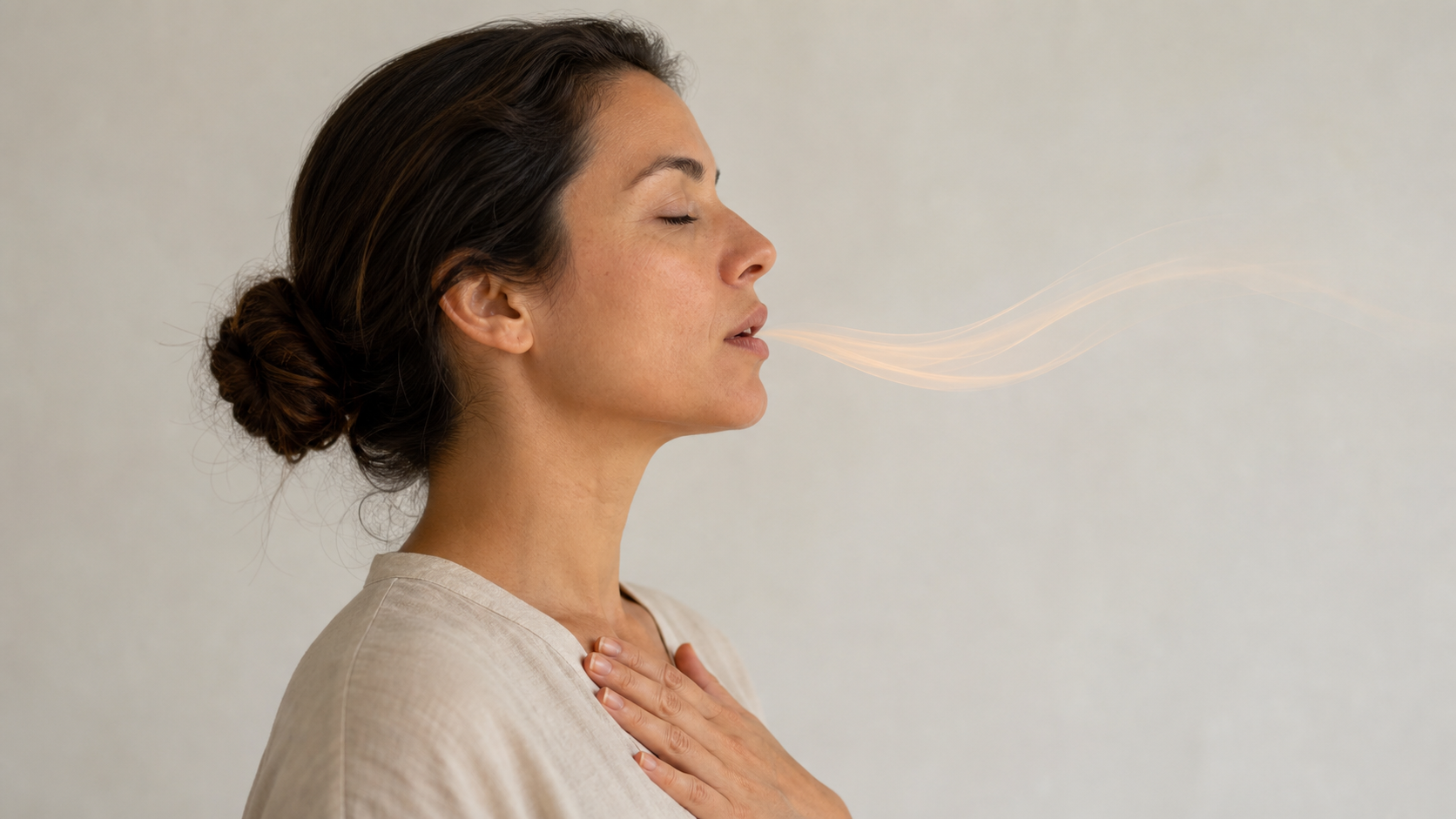
- Establish the body and breath. Keep the spine comfortably upright rather than rigid. Take three to nine rounds of gentle, equal-length inhalation and exhalation. Do not add strain or breath retention merely to make the preparation feel advanced.
- State one dharmic sankalpa. Make it behavioural and open-handed. You might resolve that your speech become truthful, that knowledge and action come into alignment, or that desire serve mutual good. Avoid framing the practice around compelling a named person or guaranteeing a particular outcome.
- Recite Aim 108 times. Let the sound remain clear and unhurried. You may place attention at the throat or brow and imagine a cool white or moon-silver luminosity. After the final repetition, pause long enough to notice the remaining resonance without manufacturing an experience.
- Recite Hrim 108 times. Rest attention in the heart area. If it helps, place the right palm lightly over the centre of the chest. A golden or rose-coloured radiance may accompany the sound. Let the practice collect thought, emotion, and purpose rather than turning into an effort to produce warmth.
- Recite Klim 108 times. Place attention at the lower abdomen if you are working with life-force, or at the heart if you are working with affection and relationship. A tender ruby colour is an optional aid. Keep returning the meaning of attraction to dharma, reciprocity, and benevolence.
- End in silence. Do not leap directly from the last hum into a screen, conversation, or task. Allow the breath to return to its ordinary rhythm and attend to the after-sound. The silence is part of the practice rather than unused time after it.
A mala is useful because it lets the hand carry the count while the mind remains with the sound. If counting mentally makes you tense, do not sacrifice articulation to numerical anxiety. Arrange the practice so that the count supports attention instead of replacing it.
The bodily placements are a simple form of embodied attention, not a rigid claim that each mantra belongs to only one point. Aim is commonly related to the throat and brow; Hrim to the heart; Klim to the lower abdomen or heart. Use the placement that makes the mantra’s function intelligible, then release it when you enter silence.
Some traditions prefix the practice with Om. The three bijas also occur in the Navarna Mantra, Om Aim Hrim Klim Chamundayai Viche. Do not treat that longer mantra as an interchangeable extension of an introductory routine. It invokes Chamunda and carries lineage-specific dimensions of tone, count, visualization, and nyasa that are best learned through diksha from a qualified guru.
Pronounce the syllables without forcing the breath
The everyday spellings Aim, Hrim, and Klim hide two important features: the long ī in Hrīṁ and Klīṁ, and the final anusvara, written ṃ. The anusvara should resolve as a soft nasal resonance rather than a sharply clipped English m. Let it gather the sound inward without exaggerating the hum.
Aiṁ: one continuous diphthong
Begin Aiṁ with the continuous vowel movement heard approximately in the English word eye, then let it close into a gentle nasal resonance. Do not split it into two detached beats. The movement of the diphthong should be smooth enough that breath and attention remain joined.
Hrīṁ: a light r and a long vowel
Let the h open with breath, touch the r lightly, sustain the long ee sound, and finish with the nasal resonance: roughly hreem, but without letting the English approximation become harsh. Do not insert a heavy extra vowel between h and r. The sound should open and recollect naturally in the chest rather than being pushed down into it.
Klīṁ: keep the consonant cluster intact
Articulate k and l as a compact cluster, follow them with the long ee sound, and let the final resonance taper inward: approximately kleem. Avoid turning the syllable into kuh-leem or kil-im. Precision means clean continuity, not muscular effort.
- Use a comfortable pitch. A lower or louder voice is not automatically more potent.
- Let the sound ride on an easy exhalation. Return to normal breathing whenever the breath starts to feel managed or tight.
- Give the consonant a clean beginning, the vowel a stable body, and the anusvara an unforced ending.
- Do not lengthen the nasal hum until the next inhalation becomes a gasp. Resonance is useful only while the breath remains poised.
- Correct one pronunciation problem at a time. Constant self-monitoring can fragment attention as thoroughly as careless chanting.
Roman approximations can start you in the right direction, but they cannot transmit every oral nuance. If you have access to a teacher in the lineage whose practice you are undertaking, listen to the living pronunciation and allow that instruction to replace generic phonetic advice.
Judge the practice by what changes after japa
You may notice mental brightness with Aim, warmth or inward ease with Hrim, and a softening of relational energy with Klim. You may also notice nothing dramatic. Neither outcome, by itself, tells you whether the practice is maturing. Sensations vary; conduct reveals whether the mantra is being integrated.
- Test Aim in speech. Before sending a difficult message or repeating a claim, ask whether you understand it and whether your wording is both truthful and necessary.
- Test Hrim in moments of division. When emotion, knowledge, and duty pull in different directions, pause before acting. Look for a response that can hold all three without denial.
- Test Klim at the moment of wanting. Ask whether the desire honours another person’s agency, whether it advances a wholesome relationship, and what habit it will strengthen if followed.
- Test the triad in action. A decision should become clearer through Aim, inwardly coherent through Hrim, and ethically worth pursuing through Klim.
The three-state map can sharpen this observation. In waking life, watch the quality of your speech and discrimination. When you remember a dream, notice the longing, fear, or image around which it was organised rather than treating every dream as an instruction. Deep sleep is not another image to force; Hrim offers a way to contemplate the ground into which ordinary distinctions dissolve. In the quiet following the three bijas, remain available to the awareness that is not exhausted by any one state.
Several common mistakes become visible through this standard. Aim can be distorted into intellectual vanity, Hrim into the fantasy of being invulnerable, and Klim into a promise of personal magnetism. All three errors make the ego’s demand larger. A sound practice moves in the other direction: more discrimination, more integrated courage, and less possessive desire.
If you find yourself increasing counts because an ordinary session feels disappointing, return to the basic sequence. More repetitions do not correct a confused sankalpa, careless pronunciation, or manipulative motive. If the breath becomes strained, the throat hurts, or the practice produces persistent agitation, stop forcing it and seek guidance from a qualified teacher before intensifying the routine.
Frequently asked questions
Should Aim, Hrim, and Klim be chanted separately or together?
Both forms have a place. Separating them into 108 repetitions each lets you attend to clarity, integration, and ethical attraction as distinct functions. Reciting the cluster preserves their coordinated movement. For a self-contained foundational session, the staged sequence makes it easier to notice where your attention or intention loses coherence. Follow your lineage if it prescribes a combined form.
What should you do when there is not enough time for all 324 repetitions?
Do not compress the full sequence into rushed, indistinct sounds. Each bija can be practised individually. Choose Aim when the immediate work concerns learning or speech, Hrim when knowledge and action need integration, or Klim when desire and relationship need dharmic examination. Complete one attentive round of 108 and return to the full triad when your schedule permits. If you have received a prescribed daily practice, ask your teacher how it should be shortened rather than altering it silently.
Do you need initiation to begin?
Bija mantras belong to living traditions in which diksha, pronunciation, deity contemplation, nyasa, and count may be transmitted together. If you already have a guru, use that method. Without such instruction, keep an introductory practice simple and stable. Do not improvise elaborate nyasa, rapidly escalate counts, or assume that the Navarna Mantra is merely a stronger version of the three bijas. Seek qualified guidance when you want to enter a specific lineage practice.
Can Klim be used to attract a particular person?
That is the wrong test of Klim. A dharmic practice does not reduce another person’s will to an object of your desire. Direct the sankalpa toward the quality of relationship you are prepared to cultivate: reciprocity, affection, truthfulness, and mutual good. Then let the other person remain free. Klim becomes spiritually useful when attraction is purified of compulsion, not when compulsion acquires sacred vocabulary.
At your next sitting, prepare the space before deciding what you want from the mantra. State one dharmic intention, complete only the repetitions you can pronounce without haste, and leave enough silence to notice what remains. Then protect the practice where it matters: in the next sentence you speak and the next desire you choose to follow.