You know the bind: a parent, leader, or community expects your support, yet giving it would help something you believe is wrong. Refusal feels like betrayal. Obedience feels like complicity. The closer the relationship, the easier it is to confuse love for the person with service to the person’s cause.
Indrajit’s conflict gives you a precise way to think through that pressure. His tragedy is not a lack of loyalty, courage, discipline, or ability. It is that all four virtues remain attached to Ravana’s adharmic project. His fate therefore helps you distinguish loyalty from obedience, recognize when duty has been corrupted, and set an ethical boundary without pretending that family bonds do not matter.
The conflict begins when obedience replaces moral judgment
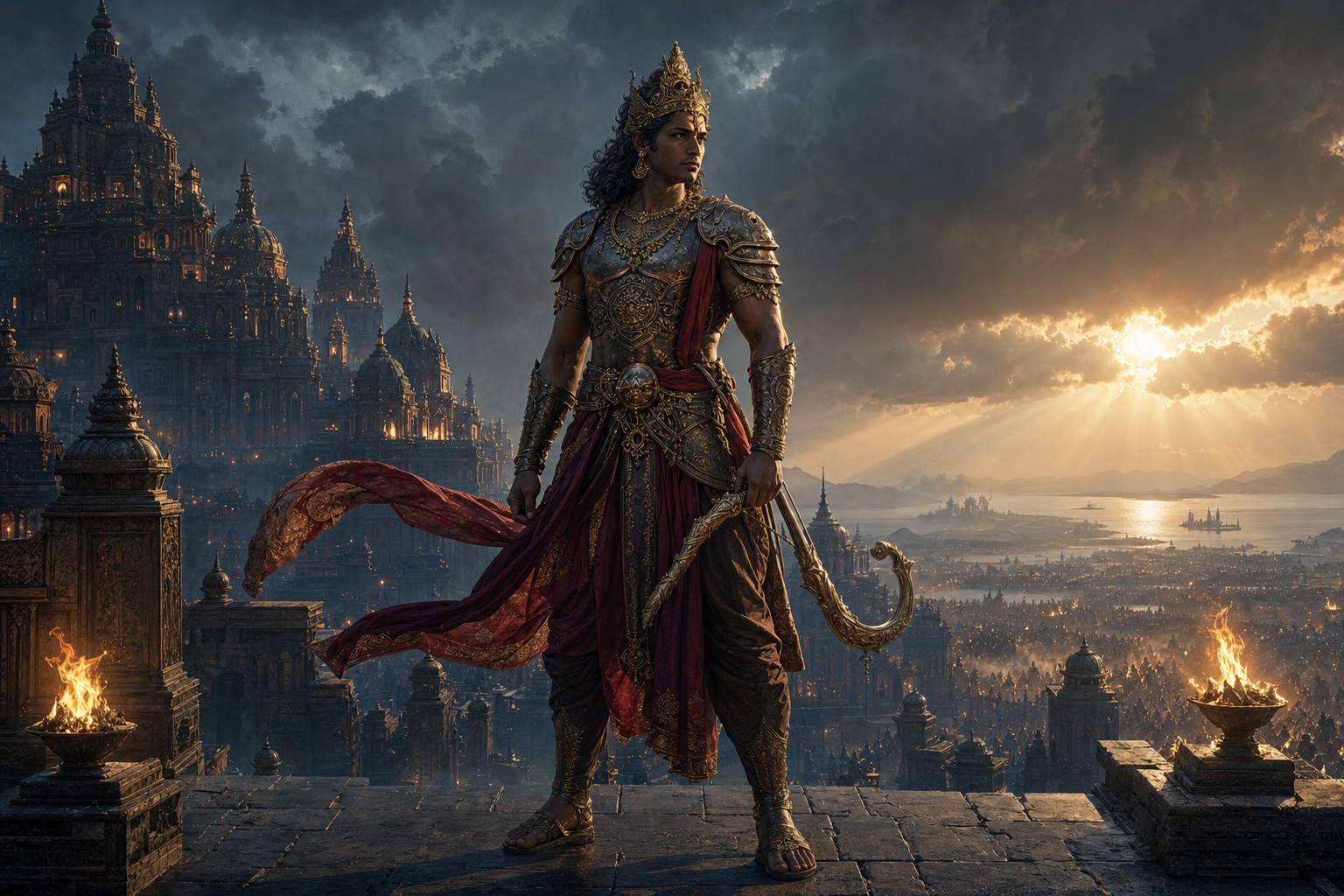
Indrajit, also known as Meghanada, is Ravana’s son, Lanka’s pre-eminent warrior, and the conqueror of Indra. He does not defend his father weakly or reluctantly. He commits his intelligence, martial knowledge, ritual discipline, and life to the struggle.
That commitment makes his choice emotionally comprehensible. A son’s duty toward his father is real. A prince also has duties toward his kingdom and fellow warriors. But dharma cannot mean that the nearest relationship automatically defeats every wider obligation. If it did, no ruler could be restrained by justice, no family wrongdoing could be opposed from within, and loyalty would become a shield for whoever already possesses authority.
The decisive distinction is between remaining faithful to a person and participating in that person’s conduct. You can honor a relationship while refusing an action. You can protect a relative’s dignity without concealing the harm that relative has caused. You can advise a leader truthfully without defending every decision. When those distinctions collapse, loyalty becomes obedience; when obedience helps wrongdoing continue, it becomes complicity.
| Response | What it protects | The question to ask |
|---|---|---|
| Loyalty | The person’s legitimate good and the integrity of the relationship | Am I helping this person return to what is right? |
| Obedience | The instruction or authority attached to a role | Is this command itself within the limits of dharma? |
| Complicity | The continuation of a harmful act, often under the language of loyalty | Whose harm am I being asked to ignore, hide, or enable? |
This does not make personal conviction an infallible substitute for dharma. Discomfort may come from wounded pride, inconvenience, fear, or rivalry. Before resisting, identify the actual wrong in plain language. Do not say only, This feels wrong to me. Ask what truth is being denied, who will bear the foreseeable harm, which duty is being violated, and whether you would defend the same conduct if an opposing family or faction performed it.
That last question is especially useful. Attachment changes the names in a conflict; dharma tests whether your standard survives the change. If an act becomes acceptable only when your own side performs it, you are probably defending identity rather than principle.
Indrajit’s greatness makes his failure more instructive
Indrajit is not useful as a moral example because he is easily dismissed. He is useful because he is formidable. His battlefield record includes Nagapasha, which binds Rama and Lakshmana until Garuda intervenes; the Shakti weapon, which leaves Lakshmana in mortal peril; and maya-based tactics that unsettle his opponents. He combines courage with technical mastery and strategic imagination.
Those abilities do not cancel his moral agency. They enlarge it. The more capable you are, the more consequential your decision about whom and what to serve becomes. Intelligence can expose a falsehood, or make the falsehood harder to detect. Discipline can restrain aggression, or execute it more efficiently. Courage can defend the vulnerable, or prevent an unjust leader from facing the consequences of his choices.
This is where many loyalty conflicts are misread. A person may assume that admirable motives or excellent conduct in one part of life sanctify the whole cause. They do not. A devoted son can still defend adharma. A brave soldier can still serve an unrighteous objective. A disciplined worshipper can still seek a fruit that should not be sought. Virtue at the level of character does not automatically make the chosen end righteous.
Indrajit’s use of maya sharpens the problem. Strategy is not inherently unrighteous, and dharmic action does not require naivety. Yet a tactical success must still be judged by its purpose, means, and consequences. The relevant question is not merely, Did the plan work? It is, What order did the plan preserve, and what truth did it require us to obscure?
Watch for four signs that your competence is being recruited into complicity:
- You are asked to describe a harmful act with a softer name so that others will accept it.
- You are praised for loyalty precisely when you stop asking questions.
- The group’s reputation is treated as more important than correcting the wrong.
- Ritual, rank, tradition, or past sacrifice is invoked as though it places the present act beyond examination.
If one of these appears, slow the decision down. Restate the request without the language of family prestige, institutional loyalty, or factional victory. A request to keep peace in the family, for example, may actually be a request to conceal conduct from the person harmed by it. You cannot judge the duty clearly until you name the act clearly.
Nikumbhila shows why a sacred form cannot purify an unjust aim
Indrajit’s rite at Nikumbhila brings the conflict into its sharpest form. The yuddha-yajna is both sacred discipline and military preparation. Its completion would make him unconquerable in battle in several tellings, so Vibhishana directs Lakshmana to intervene before the rite is completed.
The episode can be misunderstood in two opposite ways. One reading reduces the rite to a magical device and ignores its religious seriousness. The other assumes that because an act has sacred form, its intended fruit must be righteous. Neither reading is adequate. Indrajit’s austerity may be sincere. His concentration may be complete. The ritual may express a genuine desire to place martial power under a sacred sanction. But sincerity, discipline, and sacred form cannot by themselves repair the aim they serve.
In some regional traditions, Nikumbhila is associated explicitly with Kali, while the Valmiki Ramayana does not plainly name the goddess in this setting. That distinction matters. The Kali-centered interpretation should be received as a powerful regional and Shakta lens, not projected backward as an identical detail in every recension.
Through that Shakta lens, Indrajit stands before the power that exposes the impermanence of every conquest. The warrior who defeated Indra still faces time, death, and the moral limit of power. His vrata can then be understood as penance-like inner discipline: an attempt to reconcile valor, filial duty, and a higher order. The attempt gives his end gravity. It does not make Ravana’s cause dharmic.
The practical lesson is demanding: religious observance is not an ethical bypass. Prayer before an action does not settle whether the action is just. A vow does not make its object worthy. An inherited custom does not become immune to moral scrutiny merely because your elders practiced it. Professional procedure works the same way: following every formal step cannot justify an objective that the steps were never entitled to serve.
When sacred or institutional authority is invoked in a loyalty conflict, ask three separate questions:
- What fruit is being sought? Name the concrete outcome, not only the elevated language surrounding it.
- Who receives the protection and who bears the cost? A cause that protects status by transferring harm to the powerless requires scrutiny.
- Would the form still look righteous in an opponent’s hands? If you would condemn the same rite, tactic, or rule when used against your side, sacred vocabulary is probably masking partiality.
Lakshmana’s intervention should not be generalized into permission to violate worship whenever one dislikes its practitioner. Nikumbhila belongs to a particular wartime crisis in which the rite is inseparable from the immediate attempt to make a champion of Ravana’s cause unbeatable. The moral distinction lies in preventing the unjust fruit, not in showing contempt for sacred practice.
Vibhishana reveals the harder and more faithful refusal
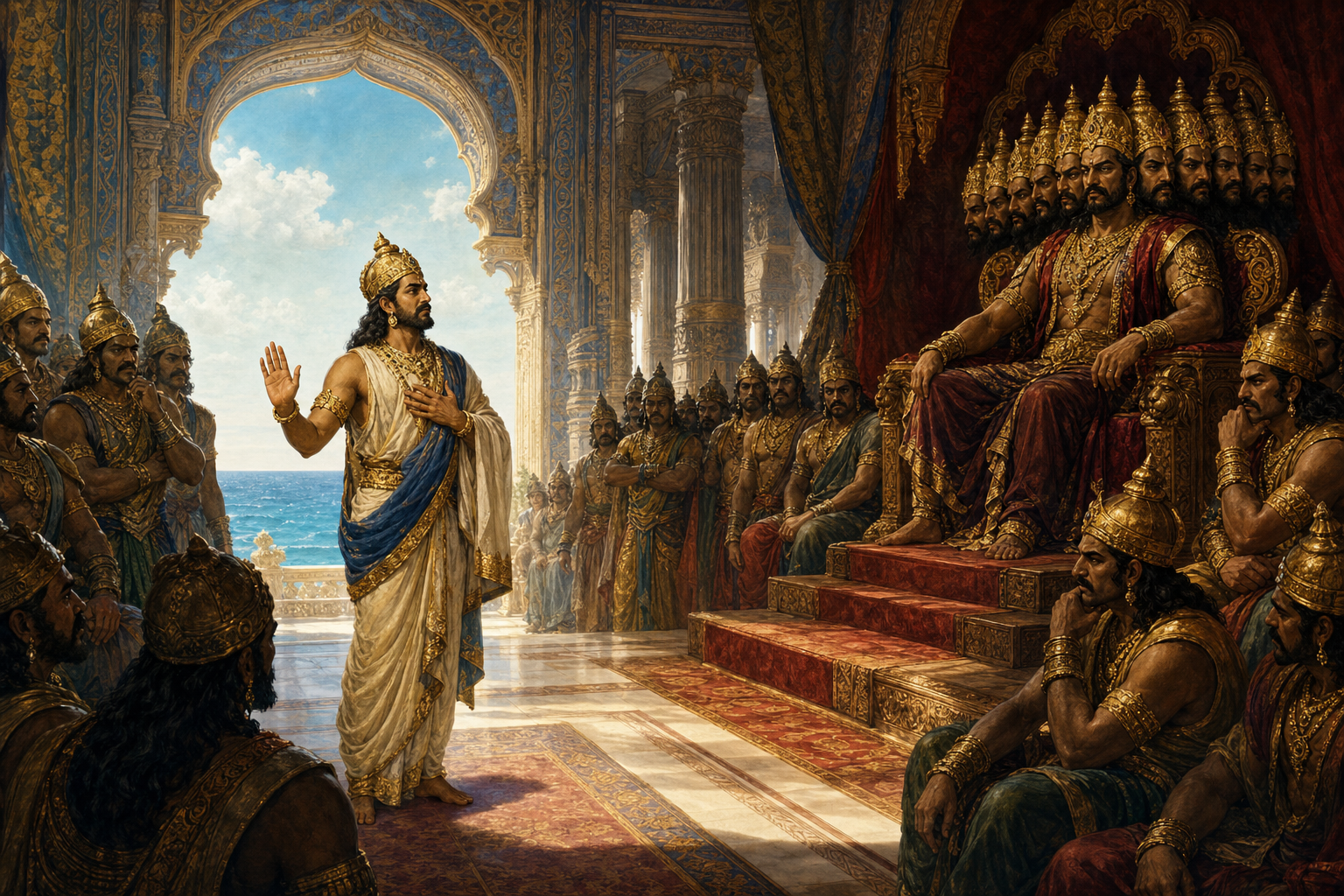
Indrajit and Vibhishana stand on opposite sides of the same family wound. Indrajit remains with Ravana and spends his extraordinary powers defending his father’s rule. Vibhishana breaks with his brother, joins Rama’s side, and supplies the knowledge needed to stop Indrajit at Nikumbhila. One preserves family alignment at the cost of the wider moral order; the other accepts the appearance of betrayal rather than continue serving adharma.
Vibhishana’s choice prevents us from treating kinship as irrelevant. Opposition to one’s own family is painful precisely because the bond is real. Dharmic refusal is not emotional indifference, and it need not be fueled by hatred. Its harder purpose is correction: to stop the person or group you belong to from extending the wrong, even when that means standing apart from them.
That is a more demanding form of loyalty than applause. It requires you to value a person’s moral good above their immediate approval. If a father is walking toward ruin, helping him walk faster is not filial devotion. If a community is preserving its honor by refusing accountability, protecting the appearance of honor helps destroy the substance of it.
Still, Vibhishana is not a license for every angry dissenter to declare himself righteous. Refusal needs discipline. Before a break becomes necessary, state the wrong specifically, offer a path of correction when one remains possible, refuse the harmful instruction, and protect uninvolved people from avoidable fallout. Do not add humiliation merely because the boundary itself is justified.
Lakshmana supplies the corresponding discipline in action. After Nikumbhila, he meets Indrajit in a closely matched exchange of celestial weapons and defeats him with Vibhishana’s strategic help. The importance of the episode lies not only in superior force. Right action requires discernment, counsel, timing, and the willingness to oppose a great warrior without denying his greatness.
A broader Dharmic comparison reinforces the limit on clan loyalty without pretending that different traditions are identical. Buddhist and Jain ethics emphasize moral causality and self-restraint, while the Sikh ideal of the sant-sipahi joins spiritual discipline to the duty to resist injustice. The shared insight is not that all conflict is righteous. It is that power must answer to truth and restraint rather than family vanity, factional identity, or personal glory.
Use this six-question test before loyalty becomes complicity
You do not need a battlefield to face Indrajit’s dilemma. It appears whenever someone uses a real relationship to demand participation in a wrong. Work through these questions before the pressure of the moment decides for you:
- What am I actually being asked to do? Replace words such as support, unity, discretion, and tradition with the concrete act: repeat a falsehood, hide information, intimidate a critic, excuse harm, or remain silent.
- Which duties are genuinely present? List them separately. You may owe respect to a parent, truth to the affected person, fairness to colleagues, and protection to someone vulnerable. Do not let the loudest claimant erase the others.
- What are the aim, means, and foreseeable fruit? A legitimate aim pursued by corrupt means is not enough. Neither are clean procedures directed toward an unjust result. Examine all three.
- Would I accept this standard if the sides were reversed? Imagine the same act performed by a rival family, political faction, religious community, or institution. If your judgment changes only with the identity of the actor, attachment has probably displaced principle.
- Have I attempted truthful correction? Say what must stop, why it is wrong, and what a just alternative would require. Counsel is more useful than vague disapproval. Where direct confrontation would expose someone to danger, seek safe support instead of turning courage into recklessness.
- What boundary will I keep, and what cost will I accept? A moral position that disappears when status, inheritance, belonging, or advancement is threatened is still only a preference. State what you will not do and decide how you will respond if the pressure continues.
The test should produce a boundary, not merely an opinion. A clear boundary sounds like this: I will continue to care for you, but I will not repeat that claim, conceal that action, or help punish the person who raised the concern. It separates the relationship you intend to preserve from the conduct you refuse to enable.
Key takeaways
- Family duty is real, but it does not make obedience unlimited.
- Loyalty seeks a person’s legitimate good; complicity protects the continuation of wrongdoing.
- Courage, skill, ritual discipline, and sincere motives cannot sanctify an adharmic aim.
- Test your rule by reversing the sides. Dharma should not change when the family or faction name changes.
- Refuse the act precisely, preserve dignity where possible, and accept the cost of the boundary you set.
Before your next difficult conversation, write three sentences: I remain loyal to… I cannot participate in… I am willing to accept… If you cannot complete all three plainly, the boundary is not yet clear enough to survive pressure.
Indrajit’s warning is that the final crisis may arrive only after talent, identity, and sacrifice have become deeply invested in the wrong cause. Set your boundary earlier. Speak while correction is still possible, and let loyalty serve the return to dharma rather than the defense of adharma.