

When you ask Shiva for protection during an unstable period, the immediate wish is usually simple: stop the loss, threat, or uncertainty. Shaiva symbolism gives a more demanding answer. Protection is not the freezing of events; it is the preservation of right order while events move.
That shift tells you what to do when fear makes everything look equally urgent. Read the danger accurately. Defend the right boundary. Preserve what still serves dharma. Withdraw support from what has become disorderly. Then leave room for a response that fear alone could not have produced.
Protection does not mean preventing every ending
Shiva’s cosmic activity is commonly understood through the five acts of emanation, maintenance, withdrawal, veiling, and grace: srishti, sthiti, samhara, tirobhava, and anugraha. These are not five unrelated events. They describe an order in which forms arise, endure, recede, become obscured, and open toward liberation.
If you identify protection only with sthiti, or preservation, every ending will look like failure. Yet endless preservation can protect decay as easily as it protects life. Samhara withdraws what has completed its function. Tirobhava warns that you may be acting through incomplete perception. Anugraha points beyond survival toward clarity and freedom. Cosmic order needs all five movements.
This is why agni and abhaya can belong to the same sacred image. Fire dissolves a form, while the gesture of fearlessness communicates protection. The combination does not promise that nothing will be lost. It says that you need not abandon dharma when loss, change, or uncertainty arrives.
Nondual readings deepen the point without making every Shaiva school identical. Advaita Vedanta can read the moving forms of the dance against a nondual substratum, while Kashmir Shaivism associates manifestation with spanda, the subtle pulse of consciousness. In practice, both readings direct your attention toward the stillness from which a clear response can arise. Pause there before you turn fear into speech or action.
Do not use this cosmic frame to romanticize preventable harm. Calling an event transformative does not excuse abuse, negligence, dishonesty, or cowardice. Intervention may be precisely what maintenance of dharma requires. Acceptance means seeing what is happening; it does not mean consenting to everything that happens.
Key takeaways
- Ask what must remain aligned with dharma, not merely what you want to remain unchanged.
- Treat dissolution as a legitimate function of order, but never as an excuse for careless destruction.
- Read abhaya as the capacity to act without being governed by fear, not as a guarantee of immunity from consequences.
- Measure protection by the order it preserves: truthful conduct, proportionate boundaries, responsible stewardship, and room for grace.
Read Shiva’s dance as a map for your response
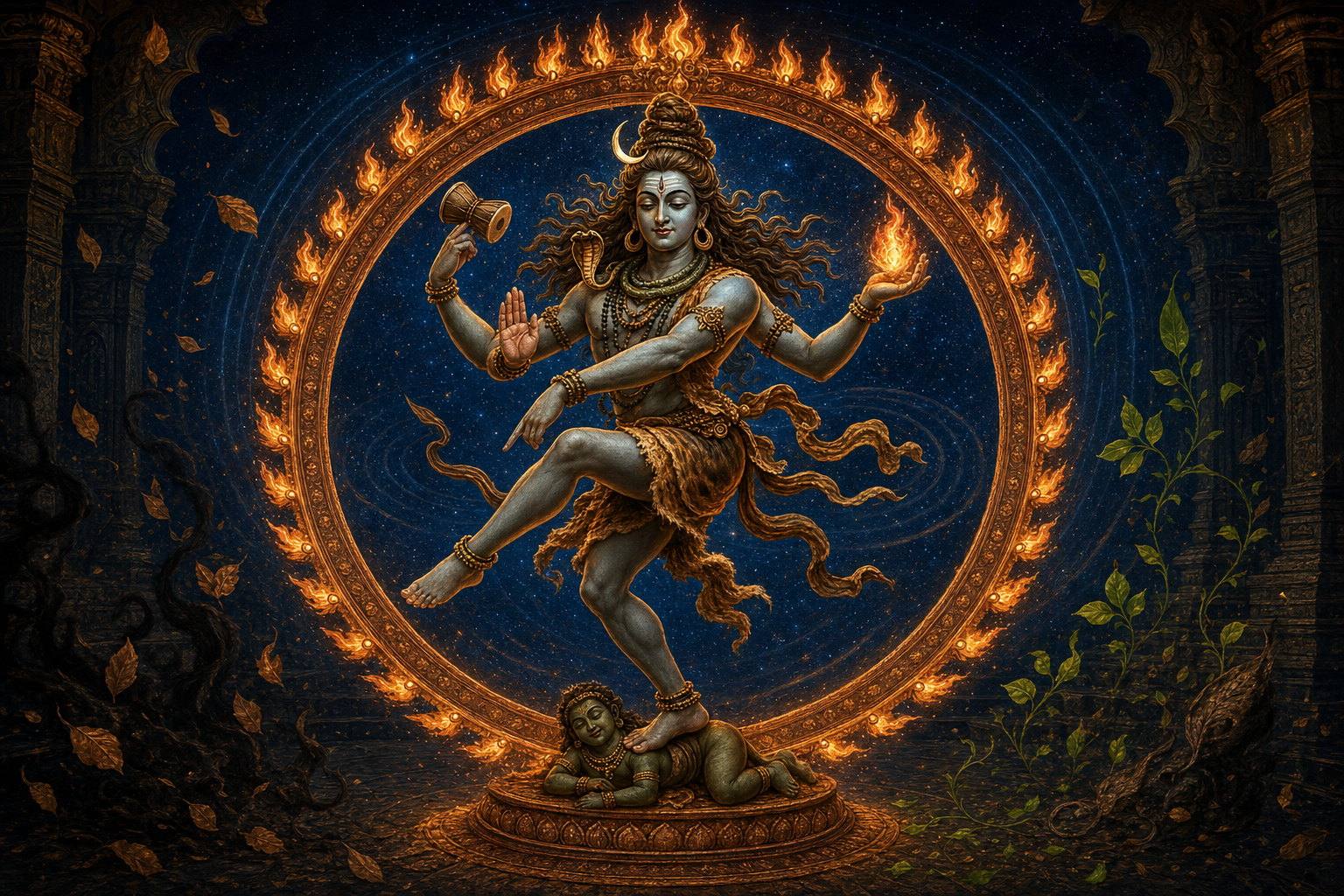
The dynamic image of Shiva becomes useful when you stop treating its attributes as decorative objects. The damaru, flame, trident, gestures, lifted foot, and subdued Apasmara each draw attention to a different function that a balanced response may require.
An eight-armed Kalita Tandava form expands this symbolic field, sometimes inviting associations with guardianship, elemental harmony, or the eight directions. The name Kalita Tandava is less standardized than better-known designations such as Ananda or Rudra Tandava, and regional or artistic lineages need not assign every attribute an identical meaning. Use the image as a contemplative map without pretending that one modern decoding is universal.
| Image | Function within cosmic order | Question for your situation |
|---|---|---|
| Damaru | The pulse of emergence and creation | What is trying to come into being, and what disciplined first form should you give it? |
| Agni | Dissolution into renewed potential | What must end because its continuation now produces disorder? |
| Trishula | Discernment and the stabilization of order | Which boundary or decision have you avoided stating plainly? |
| Abhaya mudra | Protection and fearlessness | What would you do if fear informed you without commanding you? |
| Varada mudra | Benevolence and grace | What positive provision should accompany the restriction or ending you impose? |
| Apasmara | Ignorance or unconscious forgetfulness brought under awareness | Which unexamined assumption is distorting your response? |
| Lifted foot | Release and the possibility of rising into clarity | What is the next concrete step away from confusion? |
Work through the image as a sequence of questions, not as an omen. The damaru asks what needs a beginning. Agni asks what needs an ending. The trishula asks for discernment. Abhaya steadies you, varada keeps firmness from becoming cruelty, and Apasmara exposes the ignorance beneath the reaction. The lifted foot then demands movement. If contemplation never changes your next action, it has not yet become protection.
Bhairava guards the thresholds you must also guard

Bhairava brings the protective dimension of Shiva into sharper focus. As kshetrapala, he guards sacred precincts, boundaries, time, and transitions. The name Bhutapataye joins bhuta, which can refer to the elemental matrix as well as beings or subtle presences within nature’s field, with pataye, lordship or guardianship. Its governing idea is sovereignty expressed as sacred stewardship.
This distinction matters. A guardian does not merely repel an intruder. A guardian knows what the precinct is for, what may enter it, what must leave it, and which conduct preserves its sanctity. Bhairava’s fierceness therefore does not authorize uncontrolled anger. It represents vigilance that will not bargain away the boundary simply because enforcing it is uncomfortable.
His attributes sharpen that discipline. The dog signifies loyalty and alert guardianship. The skull-bowl confronts impermanence and the transformation of tamas. The trident can evoke mastery over the threefold measure of time as well as the ordering discernment seen in other Shaiva forms. Ash and bone ornaments return attention to the elemental ground beneath status and appearance. The fierce gaze asks whether you are willing to see plainly.
Use that imagery for a boundary audit:
- Name the precinct. Decide exactly what you are protecting: a person, a household, a period of practice, a temple responsibility, a community process, or your own attention.
- Name its purpose. A boundary without a dharmic purpose easily becomes habit, fear, or control.
- State what may enter. Identify the speech, behaviour, information, or commitments compatible with that purpose.
- State what must stop. Make the limit observable. Be specific about conduct rather than condemning an entire person.
- Accept the guardian’s duty. A boundary that is never communicated, maintained, or reviewed is only a private wish.
Bhutapataye also turns your attention toward the pancha-bhuta: earth, water, fire, air, and space. Elemental mastery is not permission to exploit them. It is responsibility for the conditions that sustain embodied and communal life. Before asking for protection, look for the neglected element in ordinary terms. Is the physical setting secure? Is water being treated responsibly? Is heat or power contained? Is breath and movement constricted by panic? Is there enough space for attention and sound judgment? This is a practical audit, not a fixed Agamic ritual correspondence.
Shaiva and Tantric traditions invoke Bhairava through practices including japa, vrata, homa, stotra recitation, temple observance, and pilgrimage. Living devotional accounts associate such practice with steadiness, courage, lucid attention, and a felt sense of safety during travel or difficult transitions. Receive those accounts within their devotional setting. They do not establish a guarantee that danger will disappear.
Spiritual practice should accompany practical protection, not replace it. Plan the journey, maintain the lock, verify the message, ask for qualified help, and leave an unsafe place when necessary. Practices belonging to an initiated or regional lineage should be learned through that lineage. Homa also involves literal fire and should not be improvised without competent guidance and appropriate safety measures.
Use the five cosmic acts to make a difficult decision

You can turn the five acts into a disciplined reflection whenever a problem feels too tangled for a simple preserve-or-destroy choice. The following exercise is a practical application of the Shaiva framework, not a substitute for a lineage ritual.
- Srishti: Write down what is actually emerging. Include new facts, needs, relationships, obligations, or risks. Do not begin by deciding whether you like them.
- Sthiti: Identify what must be maintained because it remains truthful, life-supporting, or dharmically necessary. Name the duty, not just the preferred outcome.
- Samhara: Identify what should be withdrawn. This may be a harmful habit, an expired arrangement, an inflammatory message, misplaced access, or your support for conduct that can no longer be defended.
- Tirobhava: Mark what is veiled. Separate verified facts from assumptions, motives you have inferred, and emotions that may be narrowing your view. If a crucial fact is missing, seek it before making an irreversible decision.
- Anugraha: Choose the response that creates the best opening for clarity, responsibility, and freedom from repetition. Make it concrete enough to begin rather than leaving grace as an abstract hope.
Suppose a disagreement is damaging a dharmic community. Srishti identifies the new conditions and concerns that have appeared. Sthiti protects the community’s purpose, fair process, and the dignity of those involved. Samhara stops rumour, personal attack, or an arrangement that no longer works. Tirobhava distinguishes evidence from factional assumption. Anugraha may take the form of a fact-finding conversation, a proportionate boundary, and a way for corrected conduct to be restored. The framework cannot guarantee agreement, but it prevents protection from being reduced to defeating the other side.
Run the proposed action through an elemental check before you commit. In this everyday adaptation, earth means concrete conditions, water means the flow of resources and relationships, fire means urgency and power, air means speech and movement, and space means room for reflection. A plan that sounds spiritually impressive but ignores physical conditions, consumes shared resources, inflames everyone, obstructs communication, or leaves no room to think is not yet balanced.
End the reflection with one observable action. Send the accurate message. Remove the unsafe access. Repair the neglected place. Begin the necessary conversation. Stop funding the harmful pattern. A cosmic framework becomes useful only when it changes how you govern the next threshold.
Put every claim of protection through an ethical test
Shaiva protection joins fierceness to benevolence. Severing without care becomes aggression. Care without boundaries becomes helplessness. The image of Bhairava and the dance of Shiva hold these forces together, asking for severity proportionate to what is being protected and compassion proportionate to the dignity of those affected.
Before calling an action protective, ask:
- Does it respond to verified conduct, or only to suspicion and fear?
- Is the boundary proportionate to the threat, and can you state its purpose truthfully?
- Does it protect the vulnerable without turning cruelty into a virtue?
- Are you accepting responsibility for the material, ecological, and communal consequences?
- Does the response leave a path toward clarity, correction, or grace where such a path remains possible?
Other dharmic traditions offer resonant ethical checks without becoming interchangeable with Shaiva theology. Vajrayana images of Mahakala, Jain attention to ahimsa and elemental life, and Sikh alignment with hukam each connect spiritual order with disciplined conduct. Their doctrinal foundations differ, but the convergence is useful: genuine protection should restrain ignorance and harm rather than merely give sacred language to domination.
For a household, that may mean naming a harmful pattern without dehumanizing the person caught in it. For a temple or community, it may mean clear access rules, truthful records, accountable stewardship, and consistent care for sacred space. For the environment, it means refusing to praise the five elements in worship while treating them as disposable outside the shrine.
Choose one threshold that needs guardianship today: a doorway, a conversation, a commitment, a community role, or a habit. Name what the threshold protects, what may cross it, and what must stop there. Then take one visible action. Shaiva protection begins to become real when reverence turns into responsible governance.
References
- DharmaRenaissance Blog — Kalita Tandava Unveiled: Shiva’s Eight-Armed Cosmic Dance of Balance, Time, and Renewal
- DharmaRenaissance Blog — Bhutapataye Bhairava: Timeless Protector of the Five Elements and Pathway to Fearlessness
