
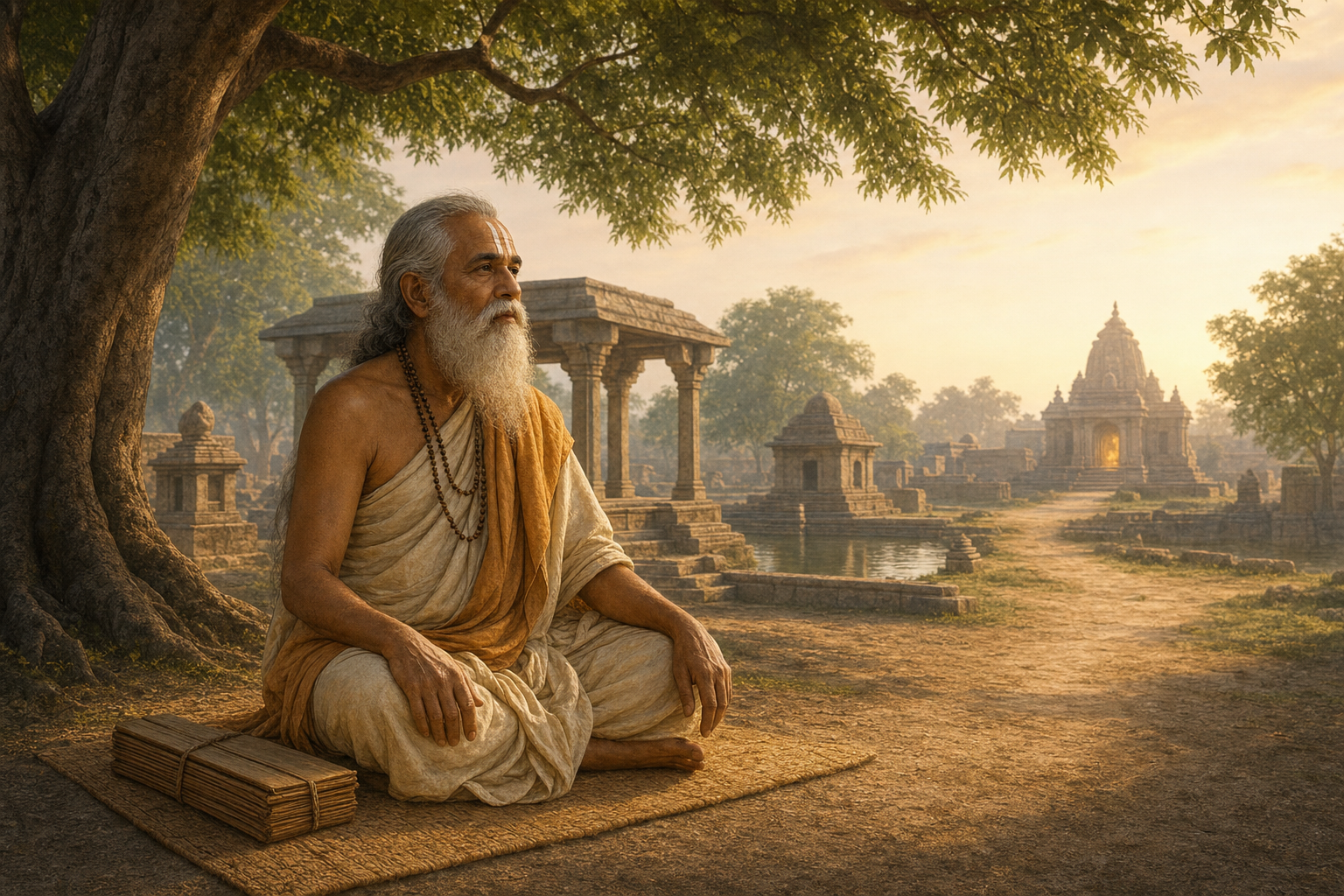
If you know Thirumazhisai Alvar mainly as the saint whose words moved Perumal to leave Kanchi, you have encountered the consequence before the cause. The more revealing question is this: what kind of devotion could make that extraordinary temple memory intelligible?
The answer lies in a life remembered for fearless inquiry and in two tightly constructed Tamil works. Read together, they show why Thirumazhisai Alvar matters not only as a figure in sacred biography, but as a theologian who joined intellectual clarity, poetic discipline and complete refuge in Narayana.
Key takeaways: where Thirumazhisai Alvar fits
- Thirumazhisai Alvar is traditionally placed fourth among the twelve Alvars and revered as an amsa, or divine manifestation, of Vishnu’s Sudarshana Chakra.
- His received contribution to the Nalayira Divya Prabandham consists of Naanmugan Tiruvandadi, traditionally counted at 96 verses, and Tiruchanda Viruttam, counted at 120.
- His central teaching is not merely that Narayana is supreme. Narayana is both the refuge by which the jiva reaches liberation and the goal whom the liberated soul seeks.
- The story of Yathothkari Perumal leaving Kanchi with the Alvar and Kanikannan dramatizes divine accessibility, loyalty to a disciple and freedom from political flattery.
- If you want to understand him responsibly, distinguish the broad Pallava-era setting from sacred birth narratives and temple traditions. Both matter, but they answer different questions.
A sacred biography set in the plural world of Pallava Kanchi
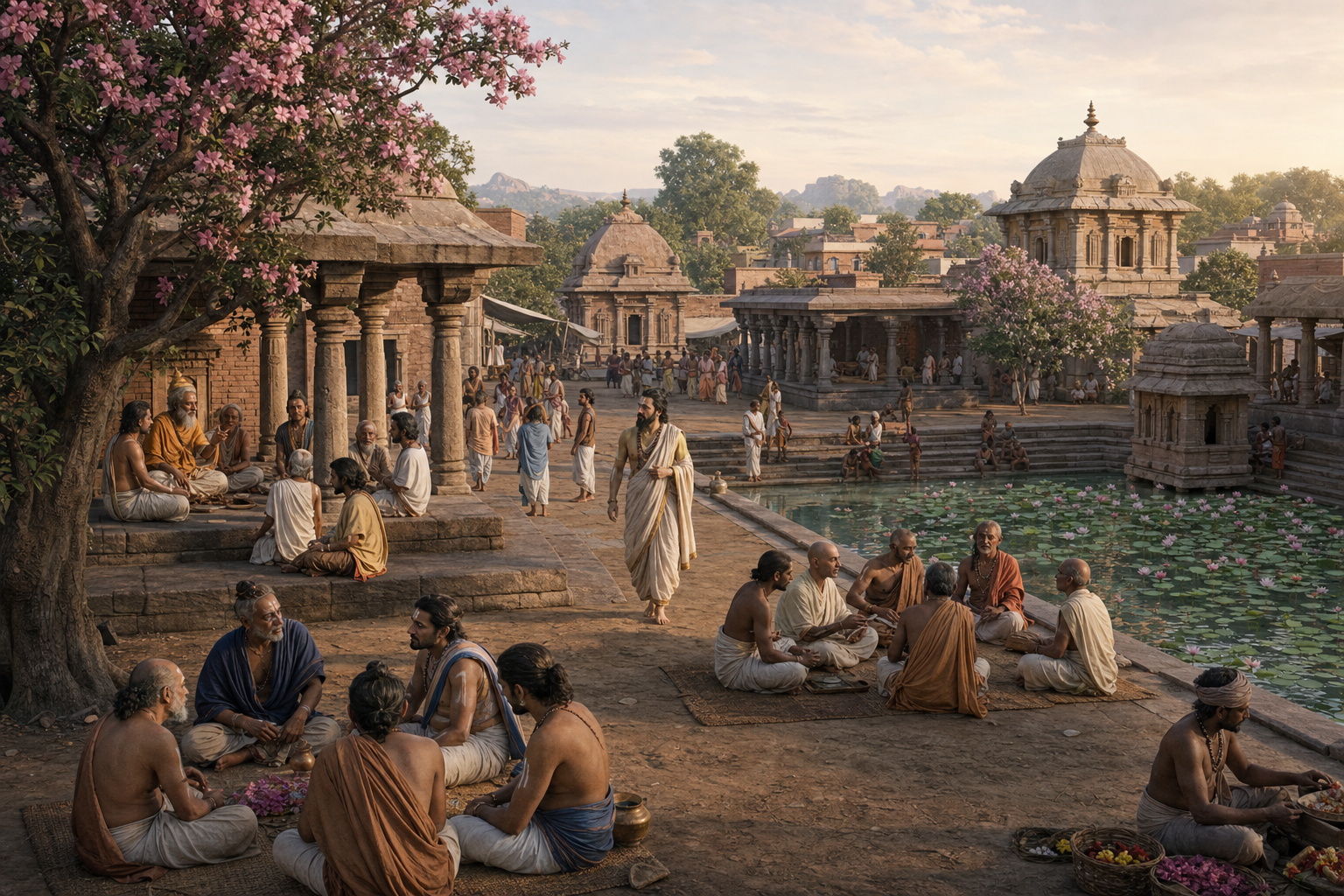
Thirumazhisai Alvar’s precise dates remain debated. He is generally situated in the Pallava environment of roughly the seventh to eighth centuries CE, when Kanchipuram was a major meeting ground of learning, ritual and competing visions of liberation. Vaishnava, Shaiva, Buddhist and Jain communities all belonged to that environment. Treat the date range as historical orientation, not as an exact birth certificate.
Sri Vaishnava tradition places his birth at Thirumazhisai, near present-day Chennai, in the Tamil month of Thai under the Magam star. His Thai-Magam Thirunakshatram still provides the ritual setting in which devotees remember his birth, recite his hymns and honour him at Thirumazhisai and Kanchipuram.
The more wondrous parts of his life belong explicitly to hagiography. Traditional accounts tell of an extraordinary birth and of a humble couple discovering and raising him. That detail carries a deliberate bhakti teaching: spiritual stature is not secured by social pedigree. Grace can disclose holiness where inherited status would fail to look for it.
His identification with the Sudarshana Chakra works in the same symbolic register. The Chakra protects, discriminates and cuts through obstruction. Thirumazhisai Alvar’s literary voice performs those functions. It rejects theological ambiguity with unusual sharpness, yet directs the seeker toward refuge rather than intellectual pride.
Traditional memories also portray him moving through several Indic darshanas before arriving at unwavering devotion to Narayana. This should not be reduced to either a tale of casual religious sampling or a claim that every doctrine means the same thing. The useful lesson is more exacting: he is remembered as a seeker who took rival answers seriously, made a judgment and accepted the obligations of that judgment.
When you encounter a claim about his life, sort it into three layers. Ask whether it describes the historical Pallava setting, the saint’s sacred identity, or the theological meaning preserved through temple memory. This simple distinction prevents two common errors: dismissing sacred biography because it is not modern archival history, and presenting every devotional episode as an independently dated public event.
Two compositions, each training the devotee differently
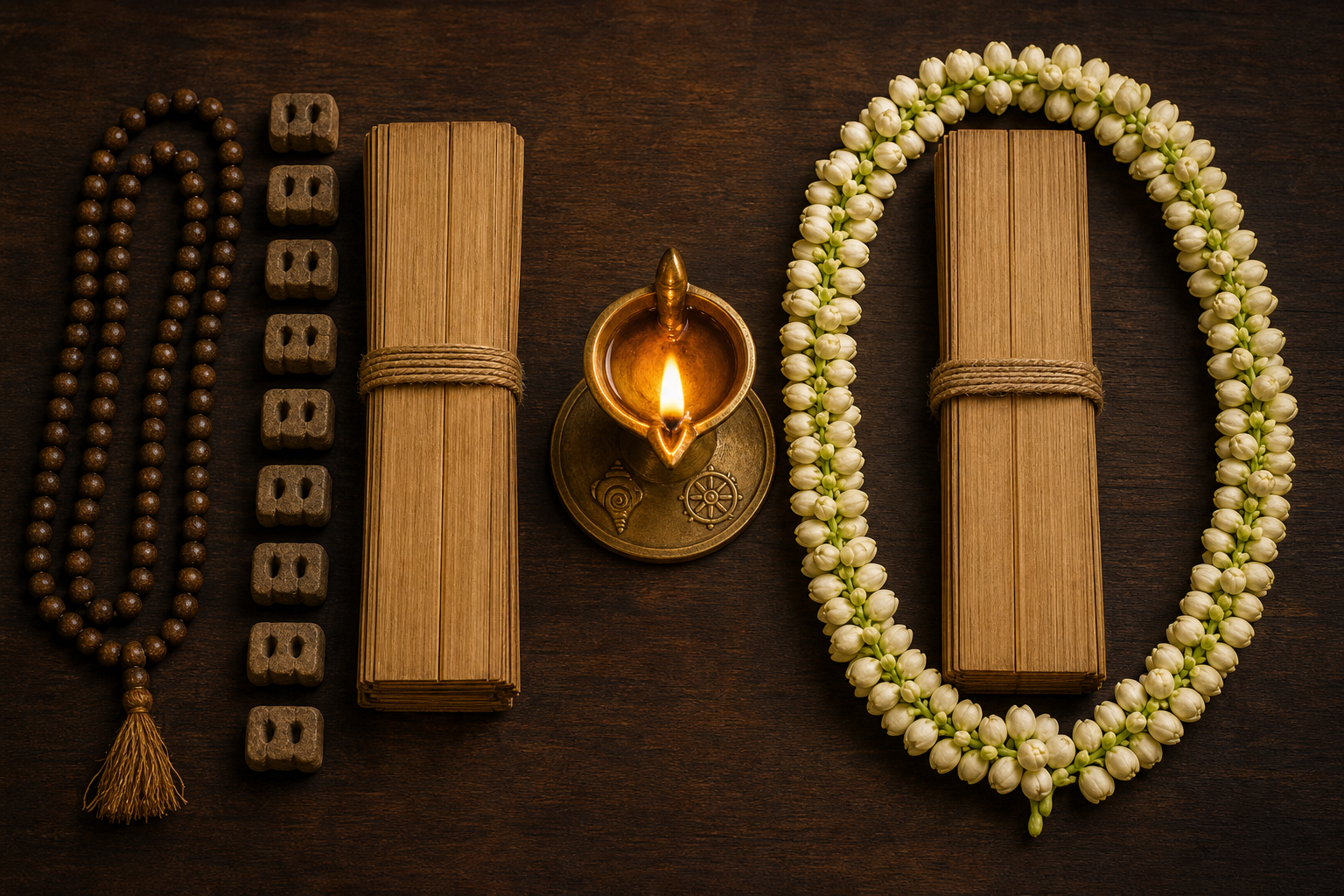
Thirumazhisai Alvar’s literary legacy rests on two works with traditional counts totalling 216 verses. They communicate a consistent theology, but their forms ask different things of you as a reader and reciter.
| Work | Traditional count | Literary form | Primary reading discipline |
|---|---|---|---|
| Naanmugan Tiruvandadi | 96 verses | Andadi, in which the end of one verse feeds the beginning of the next | Follow the theological argument as a connected sequence rather than mining isolated lines |
| Tiruchanda Viruttam | 120 verses | Regulated, metrical viruttam | Attend to cadence, repetition and the movement between divine transcendence and nearness |
Naanmugan Tiruvandadi: continuity becomes an argument
Naanmugan refers to the four-faced Brahma. The title directs attention to a cosmological hierarchy developed throughout the work: Brahma and the other divine functions of the cosmos ultimately depend upon Narayana. This is a definite Vaishnava claim, not a vague celebration of divinity in general.
The andadi form reinforces that claim. Because one verse hands language to the next, the poem resists a fragmented reading. Its verbal chain turns continuity into a spiritual discipline: each perception of dependence leads to another, and each recognition directs the mind back toward the same ground.
If you are reading the work for the first time, do not begin by collecting memorable quotations. Read the verses in order, preferably with Tamil, transliteration and meaning together. Mark every transition involving the jiva’s dependence, divine grace, surrender and liberation. You will then see a theological architecture that isolated quotations can conceal.
Tiruchanda Viruttam: rhythm steadies theological attention
Tiruchanda Viruttam works through compact metrical control. Its regulated cadence supports memorisation and contemplative recitation, giving the intellect a pattern within which to dwell on Narayana. Here poetic technique is not decoration added after the teaching. The rhythm helps train the attention that the teaching demands.
Read it aloud at a measured pace if you can, even when you need a transliteration. Listen especially for the recurring tension between paratva, the Lord’s unsurpassed supremacy, and saulabhya, His willingness to become approachable. Neither should erase the other. Supremacy without accessibility leaves the seeker at a distance; accessibility without supremacy loses sight of why the Lord can be the final refuge.
A four-question map for reading the theology
Later Sri Vaishnava vocabulary offers a useful map for noticing what the two compositions repeatedly do. Keep these four questions beside you:
- What is real? Notice the relation between Narayana, the dependent jiva and the ordered cosmos. This is the question of tattva.
- What is the means? Watch how devotion and prapatti, or surrender, replace self-sufficiency with refuge. This is hita.
- What is the goal? Liberation is not presented as an achievement detached from the Lord. Narayana is the sought destination, the upeya. This is purushartha.
- Who finally carries the seeker? Divine grace is decisive, so Narayana is also the upaya, the effective means. Surrender is therefore not another technique for controlling the result; it is the relinquishment of that controlling claim.
This last distinction is the key to the Alvar’s literary force. The devotee does not merely travel toward Narayana with independently acquired spiritual power. The One being sought is also the One who makes the seeking fruitful.
Why Perumal left Kanchi: the legend as lived theology
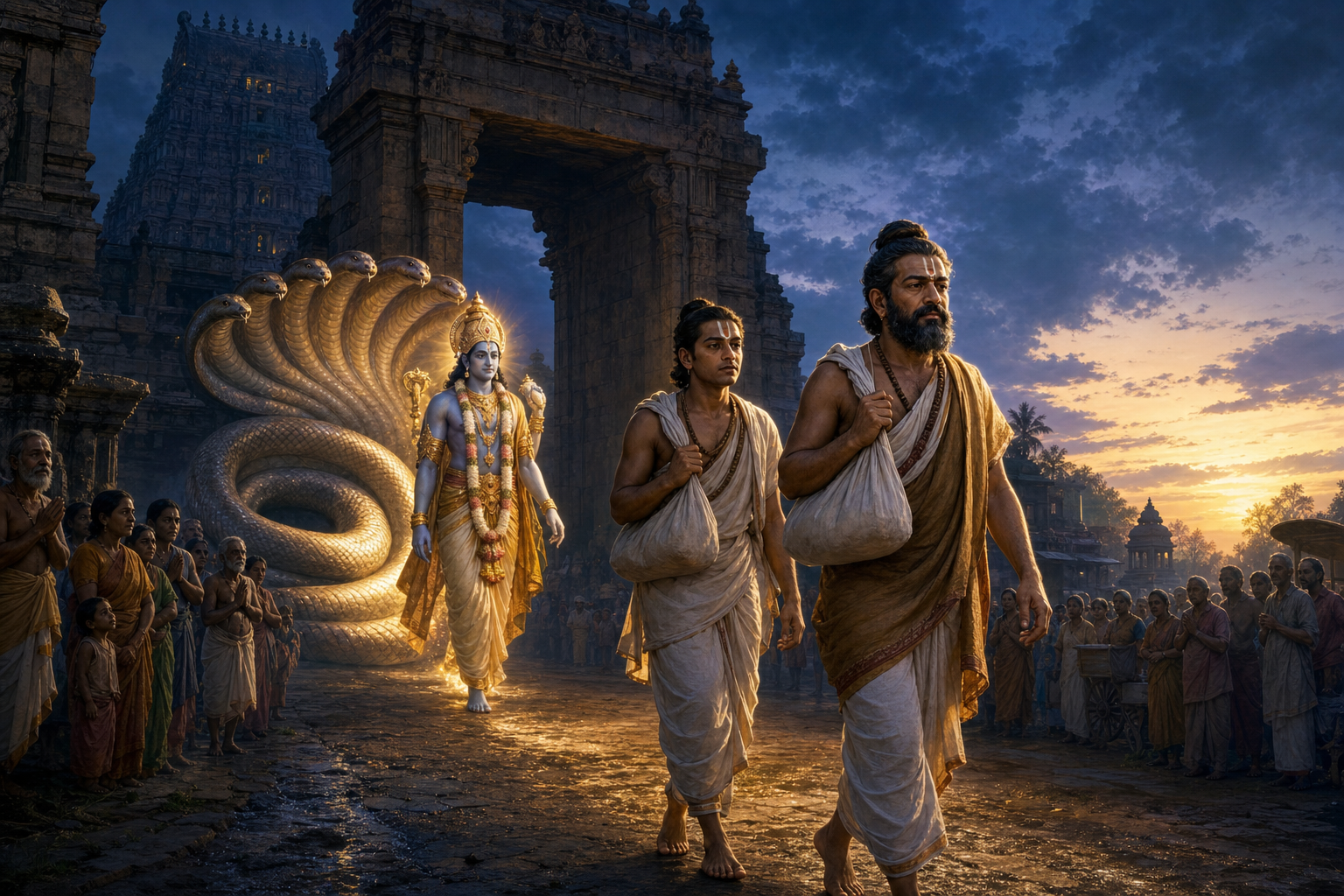
The best-known episode unfolds at Thiruvekka in Kanchipuram, the Divya Desam of Yathothkari Perumal. Kanikannan, the Alvar’s disciple, was banished by a ruler. Thirumazhisai Alvar would not preserve his own comfort by abandoning his disciple, so he prepared to leave as well. He then addressed Perumal and asked the Lord to depart with them. In temple memory, Perumal and Thayar did so.
The ruler recognised his error and requested their return. The restored relationship is remembered in the name Sonna Vannam Seitha Perumal, the Lord who acted as requested. The Sanskrit name Yathothkari carries the same central memory of a deity who responded to the words of His devotee.
It is easy to misread this as a story about a saint exercising power over God. That interpretation misses the Alvar’s own theology. The episode is better understood as an image of saulabhya: the supreme Lord freely enters an intimate relationship with a truthful bhakta. Perumal’s response does not inflate the devotee’s ego. It reveals what uncalculated loyalty, surrender and divine accessibility look like when narrated as sacred drama.
A companion tradition makes the political lesson sharper. An elderly woman received the Alvar’s blessing and regained youth. When royal authority sought the same benefit and expected poetic praise in return, the Alvar refused to treat a ruler as the proper object of sacred glorification. The point is not disrespect for civil authority. It is the refusal to exchange religious speech for patronage.
These two memories give you a practical test for interpreting his public integrity. Ask who is vulnerable, what worldly demand is being refused, and what reconciliation requires. Kanikannan is not sacrificed to political convenience. Praise is not sold for access. The ruler can be received again, but only after recognising the wrong. Devotion here produces moral clarity rather than withdrawal from obligation.
A literary legacy still carried by recitation and place
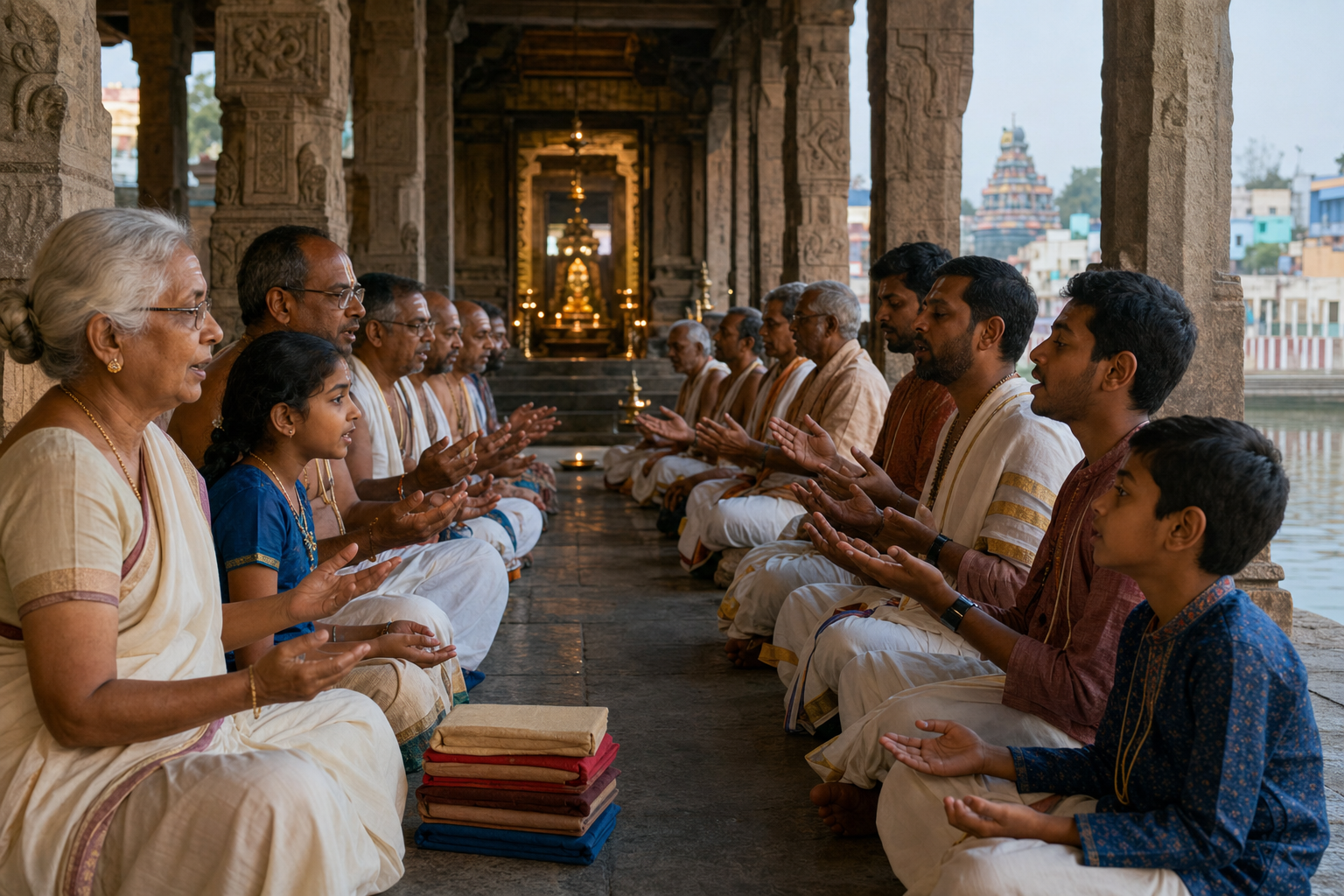
Thirumazhisai Alvar’s influence survives through three mutually supporting channels: a canon, a commentarial tradition and a sacred geography. Remove any one of them and you see only part of his legacy.
- Canon: Naanmugan Tiruvandadi and Tiruchanda Viruttam belong to the Nalayira Divya Prabandham and remain available for congregational recitation rather than only academic study.
- Commentary: Sri Vaishnava interpreters read Tamil bhakti alongside the Sanskrit Vedic and Upanishadic horizon. This Tamil-Sanskrit intellectual world helped make rigorous theology available in an emotionally immediate devotional language.
- Sacred geography: Thirumazhisai and Kanchipuram’s Thiruvekka preserve the saint’s memory through icons, festival observance, recitation and narration at the shrine itself.
His works also anticipate the systematic concerns associated with later Sri Vaishnava Acharyas such as Nathamuni, Yamunacharya and Ramanujacharya. That does not mean you should force every later technical formulation backward into every verse. It means the hymns already hold together the questions those teachers would continue to articulate: the nature of reality, the dependent self, the means to liberation, the reach of grace and the identity of the final goal.
His encounters with different darshanas carry a lesson for a modern Dharmic audience as well. Respectful engagement does not require doctrinal indistinctness. You can recognise the shared civilisation in which Hindu, Buddhist and Jain thinkers disputed ultimate questions while still allowing Thirumazhisai Alvar to reach an unmistakably Vaishnava conclusion. Honest pluralism lets a thinker say what he actually believed.
If you want to move from admiration to understanding, use a simple sequence. First, read Naanmugan Tiruvandadi in order and trace its chain of dependence. Next, recite portions of Tiruchanda Viruttam aloud and attend to how meter disciplines attention. Then revisit the Thiruvekka episode and identify where the poem’s themes of supremacy, accessibility and surrender have become narrative action.
For a temple observance, consult the current local calendar for Thai-Magam rather than assuming a fixed Gregorian date. At Thiruvekka, listen for the explanation of Yathothkari Perumal’s distinctive name; at Thirumazhisai, connect the birth tradition with the hymns rather than treating the celebration as a detached anniversary. If travel is not possible, a complete sequential recitation is more faithful to the Alvar’s literary method than a collection of decontextualised sayings.
Begin with one work, one notebook and the four reading questions above. By the end, you should be able to explain not only that Thirumazhisai Alvar praised Narayana, but how his poetic forms train the seeker to recognise dependence, receive grace and live without confusing temporal power with the Supreme.
References
