
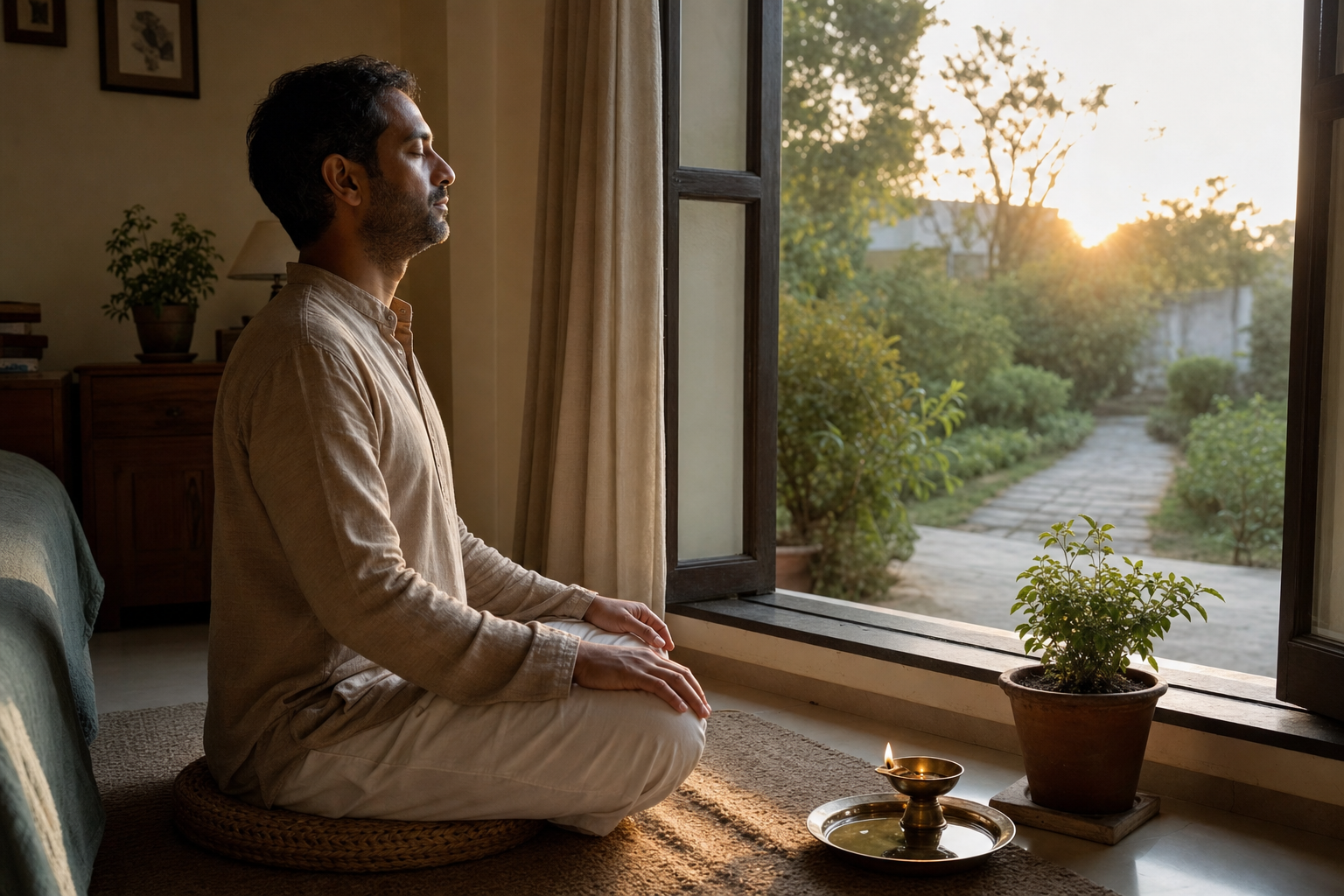
Your mind may be asking two questions at once: How do I stop this stream of negative thoughts, and what am I meant to do with my life? Answer them in that order. A noisy mental state can make every obligation seem urgent, every setback feel permanent, and every possible direction look either dazzling or pointless.
You don’t need a perfectly empty mind before making a decision. You need enough steadiness to distinguish a passing impulse from a durable responsibility. Dharmic practice helps you create that steadiness through the body, breath, attention, ethical discernment, and seva. Purpose then becomes something you can test in life, not merely a grand statement you are expected to believe.
Clear the mind before you define the mission
When you feel lost, the natural temptation is to search harder: read more advice, compare more careers, consult more people, or repeatedly rewrite your plans. That often adds material to the very mind that is already overloaded. The first task is therefore not to discover a permanent identity. It is to notice the condition from which you are trying to choose.
The classical language of the gunas offers a useful diagnostic lens. Rajas appears as agitation, urgency, restless comparison, and the impulse to act merely to escape uncertainty. Tamas appears as heaviness, avoidance, confusion, and the belief that no action could matter. Sattva is the greater lucidity in which you can see an obligation without exaggerating it, compare choices without being consumed by them, and act without needing immediate validation.
These are changing qualities of mind, not permanent labels for your personality. You can move among them during the same day. The practical rule is simple: do not turn a rajasic impulse or a tamasic conclusion into a life mission. First settle your state. Then return to the decision.
- If you are repeatedly changing plans, gathering more opinions, or feeling that everything must be decided immediately, treat agitation before making another plan.
- If you are postponing ordinary duties because the whole future feels meaningless, restore movement and routine before demanding inspiration from yourself.
- If you can hold competing considerations without panic, acknowledge limits, and choose a responsible next action, you are in a better condition for discernment.
A clear mind does not necessarily deliver a dramatic revelation. More often, priorities become simpler and a useful direction becomes easier to recognize. Begin with a provisional sentence:
For now, I will use [a strength I can cultivate] to help [people or a need I genuinely care about] through [a repeatable form of action].
The phrase “for now” matters. Dharma is not served by turning an early intuition into an inflexible identity. Your understanding can deepen as your competence, responsibilities, and awareness of other people’s needs develop.
Build clarity through body, breath, and attention

Mental practice does not begin at the neck. Poor sleep, physical tension, irregular meals, sluggish digestion, and a day spent almost entirely sitting can all complicate your inner work. In particular, some people notice that rumination and mental heaviness intensify alongside constipation or irregular digestion. That does not mean every troubling thought is caused by the gut. It means the body is one part of the field you should examine rather than ignore.
Use a sequence that moves from the gross to the subtle:
- Restore a basic bodily rhythm. Hydrate adequately. If it suits you, begin the morning with warm water. Favor fresh fruits, vegetables, whole grains, consistent mealtimes, unhurried chewing, and a lighter evening meal. Treat these as supportive habits, not as a cure for mental illness.
- Move before asking the mind to become still. A mindful walk, a gentle asana sequence, or Surya Namaskar for 10 to 20 minutes can ease muscular tension and help you arrive at the seat with less restlessness.
- Regulate the breath without force. Spend 5 to 10 minutes breathing slowly and evenly, at roughly 5 to 6 breaths per minute. Gentle dirgha breathing or nadi shodhana can be used if you already know the method. Do not strain or add forceful retention on your own. If you become light-headed or uncomfortable, stop and return to natural breathing.
- Train attention. Follow the breath, mantra, or contemplative method of your path for 10 to 15 minutes. When thoughts appear, notice them and return. The return is not evidence that you failed; it is the repetition through which attention becomes steadier.
You do not need to combine every Dharmic method into one session. Hindu dhyana and japa, Buddhist anapanasati and vipassana, Jain samayik and dhyana, and Sikh simran or Naam Jap all cultivate attention and ethical discernment, but their theological settings and disciplines are not interchangeable. Choose a practice you can approach with sincerity, preferably within a lineage or community you trust, and let repetition give it depth.
Hollow and Empty meditation is another option for seekers who have learned it within the Art of Living tradition. It can occupy the longer weekly session in your routine. Because it is a taught practice, use the method as instructed rather than reconstructing it from a brief description. A trusted Guru, teacher, satsang, or sangha can help you correct technique and continue when initial enthusiasm fades.
During a negative-thought spiral, do not begin by debating every thought. Sit or stand securely, relax unnecessary muscular effort, and give the slow breath your full attention for the supported 5-to-10-minute period. Then write down what happened, what your mind is adding to it, and what responsible action is actually available. This turns an indistinct mental storm into an event, an interpretation, and a choice.
Support that practice with cognitive hygiene. Put a deliberate boundary around doom-scrolling and highly stimulating media. Use brief journaling to move repetitive material out of working memory. Add a concrete gratitude reflection, not to deny a difficulty but to prevent the difficulty from occupying the whole field of attention.
Persistent or worsening negative thoughts that interfere with work, sleep, relationships, self-care, or other daily functioning warrant help from a qualified healthcare professional. Spiritual counsel can accompany that care; it should not replace it. If you may harm yourself or someone else, seek immediate help through local emergency or crisis services rather than relying on a meditation routine.
Turn a calmer mind into a purpose you can test

Calm creates better conditions for discernment, but a peaceful feeling is not proof of a cosmic command. Purpose becomes trustworthy when it survives contact with effort, ethics, skill, other people’s needs, and honest feedback.
After meditation, use these questions instead of asking only, “What do I feel called to do?”
- Steady energy: Which activities remain meaningful after the novelty passes? This does not mean you are never tired. It means the work continues to feel worth returning to.
- Useful capacity: Which abilities are you willing to refine with regular discipline, including the unglamorous parts?
- Real beneficiary: Who becomes safer, wiser, healthier, freer, better supported, or more capable because you did the work?
- Spontaneous responsibility: In which situations do you naturally notice what needs doing and accept an appropriate share of it?
- Community confirmation: What contribution do trustworthy people consistently recognize in you? Feedback is evidence to weigh, not a command to obey.
Then test your provisional mission through weekly seva. Choose a form of service connected to your actual interests and capacities. Teach something you know, support a community effort, help maintain a shared institution, care for someone within reasonable limits, or contribute skilled work where it is genuinely needed. Seva prevents purpose from becoming self-fascination because another person’s welfare enters the test.
After serving, journal with sharper questions:
- What part of this work gave me steady energy rather than a brief emotional high?
- What did the people involved actually need, as distinct from what I wanted to offer?
- Where did my present skill fall short, and am I willing to train?
- Did the action make me more truthful, compassionate, disciplined, and responsible?
- What should I repeat, change, or release?
Look for convergence rather than a single dramatic sign. Meaningful energy, simpler priorities, sustained skill-building, community feedback, and a movement toward service together provide better evidence than excitement alone. If one element is missing, investigate it. Enjoyment without benefit may be a preference rather than a mission. Benefit without appropriate capacity may require training or a different role. Praise without inner conviction may reflect someone else’s plan for you.
Ahimsa also belongs in this discernment. Do not use purpose as permission to neglect health, coerce family members, despise ordinary duties, or treat yourself as valuable only when productive. A dharmic direction should make your conduct more ethical and your service more responsible. If it steadily produces vanity, secrecy, contempt, or avoidable harm, the claim of purpose needs to be re-examined.
A weekly rhythm that can survive an ordinary life

Consistency matters more than an occasional heroic session. Nairantarya abhyasa, an unbroken rhythm of practice, gradually turns clarity from an exceptional mood into a more stable capacity. Use the following structure as a starting point and adjust it around health, family, work, and the instructions of your tradition.
| Cadence | Practice | What to notice |
|---|---|---|
| On waking | Hydrate, take a brief walk when possible, and support regular digestion. | Whether bodily heaviness, sleep disruption, or irregularity is amplifying mental fog. |
| Daily | Practice breath awareness for 5 to 10 minutes, followed by meditation for 10 to 15 minutes. | Whether you can return to the chosen object without attacking yourself for wandering. |
| Alternate days | Add gentle pranayama such as nadi shodhana or dirgha breathing if it is suitable and familiar. | Whether the practice leaves you steadier rather than strained, agitated, or light-headed. |
| Before a key activity | Pause for a brief mindful check-in: What is my state, what is my duty now, and what can wait? | Whether urgency is coming from the situation or from mental momentum. |
| Evening | Choose lighter movement or stretching, a regular meal rhythm, and a clear boundary around stimulating media. | Which inputs keep repetitive thought active after their practical value has ended. |
| Weekly | Undertake a longer meditation, perform seva aligned with your capacities, and journal afterward. | Which strengths, beneficiaries, responsibilities, and ethical corrections keep recurring. |
Do not make a missed session into evidence that you lack discipline. Resume at the next ordinary opportunity. Also resist expanding the routine every time you have a good day. A practice you can keep during a demanding week will teach you more than an elaborate schedule that depends on ideal conditions.
Review your notes periodically for repeated patterns. You are looking for a direction that becomes clearer as agitation decreases, remains meaningful when work is required, benefits someone beyond your self-image, and can be pursued without violating your responsibilities. Revise the provisional mission sentence when your lived evidence changes.
Key takeaways
- Treat mental state and life direction as related but distinct problems: settle agitation or heaviness before making a major declaration about purpose.
- Use a body-to-mind sequence: supportive daily rhythms, gentle movement, slow breathing, and then meditation.
- Practice one Dharmic method with continuity instead of constantly mixing techniques in search of a faster result.
- Observe negative thoughts as mental events. Separate what happened, what the mind added, and what responsible action is available.
- Test purpose through seva, skill-building, ethical conduct, and trustworthy community feedback.
- Seek qualified healthcare support when negative thoughts persist, worsen, or impair daily functioning; contemplative practice is complementary care, not a replacement for treatment.
Begin with the smallest complete sequence you can sustain: settle the body, regulate the breath, sit in your chosen practice, and write one provisional direction. Then choose an act of seva that can test it in the world. Let abhyasa make the mind clearer, and let usefulness, ethics, and honest feedback refine what you call your purpose.
References
- DharmaRenaissance Blog – Unlocking Life’s Mission: Clear-Mind Meditation and Dharmic Wisdom for Enduring Purpose
- DharmaRenaissance Blog – Overcome Overwhelming Negative Thoughts with Dharmic Mind-Body Practices for Clarity
