
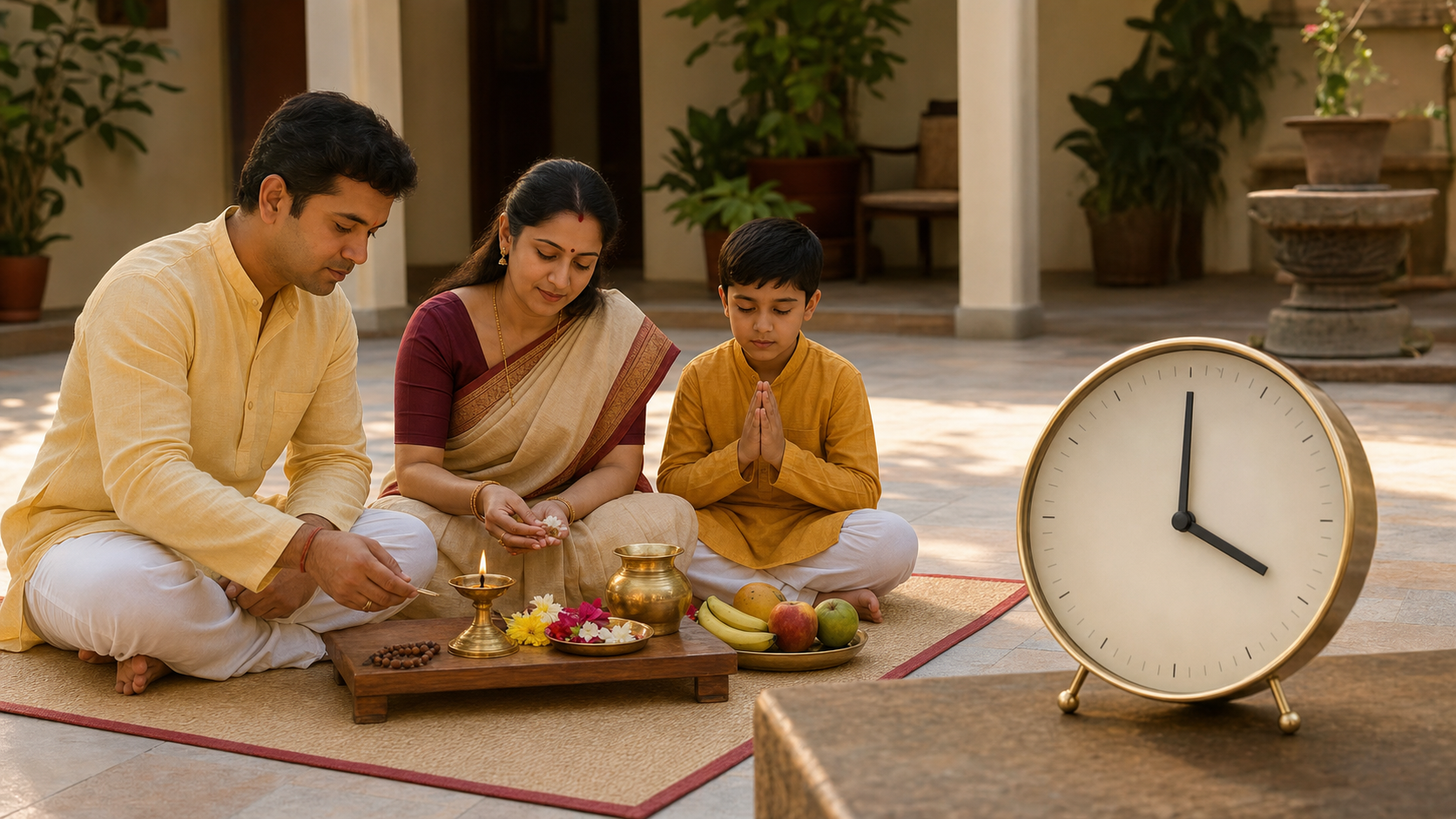
If you are arranging Purnima puja, vrata, japa, or a family gathering on January 3, the decisive detail is easy to miss: Purnima does not continue through the evening. The tithi changes at 4:03 PM IST.
Plan any observance that must fall within Purnima for the morning or early afternoon, leaving enough time to finish before the boundary. After 4:03 PM, the Panchang places you in Krishna Paksha Pratipada, even though the Moon may still appear full to the eye.
January 3 Purnima timings at a glance
On Saturday, January 3, 2026, Purnima lasts until 4:03 PM IST. Krishna Paksha Pratipada begins from that transition and continues until 2:08 PM IST on Sunday, January 4.
| Period | Tithi | What it means for planning |
|---|---|---|
| January 3 until 4:03 PM IST | Purnima | Use this period for an observance that specifically requires Purnima tithi. |
| January 3 after 4:03 PM IST | Krishna Paksha Pratipada | The waning fortnight has begun; do not treat an evening activity as occurring within Purnima solely because the civil date is still January 3. |
| January 4 until 2:08 PM IST | Krishna Paksha Pratipada | Pratipada remains in effect until its afternoon boundary. |
These timings are stated in Indian Standard Time and are generally applicable across India. If you are outside India, do not simply use 4:03 PM in your own time zone. Consult a Panchang calculated for your location, because the local civil date and relevant observance window may differ.
Why the 4:03 PM boundary changes your plan
A tithi is a lunar-calendar division, not a midnight-to-midnight date. That is why January 3 contains portions of two tithis: Purnima first, followed by Krishna Paksha Pratipada. The printed date on your calendar cannot tell you which tithi is operating at the hour of your observance.
For practical purposes, treat 4:03 PM as a firm scheduling boundary. If the practice must be completed during Purnima, work backward from that time rather than choosing a convenient evening start and assuming the civil date is sufficient.
- For a personal vrata or short prayer: complete the Purnima-specific portion before 4:03 PM IST, following the rules of your sampradaya or family tradition.
- For Satyanarayan puja: allow for the complete puja rather than treating 4:03 PM as the time to begin. Confirm any more specific ritual requirement with your priest or customary Panchang.
- For a temple or community programme: count setup, sankalpa, recitation, offerings, and foreseeable delays when choosing the start time.
- For an evening gathering: describe it accurately as a gathering after the transition into Krishna Paksha Pratipada unless your tradition applies a different observance rule.
The Moon’s visible appearance is not a substitute for the calculated tithi. It does not suddenly look different at 4:03 PM, but the Panchang classification changes. Use the tithi boundary for ritual timing and the visible moonlight for contemplation without confusing the two.
Tithi timing is not the same as a complete muhurta
The 4:03 PM cutoff answers one precise question: whether a chosen time falls in Purnima or Krishna Paksha Pratipada. It does not, by itself, establish the most suitable muhurta for every ceremony.
A fuller muhurta assessment may also consider Nakshatra, Rashi, Yoga, and Karana. Those factors, as well as the instructions of a particular lineage, can affect the final choice. This distinction matters most when you are planning a formal samskara, temple rite, or another observance for which your tradition specifies more than the tithi.
- Decide whether your activity actually requires Purnima tithi or merely uses the full-moon date as a devotional reminder.
- If Purnima is required, place the entire tithi-dependent portion before 4:03 PM IST.
- Check a trusted regional Panchang for the city where the observance will occur.
- Confirm any lineage-specific rule with the priest, teacher, temple, or family authority guiding the practice.
- Tell participants both the civil start time and the reason for it, so an evening assumption does not create last-minute confusion.
For ordinary japa, scripture reading, meditation, or seva, you may not need an elaborate muhurta calculation. Follow the discipline of your tradition and use the tithi boundary only to make the distinction you actually need.
Choose a practice that belongs to your tradition
The full moon provides a shared contemplative rhythm across several Dharmic traditions, but it does not make their observances interchangeable. The useful approach is to recognise the common movement toward restraint and reflection while practising within your own path.
- Hindu practice: Purnima may be marked through Satyanarayan puja, japa, vrata, stotra recitation, meditation, or quiet study of scripture.
- Buddhist practice: a full-moon observance may centre on Uposatha reflection and renewed attention to ethical discipline, according to the practitioner’s community.
- Jain practice: Purnima may support fasting, self-examination, and disciplined sadhana as taught within the relevant tradition.
- Sikh contemplative practice: households that personally use the lunar date as a reminder may turn toward simran and seva, without presenting Purnima as a universal Sikh ritual obligation.
The transition after 4:03 PM can also serve as a clean practical marker. Purnima expresses completion; Krishna Paksha begins a period of waning. You can use that change to reduce one unnecessary habit, establish a steady daily recitation, or choose a concrete act of service for the fortnight. Keep the commitment small enough to repeat rather than making the lunar transition an occasion for an elaborate promise you will abandon.
Key takeaways
- Purnima tithi on Saturday, January 3, 2026 ends at 4:03 PM IST.
- Krishna Paksha Pratipada begins after that boundary and lasts until 2:08 PM IST on Sunday, January 4.
- If an observance must occur during Purnima, schedule it early enough to finish before 4:03 PM.
- Do not assume that the evening of January 3 remains Purnima merely because the civil date has not changed.
- Use a regional Panchang and your tradition’s instructions when Nakshatra, Rashi, Yoga, Karana, or a lineage-specific rule also matters.
Set your start time now, add enough margin for the complete observance, and share the 4:03 PM cutoff with everyone involved. That one step prevents the most likely Panchang error on this Purnima.
References
