
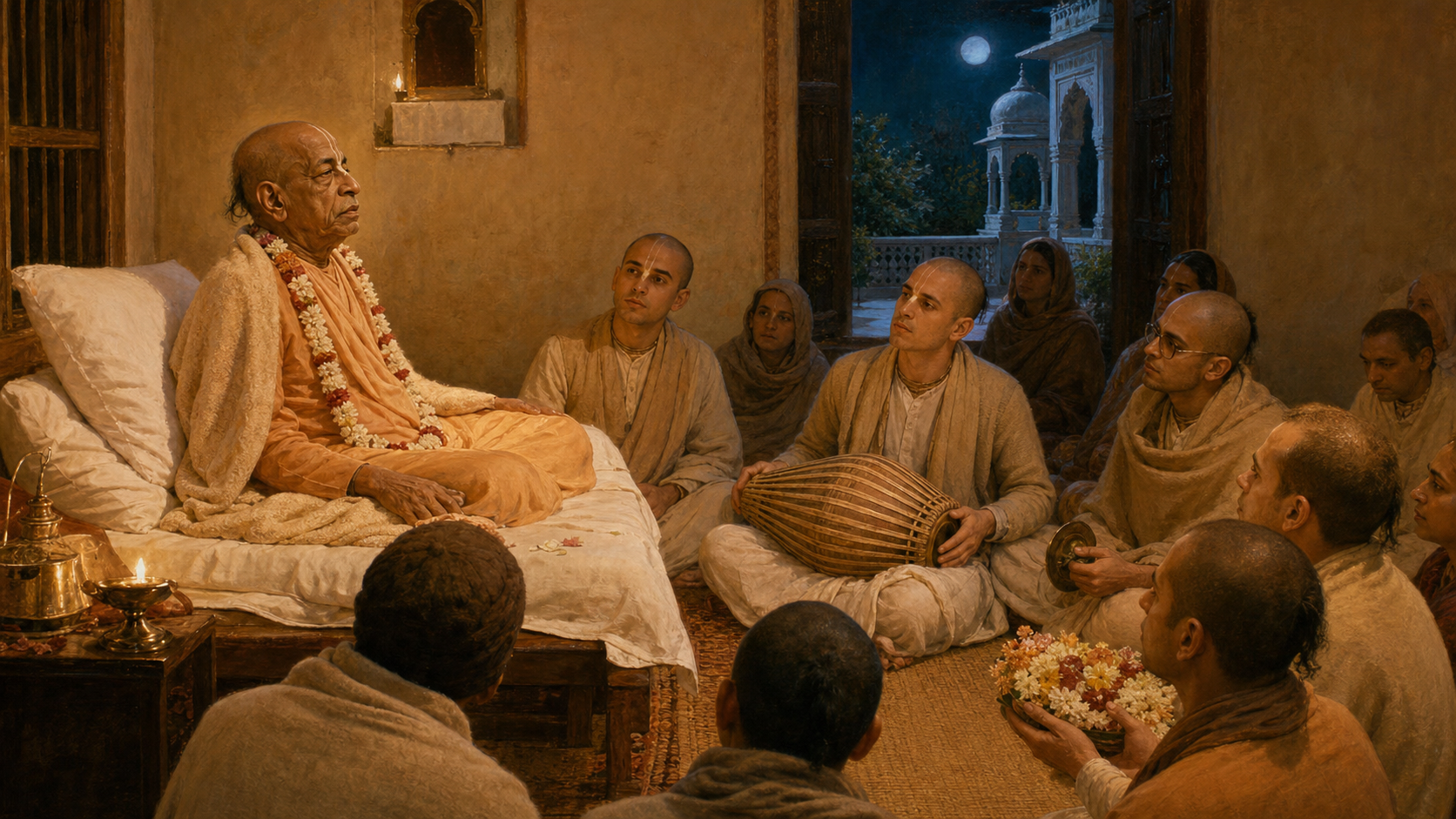
If you have been asked to speak at Srila Prabhupada’s disappearance observance, or you want to mark the day at home, the hardest part is not choosing enough material. It is knowing what the remembrance should accomplish. A bare chronology can feel distant, while an entirely emotional tribute can leave you moved but unchanged.
The more useful question is simple: after the kirtan, reading, and flowers, what instruction will remain active in your life? Srila Prabhupada’s final days point toward an answer grounded in clarity, attentive discipleship, sacred place, and seva.
The midnight instruction: clarity before emotion
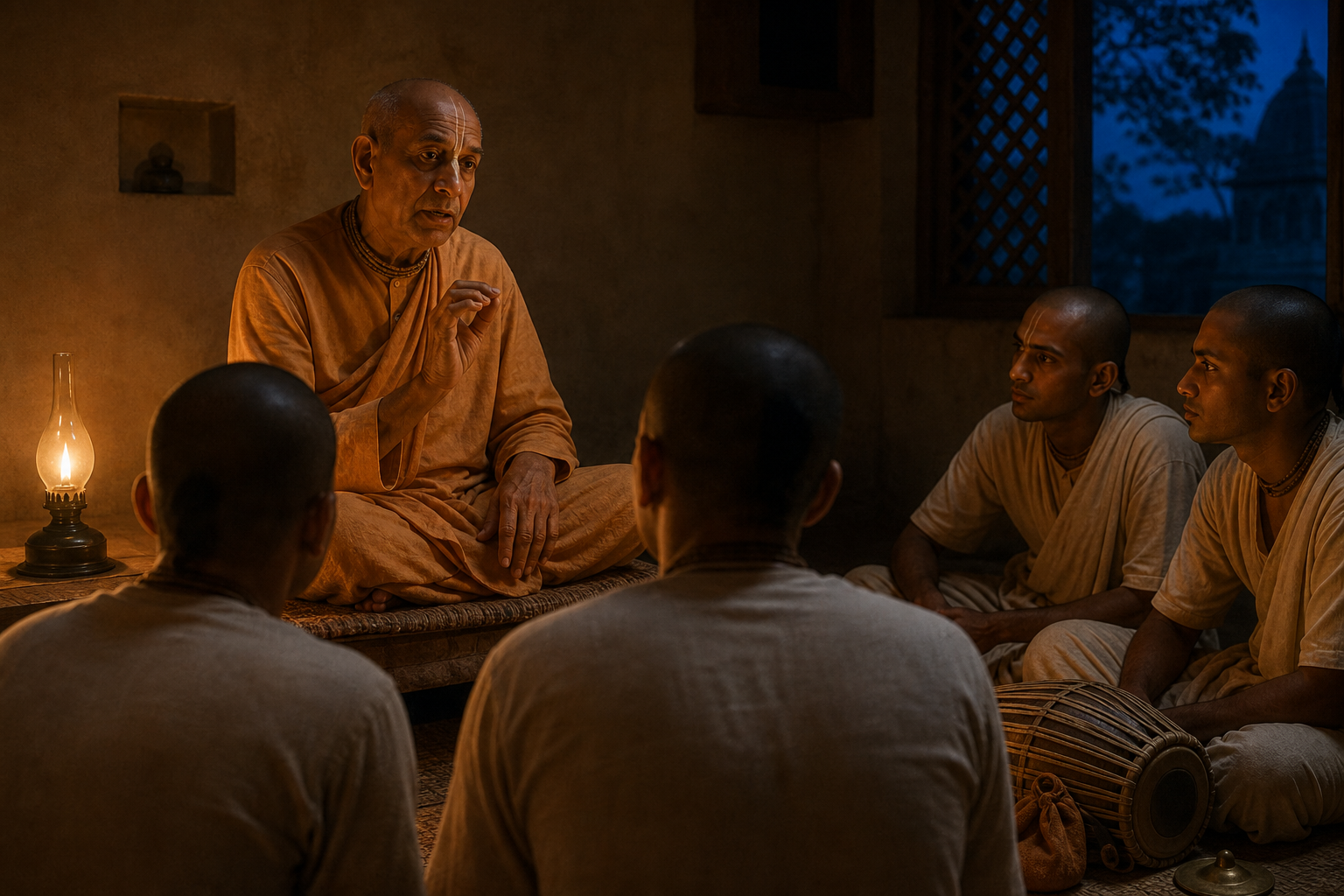
During a regular late-night seva rotation from midnight until 2 a.m., Bhakti Caru Swami was called to Srila Prabhupada’s side. At about 1 a.m., Srila Prabhupada gave a direct instruction concerning Vrindavan:
The time has come for me to leave this planet, therefore you should make arrangement to take me to Vrindavan immediately.
Srila Prabhupada, speaking to Bhakti Caru Swami
Bhakti Caru Swami felt the force of the moment, but he did not let emotion delay service. He went downstairs, woke Tamal Krishna Maharaj, and began the work of carrying out the instruction. That order of events matters: attentive presence, unmistakable direction, and immediate coordination.
The wish to go to Vrindavan was not a decorative final sentiment. Within Gaudiya Vaishnavism, Vrindavan is sacred geography inseparable from remembrance of Sri Krishna and loving devotional service. Srila Prabhupada’s request therefore joined place, spiritual intention, and practical duty. His disciples could not honor it merely by agreeing with its meaning; they had to make arrangements.
This is also where a responsible retelling should remain disciplined. The preserved exchange gives us a clear request and a clear response. It does not require invented descriptions of the room, unrecorded conversations, or claims about every inward feeling. Restraint does not weaken the remembrance. It protects the instruction from being buried under devotional embellishment.
If you are narrating this moment for a congregation, class, or family, keep four distinctions clear:
- State the known setting precisely: a late-night seva rotation, with the instruction given at about 1 a.m.
- Preserve the substance of the request: Srila Prabhupada wanted arrangements made to take him to Vrindavan immediately.
- Explain the devotional significance of Vrindavan separately from the historical sequence. Interpretation should illuminate the event, not replace it.
- End with the disciple’s response. The lasting lesson concerns not only what the guru said, but how quickly service followed hearing.
Why tirabhava changes the work of remembrance

A Vaishnava disappearance observance is not an ordinary memorial with religious music added to it. The physical departure is acknowledged, but it is understood through guru-tattva and parampara. The teacher’s visible presence has withdrawn; the responsibility to hear, preserve, practise, and transmit the teaching becomes more pronounced.
This is the force of tirabhava, or sacred disappearance. It does not mean that bereavement is unreal or that the historical person has become an abstraction. It means that separation is answered through continued service. The guru remains present to disciples through instruction, example, sacred sound, and the lineage that responsibly carries the teaching forward.
The historical anchor should still be stated plainly. Srila Prabhupada physically departed in 1977, and the 48th Tirabhava Mahotsava in 2025 was observed during Kartik. Using the language of disappearance does not require you to conceal the date or avoid the fact of death. It asks you to explain why a Gaudiya Vaishnava community understands that departure in a particular theological way.
For newcomers, one clear explanation is enough: “Srila Prabhupada physically departed in 1977. Gaudiya Vaishnavas observe his tirabhava because his teachings and mission continue through parampara and seva.” That wording gives visitors the historical fact, the tradition’s own term, and its practical consequence without asking them to decode insider language.
The consequence is demanding. Remembrance is incomplete if it only establishes that Srila Prabhupada was important. As ISKCON’s founder-acharya, he made central bhakti texts accessible through translation and commentary, and he established educational, cultural, and devotional structures through which people could study and practise. To remember him as acharya is therefore to ask whether his teaching is still being heard accurately and embodied responsibly.
Build the observance around sound, text, gratitude, and seva
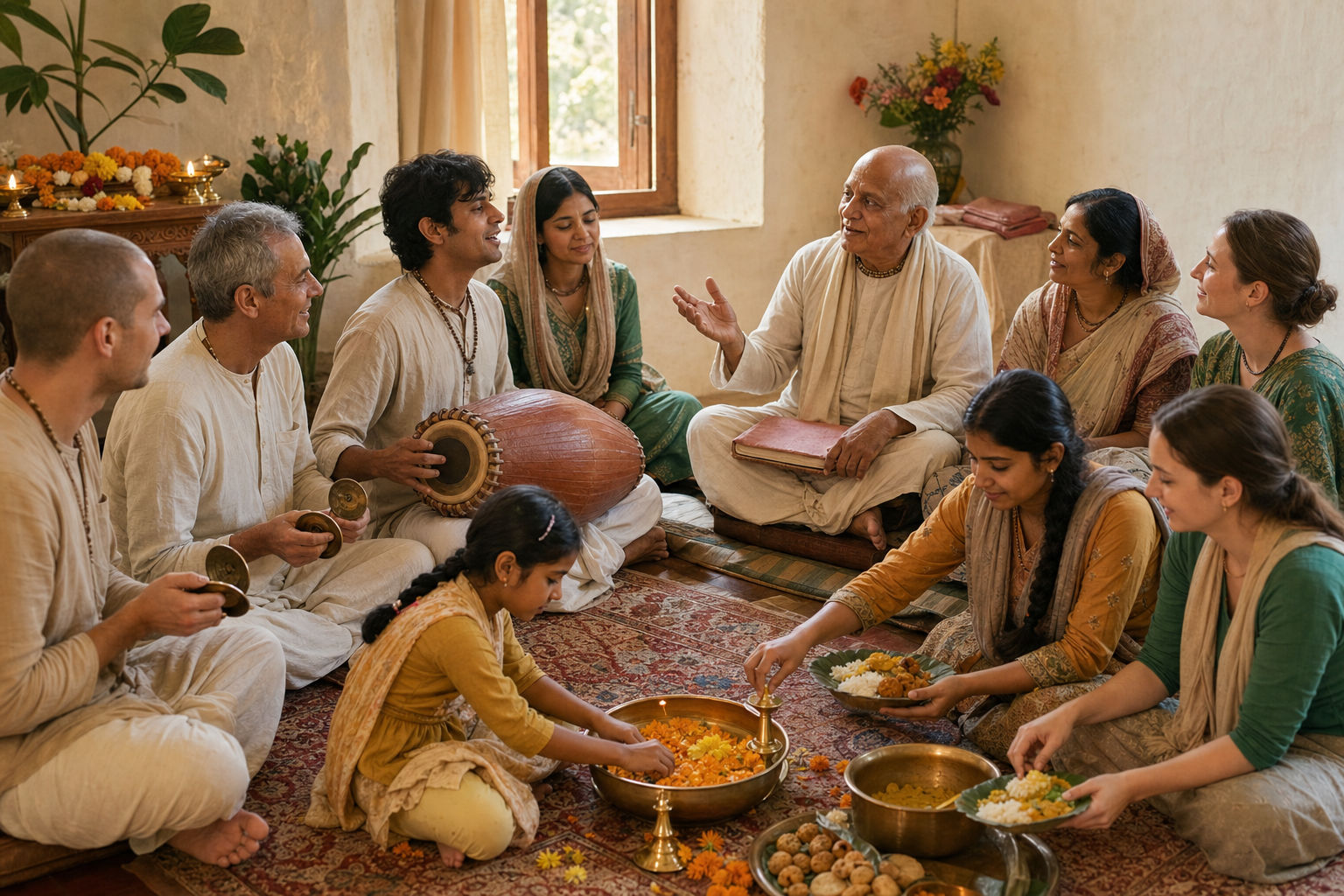
Major observances provide a useful pattern. At ISKCON Mayapur, customary elements include nama-kirtan, readings, reflective talks, puspanjali, guru-puja, seva, prasada distribution, and parikrama. Bhaktivedanta Manor has also used live broadcasting to make remembrance accessible to households and participants who cannot be physically present.
You do not need to reproduce every temple element in a home or study circle. Preserve the internal movement of the observance instead: from sacred sound to attentive hearing, from hearing to gratitude, and from gratitude to service.
- Begin with nama-kirtan. Treat it as invocation and shared prayer, not as a musical opening act. The point is to gather attention around the holy name before personal recollections begin.
- Read a coherent passage. Choose from Bhagavad-gita As It Is, Srimad-Bhagavatam, or another text central to the community’s established practice. Select a passage that can be understood and discussed; a pile of disconnected excerpts usually produces less hearing, not more.
- Connect the text to Srila Prabhupada’s work. Explain how his translations, commentaries, teaching, or institution-building helped people encounter that wisdom. Keep the focus on what the contribution enables the listener to understand or practise.
- Offer remembrances with a purpose. Ask each speaker to identify a quality, instruction, or example and then name its practical consequence. “He taught service” is general. “This remembrance moves us to make our study regular and our community service dependable” gives the listener something to do.
- Offer puspanjali or guru-puja according to established practice. If you are unfamiliar with the ritual, follow the guidance of your local Vaishnava community. Sincerity is not a reason to improvise a formal temple rite without understanding it.
- Make seva visible. Prasada distribution, spiritual education, care for the community, or another defined act of service gives gratitude an outward form. Decide who will do what before the gathering closes.
Parikrama belongs naturally in a sacred place where the route, community, and organizers support it. A virtual participant should not feel that distance makes the observance empty. Kirtan, scriptural reading, gratitude, reflection, and service can form a serious household observance. The setting changes; the disciplines of hearing and response do not.
Before the program, settle one practical question: where will the remembrance lead? If the only answer is “to the end of the ceremony,” the design is unfinished. Give participants a defined next step, such as joining a study gathering, helping with prasada service, supporting spiritual education, or adopting a regular discipline of reading and chanting.
Honor shared Dharmic values without erasing distinctions
Srila Prabhupada’s remembrance can be meaningful to people beyond an ISKCON congregation. Ahimsa, compassion, truthful living, self-discipline, reverence for sacred learning, and service have recognizable resonances across Hindu, Buddhist, Jain, and Sikh traditions. These connections can make a public observance hospitable without turning it into a vague celebration of spirituality.
Shared ethical ground does not mean identical theology. The Gaudiya Vaishnava understanding of Sri Krishna, guru-tattva, nama-kirtan, Vrindavan, and parampara should be presented in its own terms. Buddhism, Jainism, and Sikhism have their own accounts of liberation, authority, sacred practice, and the teacher-disciple relationship. Respect grows through accurate distinction, not through the claim that every Dharmic path is secretly saying the same thing.
If you are hosting an inter-Dharmic audience, use this order:
- Introduce Srila Prabhupada as the founder-acharya of ISKCON and a teacher in the Gaudiya Vaishnava lineage.
- Explain tirabhava, Vrindavan, kirtan, and seva before drawing comparisons with other traditions.
- Name shared values only after the distinct Vaishnava framework is clear.
- Invite guests to recognize ethical kinship without asking them to collapse their own doctrines into Gaudiya Vaishnavism.
- Let service provide the meeting point. Compassion and responsible action are more substantial forms of Dharmic solidarity than imprecise claims of sameness.
The same discipline helps you avoid several common failures in remembrance. Do not turn the final days into a spectacle of decline. Do not use the word “disappearance” to evade the reality of physical departure. Do not reduce Srila Prabhupada’s legacy to a list of temples and publications without asking what they transmit. Do not praise unity by blurring the identities of other Dharmic paths. Above all, do not let a call to seva remain so general that nobody knows what happens next.
Key takeaways
- Srila Prabhupada’s late-night request to be taken to Vrindavan joins sacred intention with the practical duty of disciples.
- Bhakti Caru Swami’s response shows that service begins with careful hearing and continues through prompt, coordinated action.
- Tirabhava acknowledges physical departure while emphasizing the guru’s continuing presence through instruction, example, and parampara.
- A sound observance moves through kirtan, scripture, gratitude, and a clearly defined act of seva.
- Public or inter-Dharmic remembrance should recognize shared values while preserving the distinctive teachings of each tradition.
- The best measure of a tribute is not how much emotion it produces, but whether hearing becomes disciplined practice and service.
Choose the teaching or quality you intend to remember before you choose the program’s ornamentation. Then attach that remembrance to a real act of service. When the flowers have been offered and the final kirtan has ended, that act is where your observance should continue.
References
- Dandavats – Essential Tribute to Srila Prabhupada: Transformative Legacy at Bhaktivedanta Manor, Oct 25, 2025
- Dandavats – Complete Guide: Discover Srila Prabhupada 48th Tirabhava Mahotsava 2025 at ISKCON Mayapur
- Dandavats – Discover the Complete, Heartfelt Account of Srila Prabhupada’s Final Wish in Vrindavan
