

If your Krishna practice feels divided between asking for shelter and offering loving care, Govardhan and vatsalya-bhava bring those movements together. At Govardhan, Sri Krishna is the protector who gives refuge. In vatsalya-bhava, you approach that same Krishna with the attentive tenderness shown to a cherished child.
This changes what you look for in daily sadhana. Strong emotion may come or go. The more useful questions are concrete: Did you remember Krishna before consuming what you received? Did your worship make you humbler? Did anyone – a person, an animal, or the place where you live – experience greater care because of your devotion?
Let Govardhan’s shelter and vatsalya’s tenderness correct each other
Govardhan devotion begins with refuge, but it doesn’t end in personal security. Its mature qualities are gratitude, humility, service, and reverence for land, animals, and community. Krishna’s protection therefore becomes an ethical instruction: receive shelter, relinquish pride, and help create shelter for others.
Vatsalya-bhava moves in the other direction. Instead of standing before Krishna only as someone in need, you cultivate the responsibility of care. Feeding, singing, offering, and steady attention turn familial tenderness into a disciplined form of bhakti. The devotee learns to ask not only, “What will Krishna give me?” but also, “How may I serve Krishna with patience and affection?”
There is no theological contradiction here. Vatsalya-bhava doesn’t make the devotee metaphysically greater than Bhagavan, nor does it imply that the Supreme is actually helpless. Bhakti permits intimacy without erasing divinity. You know Krishna as the source of protection while practicing the self-forgetful attentiveness of one who cares for Bala Krishna.
The two moods keep each other honest. Govardhan prevents tenderness from becoming possessive sentiment: the child you adore is also the Lord in whom the whole community finds refuge. Vatsalya prevents refuge from becoming passive dependence: love for Krishna must become regular, careful service.
- When fear dominates your prayer, remember Govardhan and ask which principle you still need to stand under: truthfulness, humility, gratitude, or seva.
- When worship feeds pride, approach Bala Krishna through a small task that carries no prestige and needs no audience.
- When practice feels emotionally dry, don’t manufacture a mood. Perform the next act of care faithfully; in vatsalya-bhava, constancy is itself an expression of love.
- When devotion remains confined to requests, offer Krishna something you were already going to use, then receive it as prasada rather than as private possession.
Choose the question that exposes your present imbalance. If you are anxious, begin with refuge. If you are self-absorbed, begin with service. If you are proud of your service, return to gratitude.
Build a household practice that survives an ordinary day
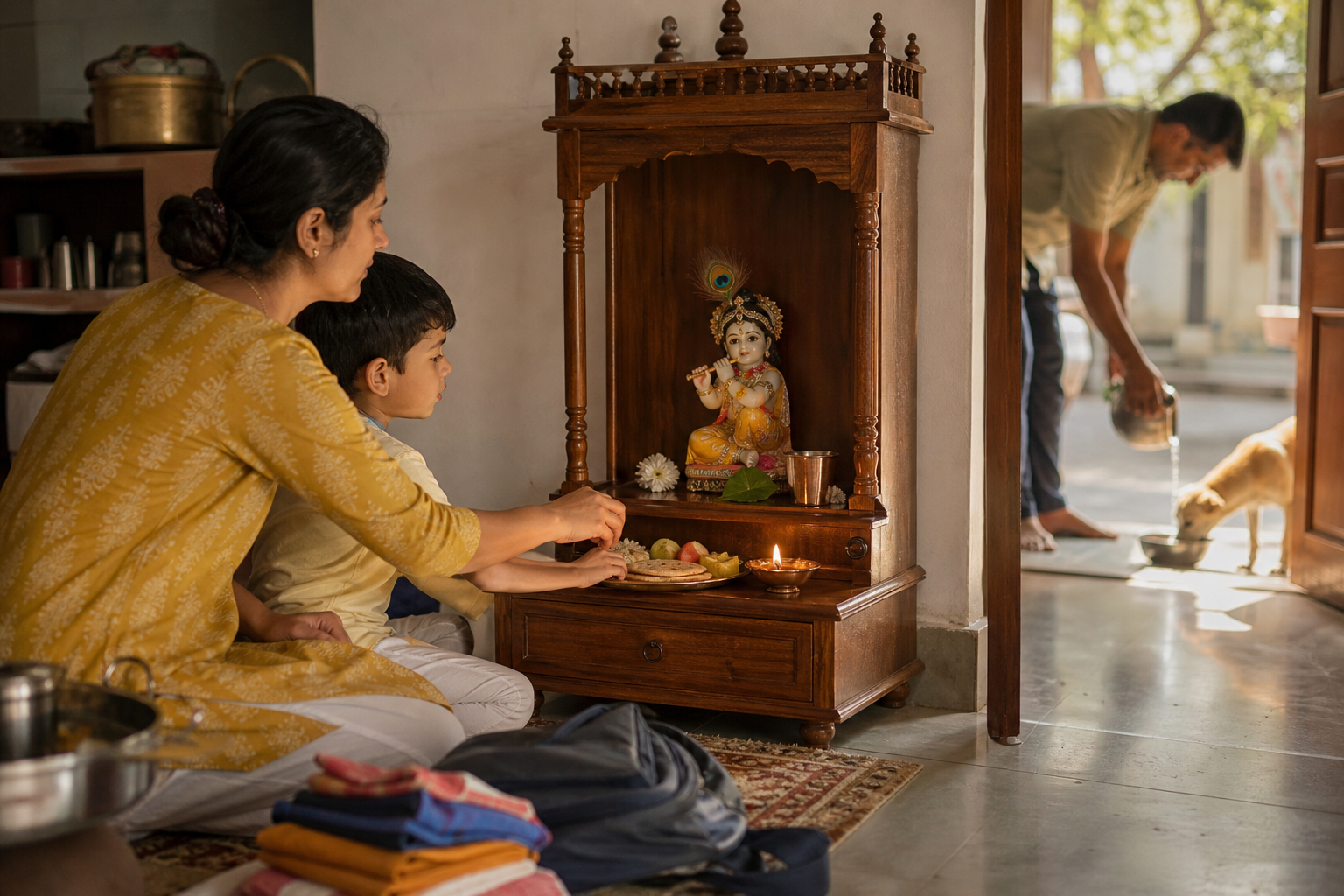
A sustainable vatsalya practice should fit the life you actually have. Elaborate observances performed briefly and then abandoned won’t train attention as deeply as a modest rhythm you can maintain through work, family demands, and low-energy days.
Begin with the Divine Name
At your first quiet opportunity, repeat the Krishna name or mantra already established in your sampradaya or family practice. Hear the name rather than rushing through it. In a vatsalya mood, let the repetition carry warmth and attentiveness, as though calling someone beloved rather than completing a verbal quota.
If you have received a mantra from a guru, follow those instructions instead of replacing them with a generic routine. Relational feeling should deepen fidelity, not become a reason to improvise over the discipline you have accepted.
Offer before you consume
Set aside a small portion of the food prepared in your home and offer it to Krishna before treating the meal as yours. The practical lesson is larger than the plate: gratitude interrupts the assumption that food, land, labor, and care belong to us by right. Receiving the offering as prasada then turns eating into remembrance.
Keep the act sincere and proportionate to your circumstances. The aim isn’t display or waste. If your household follows established rules for deity worship and food offerings, preserve them. If you are just beginning, use a simple form you can perform respectfully and consistently rather than copying temple-scale worship.
Use song and katha to soften the household atmosphere
A Krishna bhajan sung gently, especially one that evokes Bala Krishna, can move the mind from agitation to care. It doesn’t need to become a performance. A lullaby-like bhajan, family kirtan, or quiet listening can establish the emotional register of vatsalya: unhurried, affectionate, and attentive.
Pair song with a passage from the Bhagavata Purana or a trusted katha. Don’t read merely for volume. Notice one quality that the lila asks you to practice – patience, delight without possession, humility, or readiness to serve – and carry that quality into the next household interaction.
Close the day with an ethical test
Ask, “Whom did my Krishna bhakti help me care for today?” This prevents devotional feeling from becoming self-referential. If the honest answer is “no one,” choose a specific repair for the next available opportunity: help with an overlooked household task, attend patiently to an elder, support a child’s need, share food, or relieve someone carrying a community responsibility.
Parents can invite children into song or offering without forcing a particular emotion. Elders can contribute through remembrance and katha even when other forms of service are difficult. Working adults can anchor practice to transitions already present in the day. The form may differ, but the governing principle remains the same: give Krishna your reliable attention, not only your occasional intensity.
Make Govardhan visible in what your devotion protects
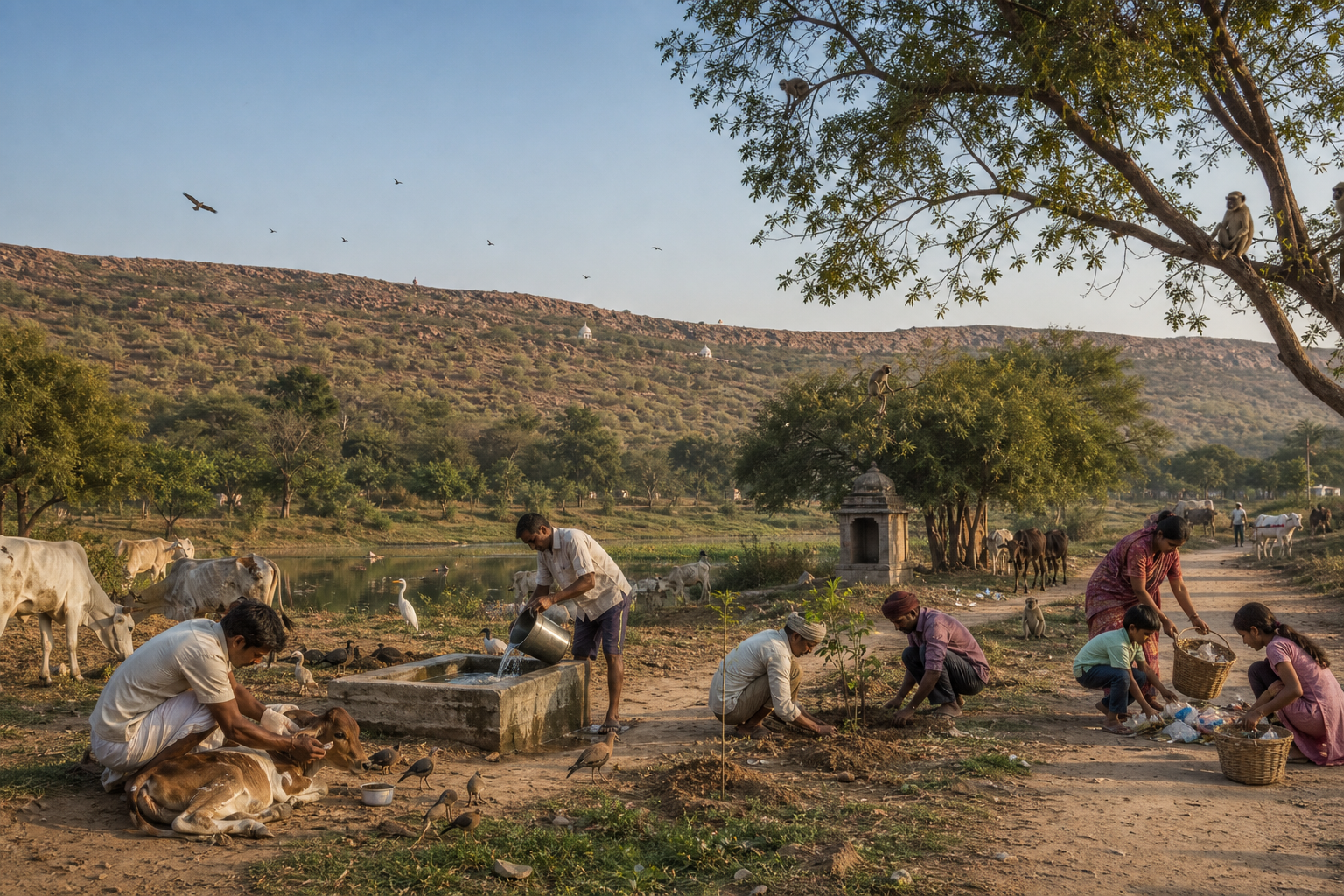
It is easy to praise sacred ecology in general terms. Govardhan devotion asks for something more demanding: a visible duty toward the conditions that sustain life. Land, animals, food, and community are not decorative symbols around Krishna’s lila. They belong within the field of seva.
- Food: take what you can honor, avoid careless waste, and share prasada when circumstances permit. Gratitude becomes credible when it changes consumption.
- Place: adopt a recurring task that improves the physical environment around your home, temple, or local community. Cleaning a neglected area is more concrete than speaking vaguely about reverence for nature.
- Animals: support humane care with attention to what actually helps. Affection isn’t an excuse to leave waste, packaging, or disorder behind.
- Community: help with prasada distribution, a community kitchen, children’s education, elder care, or another form of service where reliability matters more than recognition.
- Household conduct: refuse the contradiction of tenderness at the shrine and harshness toward the people doing unseen work around you. Thank them, share burdens, and correct without humiliation.
Use a simple test: could someone who never saw your shrine identify what your devotion protects? If the answer is yes because food is treated with respect, vulnerable people receive attention, animals aren’t handled carelessly, and shared places are better maintained, Govardhan has entered your conduct. If nothing outside the ritual changes, the lesson has remained incomplete.
Vatsalya-bhava also guards this service against abstraction. You don’t care for a child by admiring the idea of childhood; you notice the need in front of you. In the same way, don’t turn a person receiving seva into an accessory to your spiritual self-image. Ask what is useful, listen, and perform the unglamorous part of the work.
This Krishna-centered theology remains distinctively Vaishnava, but its ethical fruits are recognizable across the Dharmic family. Ahimsa, compassion, disciplined remembrance, and service have resonances in Hindu, Buddhist, Jain, and Sikh life. Respecting that kinship doesn’t require flattening the traditions into one system. It requires letting shared virtues strengthen cooperation while each path retains its integrity.
Let Govardhan Puja and parikrama change what happens afterward
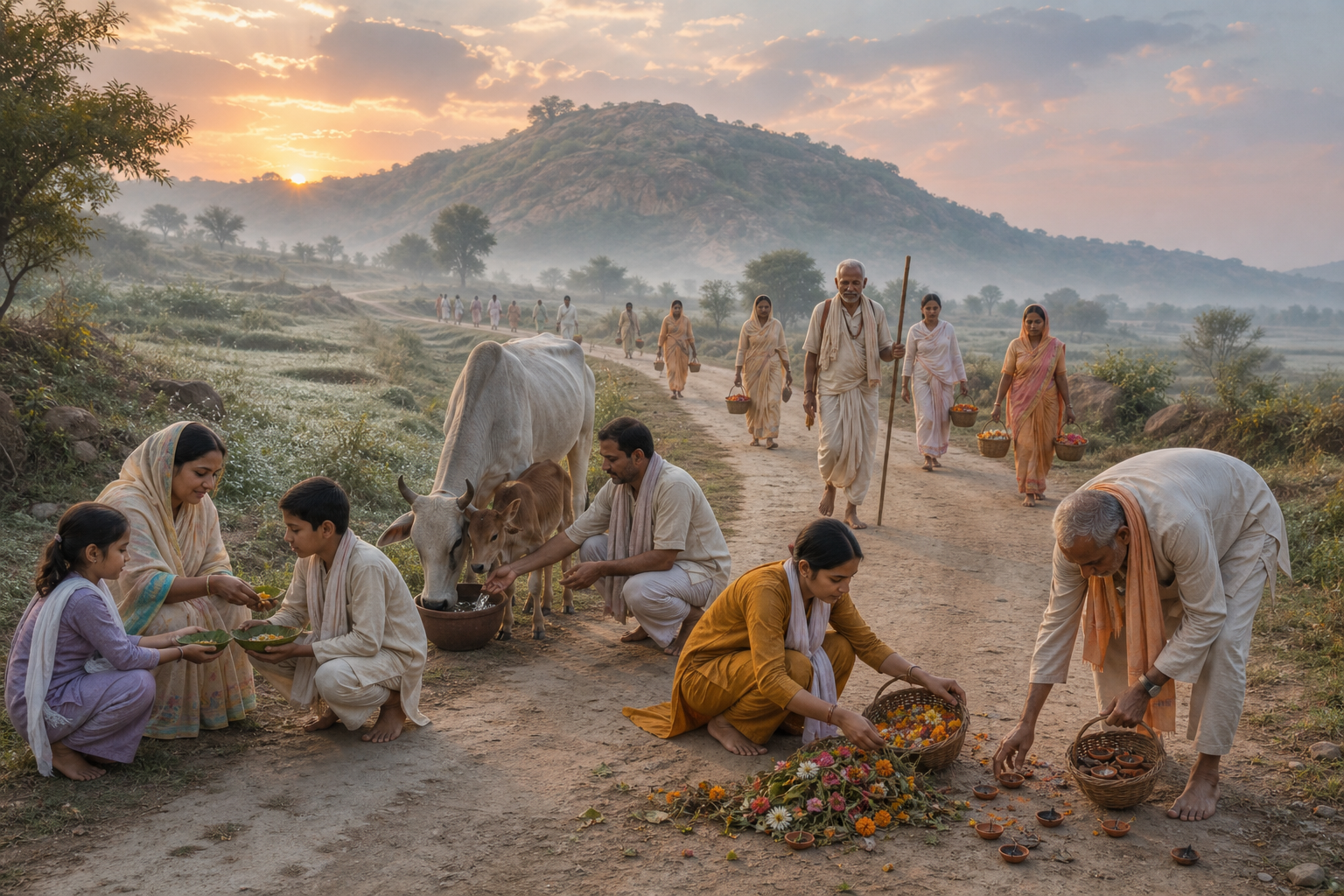
A pilgrimage can become another form of consumption: arrive, complete the visible observance, collect impressions, and return unchanged. Govardhan asks for a different measure. The physical journey should educate the attention that returns home.
Kirtan, katha, and the rhythm of parikrama can turn sacred geography into a moving classroom. Walking matters because remembrance is carried through the body, shared with a devotional community, and placed within the landscape of Krishna’s protection. Yet physical completion alone doesn’t guarantee inner movement. Pride can accompany a sacred route as easily as humility can.
- Before the observance: name one form of pride you want to relinquish and one gift for which you have failed to show gratitude. Keep both concrete.
- During kirtan or parikrama: return attention to the Divine Name whenever comparison, irritation, display, or hurry takes over. Let other pilgrims be participants in Krishna’s shelter, not obstacles to your private experience.
- While making an offering: remember the chain of land, animals, labor, household care, and community cooperation that made the offering possible.
- When receiving prasada: receive it as grace and participation, not merely as food acquired at a festival.
- After returning: convert one insight into a continuing duty. Keep a food offering, a regular bhajan, a community responsibility, or a concrete act of ecological care in your household rule.
If you cannot travel to Govardhan, don’t treat distance as exclusion from the devotional principle. Participate through Govardhan Puja at home or in a temple community, hear katha, join kirtan, make a sincere food offering, and choose an act of seva connected to protection and gratitude. This doesn’t pretend that home practice and physical parikrama are identical. It lets the central teaching operate where you are.
The most revealing moment comes after the festival atmosphere fades. If Govardhan taught refuge, identify whom you will help shelter. If the offering awakened gratitude, change how you handle food and shared resources. If vatsalya awakened tenderness, give patient attention to someone whose needs are easy to postpone. A sacred observance becomes sadhana when it establishes a new pattern rather than supplying a temporary mood.
Key takeaways
- Govardhan bhakti teaches you to receive Krishna’s protection and extend protection through humility, gratitude, and seva.
- Vatsalya-bhava is disciplined care for Bala Krishna, not a claim that the devotee is greater than Bhagavan or a license for uncontrolled sentiment.
- A workable household rhythm can center on nama, a modest food offering, Krishna bhajan, katha, and an honest review of whom your devotion helped you serve.
- Sacred ecology becomes real through duties involving food, land, animals, and community, not through admiration of nature alone.
- Judge Govardhan Puja or parikrama by the practice it leaves behind after you return to ordinary life.
Begin with your next meal. Offer a small portion to Krishna with gratitude, receive it as prasada, and choose one act of care that carries the offering beyond the shrine. Keep it quiet enough to avoid pride and regular enough to become your nature. That is where Govardhan’s shelter and vatsalya’s tenderness begin to form one Krishna bhakti.
References
- DharmaRenaissance Blog – The Complete Spirit of Govardhan Puja: Discover Kartik Yatra 2025’s Transformative Wisdom
- DharmaRenaissance Blog – The Proven Power of Bhakti: Discover How Devotion Sees Guruvayoor Unnikannan as Child-God
