

You may see Krishnadasa Kaviraja Goswami’s disappearance day on a devotional calendar and wonder what the observance actually requires. Should you attend a temple, read, fast, make an offering, or simply remember him?
A useful commemoration has a clear movement: receive the saint’s legacy attentively, examine your own practice honestly, and carry one teaching into service. That is a sound way to approach the disappearance-day remembrance of Srila Krishnadasa Kaviraja Goswami, whether you join a full temple programme or observe quietly at home.
Treat the day as an encounter, not a biography lesson
Biographical knowledge has value, but collecting facts is not the same as commemorating a saint. The devotional term “disappearance day” directs attention beyond an ordinary anniversary of death. It asks how a teacher’s instructions, example, and service remain present among later generations.
Begin with three questions. They prevent the observance from becoming either sentimental praise or an academic exercise:
- What quality in Krishnadasa Kaviraja Goswami’s devotional example am I being asked to notice?
- Which teaching connected with him exposes a weakness or confusion in my own practice?
- What can I do after the commemoration so that remembrance becomes service?
You do not need impressive answers. A precise answer is better than an ornate one. “I will read with more attention” or “I will stop repeating quotations I have not verified” can be more meaningful than a long tribute that changes nothing.
Prepare the reading before you prepare the ceremony

The strongest home observances are usually decided before the lamp is lit or the gathering begins. Choose what you will hear or read, where it comes from, and what you intend to do with it. Otherwise, the occasion can dissolve into hurried searching, disconnected videos, and attractive quotation cards with uncertain wording.
- Confirm the observance through the calendar used by your temple, teacher, or lineage. If you will join a community programme, follow that community’s announced day and schedule rather than an isolated social-media graphic.
- Ask a trusted teacher, temple librarian, or knowledgeable practitioner to identify a reliable passage associated with Krishnadasa Kaviraja Goswami. Record the work, edition, translator, or speaker when that information is available.
- Choose an amount you can read slowly. A short passage studied carefully is more useful than many pages rushed for the sake of completion.
- Read once for basic meaning and again for instruction. On the second reading, mark the sentence that most directly challenges or clarifies your conduct.
- Write one practical response. It should name an action you can recognize later, not merely a feeling you hope to retain.
When a quotation circulates without a work, speaker, or dependable context, do not build the commemoration around it. Preserve it as an unverified saying until you can trace it. Reverence includes care with another person’s words.
The same discipline applies to videos and talks. Prefer a programme that identifies its teacher and textual basis, distinguishes a quoted passage from explanation, and leaves you with something you can revisit. Emotional force alone does not establish accuracy.
A simple home observance with a definite beginning and end
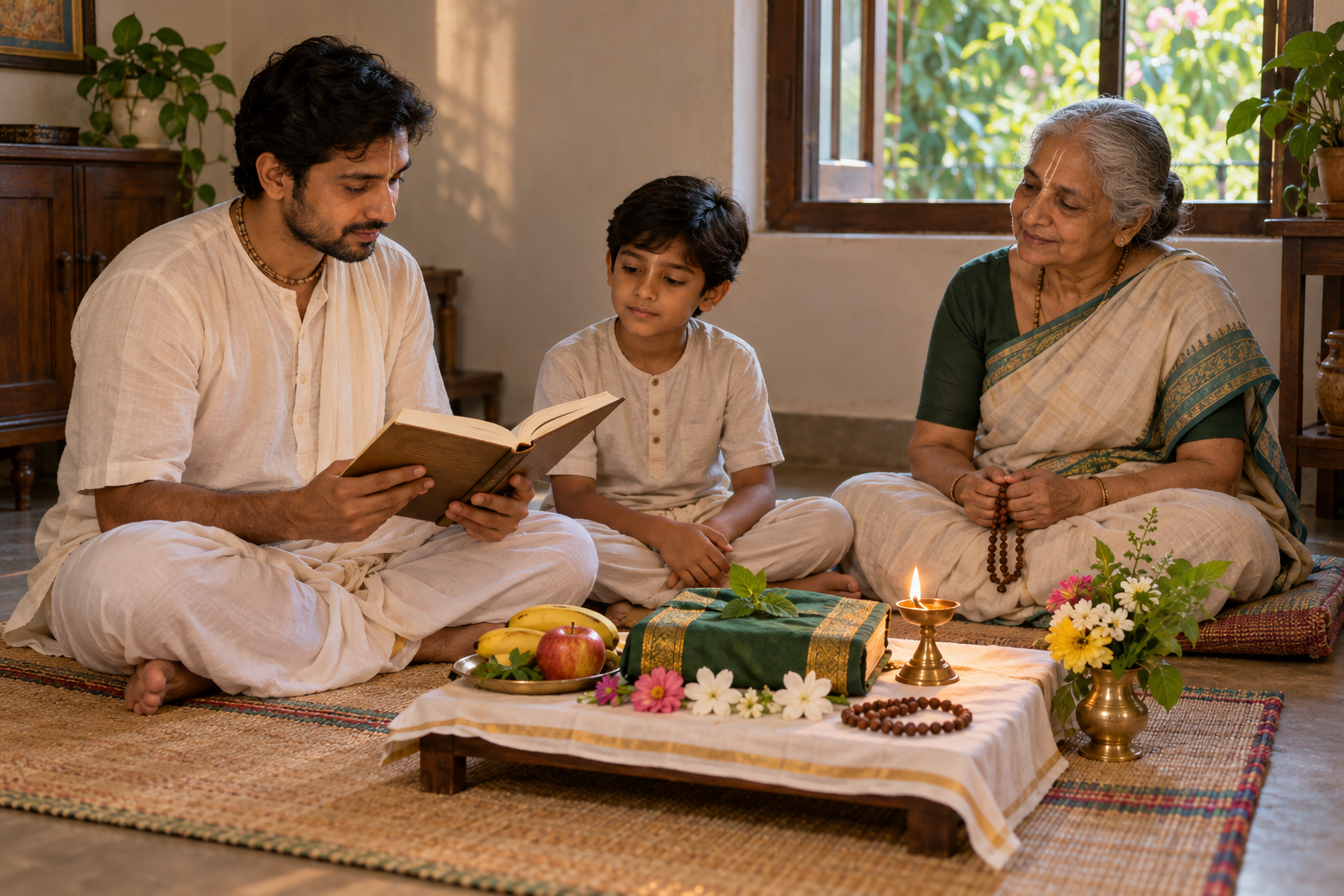
If you cannot attend a temple programme, keep the household observance modest and coherent. Do not imitate ceremonial details you have never learned. Use the established practices of your home or lineage, and let attentive hearing carry the commemoration.
- Prepare the space. Put away unrelated screens and tasks. Place the selected reading where you will not need to interrupt the observance to search for it.
- Begin with the form of prayer, pranam, chanting, or silence already recognized in your practice. If you do not know a formal invocation, speak plainly: offer respect, ask to receive the teaching without vanity, and avoid inventing a mantra.
- Say Krishnadasa Kaviraja Goswami’s full name deliberately. This small act keeps the observance centered on the person being commemorated rather than on a generic idea of spirituality.
- Read or hear the chosen passage without multitasking. Pause when a sentence requires attention. Look up unfamiliar terms instead of guessing from their emotional tone.
- Reflect in writing. Complete two statements: “This passage asks me to notice…” and “Because of it, I will…”
- Offer a corresponding act of service. You might help with an established temple need, assist someone in accessing a reliable devotional text, clean a place used for worship, or correct a quotation you previously shared without verification.
- Close with gratitude and a clear commitment. If your tradition prescribes arati, kirtan, food offerings, or another ritual form, follow the standard you have actually received from that tradition.
The service does not need to be public. In fact, an unseen act may protect the observance from becoming a performance. If you do publish something, include the saint’s name, identify the occasion correctly, and link readers to a dependable place where they can learn or hear more.
Avoid treating a devotional post as the completed offering. Posting can direct others toward remembrance, but it cannot replace your own hearing, reflection, or service. Ask whether the publication serves the commemoration or merely displays your participation in it.
Practical questions about the commemoration
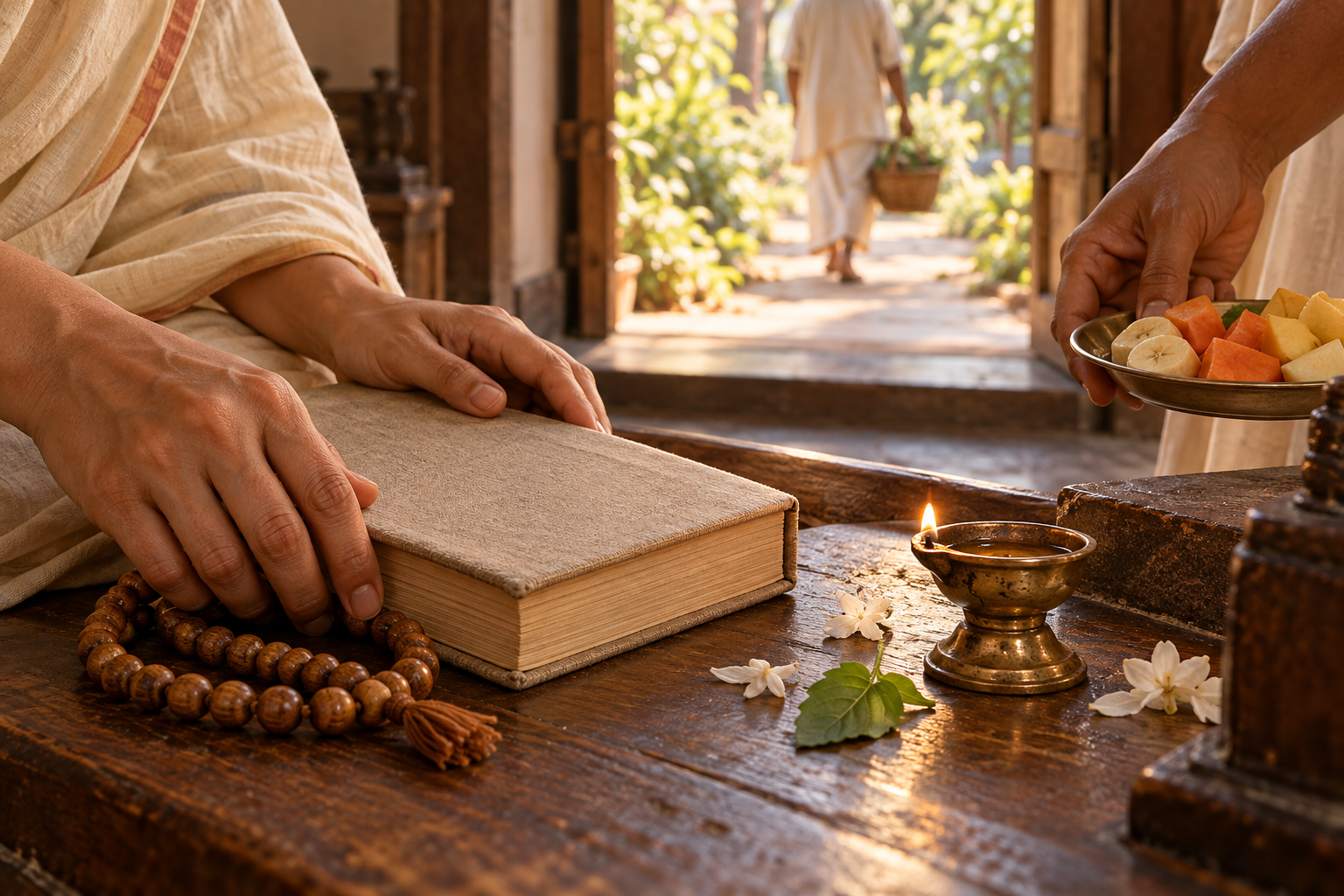
Do you have to attend a temple?
A temple gathering gives you the benefit of shared worship, qualified guidance, and an established form of observance. When attendance is not possible, however, a careful home remembrance can still unite reading, reflection, and service. If your teacher or lineage has given you a particular obligation, that instruction takes priority over a general plan.
What should you do if calendars disagree?
Do not attempt to settle a calendrical question through forwarded images or comment-thread arguments. For communal worship, use the date observed by the host temple. For a private observance, consult the calendar followed by your own teacher or community. If uncertainty remains, ask the person responsible for that calendar how the date is being applied in your location.
What if you know very little about Krishnadasa Kaviraja Goswami?
Let the day become the beginning of disciplined study. Ask for one reliable introductory reading and one passage directly connected with his devotional legacy. Keep separate notes for established information, interpretation offered by a teacher, and your own reflection. That distinction will help you learn without turning an impression into a fact.
How do you know whether the observance was fruitful?
Look for a concrete remainder. You should leave with a passage you understand more clearly, a misconception you have corrected, a service you have performed, or a practice you intend to continue. A commemoration that produces only temporary admiration has stopped one step too early.
Choose your reading before the day arrives and decide where you will seek guidance if a question arises. Then let the remembrance lead to one quiet, verifiable act. That is how a date on the calendar begins to shape the life lived after it.
References

Leave a Reply
You must be logged in to post a comment.