
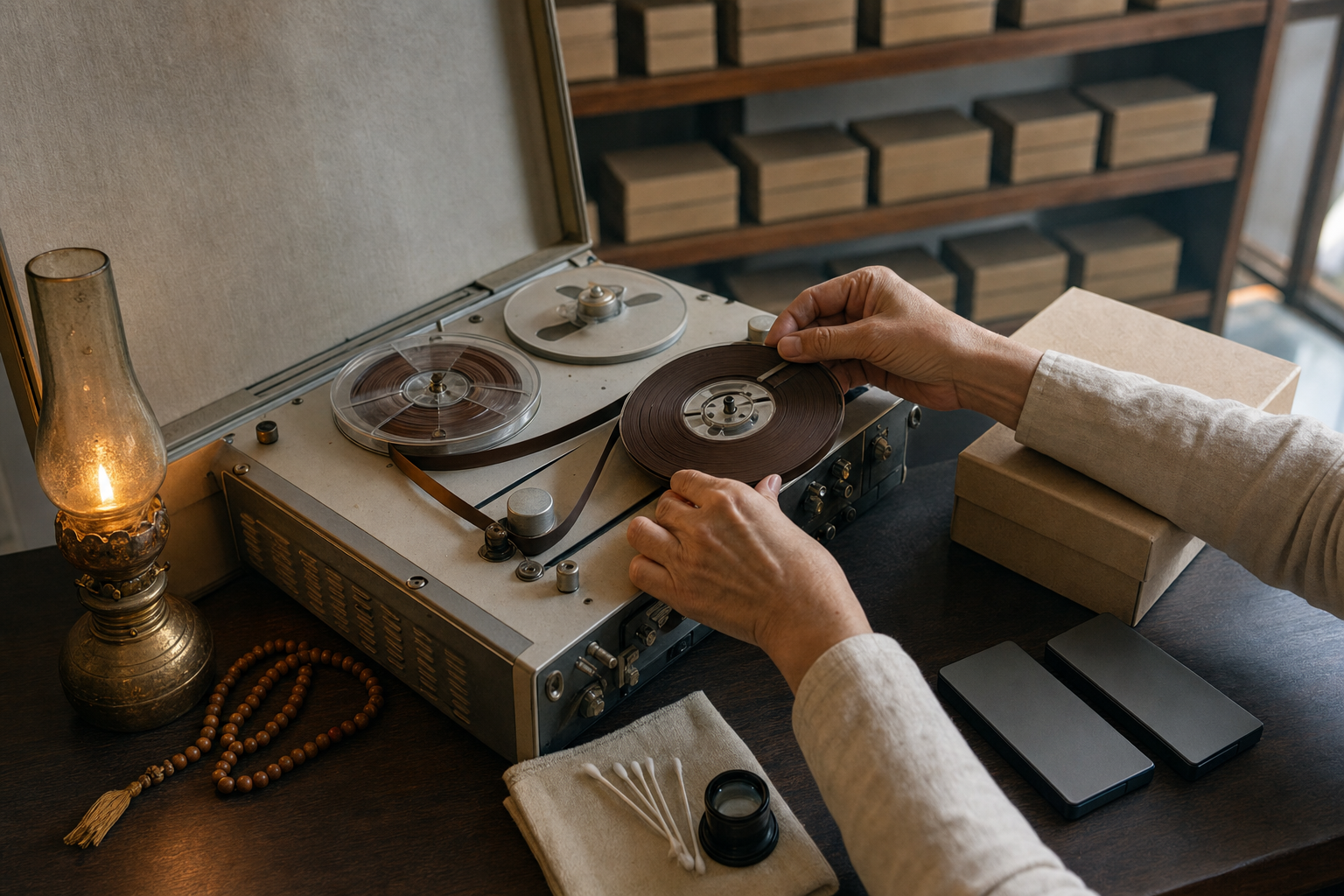
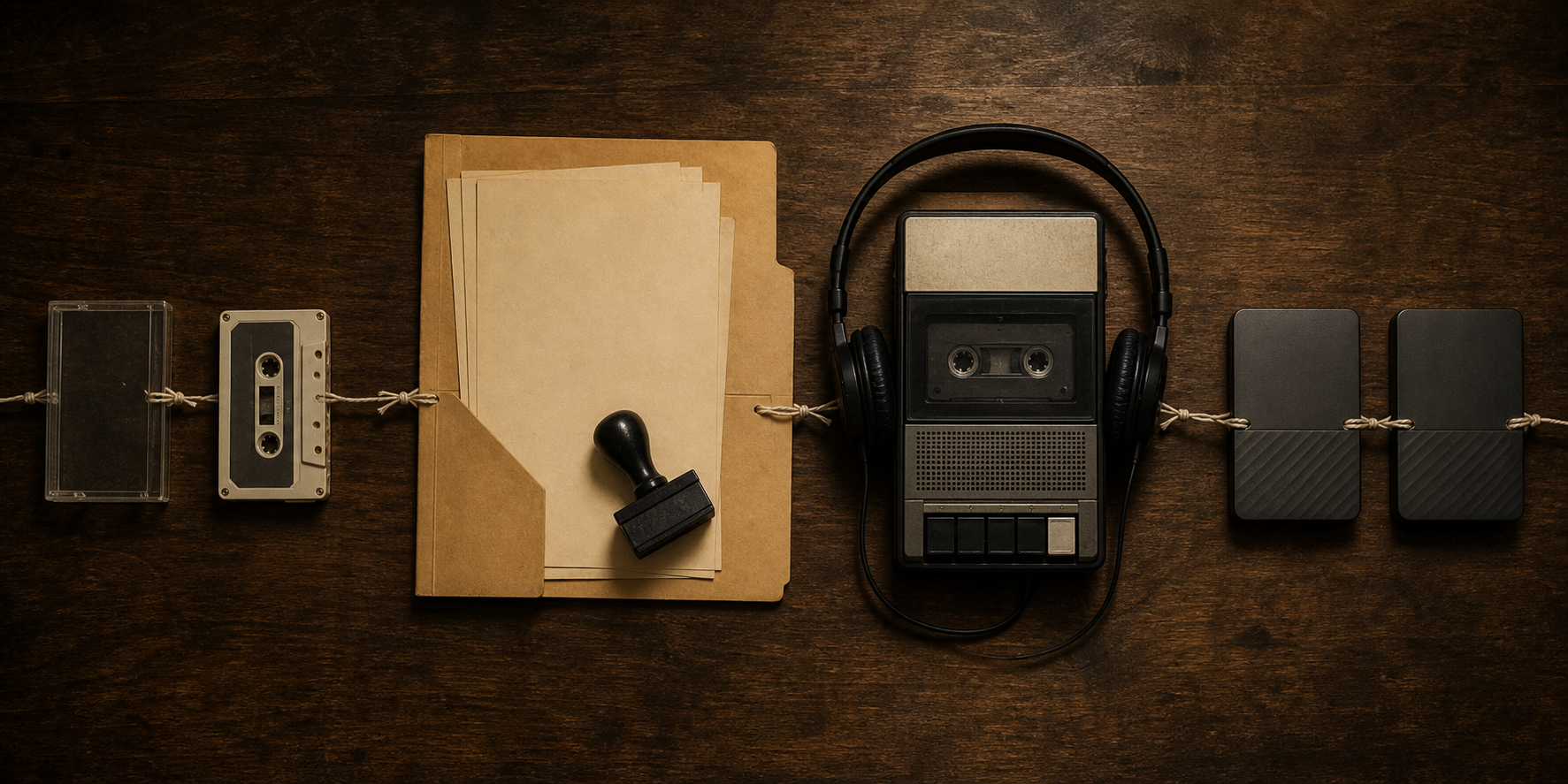
You press play on an old lecture and hear Śrīla Prabhupāda’s voice as if the distance between his room and yours has collapsed. It feels immediate. Yet that moment depends on an easily overlooked chain of custody: someone identified the recording, handled its aging carrier correctly, captured it without obscuring the voice, documented its origin, verified the digital file, and kept more than one safe copy.
Ekanātha dāsa devoted years to that chain at the Bhaktivedanta Archives. If you want to understand his legacy, or decide how your temple, family, or institution should care for devotional materials, look beyond the final audio file or searchable transcript. The real standard is whether the original meaning, context, and provenance can still be trusted after technologies and custodians change.
Ekanātha dāsa made continuity a form of seva
Devotional communities naturally remember the preacher at the lectern, the singer leading kīrtana, or the teacher opening a sacred text. The steward working among tapes, photographs, catalogues, and storage systems is less visible. But without that service, later generations may receive a partial recording, an uncertain date, an altered transcript, or a quotation detached from the conversation that gave it meaning.
Ekanātha dāsa was a long-serving member of the Bhaktivedanta Archives whose sudden departure followed heart failure. His passing is therefore more than the loss of a colleague with technical knowledge. It is the loss of a custodian who helped carry institutional memory across changing media, equipment, software, and organizational circumstances.
The Bhaktivedanta Archives preserves audio, video, photographs, manuscripts, transcripts, and related materials concerning Śrīla Prabhupāda and the early growth of ISKCON. These are not interchangeable objects. A manuscript bears handwriting and physical history. A photograph contains visual evidence that a caption can misidentify. A recording preserves voice, pacing, emphasis, and response from other people in the room. Each format requires its own treatment, but all require the same moral discipline: do not claim more than the evidence permits, and do not silently alter what has been entrusted to you.
This is where archival work becomes recognizably bhakti. Fidelity is not clerical fussiness when practitioners depend on a recording for śravaṇa, teachers build lessons around it, and scholars cite it as primary evidence. Patient description, repeated quality checks, and an honest notation of uncertainty protect the relationship between teacher, teaching, and listener. Ekanātha dāsa’s example makes that quiet responsibility visible.
Preservation begins with the carrier, not the upload button
Digitization is often mistaken for preservation. The distinction matters. A digital file can be incomplete, excessively processed, poorly described, stored on one failing drive, or exported in a format chosen only for convenient listening. Converting an object into bits solves the problem of access only when the resulting file is accurate, traceable, verified, and managed over time.
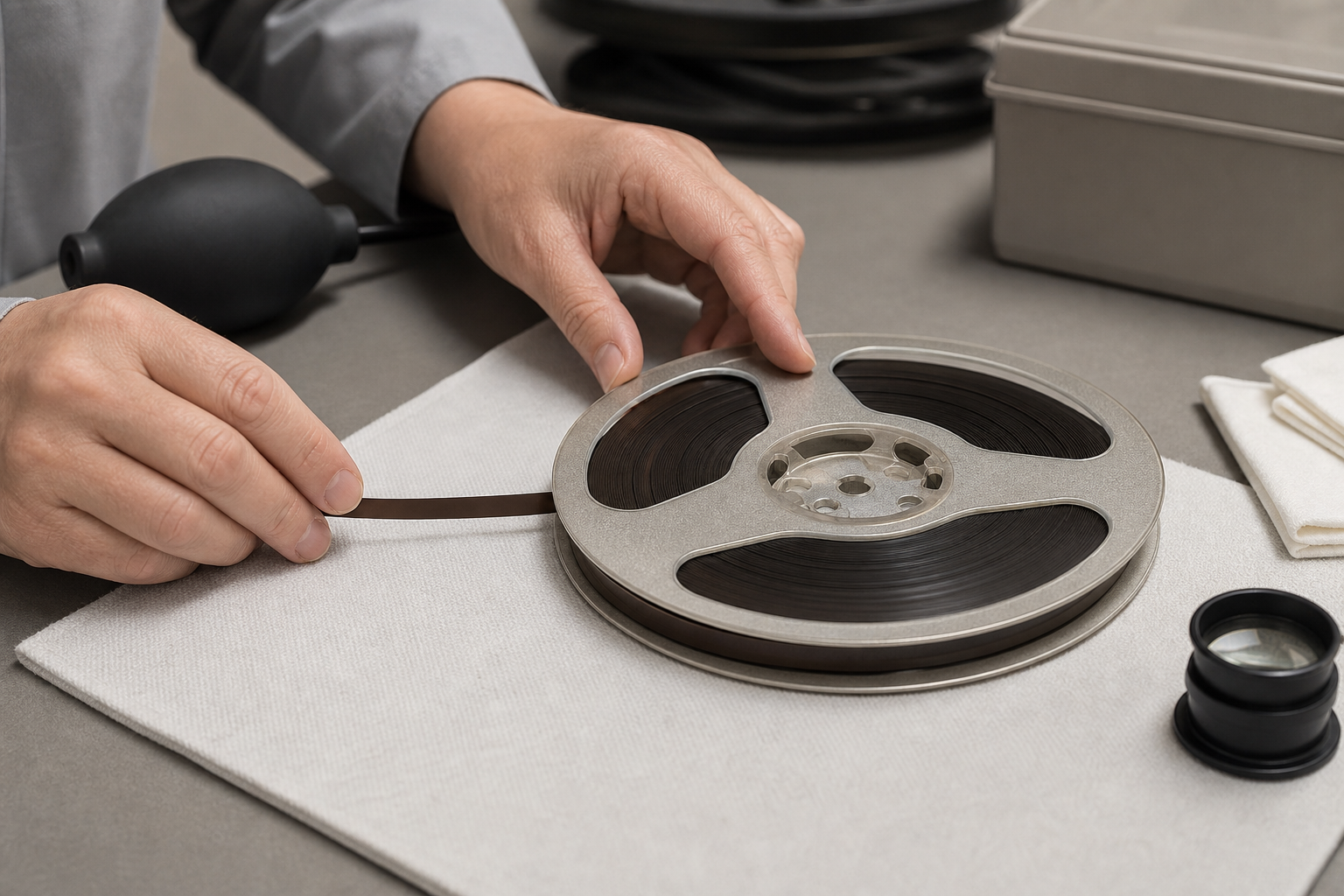
The physical carrier sets the first constraint. Magnetic tape can shed. Photographs can fade. Optical discs can delaminate. Hard drives can fail. Repeatedly playing an unstable tape on unsuitable equipment may damage the very content you intended to save. When a carrier appears rare, fragile, mould-affected, warped, or otherwise compromised, the safe decision is to stop experimenting and consult someone equipped for audiovisual conservation.
- Inspect and identify the carrier before playback. Preserve labels, boxes, reel markings, recording speeds, and any accompanying notes because they may contain the only surviving provenance.
- Use calibrated equipment appropriate to the original format. Gentle remediation may be necessary for a compromised tape, but intervention should be limited to what safe transfer requires.
- Capture a preservation master in a non-lossy form. For audio, linear PCM in BWF/WAV at an archival bit depth and sampling rate preserves more of the signal and metadata than a compressed listening file.
- Keep restoration minimal and documented. Noise reduction that makes listening easier can also remove information or change the perceived character of a voice. Preserve the unaltered transfer and create any cleaned version as a separate derivative.
- Generate a fixity value such as SHA-256 after ingest. A later check can then reveal whether the file has changed or become corrupted, even when the damage is not obvious during ordinary playback.
- Maintain redundant copies in geographically separate locations and plan for future format migration. One drive, one server, or one cloud account is a single point of failure, not an archive.
Text and images require the same separation between master and convenience copy. Color-managed, high-fidelity scans preserve tonal and visual evidence that an aggressively enhanced image may lose. Optical character recognition can make a page searchable, but OCR output is not automatically an authoritative transcript. It must be proofread, and every editorial correction should remain distinguishable from the underlying scan.
Time-aligned transcripts are especially useful because you can move from a sentence to the corresponding moment in the audio. That connection also creates accountability: when wording, punctuation, or speaker identification is disputed, the listener can return to the recorded voice. The transcript becomes a navigation and study tool without pretending to replace the primary recording.
A trustworthy archive preserves context as carefully as content
An unlabeled recording may contain every audible word and still be difficult to use responsibly. Who is speaking? Where was the conversation held? Is the date certain or inferred? Is this the complete recording or one segment? Was the transcript prepared from this file or from another copy? Without answers, a quotation can circulate with more confidence than its provenance warrants.
Good metadata prevents that drift. At minimum, a devotional archive should preserve a stable identifier; the known speaker or creator; date and place with uncertainty clearly marked; original carrier information; custodial history; language; subject terms; relationships among recordings, scans, and transcripts; technical actions; editorial revisions; rights information; and access restrictions. An honest “unknown” is better than a confident guess that later becomes inherited as fact.
Consistency matters as much as detail. Controlled vocabularies keep one person, location, or topic from splintering across several spellings. Sanskrit and Bengali terms need a declared romanization practice so that readers can find related materials. A descriptive structure drawing on Dublin Core can help the collection communicate with wider library and archival systems, while community-specific fields can retain details important to Gauḍīya Vaiṣṇava practice and history.
Version control addresses a different kind of context: what people did to the material after its creation. If punctuation was added to a transcript, a damaged passage was reconstructed, a photograph was cropped, or background noise was reduced, the archive should retain a record of that action. Transparency does not forbid editorial work. It allows a reader to distinguish the historical object from later efforts to make it legible or accessible.
Rights and access also belong inside stewardship, not outside it. Open access can support sādhanā, teaching, historical inquiry, and digital humanities. But responsible access must still account for ownership, donor agreements, private information, sacred context, and community norms. Preservation, discoverability, and unrestricted publication are three different decisions. A mature archive does not confuse them.
Key takeaways for judging archival stewardship
Before you donate materials, fund a preservation effort, cite a transcript, or rely on an online collection, ask questions that reveal the underlying chain of trust:
- Before donating: Will the original carrier, its labels, its order, and its custodial history remain connected after transfer?
- Before digitizing: Is the equipment appropriate and calibrated, and will the transfer produce a non-lossy preservation master rather than only a compressed access copy?
- Before editing: Will the unaltered master survive, with restoration, transcription, and correction recorded as separate actions?
- Before funding: Does the institution perform fixity checks, keep redundant copies in separate locations, control access appropriately, and plan for format migration?
- Before citing: Can you identify a stable record and move from the quotation or transcript back to the relevant scan, manuscript, or point in the recording?
- Before sharing: Are the date, speaker, location, completeness, rights, and uncertainty clear enough to prevent a convenient excerpt from becoming a misleading claim?
These questions separate a searchable website from a preservation system. The OAIS model’s concern with verified ingest, managed storage, and continuing access provides a useful institutional frame. The LOCKSS principle — Lots of Copies Keep Stuff Safe — supplies an equally memorable warning against concentrating irreplaceable memory in one location. Neither framework replaces human judgment. Both make that judgment more accountable.
If devotional materials are in your care, start here
You do not need to become a professional archivist before helping. You do need to avoid irreversible improvisation. If you have inherited tapes, letters, photographs, notebooks, discs, or early digital files connected with a guru, temple, pilgrimage, or community, take these steps before trying to “clean up” the collection:
- Pause playback and alteration. Do not repeatedly test a fragile recording, clean a carrier with household products, rewrite labels, crop the only scan, or replace an original file with an edited copy.
- Preserve the existing order. Keep envelopes, boxes, captions, reel leaders, filenames, and neighboring items together. Photograph the arrangement if items must be moved.
- Write down provenance now. Record who created or held the material, how it reached you, and any known people, places, dates, or circumstances. Separate remembered facts from inference, and mark uncertainty explicitly.
- Make an inventory without forcing conclusions. Give each item a stable identifier and a brief physical description. Transcribe the exact label separately from your interpretation of it.
- Seek appropriate help for fragile or unique media. Contact a mission-aligned archive or qualified conservation professional before playback or cleaning. A failed do-it-yourself transfer may destroy information that no later expertise can recover.
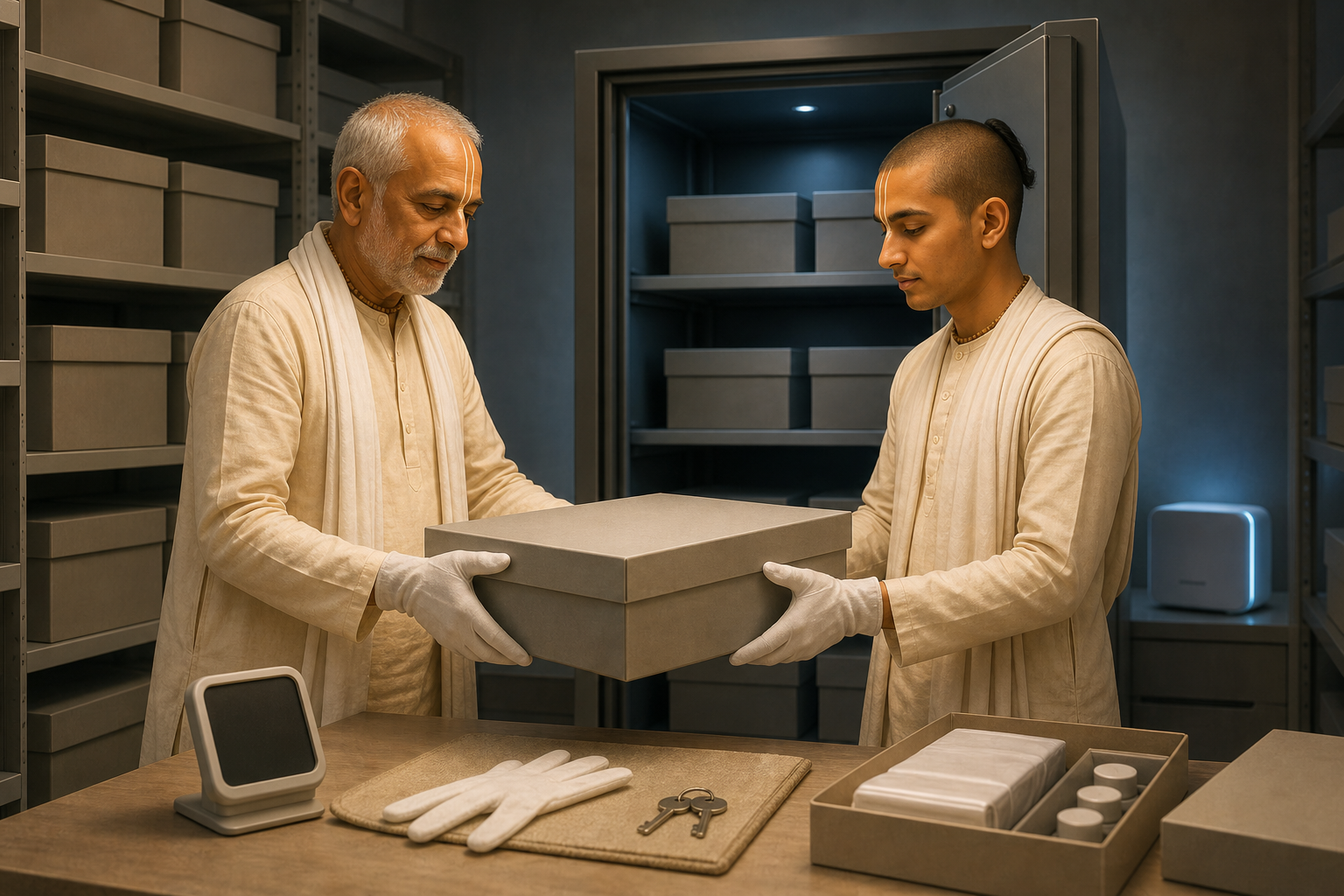
- Document the handoff. If the material is transferred, retain an inventory, the receiving institution’s acknowledgment, and a clear agreement about ownership, access, reproduction, privacy, and future use.
You can also support stewardship without owning a collection. Cite stable archival records rather than unattributed clips. Report a suspected error with the evidence needed to check it. Fund storage, cataloguing, preservation equipment, and trained staff even though those needs are less visible than a public release. Encourage younger devotees to combine linguistic, historical, technical, and devotional competence.
The most fitting response to Ekanātha dāsa’s service is a concrete one. Choose one recording, photograph, letter, or folder in your care and restore its connection to its history: preserve its label, record its provenance, identify its uncertainties, and place it on a path toward competent custody. That modest act extends the chain by which a living voice reaches a future listener without losing its truth along the way.
References
